BIOL 224 Lab 16: Gestation and Contraception
 Call Kai
 Learn
 Practice Test
 Spaced Repetition
 Match
 Flashcards
 Knowt Play
1/36

There's no tags or description
Looks like no tags are added yet.
37 Terms
sperm

head of sperm
top

neck of sperm
B

middle piece of sperm
C

tail of sperm
D

oocyte
The purple middle circle

secondary oocyte
Once the egg leaves the ovary and becomes fertilized in uterine tube.
corona radiate
outer portion of secondary oocyte

corpus luteum
5

blastomere
from 2-cell stage to ball of cell stage
= a cell

morula
solid ball of blastomeres

blastocyst
the whole ball structure

blastocoele
SPACE

trophoblast
"epithelium" outer layer of blastocyst

inner cell mass
blue portion

first 13 weeks
- rudimentary organ systems have formed.
- fetus is approx 3 inches long
fetus weighs 0.5 lbs.
first trimester
Weeks 14-26
- fetal movements begins around 16-20 weeks
- fetus is approximately 9 inches and 1.4 lbs.
- eyelids open
second trimester
weeks 27-40
- Average 14 inches and 7lbs
third trimester
born prior to 37 weeks
pre-term
born between 37 and 40 weeks
Term
born at greater than 40 weeks
post-term
yolk sac
sac

placenta
red

umbilical cord
3
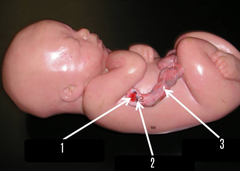
umbilical arteries
In reference to child, fetus does not pump their own blood. THESE ARE DEOXYGENATED, move away from baby. (Two vessels)

umbilical vein
ARE OXYGENATED, and move towards baby. (One vessel)
amniotic cavity
space around baby
5

amnion
first innermost layer

chorion
2nd layer (more superficial) surrounding baby

chorionic villi
branching in placenta

decidua parietalis
B

decidua basalis
child and parent

male condom
female condom
diaphragm
cervical cap
sponge contraception
copper intrauterine device
spermicide
non-hormonal methods of contraception
oral contraceptives
injection
patch
progestin implant
vaginal ring
hormonal intrauterine device
hormonal methods of contraception
vasectomy
tubal ligation
intra-uterine tube coil placement
permanent methods of contraception
decidua capsularis
C

zygote
fertilized egg
