EBPR Week 2 - Lumbar Spine Conditions
 Call Kai
 Learn
 Practice Test
 Spaced Repetition
 Match
 Flashcards
 Knowt Play
1/44

There's no tags or description
Looks like no tags are added yet.
45 Terms
What is the definition of Pain?
unpleasant sensory and emotion experience associated with actual or potential tissue damage
What is the differenc ebetween Neuropathic, Nociceptive, and nociplastic pain?
Neuropathic - caused by lesion or disease of the somatosensory NS, nociceptive - pain that arises from actual damage to non-neural tissue and is due to the activation of nociceptors, nociplastic - persistent pain from altered nociception despite no evidence of actual tissue tamage
What differentiates the a-delta from c-fibers?
A = myelin, fast, high sharp pain (20% of nociception), C = slow, dull throbbing pain (80% nociception)
How does the withdrawal reflex work
stimulus → afferent → integrating → efferent → effector
What is Gate Control Theory of Pain
A-delt and c-fibers = pain afferent, A beta = inhibit pain before afferents arrive
What is sensitization?
Decreased pain threshold
How does hyperalgesia and allodynia arise due to sensitization
Hyperaglesia = Higher magnitude and duration of pain stimulus (injury site) Allodynia = lower pain threshold → increased pain for usually non-painful stimuli
What is the Endogenous Opioid Theory?
Inhibition of GABA —> lower pain afferent and higher a-beta & pain inhibition (natural painkillers)
VAS
Visual analog scale, outcome measure, no pain to worst pain on a line
NPRS
numeric pain rating scale, outcome measure, 0-10 with 10 being worst pain
RMDQ
roland-morris LBP and disability questionnaire, 24-item self-report, how lbp affects functional, yes/no, higher score = higher disability
ODI
Oswestry disability index, outcome measure for LBP, 10-item self-report, best for severe disability, 0-5 scale, greater score = greater disability
ODI disability categories
0-10 = minimal, 11-20 = moderate, 21-30 = severe, 31-40 = crippled, 41-50 = bed-bound
lordosis vs kyphosis
exaggerate lumbar curve (inwards) vs exaggerated throacic curve (outwards)
flat back
decrease kyphotic curve
humpback
hyperkyphosis
round back
thoracic sways back and posterior pelvic tilt
ROM of lower back
flexion = 40-60, extension = 20-35, side flexion = 15-20, rotation = 3-18
Charting active ROM & Pain symbols
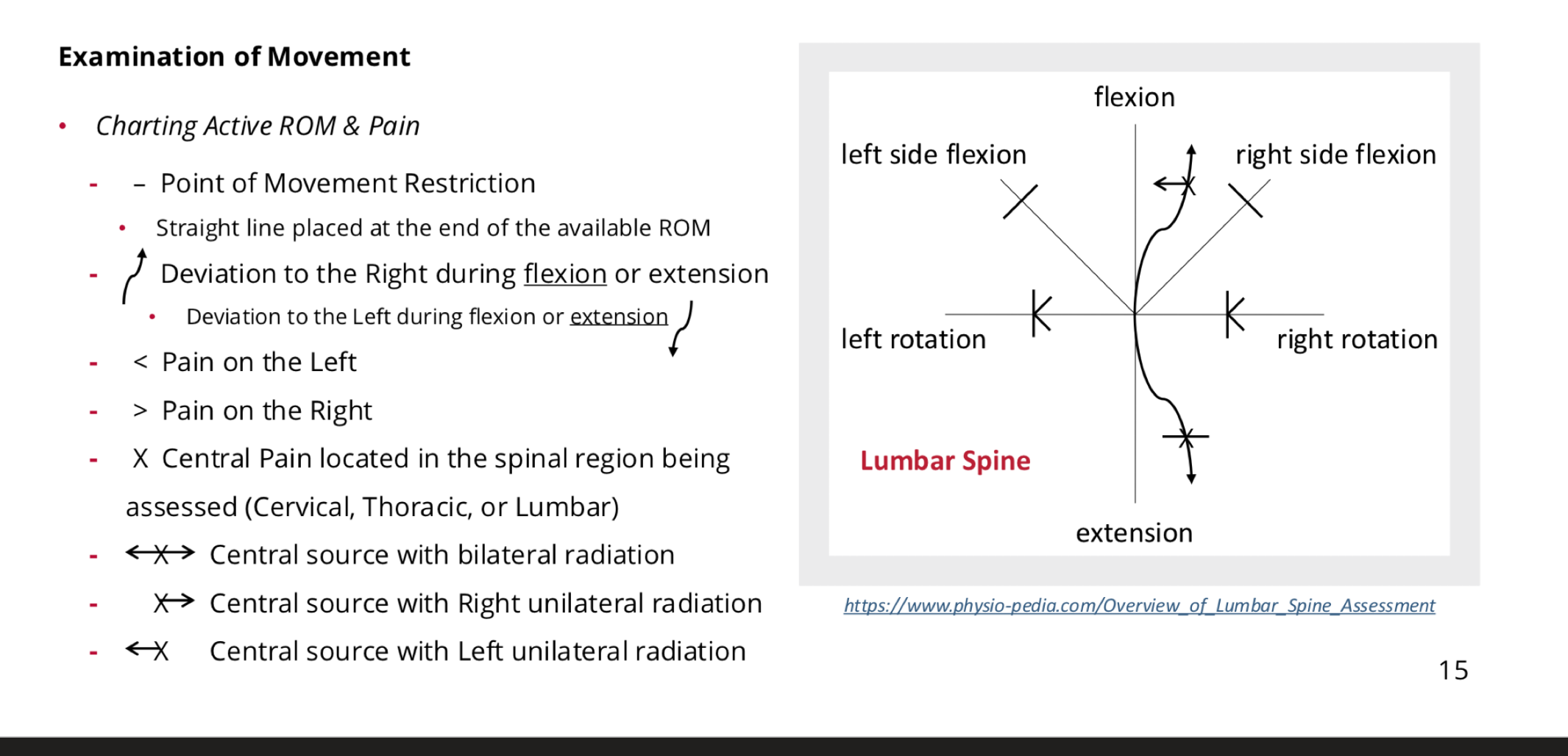
Most provocative combined movement
Rotation and extension
Grading of 4 patterns of nervous or contractile lesions
strong and pain free = none, strong and painful = gr 1-2, weak and painful = severe, weak and pain free = gr3 or nerve
SLR
Special test for neural compression from disc herniation, positive = pain or tight in back or posterior leg
SLR individual nerves
TED (tibial = eversion and DF), PIP (peroneal = inversion and PF), SID (sural = inversion and DF)
Slump test
Special test for neural compression from disc herniation, pt sits with arms behind back and slumps and head to chest, positive = pain or tight in post leg when knee extended and relieved when lift head back up
Prone knee bend test
Special test for neural compression at L2-L3, pt prone passive knee flex, positive = pain or tightness in anterior thigh or lower back or buttock
Passive lumbar extension test
Special test for lumbar instability, pt prone and passively lift both legs, positive = pain/heavy low back when lifted
Pone instability test
Special test for lumbar instability, pt prone off edge of bed then pushing each lumbar vertebrae, if pain then ask to lift leg and check for pain, positive = pain in resting position only
Prevalence of LBP conditions
Non-specific mechanical LBP = most common, non-mechanical LBP = rare
Mechanical LBP presentation
Cyclical pain - gets worse throughout day, start pain, pain increase or decrease w/movement, pain is relieved with change of position
Non-mechanical LBP presentation
Unclear pain pattern - at rest or at night, red flags and other flags
LBP red flags
N - cauda equina, I - spina infection, F - spinal fracture, T - spinal malignancy
Cauda equina syndrome
Compression of multiple lumbar nerve roots, *changes in bladder/bowel function
Types of disc herniation from least severe to worst
bulge, protrusion, extrusion, sequestration
Disc herniation presentation
Severe LBP, radiating into buttock and leg, mechanical pain, pain exacerbated by coughing or sneezing
What is the bio-medical model
Classification of LBP, finding anatomical defect causing the pain, MRI = gold standard
Limitations of the bio-medical model
Excessive reliance on diagnostic testing and being overly cautious
When are x-rays and CT scans plausible?
Red flags
What is the McKenzie Classification?
Classification of LBP, mechanical diagnosis & treatment (MDT), categorization based on pain patterns during sustained and repeated spinal movements
Three primary categories of Mckenzie Classification
Postural syndrome = appears after prolonged static loading (sitting hurts after a while, best case)
Dysfunction syndrome = adaptive shortening, resulting in loss of mobility, causing pain (pain at end of ROM)
Derangement syndrome = pain arises due to a displacement in the intervertebral segments (pain during or after movement, or rest, worst case)
What is the CORE Back Tool
Helps recognize common mechanical back pain syndromes and screen for other conditions
What is the Treatment-Based Classification System for LBP
Two levels of triage, first level = first-contact health provider, rules out serious pathologies to determine if pt requires medical (severe), rehabilitation (moderate), or self-management (mild) (family doctors/physician), second level = rehabilitation management, conduct symptom modulation, movement control, & functional optimization (PT/OT)
What are the 3 rehabilitation management approaches and the clinical findings and treatments for each
Symptom modulation (severe): high disability, volatile symptoms, high to moderate pain; traction/manipulation, movement control: moderate findings; sensorimotor/stabilization/flexibility, functional optimization: low findings; strength and conditioning, specific tasks (sport/work)
What is SINSS?
Clinical reasoning tool to help understand symptoms, Severity, Irritability, Nature, Stage, Stability
Explain each term of SINSS
Severity - NPRS (0-10), impact on ADLs, night pain Y/N
Irritability - ratio of aggravating to easing 2:1 & no sleep interrupt (mild) 1:1 & sleep interrput <30 mins (moderate) 1:2 & sleep interrupt >30 mins(severe)
Nature - describing patient characteristics and their pain (poor, old lady, lets pain continue)
Stage - acute, sub-acute, chronic
Stability - Improving, not improving, worsening, or up and down
What are the best and worst interventions for the management of acute LBP?
Grade A = strong evidence and best
A - manual therapy (join mobilization), active education (biopsychosocial contributors to pain and self-management strategies like remaining active)
B - MT (massage/STR), passive education (providing links of articles to patients), classification systems (TBC), exercise (LBP)
C - classification systems (Mckenzie), exercise (LBP with leg pain)