Corporations
 Call Kai
 Learn
Learn Practice Test
 Spaced Repetition
 Match
Match Flashcards
 Knowt Play
 Podcast
1/63

Earn XP
Description and Tags
Fall
Name | Mastery | Learn | Test | Matching | Spaced | Call with Kai | Chat |
|---|
No analytics yet
Send a link to your students to track their progress
64 Terms
Sole proprietorships
Simplest form of carrying on a business. Not a separate entity from the proprietor. They are owned and operated by one person who retains all profits and assumes all liabilities. Income from the business is taxed directly in the hands of the proprietor. Other than declaring a trade name, no docs are required to be filed.
Corporations
Legal entities separate from owners, which can own assets, incur liabilities, and issue stock. Corporations are subject to corporate taxes and provide limited liability protection to their shareholders with exceptions.
Registration Requirment of Corporations
Articles of Incorporation in the prescribed form must set out the corporation's name, classes, any maximum number of shares, restrictions on share transfers, number or minimum or maximum of corporate directors and any restrictions on the corp’s business. Articles of Incorporation must be submitted to a registry agent with fee, NUANS name search reserving the name, notice of directors and notice of address.
Unlimited Liability Corporations (ULCs)
An exception to the limited liability of corporations. In ULCs, owners may be personally liable for corporate debts, allowing for taxation benefits while retaining personal risk. This structure is often used for foreign corporations operating in Canada. The articles must state that “the liability of each of the shareholders of the unlimited liability corporation for any liability, act or default of the unlimited liability corporation is unlimited in extent and joint and several in nature” Corporations names must end with the words “ —-”.
Exception to the Limited Liability Principle of Corporations
A shareholder signs a personal guarantee for the corporation’s debts,
A shareholder has contracted personally without giving adequate notice to a third party that he or she was acting as an agent for the corporation,
• Loss occurs as a result of a shareholder’s personal act or negligence,
• A shareholder has not fully paid for his or her shares, to the extent of the unpaid amount,
• Personal liability is provided for by statute, for example, under s 38 of the BCA,
• A shareholder has assumed the powers of a director under a unanimous shareholders agreement (BCA, s 146),
• A shareholder has received over-payments on liquidation (BCA, s 227),
• A court has “lifted the corporate veil”
Volzke Construction v Westlock Foods, 1986, ABCA
Facts: Mr. Shefsky was the main shareholder of Westlock Foods (defendant/respondent). Volzke
Construction (plaintiff/appellant) undertook to build the Westlock Shopping Centre, which was
80% owned by Bonel Properties, and 20% owned by Westlock Foods.
- Volzke was not paid in full. It was accepted as fact that amounts went unpaid ($77,000) and a contract did exist
- Volzke brought action against Westlock, alleging that Westlock Foods is a partner of Bonel
Ratio: Control is not a factor to determine partnerships. The domain of sharing profits and interest in how the enterprise is being managed = partnership. Cannot say ‘we are not a partnership’ if they are acting like it.
McDonic estate v Hetherington (Liability of partners through authority)
Facts: Mr. Watt was a partner with at a legal firm. He was partners to Hetherington et al. (partner defendants) and was retained by Ms. McDonic and Ms. Cooper (plaintiffs) for an investment transaction. Watt made various investments for the plaintiffs. Some loans were insufficiently secured. He failed to protect their interests.
- The plaintiffs eventually lost several hundred thousands of dollars, so they bring action against Watt and all other partners
PH: At trial, partners were not liable since Watt was just an advisor, outside a law firms authority
Issue: Are the defendants, as Watt’s partners, liable to the plaintiffs for their loss based on actual or apparent authority of agency? (was there an agency relationship?)
Ratio : It is the nature of the activity, and not how it was performed, that will determine whether the activity falls in the scope of that firms ordinary business. Apparent authority is determined by a consideration of whether the person dealing with the partnership would reasonably regard the partner as acting on behalf of a partnership. Express authority can be cemented from the authorization of the other partners. Implied authority does not have to be grounded in the industry standard for ordinary business, but the ordinary business of that specific company.
- Representations to ground apparent authority don’t need to be express, but the conduct being done on the partners behalf and therefore cloaked the agent in apparent authority
Partnerships
2 or more people engaged in a business in common with the view to make profit. Partners are agents for each other and for the firm, for the purpose of the business of the partnership. Presumption that the income of the partnership is shared equally.
Joint Liability
In a partnership, each individual is liable to the full extent of the debts and obligations of the firm incurred. S.11 of the Partnership Act. This is the presumption of Partnership.
Several Liability
In a partnership context, several liability means that each partner is only responsible for their own share of the obligations and debts, not the entire amount, allowing for individual liability in legal claims.Separate liability based on apportionment according to fault/responsibility.
General Partnerships
Very simple form. Jointly and severally liable for the tortious activities of other partners (s. 11(2) of Partnership Act). General partners have unlimited liability (s.51 of PA).
Limited Partnerships
A form of partnership where at least one partner has limited liability, typically involving general partners who manage the business and limited partners who contribute capital but do not participate in day-to-day operations. Think of limited partners as investors. Can be a general partner & limited partner at the same time. Limited partner only liable to the extent of their property or investment in the partnership.
S. 64 of Partnership Act
Limited partners eliminate their limited liability if he takes responsibilities of a general partner.
Limited Liability Partnerships (LLP)
Only available to certain professions. Governed by s.81-104 of the Partnership Act. If one of the LLP partners are negligent, the other partners are shielded from personal liability. It absolves you from liability of the tortious acts of your partner. Remain liable for the ordinary debts of the firm.
S.6 of Partnership Act
Each partner is an agent of the firm and of the other partners regarding the business.
Exceptions to the principle of limited liability for a corporation’s shareholders
A shareholder signs a personal guarantee for the corporation’s debts,
A shareholder has contracted personally without giving adequate notice to a third party that he or she was acting as an agent for the corporation,
Loss occurs as a result of a shareholder’s personal act or negligence,
A court has “lifted the corporate veil or pierced it”
A shareholder has not fully paid for his or her shares, to the extent of the unpaid amount,
A shareholder has assumed the powers of a director under a unanimous shareholders agreement - fiduciary duty
Personal liability is provided for by statute, for example, under s 38 of the BCA,
A shareholder has received over-payments on liquidation
s.81 of Registration of Alberta LLPs
Eligible professions means a profession or discipline that is regulated by an Act of Alberta that specifically authorizes members of the profession or discipline to carry on a business through a corporation that has the words “Professional Corporation” or “P.C” as part of its name.
Methods of Incorporation
Royal Charter/ Letters Patent
Memorandum of Association
Articles of Incorporation
Royal Charter
A historical method of incorporation. Issued by a monarch, granting rights to establish a corporation. Most famous example is the Hudson’s Bay Company.
Letters Patent
This method is a direct descendant of the Royal Charter. Involves an application made to a govt bureaucrat/ Crown rep who issues an incorporating doc. It is the constitution of the new company, contains the name, business purpose, ownership/ share structure but NOT the by-laws/ rules governing day-to-day operations. Still used in Prince Edwards Island.
Memorandum of Association
A legal document required for incorporation that outlines the company's constitution, objectives, and details about shareholders. Incorporation is achieved by registering this and articles of association. The articles set out the day-to-day operating rules. Still active in Nova Scotia and BC. In Alberta, this is used to incorporate not-for-profit corps.
Articles of Incorporation
Filed with the appropriate govt body. This serves as a legal document that establishes a corporation's existence and outlines its structure, capital structure, purpose and general matters. Used in majority of provinces including Alberta, Ontario, NL, Saskatchewan, NB and Manitoba. Must include the name of the corporation, classes and any maximum number of shares that the corp is authorized to issue, any restrictions on the transfer of shares, number of directors or the minimum & maximum number of directors, any restrictions on the business that the corporation may carry on, the registered office address, and any other provision.
Actual Express Authority
The authority which the principal has expressly given the agent by the terms of their agreement (can be written or oral)
Actual Authority
The authority which in fact the agent has been given by the principal under the agreement made between them.
Implied Authority
The authority that is not explicitly stated but is assumed to be granted to the agent to carry out their duties effectively. This includes powers that are necessary to and ordinarily incidental to fulfilling the agent's role.
Apparent Authority
Based on the doctrine of estoppel. When a principal's conduct/ representation leads a third party to reasonably believe that an agent has the authority to act on the principal's behalf, even if the agent does not have actual authority. To assert the existence of this authority, it must be proven that the third party relied on this representation and acted on it to their detriment.
Section 12 (1) of Partnership Act
A partner in Alberta LLP is not individually liable directly or indirectly by means of indemnification, contribution, for debts, obligations or liabilities of the partnership or another partner that arise from the wrongful acts of negligence, wrongful acts or omissions, malpractice, or misconduct of another partner or employee, agent or representative of the partnership, that occur in the ordinary course of carrying on a practice in an eligible profession within the meaning of s. 81.
Business Corporations Act s. 16 (1)
The corporate has the capacity and subject to this Act, the rights of a natural person.
Salomon v Salomon
Facts: S had a sole proprietorship that he incorporated and lend his own cash to the company to become its secured debtor. Business failed and went into liquidation. S took priority in getting his assets back while unsecured creditors got nothing.
Issue: Is Mr. S personally liable for the debts of the company ? NO
Is S a genuine creditor of the company? YES
Ratio: “The company was a real one and not a fiction or a myth”, the company is a separate legal entity; distinct from shareholders, directors and incorporators.
• There was no fraud, no dishonest and not a scheme; S as a shareholder did not lose his limited liability protection.
ABCA S.46 Shareholder Immunity
Shareholder immunity. A controlling shareholder of a corporation does not have personal liability for the debts or obligations of the corporation.
Directors
Fiduciary duty owed to act in the best interests of the corporation and its shareholders, and must exercise care, diligence, and skill in their decision-making.
Special acts of incorporation
Used by fed & prof government to create a corporation for a specific & distinctly identified purposes and may only acct for those purposes.
Canadian Jorex Ltd v 477749 Alberta Ltd, 1991
Facts: The Directors of Jorex (D) called a special meeting on Dec 10, but then cancel the meeting by notice on Nov 27.
Minority shareholders (P) would lose the right to examine the auditor of the corporation if the meeting is cancelled. So, they applied for an order declaring the notice of cancellation was of no force and effect.
Issue: Do the directors of the corporation have the power to cancel a special meeting called by them in advance of its advanced date?
Ratio: Section 101 codified this: (1) Subject to any unanimous shareholder agreement, the directors shall manage or supervise the management of the business and affairs of the corps. Unless there is explicit prohibition of something by the ABCA or bylaws, residual powers include the right to do so
i. Section 17(1) shows a bylaw is not needed to give powers to directors
ii. There is no bylaw saying directors can’t cancel meetings, so they can
c. Read together, unless prohibited by bylaw or USA, provisions grant directors the power to cancel meetings under residual powers of s101(1).
Section 101 was designed to give powers to directors and not restrict it.
ABCA s. 5
One or more persons may incorporate a corporation by signing articles of incorporation and complying with section 7 (roles of incorporator)
ABCA s. 1(x)
“person” includes an individual, partnership, association, body corporate, trustee, executor, administrator, or legal representative
▪ a person under 18 can sign the documents in Alberta
CBCA s.5
One or more bodies corporate or individuals who are 18 or older, not incapable, and not bankrupt
ABCA s.7
An incorporator shall send to the Registrar the articles of incorporation and the documents required by ss 12(3) ( name of corp including NUANs), 20 (Notice of address) & 106 (notice of directors).
ABCA s. 12
A name is prohibited if it is prohibited by the regulations; “identical” to the name of an ABCA corporation, CBCA corporation, or an extra provincial corporation registered in Alberta; or if it is similar such that the use of that name is confusing or misleading.
Business Corporations Regulation s.5 (a), (b)
A name is similar if it would reasonably lead to the inference that it is associated/affiliated with another corporation or if it is so similar to another name that it creates confusion among the public (mistakenly believe it is the other corporation).
Business Corporations Regulation s.4 (1)
If name is similar to existing corporate name, consent must be obtained + filed
Business Corporations Regulation s.4 (2)
If a name is similar to name of a dissolved corporation it cannot be used unless the other corporation has been dissolved for 3 years or more.
Business Corporations Regulation s.15
In determining whether a name contravenes section 12 and the regulations, the Registrar may, without limitation, consider the following:
(a) the distinctiveness of the name or any element of it and the extent to which the name has become known;
(b) the length of time the name has been in use;
(c) the nature of the business carried on under or associated with the name, including the
likelihood of any competition among businesses using such a name;
(d) the nature of the trade with which a name is associated, including the nature of the goods or services and how they are offered or distributed;
(e) the degree of similarity between the name and another name in appearance or sound;
(f) the geographic area in Alberta in which the name is likely to be used.
Business Corporations Regulation s.6
Unless a proposed name through use acquired a distinctive meaning, the name may not be used if :
The name is too general, is only descriptive of goods and services,
Is primarily or only the name (or surname) of an individual who is living or died within 30 years of incorporation or name of a geographical area
ABCA s.10
the word “Limited”, “Limitée”, “Incorporated”, “Incorporée” or “Corporation” or the abbreviation “Ltd.”, “Ltée”, “Inc.” or “Corp.” shall be the last word of the name of every corporation…”
An Alberta Corporation Name must have these 3 elements
Distinctive: A distinctive element is a unique word or location that makes your corporation name unique from others.
Descriptive : A descriptive element conveys the nature of the business or its services.
Legal Element: All Alberta corporations are required to have a legal element at the end of their name like Ltd.
Test of Confusion : Aquatera Utilities Inc. v Aquaterra Water Management Inc
Whether the names of two companies side by side either visually or orally appear the same or similar in the sense that the similarity of the names would probably not possibly deceive.
Paws Pet Food and Accessories Ltd V Paws and Shop Inc
Facts: Paws Pet Food and Accessories Ltd. (Applicant) was formed in 1987 under the ABCA
- Paws and Shop Inc. (Respondent) was formed in 1991 under the ABCA
- Both corporations operated retail shops in Calgary and sold the same types of products
Issue: Should the Registrar force R to change its name? YES
Holding: the fact that customers believed R was a second store means that they were misled and confused. Reasonable inference that they are affiliated. Directed the registrar to require the respondent to change its name.
Stenner
Facts: P, committed to sell his book of business to his daughter with a phased retirement but later due to a fall out, daughter moved to their competitor’s company. Then started to use her last name Stenner in ads and promotions, which led to confusion in the marketplace. P sued competitor for passing off. The court ruled that she could not use the name to benefit from the goodwill of the business she was supposed to inherit. P had also trademarked the name.
Passing off vs Trademark infringement
Passing off: Allows for exclusive use but requires confusion of public, existence of good will (benefit of a good name, reputation and connection of business) from P and actual or potential damages to P.
Trademark: Allows for exclusive use but does not require confusion.
Unanimous Shareholder Agreements (USAs)
s. 146 of the ABCA.
146 (1): An agreement among all shareholders that provide for any or all of the following:
a) regulation of the rights and of the shareholders and any other party to the agreement
b) the regulation of the election of directors
c) the management of the business and affairs of the corporation, including the powers and duties of officers and directors, and restrictions on powers (of the directors as well).
d) any other matter that may be contained in a unanimous shareholder agreement pursuant to any other provision of this Act.
146 (2): If a unanimous shareholder agreement is in effect at the time a share is issued by a corporation to a person other than an existing shareholder,
(a) that person is deemed to be a party to the agreement whether or not the person had actual knowledge of it when the share certificate was issued,
Cicco v 609940 Ontario Inc (Trustee of) : USA is an internal doc, not binding to a third party
Facts: 609 carried on a business as a Five Star Auto. B = director and 50% shareholder.
B + C enter into USA which states decisions affecting the corporation shall be made only consent of B+C personally
B+C have a falling out where C resigns as a director and B carries on business as a director. B assumes liability and responsibilities of C, who transfers his shares to B, but he is still party to USA.
B, without C’s consent, adopts a director’s resolution to make an assignment in bankruptcy (transfers all assets to an insolvency trustee).
Ratio: USA is an entirely internal matter between the director and the shareholders (or a third party when they agreed to it), it does not disentitle a trustee to rely on the assignment.
Holding: Here, the bank had no notice of the USA and was not privy therefore, B’s actions cannot be undone even if the USA did not allow his actions.
Corporate Shares
Intangible property, a company can issue a common divided right to profits (participation interests of the company). Shareholders do NOT have assets to the corporate assets, those belong to the company. If a corporation is dissolved then the shareholders are only entitled to a proportional value of those assets and not the specific assets (and only what remains after debt repayment and the money owed to bond holders, who technically lent money). Issued by a director but a person may acquire shares through another shareholder transferring the shares.
ABCA S. 26 (3) (Classification of shares)
If a corporation has only one class of shares, the rights of the shareholders are equal in all respects and include the rights
a) to vote at any meeting of shareholders
b) to receive dividends declared by the corporation
c) to receive the remaining property of the corp on dissolution.
ABCA S.26(4): Classification of shares
If a corporation has more than one class of shares, the rights of each class may differ but they must be set out in the articles.
b) the rights set out in subsection (3) shall be attached to at least one class but all of those rights does not need to be attached to one class.
Common Shares (equity shares)
Confers full rights to participate in the Corp, including unrestricted voting rights, dissolution and dividends.
Since holders of common shares only get paid dividends after satisfaction of other claims against corps (including debtors and preference shares) its great when company is growing but risky when Corp gets dissolved.
Preference Shares
Special shares with a preferential right which causes it to get priority over common shares in terms of dividend payments and asset distribution upon dissolution.
Non-preference Special Shares
Subject to a limitation rather than a right
Canadian Securities Regulation: relates to the distributing corporation only, which must file with the securities registry
Securities are provincially regulated, however, the federal government still has the jurisdiction of criminal enforcement in those areas (though there will be a federal securities regulator at some point)
Pre-Incorporation Contracts
A contract that is entered into the name of, on behalf of or in trust for, a corp that is yet to be incorporated.
OLD LAW (NOW CHANGED)
Liability under these contracts are governed by 2 rules (kelner v Baxter)
Person who signed contract on behalf of yet to be incorporated company was personally liable for the contract and
after the company gets incorporated, the corporation could not ratify the contract and relieve the person from personal liability.
Issues with Kelner approach: The courts could therefore not overcome the conceptual difficulty that a non-existent person could agree (by subsequent ratification or adoption) to become subject to obligations incurred on its behalf before its creation.
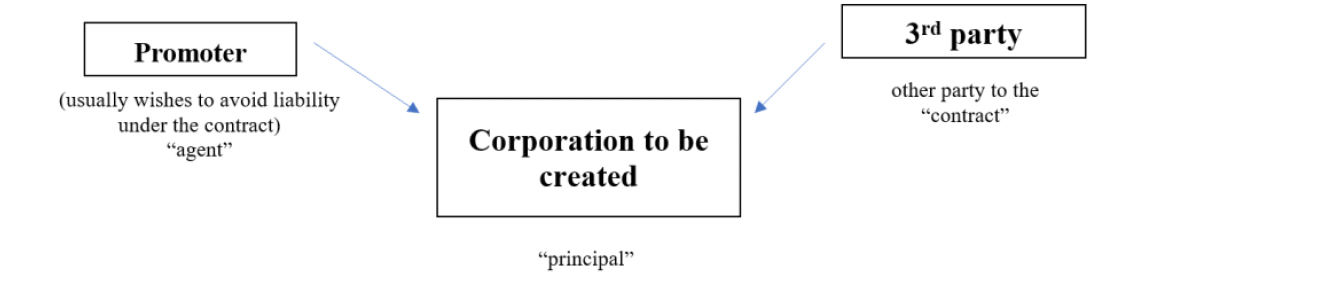
ABCA S. 15(2) (pre-incorporation contracts)
If a person enters into a written contract on behalf of a body incorporate before it comes into existence, that person will be a promoter. That person is deemed to warrant to the other side that; the corporation will come into existence within a reasonable amount of time AND that the contract will be adopted within a reasonable amount of time =
you’re not liable on the contract, but liable for the breach of the warranty
ABCA S. 15 (3) :
Corporation may, within reasonable time of coming into existence, ratify the contract o When it does so, the promoter gets released and the corporation is bound by the contract and is entitled to the benefits of the contract as if it had been in existence the whole time and had been a party to it.
ABCA S. 15(4)
A person can apply to the court for an order that the corp return any benefits they received under the contract if they ended up not ultimately adopting the contract - indicates corporation came into existence
ABCA S. 15 (6)
A person who enters, or purports to enter, a contract on behalf of a body corporate before it comes into existence is not liable if the contract expressly states that they are not liable.
Wickberg v Shatsky et al - How we measure damages of warranty under the ABCA
Facts: Shatsky’s (D) became directors of Rapid Addressing Systems Ltd
P was hired to be the new manager for the business.
May 9, 1999: P received employment contract on Rapid data letterhead.
It was signed by Lawrence Shatsky as President of rapid data.
Later, P was told that RD is dropping Ltd from its name and fired P for not working on purely commission basis.
Issue: Whether Lawrence is personally liable
Analysis: No personal liability under contract, but breach of warranty established
- Nominal damages awarded for breach of warranty
- Takeaway: the damages contemplated by section 15(2)(c ) that can be received would be nominal.