L10: Nervous System I
 Call Kai
 Learn
 Practice Test
 Spaced Repetition
 Match
 Flashcards
 Knowt Play
1/79

There's no tags or description
Looks like no tags are added yet.
80 Terms
What is CNS made of?
Brain and spinal cord
What is PNS made of?
nerves and ganglia
What are ganglia?
Collections of neuron cell bodies in PNS
What are nerves?
Bundles of axons that carry info to and from the CNS
Afferent?
To CNS
Efferent?
Away from the CNS
What are lower centers?
Spinal cord and brainstem—control basic and essential functions
What are centers?
A functional region of CNS that helps coordinate an activity
What are higher centers?
Located mainly in cerebrum and cerebellum
What are the 2 divisions of PNS?
Somatic= voluntary
Autonomic= involuntary
What protects the spinal cord?
Vertebral column, meninges, CSF, and epidural fat

What are meninges?
3 connective tissue membranes that surround and protect brain and spinal cord
What are the 3 layers that form meninges (superficial to deep)?
Dura mater
Arachnid
Pia mater

How many pairs of spinal NERVES?
31
What is the division for spinal NERVES?
8 cervical
12 thoracic
5 lumbar
5 sacral
1 coccygeal
What are spinal enlargements?
Regions spinal cord is wider because they have increased # of neurons
Where are spinal enlargements?
Cervical and lumbar regions
What is cauda equina (horse’s tail)?
Bundle of lumbar, sacral, and coccygeal spinal nerves extending inferiorly from conus medullaris
What is the conus medullaris?
Tapered inferior end of spinal cord, usually around L1-L2 vertebral level

What is filum terminale?
Thin strand of pia mater extending inferiorly from conus medullaris
What is the fuction of filum terminale?
Helps anchor spinal cord
What are glial cells?
Non-neural support cells
What are 2 PNS glial cells?
Satellite cells
Schwann cells
Satellite cell functions?
Surrounds neuron cells bodies in PNS ganglia
Provides structural and metabolic support
Regulates chemical environment
What do Schwann cells do?
Form myelin sheaths around nerve fibers
What are the 4 CNS glial cells?
Microglia
Ependymal cells
Oligodendrocytes
Astrocytes
What do microglia cells do?
Immune cells of CNS; they remove pathogens, damaged cells, debris through phagocytosis
What do ependymal cells do?
Lines brain ventricles and central canal of spinal cord; the cilia helps circulate CSF
What do astrocyte cells do?
Regulate EC chemical environment
Metabolic support to neurons
Regulates synaptic activity
Helps form blood-brain barrier
What do oligodendrocytes do?
They form myelin sheaths around nerve fibers
What are dendrites?
They receive signals from other cells and carry them towards cell body
What are cell bodies (somas)?
The metabolic and integrative center of neuron
What are axons?
They carry action potentials away from the cell body
What are nerve endings?
Send signals to other cells
What are the four neuron types (by structure)?
Multipolar
Psuedounipolar
Anaoxonic
Bipolar
What is the structure of a multipolar neuron?
One axon and many dendrites
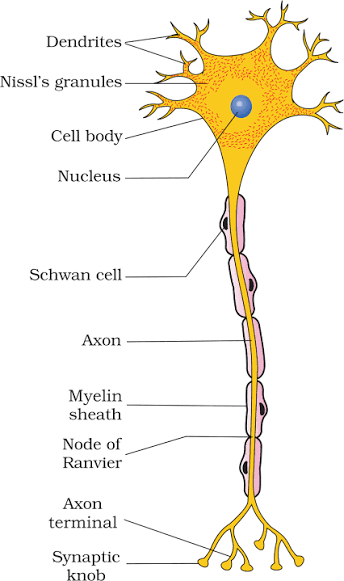
What is the most common type of neuron?
Multipolar
How do multipolar neurons function?
Usually function as motor neurons (they are walking! so cute)
What is the structure of a psuedounipolar neuron?
Single process extends from cell body and bifurcates into peripheral and central branch
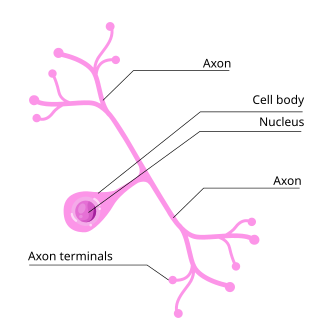
How do psuedounipolar neurons function?
Dorsal root ganglia—usually just general sensory neurons
What is the structure of an anaxonic neuron?
Many dendrites and no obvious axon

How do anaxonic neurons function?
Local interneurons—communicates strictly with nearby cells
What is the structure of a bipolar neuron?
One dendrite and one axon

What is the function of bipolar neurons?
Special sensory pathways—retina, inner ear, olfactory
What is a synapse?
Junction where a neuron communicates with another cell—neurotransmitters carry singal across small gap at synpase
What are the 3 parts of the synapse
Presynaptic axon terminal
Synaptic cleft
Postsynaptic membrane
What happens in the presynaptic axon terminal?
Synaptic vesicles are filled with neurotransmitters
What happens in the synaptic cleft?
Gap where neurotransmitter diffuses
What happens in the postsynaptic membrane?
Receptors bind neurotransmitter and produce a response
What is dopamine responsible for?
Movement, motivation, and reward-learning
What is serotonin responsible for?
Mood, sleep, appetite, and GI activity
What is norepinephrine responsible for?
Wakefulness and arousal in CNS
What is acetylcholine responsible for?
Skeletal muscle contraction, autonomic signaling, and attention/learning/memory
What neurotransmitters are monoamines (4)?
Dopamine
serotonin
norepinephrine
histamine
What neurotransmitters are amino acids (3)?
Glutamate
GABA
Glycine
What is glutamate responsible for?
Major excitatory neurotransmitter—excite neurons to help action potentials
What is GABA responsible for?
Major inhibitory neurotransmitter—prevent over excitation of neurons
What is glycine responsible for?
Inhibitory neurotransmitter in spinal cord and brainstem
What neurotransmitter loss is associated with Alzheimer’s?
Acetylcholine
What neurotransmitter loss is associated with Parkinson’s?
Dopamine
What neurotransmitters are neuropeptides (3)?
Endorphins
Substance P
Oxytocin
What are endorphins responsible for?
Pain modulation
What is substance P responsible for?
Pain signaling
What is oxytocin responsible for?
Childbirth, breastfeeding, social bonding, sexual arousal
What neurotransmitters are purines (2)?
ATP
Adenosine
What is ATP responsible for?
Acts as neurotransmitter
What is adenosine responsible for?
Decreases neural activity and promotes sleepiness
How is caffeine effective?
By blocking adenosine receptors
What is glycine important for?
Processing motor and sensory info
What is glutamate important for?
Synaptic plasticity, learning, and memory.
What is the point of the biosynthesis of catecholamine?
The enzymatic pathway that converts Tyrosine (amino acid) into important neurotransmitters
What is the biosynthesis of catecholamine?
Tyrosine —> Dopa —> Dopamine —> Norepinephrine —> Epinephrine
What are the two enzymes involved in catecholamine metabolism?
Catechol-O-methyltransferase
Monoamine oxidase
Where does action potential arrive?
Axon terminal

What enters axon terminal after potential arrives?
Voltage-gated calcium channels open and calcium enters axon terminal
What does calcium trigger?
Synaptic vesicles to fuse with presynaptic membrane and release neurotransmitter by exocytosis
Where do neurotransmitters diffuse?
Across synaptic cleft and binds to receptors on postsynaptic membrane
What is synaptic strength?
How effectively activity in one neuron produces a response in another neuron
What can increase synaptic strength?
Recent activity
What causes temporary info retention?
Recent activity