Unit 1 Kin Test (Chapter 5,6,7,8)
 Call Kai
 Learn
 Practice Test
 Spaced Repetition
 Match
 Flashcards
 Knowt Play
1/122

There's no tags or description
Looks like no tags are added yet.
123 Terms
What is the anatomical position?
Standing up, face forward, arms hanging, palms forward, legs straight, feet parallel.

What is Superior?
Towards the head (upper)
What is Inferior?
Toward the feet (lower)
What is Anterior?
Front
Posterior?
Back
Medial?
Towards the midline of the body
Lateral?
Away from the midline of the body
Promixal?
Toward or nearest the trunk or the point of origin of a part (closest to middle of the body)
(elbow is proximal to your wrist).
Distal?
Away from or farthest from the trunk or the point of origin.
Plantar?
towards the sole of the foot
Dorsum?
refers to the uppermost surface of the foot.
Superficial?
close to the surface of the body
Deep?
Farther away from the surface of the body

What is the Frontal Plane and which axis is perpendicular to this plane?
Frontal Plane separates the body into front and back parts and the anterior-posterior axis is perpendicular to this plane.


What is the Sagittal Plane and what axis is perpendicular to this plane?
The Sagittal Plane passes through the midline of the body and the axis that is perpendicular to this plane is the Horizontal or Medio-lateral axis.


What is the Transverse plane and which axis is perpendicular?
The Transverse plane separates the body into upper and lower parts and the axis that is perpendicular is the longitudinal axis.

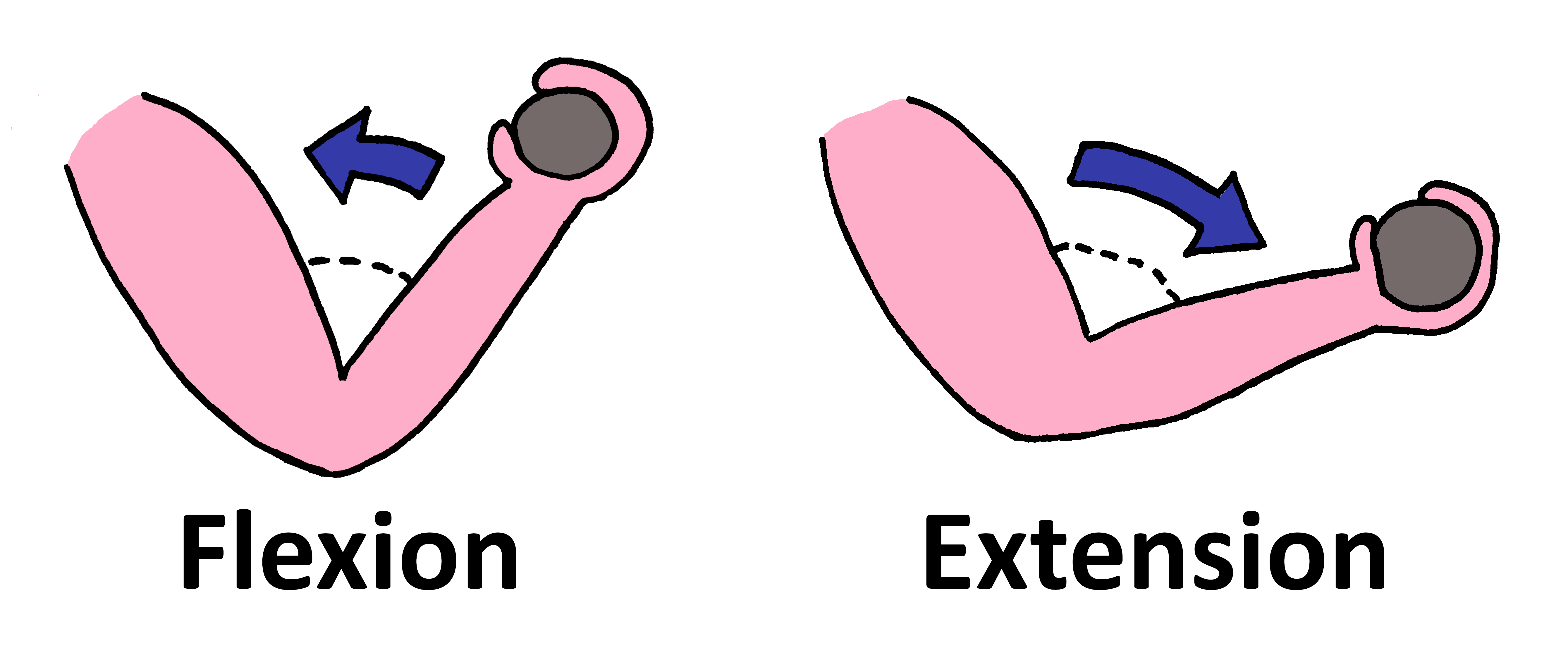
What is flexion and extension?
Flexion decreases the angle between two body parts and extension increases the angle.
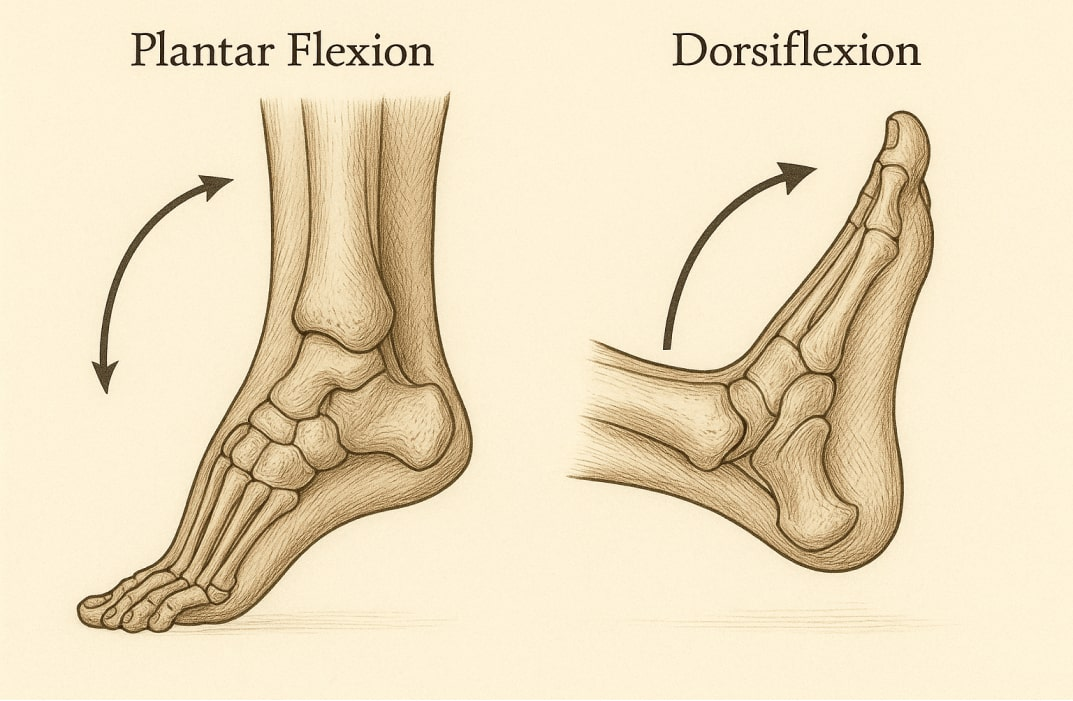
What is the two types of flexion for the ankle?
Dorsi-flexion is toes up
Plantar-flexion toes down
What is abduction and adduction?
Adduction is moving a body part towards the midline of the body, abduction is moving the body part away.

What is circumduction?
When flexion-extension is combined with abduction-adduction.

What are the two types of rotation?
Internal rotation and external rotation.

What is Pronation-Supination?
Pronation is palms facing down, while supination is palms facing up.

What is Inversion-Eversion?
Inversion brings the sole of the foot inwards, eversion brings the sole of the foot outwards.

What is Protraction-Retraction
Moving forward and backward.

What is Elevation-Depression
Elevation is raising up and depression is pulling down.

Opposition-Reposition
Opposition-movement of the thumb coming towards the other fingers, Reposition- returning to original position.

What are the 5 different types of bone and give an example of each?
Long (femur)
Short (Carpals)
Flat (Skull)
Irregular (Vertebrae bones)
Sesamoid (Patella)
What is the role of the skeleton?
-Protection
-Structure
-Attachment for muscle allowing movement
-Storage of minerals
-Blood cell formation
What is the bone composition (what is bone made of)?
-Calcium carbonate and calcium phosphate (together 60-70% of bone mass), providing stiffness.
-Collagen giving bone flexibility
-Water 20-25% of bone mass
Bone _________ and _________ is a continuous process
Bone ossification and remodeling is a continuous process.
What are osteoblasts?
Osteoblasts are bone forming cells.
What are osteoclasts?
Osteoclasts are bone-absorbing cells.
In children long bones increases in length at the _________ plates.
In children long bones increases in length at the epiphyseal plates. (The other bones grow a different way not epiphyseal plates).
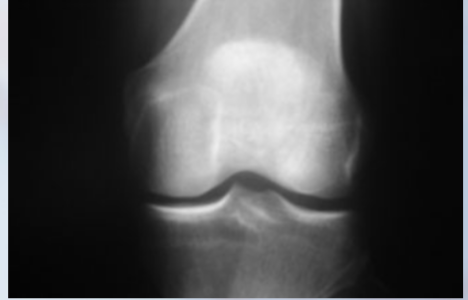
X-ray when epiphyseal plates are done growing.
X-ray when epiphyseal plates are growing.

What are the 5 different types of fractures and example each fracture?
Simple - no separation of parts of bone
Compound - separation of bone fragments and bone is popping out
Comminuted - shattered bone fragments still inside the body though
Impacted - the bone swished itself being an impacted fracture
Stress- tiny cracks over time.
What could shin splints result from?
Shin Splints could result from an over-use injury of the tibia. Shin Splints are caused by tearing of the muscle, the membrane between the tibia or fibula or the lining of the bone.
Untreated shin splints can lead to stress fractures.
What is Osteoporosis?
Osteoporosis is the loss of bone mass leading to fractures.
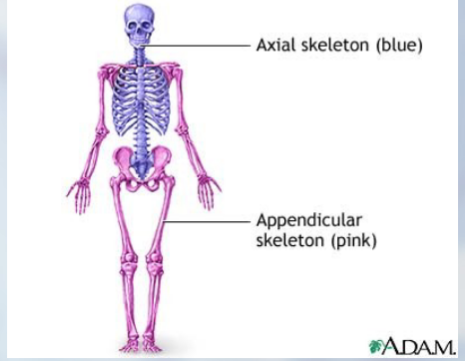
What is the axial skeleton? (Do the labbeling too)
The Axial skeleton is composed of approximately 80 bones:
Skull
Vertebrae
Ribs
Sternum.
What are the three groups of verterbrae columns and how many bones are in each group?
The three groups is cervical, thoarcic and lumbar.
7 cervical
12 thoracic
5 lumbar
What are the other two bones in the vertebral coumn and how many bones are in those?
Sacrum 5 bones
Coccyx (tail bone made up of 4-5 fused bones).
What are the three types of ribs and each many does each have?
The rib cage has three different types of ribs. True ribs (1-7) False ribs (8-10) and floating ribs (11-12)
What is the mid-line of the breast bone composed of in what order?
In this order: Manubrium, sternum and xiphoid process.

Roughly how many bones does the appendicular skeleton consists of and what are the components?
The appendicular skeleton consists of 126 bones and its the pectoral girdle, pelvic girlde etc.
What are joints?
Joints are the areas two bones meet.
What are the three types of joints and what does each joint do?
Fibrous joints allows for no movement - joints of the skull
Cartilaginous joints allow for little movement - intervertebral joints of the spine
Synovial joints allow wide range of movements, bones are joined by ligaments - knee joint, glenohumeral joint
What are the 6 types of synovial joints?
Ball and socket
Pivot
Hinge
Ellipsoid
Saddle
Gliding

Name each part of a synovial joint
Black - synovial membrane
Red - Articular cartilage - the bones are covered with wear-resistant cartilage.
Yellow - Fibrous joint capsule
Blue - joint cavity filled with synovial fluid
Brown - Ligaments.
What does the joint capsule do?
The joint capsule (synovial membrane and fibrous capsule) encloses joint and secretes synovial fluid into the joint cavity to lubricate it.
What does the hinge joint do an give one example?
-Allows movement on one axis
-Flexion and Extension
-Example - Lateral Humeral-Radial joint (Elbow)
What does the pivot joint do and give one example?
-Allows movement on the longitudial axis
-Twisting of the forearm
-Example - Radioulnar joint
What does the ball and socket joint do and give one example?
-Allows for all movements (circumduction)
-Example - glenohumeral joint
What does the ellipsoid joint do?
-Similar to the ball and socket joint
-Example - radiocarpal joint (wrist) joint
What does the saddle joint do?
-Has a concave and convex shape
-Bones are put together as in sitting on a horse allowing movement
Example - carpometacarpal joint of the thumb
What does the gliding joint do?
-Allows for gliding
Example - joints in the carpals
What do sprains refer to?
Sprains refer to injuries to ligaments and tendons.
What do strains or pulls refer to?
Strains or pulls refer to injuries to muscles.
What is tendinitis?
Inflammation of tendon due to over use.
What is separation?
When the ligaments holding two bones together are torn.

What is dislocation?
When a bone is forced out of its normal position. Involves damage to ligaments and joint capsule.

What does S.H.A.R.P. stand for?
We use SHARP to see if there is an injury
Swelling
Heat
Altered Function
Red
Painful
What does PIER stand for?
We use PIER for treatment.
Pressure
Ice
Elevation
Rest
What is the most common injury with the glenohumeral joint?
Shoulder dislocation
What is the most common injury with the acromioclavicular joint?
The most common injury is shoulder separation.
What is biceps tendonitis?
An overuse injury to the tendon of the biceps brachii making elbow flexion painful.
What is rotator cuff tears?
Tear in the tendon of one of the rotator cuff muscles causing pain in abduction and rotation of the arm.
What joint of the elbow does the hingeing?
The lateral humero-radial joint.
What joint of the elbow does the pronation and supanation?
The radio-ulnar joint.
What is the knee joint stabilized with?
Four ligaments
Menisci
Surrounding Muscles
What are the outside ligaments?
Blows to the lateral side of the knee often injure the _________ while the ______ ligament is not injured as frequently.
Blows to the lateral side of the knee often injure the Medial Collateral Ligament while the Lateral Collateral Ligament ligament is not injured as frequently.
What are the internal ligaments?
Within the knee two ligaments cross between the tibia and the femur. The _____ prevents forward displacement of the tibia with respect to the femur and the ______ prevents backward displacement of the tibia with respect to the femur.
The Anterior Cruciate Ligament prevents forward displacement and the Posterior Cruciate Ligament prevents backward displacement.
What is Osgood-Schlatter Syndrome?
Irritation where the pateller tendon attaches to the tibia.
Chapter 6
Muscles
What is contractility?
The ability to contract or shorten
What is irritability?
The ability to respond to stimulus.
What is extensibility?
The ability to stretch.
What is elasticity?
The ability to return to orginal shape.
What is conductivity?
The ability to transmit nerve impulses.
What does the properties of muscle tissues allow for?
Perform Movement
ventilation
Digestion
Heat production
Pumping of blood
What is the three different types of muscle tissue?
Skeletal muscle, smooth muscle and cardiac muscle
What does skeletal muscle do?
Skeletal muscles - attached to bone contracts to support and move the skeleton, usually under voluntary control.
What does smooth muscle do?
-Found in blood vessels and organs
-Contracts to aid body functions
-Contracts are involuntary, slow and sustained
Example - peristalsis
What does Cardiac muscle do?:
-Found in the heart
-Contracts to pump blood
-Involuntary
The voluntary skeletal muscle is also known as ______ due to its light and dark bands.
The voluntary skeletal muscle is also known as striated due to its light and dark bands.
What is the muscle producing movement called?
The agonist or prime mover.
What is the muscle opposing the action called?
Antagonist
What are muscles that work together are called?
Muscles that work together are the synergists.
What are muscles that stabilize the joint called?
The muscles that stabilize the joint are called fixators.
What are the two nervous systems that help move a muscle?
The CNS (Central nervous system) and PNS (Peripheral nervous system)
What is the junction between the nervous and muscular system called?
The neuromuscular junction?
What is the muscle contraction delievered by?
Muscle contraction is delivered by nerve impulse by the motor neuron.
What can each motor neuron do?
Each neuron can innervate several muscle fibers.
What is a motor unit?
The motor neuron and all the fibers it innervates.
What does every motor unit have? (Think what needs to happen to activate)
Every motor unit has a threshold of stimulation that must to reached to activate the muscle fibers.
If the threshold is not reached none of the fibers are activated.
The entire muscle is enclosed by the ________ inside which bundles of fibres are enclosed by the _________.
The entire muscle is enclosed by the epimysium inside which bundles of fibres are enclosed by the perimysium.

What are muscle cells called and what are their characterisics?
They are called Muscle fibers
15 cm long
Cylindrical in shape
Many nuclei
Each muscle fiber is enclosed in a ________ and is composed of _________.
Each muscle fiber is enclosed in a sacrolemma and is composed of myofibrils.
What is the following groups from largest to smallest?
Muscle fibers, myofibrils and myofilaments
Muscle fibers, myofibrils and myofilaments.
In each myofibril two types of __________ make up the contractile unit called the _______.
In each myofibril two types of myofilaments make up the contractile unit called the sacromere.
The two filaments are ______ (thick filament) and _____ (thin filament). Each _____ filament is surrounded by _____ filaments.
Myosin (thick) and actin (thin). Each myosin filament is surrounded by actin filaments.
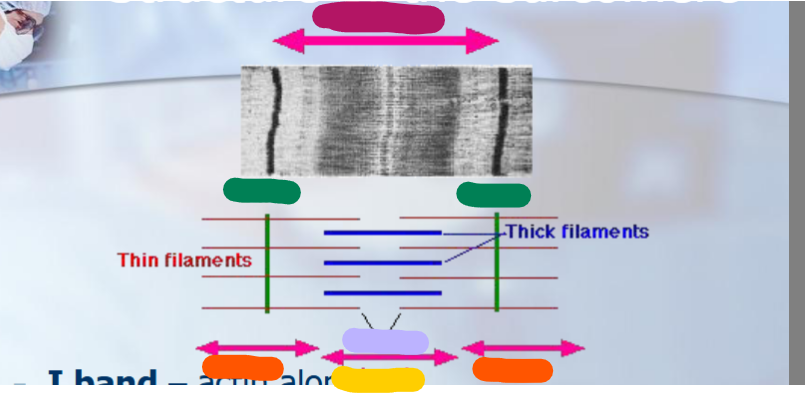
Label the following colours:
Pink: Sacromere
Green: Z-line (crosses each band, sacromere is in between the two lines).
Orange: I-band (actin alone)
Yellow: A band (myosin and actin overlap)
Purple: H-zone (myosin alone)
