Radiation Protection - Final
 Call Kai
 Learn
 Practice Test
 Spaced Repetition
 Match
 Flashcards
 Knowt Play
1/222

There's no tags or description
Looks like no tags are added yet.
223 Terms
B. November 8, 1895
Wilhelm Conrad Roentgen discovered x-rays on:
A. October 5, 1885
B. November 8, 1895
C. December 31, 1898
D. January 5, 1900
C. unknown
Roentgen called the new rays "X-rays" because X stands for:
A. energy
B. a phenomena
C. unknown
D. a scientific discovery
C. 3 mGya
If a radiographer stands 1 meter away from an x-ray tube and patient and is subject to an exposure rate dose of 12 mGya per hour, what will the exposure be if the same radiographer moves to a position located 2 meters from the x-ray tube and patient?
A. 10 mGya
B. 2 mGya
C. 3 mGya
D. 48 mGya
B. remnant radiation
X-rays that emerge from the patient and strike the image receptor are called:
A. primary radiation
B. remnant radiation
C. stem radiation
D. secondary radiation
A. genetic effects
Effects of radiation that are seen in an individual's subsequent, unexposed generations are called:
A. genetic effects
B. delayed effects
C. somatic effects
D. off-spring effects
C. Repeated radiographic exposures as a result of technical error or carelessness
Which of the following increases radiation exposure for the patient?
A. The production of optimal quality images with the first exposure
B. The use of appropriate radiation protection procedures
C. Repeated radiographic exposures as a result of technical error or carelessness
D. Limited radiographic examination, as ordered by the radiologist
A. Crookes
What type of tube was Roentgen experimenting with when he discovered x-rays?
A. Crookes
B. Coolidge
C. Franklin
D. Roentgen
C. heterogeneous - x-rays consist of many different energies and wavelengths
The x-ray beam is:
A. heterogeneous - all x-rays possess the same energy
B. homogeneous - all x-rays possess the same energy
C. heterogeneous - x-rays consist of many different energies and wavelengths
D. monoenergetic - all x-rays possess the same energy
C. The physician ordering the radiologic procedure feels that the potential benefits of the procedure in terms of knowledge gained outweighs the risk of exposure to ionizing radiation
Which one of the following is an acceptable reason for a person to undergo a radiologic procedure?
A. The individual feels routine radiologic procedures should be performed each year
B. People should have some exposure to ionizing radiation each year because it kills cancer cells that normally exist in the human body
C. The physician ordering the radiologic procedure feels that the potential benefits of the procedure in terms of knowledge gained outweighs the risk of exposure to ionizing radiation
D. There is no acceptable reason for an individual to be exposed to ionizing radiation
D. Electromagnetic
X-rays belong to which spectrum?
A. Radiation
B. Energy
C. Atomic
D. Electromagnetic
A. 1896
Angiographic work in radiology began in _____ with the post-mortem injection of mercury compounds.
A. 1896
B. 1898
C. 1901
D. 1903
A. Mrs. Roentgen's hand
The famous radiograph made by Roentgen traditionally known as "the first x-ray picture" was of:
A. Mrs. Roentgen's hand
B. a bag of marbles
C. a cat
D. a pig
D. Dr. Edwin Frost
Who was credited with making the first diagnostic radiograph in the United States?
A. Wilhelm Roentgen
B. Dr. Eliher Thompson
C. Thomas Edison
D. Dr. Edwin Frost
B. patient
The single most important scattering object in both radiography and fluoroscopy is the:
A. image receptor
B. patient
C. X-ray table
D. X-ray tube
B. do not
Radiation-induced cancer and genetic effects _____ have a threshold dose, that is, no safe dose levels exist of developing a disease or genetic effects.
A. do
B. do not
B. inversely
The wavelength and frequency of x-rays are _____ related.
A. directly
B. inversely
C. partially
D. not
D. Ionization
_____ is defined as the removal of an orbital electron from an atom.
A. Attenuation
B. Excitation
C. Radiolysis
D. Ionization
A. radiographers and radiologists keep exposure as low as reasonably achievable
Occupational and non-occupational doses will remain well below maximum allowable levels when:
A. radiographers and radiologists keep exposure as low as reasonably achievable
B. referring physicians stop ordering imaging procedures
C. orders for imaging procedures are determined only by medical insurance companies
D. patients assume sole responsibility for ordering their imaging procedures
C. Thomas Edison
Which one of the following early scientists developed the fluoroscope?
A. Alexander G. Bell
B. William Crookes
C. Thomas Edison
D. Wilhelm Roentgen
A. Coolidge tube
Which one of the following is the type of x-ray tube that is used today?
A. Coolidge tube
B. Crookes tube
C. Leonard tube
D. Geissler tube
A. Clarence Dally
Who was the first American to die because of x-ray exposure?
A. Clarence Dally
B. Thomas Edison
C. Wilhelm Roentgen
D. Edwin Frost
D. no
X-rays have _____ electrical charge.
A. a positive
B. a negative
C. an alternating positive and negative
D. no
D. 1, 2, and 3
To reduce radiation exposure to the patient:
1. reduce the amount of the x-ray "beam on" time
2. utilize as much distance as warranted between the x-ray tube and the patient for the examination
3. shield the patient with appropriate gonadal and/or specific shielding devices
A. 1 and 2 only
B. 1 and 3 only
C. 2 and 3 only
D. 1, 2, and 3
A. 1922
In what year did the United States first adopt standards for protecting health care workers from radiation?
A. 1922
B. 1920
C. 1913
D. 1900
DOB (date of birth)
Two patient identifiers should be used before performing a radiographic procedure. They are patient's name and _____.
C. Barium platinocyanide
X-rays were discovered when they caused a _____-coated plate to fluoresce.
A. Calcium tungstate
B. Gadolinium oxysulfide
C. Barium platinocyanide
D. Zinc cadmium sulfide
A. Electrons
What type of particles are used to produce x-rays?
A. Electrons
B. Neutrons
C. Positrons
D. Protons
C. 1 and 3
Remnant radiation is composed of:
1. primary/transmitted radiation
2. absorbed radiation
3. scattered radiation
A. 3 only
B. 2 only
C. 1 and 3
D. 1, 2, and 3
A. no mass
X-rays have:
A. no mass
B. twice the mass of protons
C. the same mass as protons
D. the same mass as neutrons
B. Short wavelength, high frequency x-rays
Which of the following would have the highest energy and be most penetrating?
A. Short wavelength, low frequency x-rays
B. Short wavelength, high frequency x-rays
C. Long wavelength, low frequency x-rays
D. Long wavelength, high frequency x-rays
Time, Distance, and Shielding
List the 3 cardinal rules of radiation protection:
C. Radon
The largest source of natural background radiation is:
A. Barium
B. Thorium
C. Radon
D. Calcium tungstate
A. anode of the x-ray tube
X-rays are produced on the:
A. anode of the x-ray tube
B. cathode of the x-ray tube
D. Nothing
The most frequent response to radiation is:
A. Cell death
B. Genetic mutations
C. Mutations
D. Nothing
A. 1 only
Which line/curve(s) in the diagram above is/are considered linear, non-threshold?
1. Curve A
2. Curve B
3. Curve C
A. 1 only
B. 2 only
C. 1 and 2 only
D. 1 and 3 only
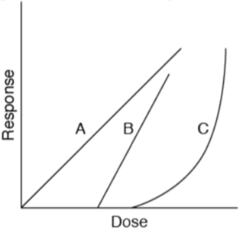
C. mAs
What technical factor relates to the amount of radiation used for an exam?
A. SID
B. kVp
C. mAs
D. OID
B. kVp
What technical factor relates to the energy of radiation used for an exam?
A. SID
B. kVp
C. mAs
D. OID
D. Anna
*BONUS*
What was Wilhelm Roentgen's wife's first name?
A. Bertha
B. Thelma
C. Irene
D. Anna
Germany
*BONUS*
In which country was Roentgen working in when he discovered x-rays?
A. 100 kVp
Which kVp would result in the lowest patient dose?
A. 100 kVp
B. 80 kVp
C. 70 kVp
D. 60 kVp
A. AP abdomen
Which one of the following procedures would most likely contribute a higher gonadal dose to a female than a male?
A. AP abdomen
B. AP knee
C. lateral hip
D. PA chest
D. 5:1
Which one of the following grids would result in the least patient dose?
A. 16:1
B. 12:1
C. 8:1
D. 5:1
D. shadow shield
Which one of the following types of gonadal shielding should be used for a patient having an examination requiring a sterile field?
A. flat contact shield
B. pseudo shield
C. shaped contact shield
D. shadow shield
B. increasing focal spot size
All of the following EXCEPT _____ will result in an increase in AEC response time.
A. decreasing kVp
B. increasing focal spot size
C. increasing part thickness
D. decreasing mA
C. 100 mGya/min
The air kerma rate should not exceed the following entrance skin exposure rate (ESE) if there is no optional high-level rate:
A. 25 mGya/min
B. 50 mGya/min
C. 100 mGya/min
D. 200 mGya/min
B. 1 and 3 only
When an individual of childbearing age undergoes a diagnostic x-ray procedure, gonadal shielding should be used to protect the reproductive organs from exposure to the useful beam:
1. when they are in or near (5 cm) of a properly collimated x-ray beam
2. when the radiographer chooses to substitute gonadal shielding for adequate collimation of the x-ray beam
3. unless shielding compromises the diagnostic value of the examination
A. 1 and 2 only
B. 1 and 3 only
C. 2 and 3 only
D. 1, 2, and 3
B. ionization chambers
Modern automatic exposure control (AEC) sensors are composed of _____.
A. scintillators
B. ionization chambers
C. autotransformers
D. collimators
B. a large dose to the whole body all at one time
Which of the following radiation situations is potentially the most harmful?
A. a small dose to a specific area over a period of time
B. a large dose to the whole body all at one time
C. a small dose to the whole body over a period of time
D. a large dose to a specific area all at once
A. air kerma (AK)
This is a SI radiation quantity that is sometimes used to express the radiation concentration delivered to a point, such as the entrance surface of a patient's body:
A. air kerma (AK)
B. automatic exposure rate dose
C. automatic brightness control
D. dose area product (DAP)
C. 3.1 mm Al
What is the minimal HVL for three-phase equipment operating at 90 kVp?
A. 1.6 mm Al
B. 2.4 mm Al
C. 3.1 mm Al
D. 4.2 mm Al
C. positive beam limitation (PBL)
Collimators that automatically restrict the beam to the size of the cassette/image receptor have a feature called automatic collimation or:
A. ionization chamber
B. phototimer
C. positive beam limitation (PBL)
D. automatic exposure control
D. aperture diaphragm
A flat piece of lead with a circle or square opening in the middle that is used to restrict the x-ray beam is called a:
A. variable aperture
B. mini-collimator
C. cone
D. aperture diaphragm
C. mGya
What is the unit of measurement for air kerma (AK)?
A. mGy/cm^2
B. R
C. mGya
D. mR
A. penetrating power of the x-ray beam
Kilovoltage (kVp) relates to the:
A. penetrating power of the x-ray beam
B. quantity of the x-ray beam
C. intensity of the x-ray beam
D. grid used for that exposure
B. no larger than the image receptor
The radiographic beam should be collimated so that it is:
A. slightly larger than the image receptor
B. no larger than the image receptor
C. twice as large as the image receptor
D. four times as large as the image receptor
D. exposure to the patient increases and spatial resolution increases
When using the magnification mode during fluoroscopy:
A. exposure to the patient decreases and spatial resolution decreases
B. exposure to the patient decreases and spatial resolution increases
C. exposure to the patient increases and spatial resolution decreases
D. exposure to the patient increases and spatial resolution increases
C. lateral hip
Which one of the following procedures would most likely contribute a higher gonadal dose to a male than a female?
A. AP abdomen
B. AP knee
C. lateral hip
D. PA chest
C. filter
Which one of the following is NOT considered to be a radiographic beam restricting device?
A. aperture diaphragm
B. collimator
C. filter
D. cylinder
B. patient skin dose
The primary function of filtration is to reduce:
A. scattered radiation
B. patient skin dose
C. operator dose
D. image quality
C. 5 minutes
A cumulative timer must be provided and used with each fluoroscopic unit. This resettable device times the x-ray beam-on time and sounds an audible alarm or temporarily interrupts the exposure after the fluoroscope has been activated for:
A. 1 minute
B. 3 minutes
C. 5 minutes
D. 10 minutes
D. ferlic
Types of gonadal shielding include all of the following EXCEPT:
A. flat contact
B. shaped contact shield
C. shadow
D. ferlic
A. kVp and mA
In fluoroscopy, automatic brightness control is used to adjust the:
A. kVp and mA
B. backup timer
C. mA and time
D. kVp and time
A. terminate the exposure in the event of equipment or operator error
A backup timer for the automatic exposure control (AEC) serves to:
A. terminate the exposure in the event of equipment or operator error
B. limit the thermal loading of the anode
C. increase inherent filtration
D. modulate tube current to reduce patient exposure
C. 6
When using an Automatic Exposure Control (AEC), regulations state that generators must terminate the exposure at 600 mAs or _____ seconds for exposures above 50 kVp.
A. 3
B. 4
C. 6
D. 8
C. 2.5 mm
What is the minimum aluminum equivalency of total filtration required for diagnostic radiographic x-ray tube operating above 70 kVp?
A. 0.5
B. 1.5
C. 2.5
D. 3.5
B. does not
When using AEC, the radiographer _____ set the time (seconds).
A. does
B. does not
B. once every second
According to 21 CFR (Code of Federal Regulations Title 21), how often shall the air kerma rate (AKR) be displayed on fluoroscopic equipment?
A. once every minute
B. once every second
C. once every 5 seconds
D. once every 5 minutes
A. automatic brightness control
This is the name of the device during fluoroscopy that adjusts exposure factors for various part/patient thickness to provide adequate brightness and contrast of the image:
A. automatic brightness control
B. automatic exposure control
C. phototimer
D. scintillator control
A. 3.0 pulses/second
With pulsed fluoroscopy, which pulse system would reduce the patient exposure the most?
A. 3.0 pulses/second
B. 5.0 pulses/second
C. 7.5 pulses/second
D. continuous
A. patient dose doubles
If mAs is doubled, what happens to patient dose?
A. patient dose doubles
B. patient dose is cut in half
C. patient dose increases by one half
D. patient dose decreases by one fourth
C. PA skull
Which one of the following positions or projections would provide the greatest radiation protection to the lens of the patient's eyes?
A. left lateral skull
B. right lateral skull
C. PA skull
D. AP skull
A. 8 x 10 inches
Which field size would lower the patient's dose the most if all technical factors remained the same?
A. 8 x 10 inches
B. 10 x 12 inches
C. 14 x 14 inches
D. 14 x 17 inches
C. 12 mAs, 75 kVp, 16:1 grid
Which of the exposure factors listed above will produce the highest patient dose?
A. 5 mAs, 80 kVp, 12:1 grid
B. 8 mAs, 80 kVp, 12:1 grid
C. 12 mAs, 75 kVp, 16:1 grid
D. 8 mAs, 70 kVp, 8:1 grid
B. smallest pulse width
To reduce patient exposure during pulse mode fluoroscopy, the _____ should be chosen.
A. widest pulse width
B. smallest pulse width
A. a double dose of radiation to the patient
A repeat radiograph results in:
A. a double dose of radiation to the patient
B. no additional exposure for the patient
C. ten times more exposure for the patient
D. less radiation exposure to the patient
B. a shadow shield is not suitable for use
During a fluoroscopic examination, because no localizing light field exists and the field of view is usually moving:
A. a flat contact shield is not suitable for use
B. a shadow shield is not suitable for use
C. a shaped contact shield is not suitable for use
D. a shield that provides any type of gonadal protection is not suitable for use
B. posterioranterior (PA)
A 10-year-old girl comes to the radiology department for scoliosis evaluation. To provide the highest degree of radiation protection for developing breast tissue, which of the following projections should the technologist use?
A. anteroposterior (AP)
B. posterioranterior (PA)
C. left anterior oblique (LAO)
D. right posterior oblique (RPO)
B. 95%
Gonadal shielding may reduce male gonad dose by up to:
A. 50%
B. 95%
C. 25%
D. 10%
A. low energy, long wavelengths
The function of a filter is to remove which of the following from the x-ray beam to help lower patient dose?
A. low energy, long wavelengths
B. high energy, short wavelengths
C. low energy, short wavelengths
D. high energy, long wavelengths
B. 10
Overall, children are up to _____ times more radiosensitive than adults.
A. 5
B. 10
C. 15
D. 20
A. increased exposure in the lung area
When using AEC with digital imaging systems, assuming all other factors are correct, selecting only the center chamber on a PA chest results in:
A. increased exposure in the lung area
B. decreased exposure in the lung area
C. appropriate exposure in the lung area
D. increased quantum noise in the image
A. up to 50%
How much may female gonadal dose be reduced by using proper shielding?
A. up to 50%
B. up to 75%
C. up to 85%
D. up to 95%
B. abdomen
Which of the following radiologic examinations would deliver the greatest entrance skin exposure (ESE)?
A. femur
B. abdomen
C. skull
D. thoracic spine
B. S number or exposure indicator
With digital imaging, what provides the technologist with an indication of the accuracy of his/her exposure setting for that given image?
A. mAs
B. S number or exposure indicator
C. look-up table
D. rescaling
D. as low as reasonably achievable
ALARA is an acronym for:
A. as long as reasonably achievable
B. as little as reasonably achievable
C. as long as radiologist allows
D. as low as reasonably achievable
B. quantity of the x-ray beam
The intensity of the x-ray beam relates to:
A. quality of the x-ray beam
B. quantity of the x-ray beam
C. both the quantity and quality of the x-ray beam
C. 2 and 3 only
A primary protective barrier of 2 mm lead equivalent is required for a fluoroscopic unit. Which of the following are considered a primary protective barrier during fluoroscopy?
1. Patient
2. Image intensifier
3. Flat-panel detector
4. Table-top
A. 1 only
B. 4 only
C. 2 and 3 only
D. 2 and 4 only
D. half-value layer
The thickness of material used to reduce the radiation intensity to one half its original value is the:
A. attenuation factor
B. tenth-value layer
C. barrier factor
D. half-value layer
B. increase
When using the Automatic brightness control (ABC) during fluoroscopy, as patient thickness increases, patient exposure (dose) would:
A. decrease
B. increase
C. have no effect
C. Gy/cm^2
What is the unit of measurement for dose area product (DAP)?
A. mGy
B. mrem
C. Gy/cm^2
D. R/min
D. collimator
A variable aperture is also known as a:
A. filter
B. cone
C. compensating filter
D. collimator
B. 1 and 2 only
The advantage(s) of beam restriction (collimation) include which of the following?
1. less scattered radiation is produced
2. less biologic tissue is irradiated
3. less total filtration will be necessary
A. 1 only
B. 1 and 2 only
C. 2 and 3 only
D. 1, 2, and 3
C. time (seconds)
The AEC controls which of the following exposure variables?
A. kVp
B. focal spot size
C. time (seconds)
D. mA
B. be the "dead-man"/pressure type
To be in compliance with radiation safety standards, the fluoroscopy exposure switch must:
A. sound during fluoro-on time
B. be the "dead-man"/pressure type
C. terminate the exposure after 10 minutes
D. be on a 6-foot cord
B. Image intensifier above the patient, further away from their chest & X-ray tube underneath the patient closer to their back
Which would result in the highest patient dose?
A. Image intensifier above the patient, closer to their chest & X-ray tube underneath the patient further away from their back
B. Image intensifier above the patient, further away from their chest & X-ray tube underneath the patient closer to their back
C. both would produce the same patient exposure
*for this question (57) and question 60 of the unit 4 test, there are pictures to go along with it. for this Quizlet, I couldn't find said pictures
B. 38 cm (15 inches) - 30 cm (12 inches)
In accordance with the National COuncil on Radiation Protection & Measurement (NCRP) regulations, the source-to-skin distance (SSD) must be no less than _____ for stationary (fixed) fluoroscopes and no less than _____ for mobile/C-Arm fluoroscopes:
A. 30 cm (12 inches) - 38 cm (15 inches)
B. 38 cm (15 inches) - 30 cm (12 inches)
C. 40 cm (16 inches) - 50 cm (20 inches)
D. 50 cm (20 inches) - 40 cm (16 inches)
B. 1.5 mm Al, 75 mGy/min exposure rate
*BONUS*
Given the following data, what is the half-value layer (HVL) of an x-ray beam whose initial value is 150 mGy/min?
A. 0.5 mm Al, 122 mGy/min exposure rate
B. 1.5 mm Al, 75 mGy/min exposure rate
C. 1.0 mm Al, 97 mGy/min exposure rate
D. 2.0 mm Al, 60 mGy/min exposure rate
A. 126 mGy
*BONUS*
Which of the following is the approximate dose for 2 min of fluoroscopy at 3 mA and 80 kV?
A. 126 mGy
B. 63 mGy
C. 6 mGy
D. 12 mGy
Electromagnetic
*BONUS*
Which spectrum do x-rays belong to?
C. Distance
*BONUS*
All of the following are used to calculate cumulative air kerma EXCEPT:
A. mA
B. Exposure time
C. Distance
D. kVp