3.1.3 Lipids
 Call Kai
 Learn
 Practice Test
 Spaced Repetition
 Match
 Flashcards
 Knowt Play
1/13

There's no tags or description
Looks like no tags are added yet.
14 Terms
2 groups of lipids
Triglyceride
Phospholipids
Properties of lipids
contain carbon, hydrogen, oxygen (like carbohydrates) but proportion of oxygen is smaller
soluble in organic solvents
waxy, oily consistancy
made of fatty acids and glycerol
Glycerol structure

Saturated fatty acid structure
Solid at room temperature due to closely packed molecules.
Animal fats e.g. butter, lard

Unsaturated fatty acid structure
The ‘kink‘ shows unsaturated fatty acids are more flexible with a double bond, so are liquid at room temperature as the phospholipids can not pack tightly together.
Plant fats e.g. sunflower or olive oil

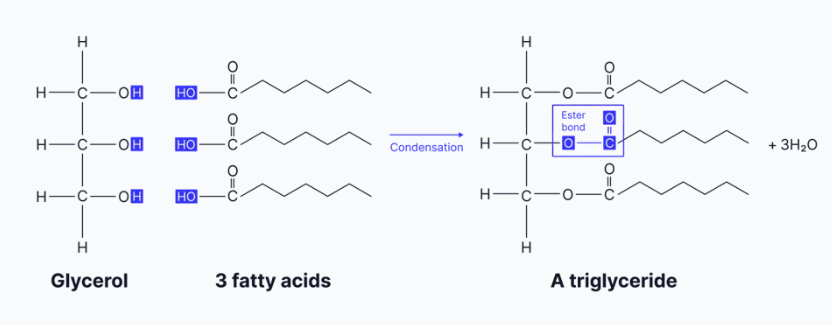
How triglyceride are formed
Via condensation reactions between one molecule of glycerol and three molecules of fatty acid (RCOOH). The R group can be saturated or unsaturated.
Ester bonds are formed.
Triglyceride structure
Properties of triglycerides
STORES ENERGY - large ratio of energy-storing carbon-hydrogen bonds compared to the number of carbon atoms
METABOLIC WATER SOURCE so can release water if they are oxidised - due to the high ratio of hydrogen to oxygen atoms
DO NOT AFFECT WATER POTENTIALS AND OSMOSIS - as they care large and hydrophobic so insoluble in water
Relatively low mass so a lot can be stored without increasing mass and preventing movement
INSULATION - electrical: around nerve cells, thermal: in mammals
BUOYANCY - triglycerides are less dense than water helping aquatic mammals e.g. seals float
Phospholipids structure
One of the fatty acids of a triglyceride is substituted by a phosphate-containing group
Made of a glycerol molecule, two fatty acid chains and a phosphate group (attached to glycerol)

How phospholipids are made
Two fatty acids bond to glycerol via two condensation reactions which form two ester bonds
Hydrophilic ‘head‘ of the phospholipid
Can interact with water as it is charged (polar) and repels other lipids
Hydrophobic ‘tail‘ of phospholipid
Repels water as the fatty acid chain is uncharged (non-polar) but still interacts with lipids
Phospholipid bilayers
In an aqueous environment, phospholipids arrange themselves into a bilayer:
Hydrophlic heads face outwards, towards where the water is
Hydrophobic tails face inwards so they are away from the water
This is the structure of the plasma membrane and it ensures the membrane is selectively permeable so the cell can control its internal environment

The emulsion test for lipids
Label the test tubes relative to what food you will test in each
Chop solid food on a tile or grind with a pestle and mortar
Add the food to their assigned test tube to a depth of roughly 1cm
Add 3cm³ of ethanol to each test tube
Put a clean bung on each test tube and shake at least 10 times about 30cm to help any lipids in the food dissolve into the ethanol
Let the food particles settle so the ethanol above the food is cleared
Dispense about 3cm deep of distilled water using a wash bottle into each test tube
Observe any changes to the tube contents
Lipids are present if a white emulsion floats/is near the top or the solution
Lipids are absent or levels are below the sensitivity of the test is no white emulstion forms