Exam 3
 Call Kai
 Learn
 Practice Test
 Spaced Repetition
 Match
 Flashcards
 Knowt Play
1/715

There's no tags or description
Looks like no tags are added yet.
716 Terms
Tablets are solid dosage forms (SDF) prepared by _____ and contain medicinal substances with suitable pharmaceutical ingredients or excipients
compression or by molding
How are tablets administered?
mostly oral, but also sublingually or buccally
Some tablets are scored, which allows them to be ____ broken into two or more parts
easily
Modern tablets were first introduced in ___
1843, England
Unscored tablets should not be ____ without the assurance that it will not cause undesired effects
broken
Modified release
Dosage forms that alter the timing and/or the rate of release of the
drug substance (Includes ER, DR)
Immediate release
Drug typically released immediately after administration.
Extended release (ER):
Dosage forms that allow at least 2-fold reduction in dosing frequency as compared to when the drug is present in an immediate-release dosage form.
Delayed release (DR)
Dosage forms that release the drugs at a time later than
immediately after administration.
Controlled release
release the drug at a predictable rate
Which of the following is a characteristic feature of enteric coated tablets?
tablets are film coated
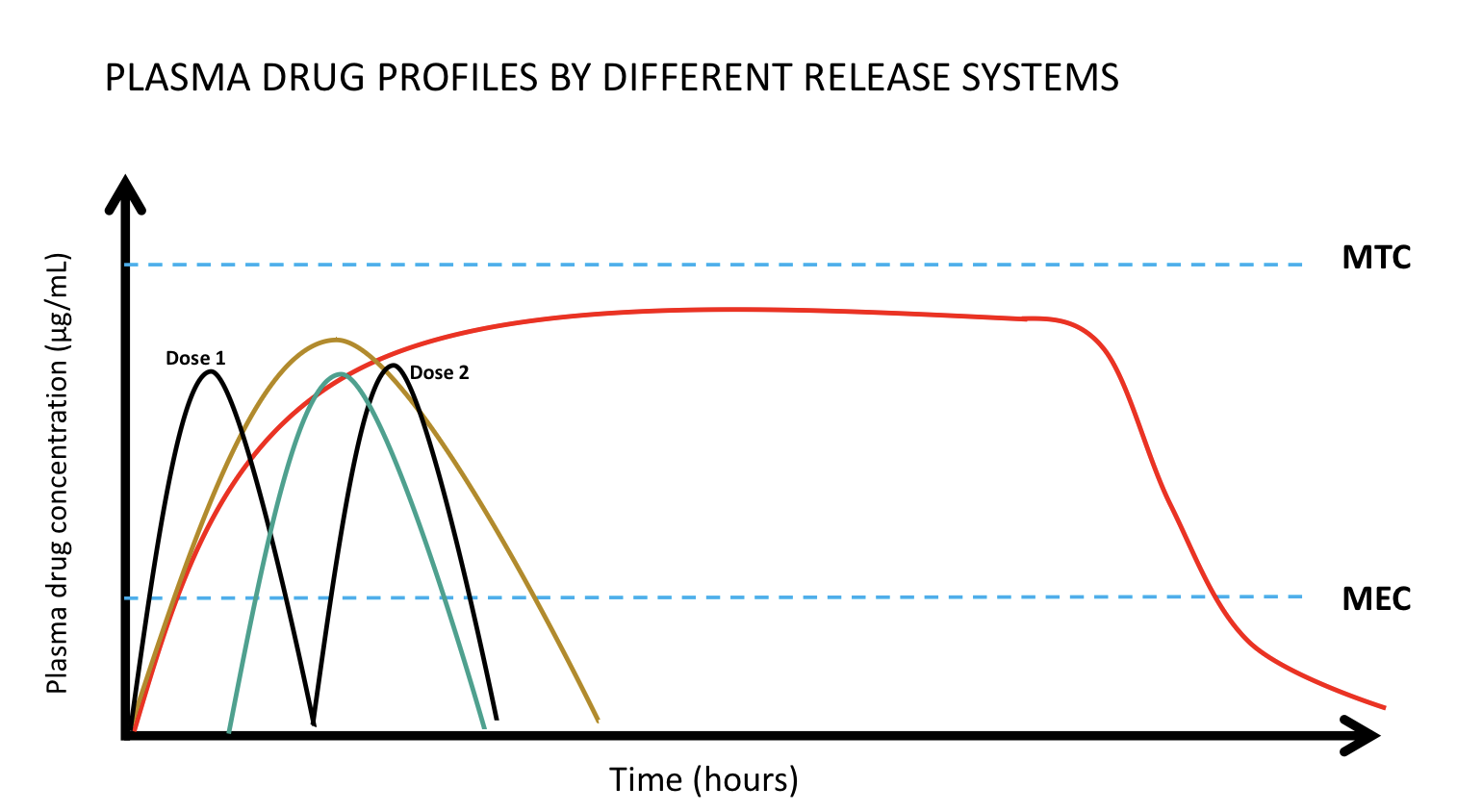
What type of tablet does the green line represent?
Delayed

What type of tablet does the yellow line represent?
Extended

What type of tablet does the black line represent?
Conventional

What type of tablet does the red line represent?
Controlled
Which is not as strong? Buccal or Sublingual
Sublingual
Which of the following does not require a disintegrate?
Chewable tablets
Which of the following is a characteristic feature of buccal tablets?
disintegrate slowly in mouth
Which disintegrates faster, tablets or powders/granules?
powders/granules due to larger surface area
chewable tablets are an example of ____
immediate release
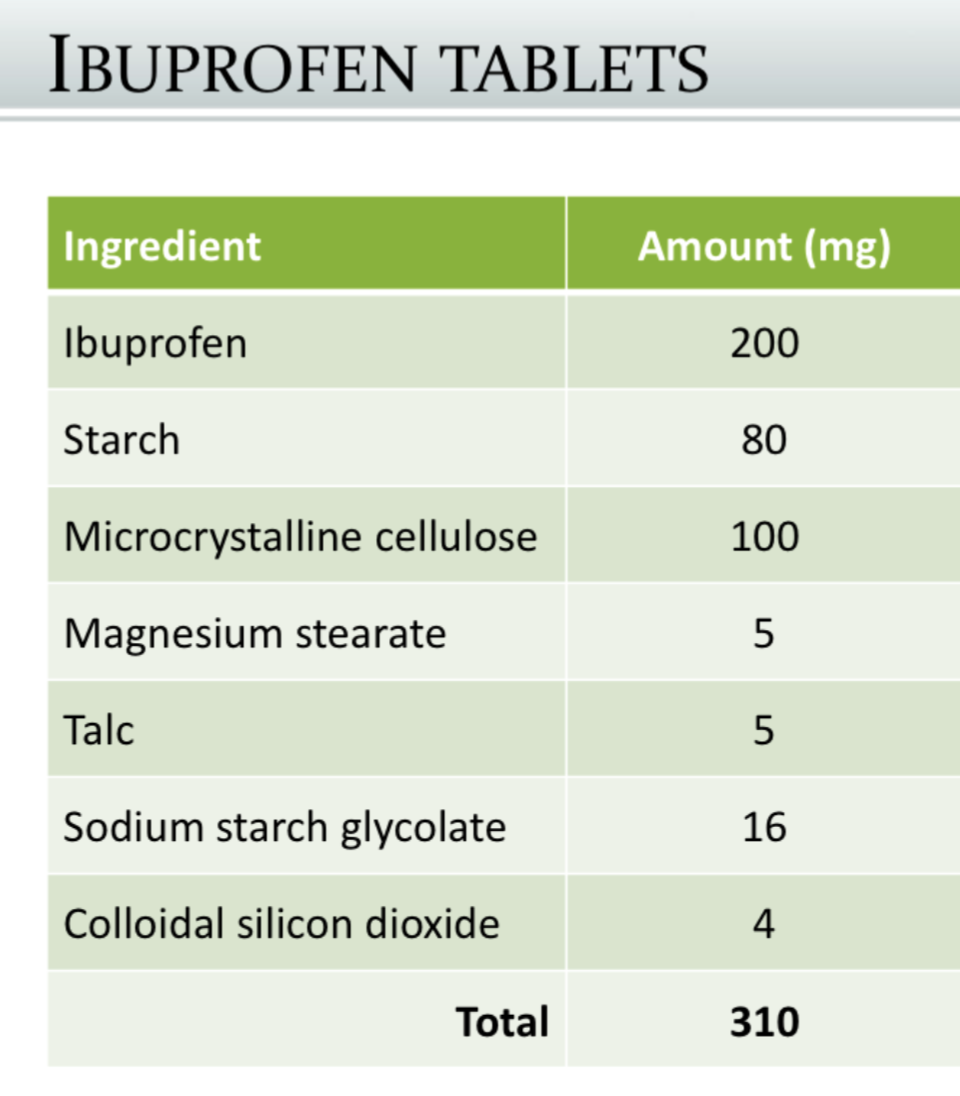
What is the primary role of starch in ibuprofen tablets?
binder

What is the primary role of microcrystalline cellulose in ibuprofen tablets?
filler

What is the primary role of starch in ibuprofen capsules?
filler/diluent

What is the role of microcrystalline in aspirin tablets?
diluent, filler, bulking agent

What is the role of methyl cellulose in aspirin tablets?
binder

What is the role of starch in aspirin tablets?
disintegrant

What is the role of magnesium stearate in aspirin tablets?
lubricant
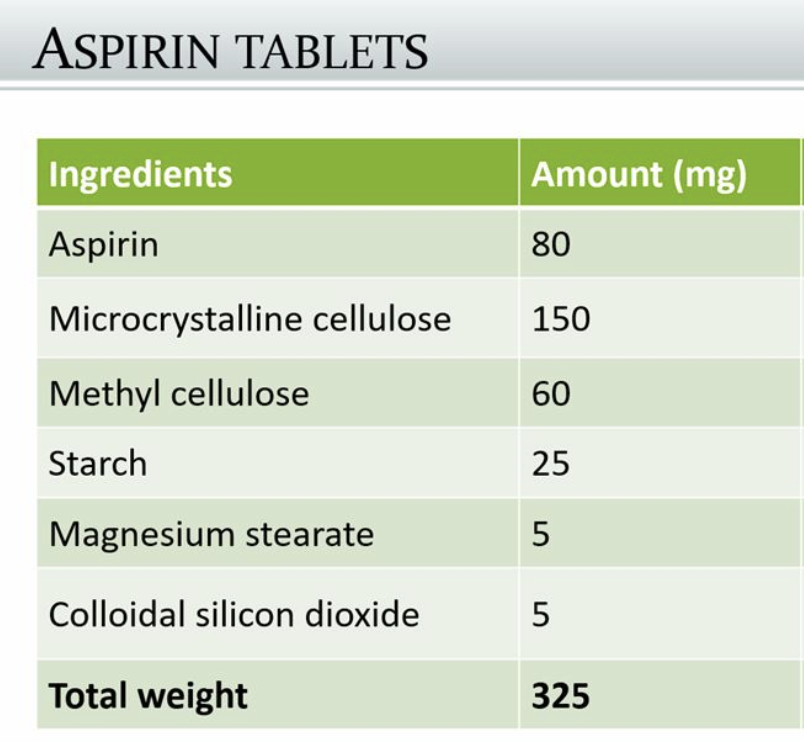
What is the role of colloidal silicon dioxide in aspirin tablets?
anti adherent

What is the role of aspirin dioxide in aspirin tablets?
drug
What are tablets?
Solid dosage forms prepared by compression or molding that contain medicinal substances and suitable pharmaceutical ingredients (excipients).
What are the two methods used to prepare tablets?
A. Compression and molding.
B. Dissolution and filtration.
C. Encapsulation and coating.
D. Grinding and distillation.
A
What is the most common route of administration for tablets?
oral
Besides oral administration, what are two other routes of administration for tablets?
A. Sublingual and buccal.
B. Intravenous and intramuscular.
C. Topical and transdermal.
D. Inhalation and nasal.
A
What does it mean when a tablet is scored?
It has a line or marking that allows it to be easily broken into two or more parts.
Should unscored tablets be broken in half?
Not unless it has been confirmed that splitting the tablet will not cause unwanted effects.
What is the main difference between scored and unscored tablets?
Scored tablets have markings to help with splitting, while unscored tablets should not be split without confirming it is safe.
Why are tablets a popular dosage form?
The oral route is generally safe, convenient, and easy to administer.
How does the chemical and physical stability of tablets compare with liquid dosage forms?
Tablets generally have better chemical and physical stability than liquid dosage forms.
Why can tablets improve patient compliance?
They are convenient to handle and easy to take.
What are the different release patterns available for tablets?
A. Immediate, delayed, and controlled release.
B. Rapid, injectable, and topical release.
C. Oral, intravenous, and intramuscular release.
D. Liquid, powder, and gas release.
A
What are two advantages of tablets regarding dosing?
They provide accurate dosing and are available in different dosage strengths.
How does the cost of tablets generally compare with capsules?
Tablets are generally less expensive than capsules.
How can tablets mask the bitter taste of medications?
By using a coating that covers the unpleasant taste.
What are two advantages of tablets related to identification and splitting?
They can be easily identified and may be scored for easier splitting.
Which of the following are advantages of tablets?
A. Better stability than liquid dosage forms.
B. Accurate dosing and variable strengths.
C. Multiple drug-release patterns and convenient handling.
D. All of the above.
D
Why can some powders and granules be a disadvantage when manufacturing tablets?
They are not always compressible, meaning they may not form tablets properly.
Can tablets generally be prepared extemporaneously?
No. Tablets generally cannot be prepared extemporaneously (prepared on demand for an individual patient).
What is a swallowing disadvantage of tablets?
Large tablets can be difficult for patients to swallow.
Why can poorly water-soluble drugs have bioavailability problems when made into tablets?
They may not dissolve well, making it harder for the body to absorb the medication.
Why can certain drugs be problematic when formulated as tablets?
Drugs that cause local irritation or other harmful effects to the GI mucosa can damage or irritate the gastrointestinal lining.
Why are unscored tablets a disadvantage when adjusting medication doses?
They are difficult to split accurately, making dose adjustments harder.
Which of the following are disadvantages of tablets?
A. Some powders and granules cannot be compressed easily.
B. Large tablets may be difficult to swallow.
C. Poorly water-soluble drugs may have bioavailability problems.
D. All of the above.
D
What are the five tablet classifications based on drug release?
A. Immediate release, extended release, delayed release, modified release, and controlled release.
B. Rapid release, slow release, oral release, delayed release, and liquid release.
C. Immediate release, topical release, sustained release, injectable release, and controlled release.
A
What are immediate-release (IR) tablets?
Tablets that typically release the drug immediately after administration.
What are extended-release (ER) tablets?
tablets designed to release medication over an extended period, allowing at least a 2-fold reduction in dosing frequency compared with immediate-release forms.
What does a 2-fold reduction in dosing frequency mean for extended-release tablets?
The medication can be taken at least half as often as the immediate-release version.
What are delayed-release (DR) tablets?
Tablets that release the drug at a later time rather than immediately after administration.
What are modified-release tablets?
Tablets designed to change the timing and/or rate at which the drug is released.
Which two types of release are included under modified-release tablets?
A. Extended release and delayed release.
B. Immediate release and controlled release.
C. Immediate release and delayed release.
D. Controlled release and immediate release.
A
What are controlled-release tablets?
Tablets designed to release the drug at a predictable rate.
What is the main difference between immediate-release and delayed-release tablets?
Immediate-release tablets release the drug right away, while delayed-release tablets release it at a later time.
What is the main difference between extended-release and controlled-release tablets?
Extended-release tablets reduce how often a medication needs to be taken, while controlled-release tablets release medication at a predictable rate.
How are compressed tablets prepared?
By applying a single compression to a formulation containing the drug and appropriate tablet excipients.
What are common excipients used in compressed tablets?
A. Diluents, binders, disintegrants, and lubricants.
B. Preservatives, antibiotics, and hormones.
C. Gelatin, glycerin, and sorbitol.
D. Oils, solvents, and alcohols.
A
Can compressed tablets be coated or uncoated?
Yes. They can be either coated or uncoated.
What are the possible colors and layers of compressed tablets?
They can be colored or uncolored and may have one, two, or three layers.
What shapes and sizes are available for compressed tablets?
They are available in different shapes and sizes.
What are two examples of compressed tablets?
Tylenol® and aspirin
How are multiple compressed tablets prepared?
By applying more than one compression. They may contain multiple layers.
Can each layer of a multiple compressed tablet contain a different drug?
Yes. Each layer may contain a different drug.
What are the purposes of multiple compressed tablets?
A. To separate physically or chemically incompatible ingredients.
B. To allow drugs to be released in stages.
C. To create a unique appearance.
D. All of the above.
D
How can multiple compressed tablets help with physical or chemical incompatibility?
They can separate incompatible ingredients into different layers.
How can multiple compressed tablets control drug release?
Different layers can release their drugs in stages.
What is an example of a multiple compressed tablet?
Norgesic®
What are the three active ingredients in Norgesic® tablets listed in the notes?
A. Orphenadrine, aspirin, and caffeine.
B. Acetaminophen, codeine, and caffeine.
C. Orphenadrine, ibuprofen, and aspirin.
D. Aspirin, acetaminophen, and caffeine.
A
What are sugar-coated tablets?
Compressed tablets covered with a sugar coating that may be colored or uncolored
What type of coating is used on sugar-coated tablets?
A water-soluble coating
How quickly does the sugar coating on these tablets dissolve?
It dissolves quickly
What are examples of sugar-coated tablets?
Tofranil®, Sudafed®, and Ex-Lax®.
Which statement about sugar-coated tablets is correct?
A. They have a colored or uncolored sugar coating.
B. Their coating is water-soluble and dissolves quickly.
C. They are made by coating already compressed tablets.
D. All of the above.
D
How does sugar coating protect medications?
It protects the drug from environmental factors such as air, moisture, and light.
How does sugar coating improve the taste and smell of medications?
It creates a barrier that masks unpleasant tastes and odors.
How does sugar coating improve tablet appearance?
It enhances the product's appearance and makes it more attractive.
Can sugar-coated tablets have identifying markings?
Yes. Imprinting is possible.
What are the advantages of sugar coating?
A. Protects against air, moisture, and light.
B. Masks unpleasant taste and odor.
C. Improves appearance and allows imprinting.
D. All of the above.
D
By how much can sugar coating increase a tablet's size, weight, and shipping cost?
up to 50%
Why can sugar coating increase manufacturing costs?
The manufacturing process is time-consuming and requires specialized expertise.
Why may sugar-coated tablets not be appropriate for diabetic patients?
The sugar coating contains sugar, which may be a concern for diabetic patients.
What are the disadvantages of sugar coating?
A. Increases tablet size, weight, and shipping costs.
B. Requires a time-consuming manufacturing process.
C. Requires specialized expertise and may not be appropriate for diabetic patients.
D. All of the above.
D
What are film-coated tablets?
Compressed tablets covered with a thin polymer coating
What types of polymers can be used in film coatings?
Water-soluble or water-insoluble polymers
What is the purpose of the polymer coating on film-coated tablets?
It is designed to rupture or dissolve in the gastrointestinal tract (GIT) as needed.
Are film-coated tablets generally colored or uncolored?
Generally colored.
What advantages do film-coated tablets have over uncoated tablets?
They have all the advantages of sugar-coated tablets, plus additional advantages.
How does the durability and size of film-coated tablets compare with sugar-coated tablets?
Film-coated tablets are more durable and less bulky.
How does the manufacturing process of film-coated tablets compare with sugar-coated tablets?
Film coating is less time-consuming and less expensive.
What is a functional film coating?
A coating that alters the drug's dissolution profile (how and when the drug dissolves).
What is a non-functional film coating?
A coating that does not alter the drug's dissolution profile.
What is the main difference between functional and non-functional film coatings?
Functional coatings change the drug's dissolution profile, while non-functional coatings do not.
Which statement correctly describes film-coated tablets?
A. They have a thin polymer coating.
B. They are generally colored.
C. They are more durable and less bulky than sugar-coated tablets.
D. All of the above.
D