Organic chemistry (unfinished)
 Call Kai
 Learn
 Practice Test
 Spaced Repetition
 Match
 Flashcards
 Knowt Play
1/49

Earn XP
Description and Tags
just whatever I can put down
50 Terms
Sn1 reaction
two step reaction via carbocation intermediate
Sn2 reaction
a concerted, single-step reaction where bond breaking and bond forming happen at the same time
which one is tertiary structures the best in?
Sn1
which one is methyl structures the best in?
Sn2
which one is best with weak nucleophiles?
Sn1
which one is best with strong nucleophiles?
Sn2
which one is best with polar protic solvents?
Sn1
which one is best with polar aprotic solvents?
Sn2
Which one involves a leaving group in the first step with a weak nucleophile attacking a flat carbocation?
Sn1
which one involves a nucleophile attacking an electrophilic carbon?
Sn2
an alkene reacts with a mercury salt in water and the pi bond attacks the mercury species to form 3 mercurinium ion intermediates
oxymercuration
treating the organomercury intermediate with NaBH4 replaces the mercury group with a hydrogen atom
demercuration
why is regioselectivity important?
the -OH group attaches to the more substituted carbon
what is the “major product”?
the nucleophile attacks the more stable/substituted carbocation
antimarkovnikov addition
the electronegative or -OH group ends up on the less substituted carbon
protonation
the carbonyl oxygen takes proton from H3O, making the carbonyl carbon more electrophilic
nucleophilic attack
a water molecular attacks the carbonyl carbons to form a tetrahedral intermediate
proton transfer
protons shift so the alkoxy group becomes protonated into a good leaving group
deprotonation
the carbonyl double bond reforms, expelling the alcohol, and water removes a proton to yield the carboxylic acid while regenerating the H3O catalyst
Acid-catalyzed ester hydrolysis is reversible. True or False?
True
Acid catalyzed hydrolysis
a chemical reaction in which water cleaves a covalent bond using a catalytic amount of acid to lower the activation energy
when an ester is converted into carboxylic acids and alcohols, or breaks amides and peptide bonds into carboxylic and amines is called what?
Acid catalyzed hydrolysis
regioselectivity
the study of where a chemical reaction occurs within a molecule and which constitutional isomer forms when multiple bond-forming or bond-breaking sites are possible
markovnikov’s rule
predicts which regioisomer forms as the major product when a polar reagent adds across an unsymmetrical alkene or alkyne
“hydrogen atom attaches to the double-bonded carbon that already has more hydrogen atoms, while the electronegative group attaches to the more substituted carbon” describes what concept?
markovnikov
add the proton to the carbon with more hydrogen leaves the positive charge on the ______ substituted carbon
more
(tertiary > secondary > primary)
more substituted pattern
hydrohalogenation
hydrogen halide adds across a carbon-carbon double bond or triple bond to form a haloalkane
protonation
the nucleophilic pi bond of the alkene attacks the electrophilic hydrogen of HX. H-X bond breaks, forming a halide ion and a carbocation intermediate on the more substituted carbon
carbocation rearrangement
a carbocation or 1,2-alkyl shift to reach a more stable position
what is Sn2 rxns effect on stereochemistry?
inversion
Sn2 is a __________ attack
backside

what is this an example of?
Sn2
Sn2 is a ________ rxn
fast

which one is the leaving group?
Br
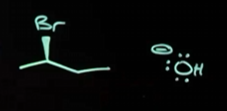
which one is the nucleophile?
OH
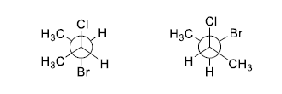
what is the relationship between the following compound?
enantiomers

The following structure possesses a carbonyl functional group with pro-chiral ‘faces’, and a prochiral centre (bonded to IIa and IIb). Which of the following statements is true?
Ha is the pro-R hydrogen and the structure is being viewed from the Re-face
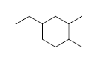
what is the IUPAC name for the following compound?
4-ethyl-1,2-dimethylcyclohexane
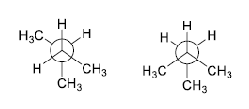
what is the relationship between the following structures?
conformers
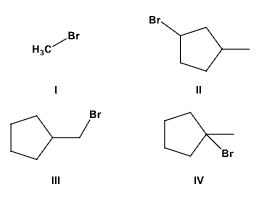
Arrange the following alkyl bromides in order of decreasing reactivity (most → least reactive) in an Sn2 rxn.
I (most) > III > II > IV (least)

arrange the following alkyl bromides in order of decreasing reactivity (most → least reactive) in an Sn1 rxn.
III (most) > II > I (least)
which one is NOT aweak nucleophile?
HO-

this is an example of…
loss of LG
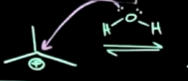
this is an example of…..
Nucleophilic attack

this is an example of….
deprotonation