Agronomy Unit 2
 Call Kai
 Learn
 Practice Test
 Spaced Repetition
 Match
 Flashcards
 Knowt Play
1/175

There's no tags or description
Looks like no tags are added yet.
176 Terms
What are macronutrients? (Not the elements)
Carbs, proteins, lipids, and water
What are micronutrients?
vitamins and minerals
How are ingredients listed on a food label?
In descending order
What does a food label have to provide?
info on nutritional facts/ % of daily value
What is under-nutrition?
occurs when there’s an insufficient number of calories to maintain daily energy requirements
What is malnutrition?
occurs when one or more essential nutrients are lacking (even though caloric intake may be sufficient) such as protein
How many amino acids are needed to construct all proteins?
20
What are essential amino acids?
amino acids that must be obtained from the diet
What are the essential amino acids?
Histidine, isoleucine, leucine, lysine, methionine, phenylalanine, threonine, trytophan, valine
What are the nonessential amino acids?
Alanine, asparagine, aspartic acid, arginine, cystine, glutamine, glutamic acid, glycine, proline, serine, tryosine
What are proteins?
a long chain of amino acids linked together
What do proteins do?
Structural (used to build, maintain, and replace muscles and tissues), enzymes, defense (component of antibodies that provide immunity against disease), and hormones (regulate metabolic activity)
What is the best source of protein?
Eggs
Can plants provide enough protein?
Yes, but there needs to be a variety of them to make sure that you get all the needed amino acids
What are the problems with meeting the world’s food needs?
Even if there’s enough quantity, it might not be quality and distribution is a problem (70% of the people live where only 25% of the world’s grain is produced and food flows in the direction of economic demand without consideration of need)
What does the body do with whole grains?
Digests them more slowly and don’t cause the sharp rise in blood sugar that occurs with the digestion of processed grains
What are the 3 parts of a seed?
endosperm, bran, and germ
What is the endosperm?
The energy source for germinating seed. It’s milled into white flour and takes up 84% of the kernel
What is the bran?
The seed coat. Whole wheat flour includes it, it’s an excellent source of fiber, may be white or red, and most of the protein is there. Is 14% of the kernel
What is the germ?
The plant embryo. Contains fats that limit the shelf life of flour and is about 2% of the kernel
How much income is spent on food in the US?
10.9% of income
How much fats and oils are consumed in the US?
39.6 kg or 87 lbs
How many essential nutrients do plants need?
17
What are the macronutrients?
Carbon (C), nitrogen (N), calcium (Ca), hydrogen (H), phosphorus (P), magnesium (Mg), oxygen (O), Potassium (K), and sulfur (S)
What are the micronutrients?
Iron (Fe), zinc (Zn), molybednum (Mo), manganese (Mn), copper (Cu), nickel (Ni), boron (B), chlorine (Cl)
What are some important compunds?
Carns, proteins, lipids, water, and nucleic acids
What are carbs made of?
C-H-O, it’s a 1:2:1 ratio, and account for 60-95% dry weight in plants
Why are carbs an important source of energy?
They’re sugars and starches
What are the 3 types of sugars?
monosaccharides, disaccharides, and polysaccharides
What are monosaccharides?
1 sugar, simple sugar, ex glucose (C6 H12 O6), fructose, xylose, galactose, ribose, etc.
What are disaccharides?
2 simple sugars bonded together. Ex sucrose, maltose, and lactose
What 2 sugars make sucrose?
glucose and fructose
What are polysaccharides?
Many sugar molecules bonded together and ex, starch, cellulose, insulin, and hemicellulose
What are the polymers of glucose?
starch (a storage form) and cellulose (a structural form)
What are the polymers of fructose? What are mixed polymers?
Inulin-fructose. Hemicellulose-mixed
How is sucrose made?
Through a dehydration reaction; glucose and fructose lose a water molecule to join together

What is this?
glucose
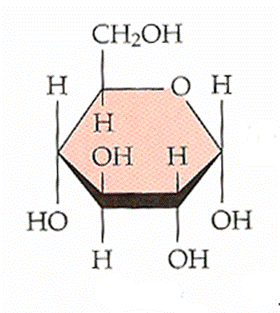
What is this?
glucose

What is this?
starch

What is this?
cellulose
What is unbranched starch?
amylose
What is branched starch?
amylopectin

What is this?
amylose

What is this?
amylose

What is this?
amylopectin

What is this?
amylopectin

What does this diagram represent?
cellulose
What animals can digest cellulose fibers?
Ruminant (cattle, sheep, goats, and deer) and functional cecum (horses and rabbits)
What typically supplies essential amino acids?
Meat and dairy products
What can also supply amino acids?
A combination of cereals (wheat, corn, rice, etc.) and legumes (beans, peas, etc.)
What are the benefits of animal products?
better distribution of essential amino acids than single plant sources and are more digestible than plant products
Where can cellulose be found?
grass, hay, silage, and crop residues
What can animals do? What do they suck at?
Ruminant animals can digest cellulose and convert into high protein food, animals can eat food unfit for human consumption. They’re terrible at converting feed into meat
What are vitamins?
small organic compounds that are important in regulating metabolism
What are the 2 types of vitamins?
Fat soluble and water soluble
What are the fat soluble vitamins?
A, D, E, and K
What are the water soluble vitamins?
C and B-complex
How many vitamins are required in the human diet?
13
What are lipids?
a group of organic compounds that are insoluble in water
What about lipids and energy?
over 2X more energy than carbs, concentrated, and animals use them as the primary form of energy storage
What are the 2 types of lipids and what are some ex?
Simple (fats and oils) and complex (phospholipids and steroid lipids-cholesterol)
Additional notes about cholesterol:
meat, eggs, butter, and cheese high in cholesterol, the body synthesizes cholestrol, and HDL is good and LDL is bad
What is solid at room temp? What is liquid at room temp?
Fats are solid, oils are liquid
What are fats and oils?
trigylcerides
What forms trigylcerides?
a glycerol and 3 fatty acids
What are the 3 types of fatty acids?
saturated, monounsaturated, and polyunsaturated

What is this?
saturated fatty acid

What is this?
monounsaturated fatty acid

What is this?
polyunsaturated fatty acid
Exs of saturated fatty acids
coconut oil, butter, cream, palm oil, and lard
Exs of monounsaturated fatty acids
olive oil, almonds, peanut oil, peanuts, canola oil
Exs of polyunsaturated fatty acid
soybean oil, corn oil, sunflower oil, safflower oil

What is this?
triglyceride tails
What are omega-3 fatty acids?
a type of polyunsaturated fat especially beneficial to your heart. The human body can not synthesize Omega-3 fatty acids (must be obtained from food). ex: fish such as salmon, tuna, and sardines, flax seed, and walnuts
What are trans fatty acids?
unsaturated fatty acids whose structure has been altered. made by partial hydrogenation (flatten the kink on tail). Found in some margarines and shortening
What is the difference between vitamins and minerals?
Minerals are elements
What makes up the bulk of organisms?
C, H, O, and N
How many essential mineral elements are needed?
17-21
What are the macro minerals?
C, H, O, N, calcium, phosphorus, sulfur, potassium, sodium, and magnesium
What are the micro minerals?
Iron, zinc, copper, manganese, nickel, boron, chlorine, and molybdenum
What is transpiration?
the evaporative loss of water from plant leaves
Where does water intake occur?
Primarily at the root tips, usually the top layer of soil (40%)
What are genes expressed as?
proteins
What are the 3 parts of a nucleotide?
phosphate group, pentose sugar, and nitrogenous base
What are the purines?
Guanine and adenine
What are the pyrimidines?
Cytosine, thymine, and uracil
What is anatomy?
The study of the internal tissues and cells of plants
What is morphology?
The study of external structure and form of plants
Are monocots herbaceous or woody?
usually herbaceous
Are dicots herbaceous or woody?
both
How many cotyledons do monocots and dicots have?
Monocots-1 dicots-2
What type of emergence do monocots have?
hypogeal
What type of emergence do dicots have?
usually epigeal
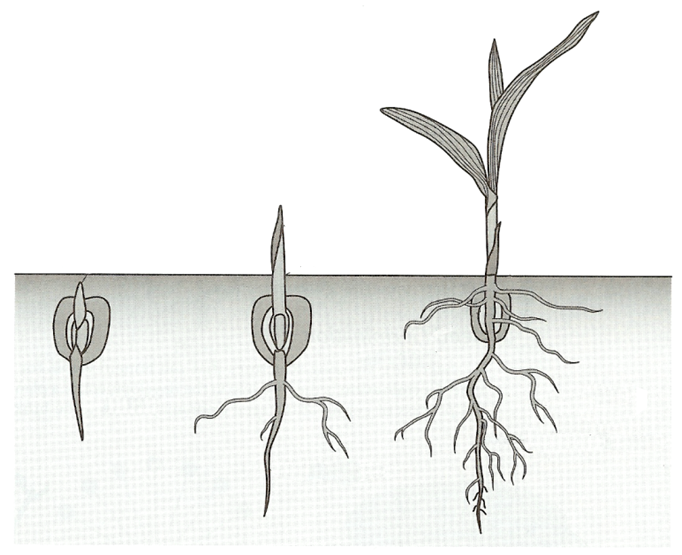
What type of emergence is this?
hypogeal

What type of emergence is this?
epigeal
What are the 5 plant tissues?
Epidermis, xylem, phloem, ground tissue, and meristems
What is the epidermis?
the outer, protective cell layer on stem and leaves. covered with a waxy cuticle to minimize water loss and protection from pests
What is a stomata?
an opening/pore on the surface of the leaf surrounded by a pair of guard cells that serve as a door for CO2 and O2 to exit/enter
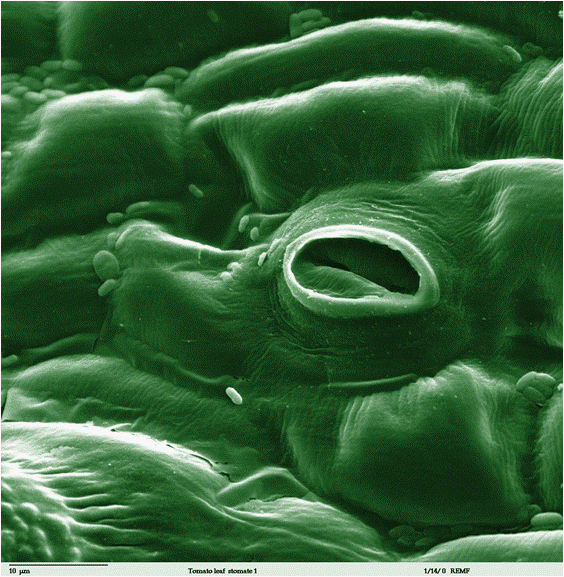
What is this?
stomata

What is this?
stomata