Plankton and larva (Week 8)
 Call Kai
 Learn
 Practice Test
 Spaced Repetition
 Match
 Flashcards
 Knowt Play
1/48

There's no tags or description
Looks like no tags are added yet.
49 Terms

What is this?
Ephyra is the larval stage of a jellyfish, characterized by its small, umbrella-shaped body and tentacles.
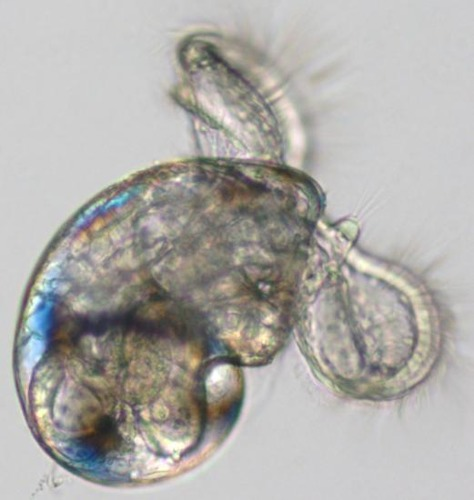
What is this and what phylum doe sit belong to?
Veliger larva; mollusca
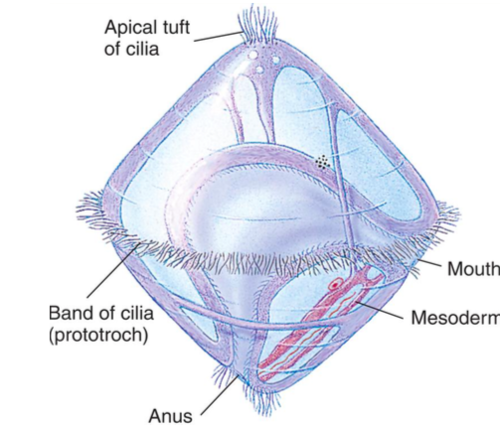
What is this?
Trochophore larva

What is this? (class + clade)

copepod larva; crustacean

What is this?
(Obelia) medusa

What is this?
Reproductive structures of Obelia (Hydrozoan)
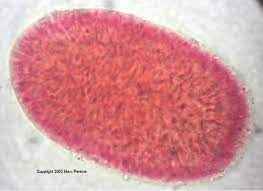
What is this?
Planula larva (Cnidaria)

What is this? (+phylum)
Trochophore larva (Mollusca)

What is this? (+phylum)
Veliger larva (mollusca)

What is this? (+phylum)
Nauplius larva of a copepod (arthropoda)
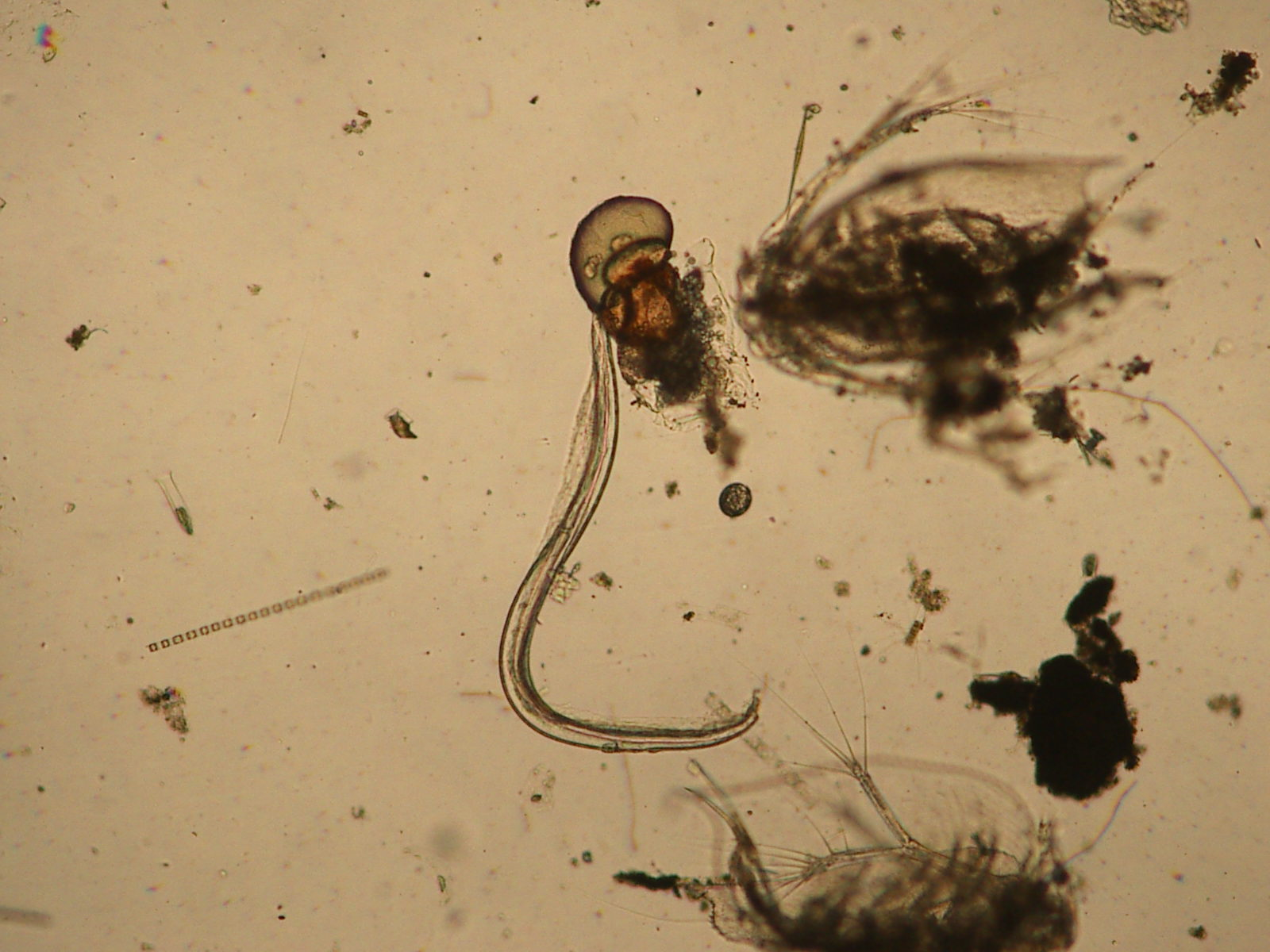
What is this? (center)
oikopleuridae (larval tunicate)
Plankton
Organisms that drift with water currents rather than swimming against them, although many are capable of short-distance propulsion.
Frustule
The rigid, glass-like cell wall of a diatom, composed of silica and consisting of two overlapping halves termed thecae.
Epitheca
The larger overlapping half or theca of a diatom's frustule, functioning similarly to the lid of a box.
Hypotheca
The smaller overlapping half or theca of a diatom's frustule, functioning similarly to the base of a box.
Striae
Fine markings or surface patterns visible on the silica frustule of diatoms that assist in identification.
Centric Diatoms
Diatoms characterized by circular, cylindrical, or disc-shaped forms that typically display radial symmetry.
Pennate Diatoms
Elongated diatoms that typically display bilateral symmetry, some of which possess a raphe.
Raphe
A narrow longitudinal slit present on the valve of certain pennate diatoms that allows them to glide over surfaces.
Thecate Dinoflagellates
Armoured dinoflagellates surrounded by cellulose plates that form a protective covering termed a theca.
Athecate Dinoflagellates
Unarmoured dinoflagellates that lack visible cellulose plates and possess a smoother cellular covering.
Cingulum
The transverse, belt-like groove encircling a dinoflagellate cell that houses the transverse flagellum.
Sulcus
The longitudinal groove on the surface of a dinoflagellate cell associated with the longitudinal flagellum.
Radiolarians
Unicellular, largely planktonic marine eukaryotes that produce complex, three-dimensional mineralised skeletons, typically made of silica.
Acantharians
A group of planktonic organisms related to radiolarians that construct mineralised skeletons composed of strontium sulphate.
Suspension Feeders
Planktonic organisms that extract suspended food particles from water, often using fine setae, cilia, or specialised feeding currents.
Raptorial Feeding
A feeding mode in zooplankton characterized by stout, grasping mouthparts adapted to capture individual prey items.
Chaetognaths
Active predatory zooplankton equipped with prominent, curved grasping spines surrounding the mouth to capture prey.
Holoplankton
Organisms that spend their entire life cycle in the plankton, including both juvenile and adult forms.
Meroplankton
Organisms that spend only a portion of their life cycle in the plankton, typically as eggs or larval stages, before becoming benthic or nektonic.
Nauplius
A primary crustacean larval stage featuring an unsegmented body, three pairs of appendages, and a single median naupliar eye.
Copepodite
The intermediate developmental stage of a copepod occurring between the nauplius stage and the adult stage.
Planktotrophic Larvae
Planktonic larvae that feed while in the water column, developing from smaller, yolk-poor eggs and generally requiring longer pelagic development.
Lecithotrophic Larvae
Planktonic larvae that rely exclusively on internal maternal yolk rather than active feeding, typically developing from larger eggs and spending less time in the plankton.
Direct Development
A developmental pathway lacking a free-living larval stage, in which embryos develop directly into juveniles resembling miniature adults.
Indirect Development
A developmental pathway involving one or more distinct, free-living larval stages that undergo metamorphosis to attain the adult body plan.
Planula
A small, ciliated, oval or elongated larva produced by Cnidaria that typically settles to form a polyp.
Trochophore
A rounded or pear-shaped larva characteristic of annelids and some molluscs, identifiable by a prominent equatorial band of cilia.
Veliger
A mollusc larval stage characterized by a developing shell, a foot, and a ciliated velum used for propulsion and feeding.
Actinotroch
A transparent larval form belonging to Phoronida, identifiable by a prominent hood and a ciliated tentacle region.
Cyphonautes
A triangular, laterally compressed bryozoan larva enclosed between two bivalved, shell-like plates.
Zoea
A decapod crustacean larva distinguished by a distinct carapace, segmented abdomen, appendages, and prominent spines.
Pluteus
A transparent, bilaterally symmetrical echinoderm larva (Echinoidea and Ophiuroidea) featuring elongated arms supported by internal skeletal rods.
Bipinnaria
A bilaterally symmetrical sea star (Asteroidea) larva characterized by distinct looping ciliated bands.
Tornaria
A transparent, ciliated larval stage of hemichordates (Enteropneusta) with complex looping ciliary bands.
Tadpole Larva
A chordate larval form found in ascidian tunicates, possessing a distinct trunk and a muscular tail with a notochord before settling into a sessile adult.
Iris Diaphragm
An adjustable shutter on a microscope condenser that regulates the aperture and contrast of the light beam passing through the specimen.
Total Magnification
The complete magnification of a compound microscope, calculated as Total Magnification=Objective Magnification×Eyepiece Magnification.