Unit 3: Physical and Geological Oceanography
 Call Kai
 Learn
 Practice Test
 Spaced Repetition
 Match
 Flashcards
 Knowt Play
1/63

There's no tags or description
Looks like no tags are added yet.
64 Terms
Detailed charting of the features of an area; heights, depths, and shapes of the surface of an area, shape of the ocean floor
What term is this?
Topography
How is the ocean-floor topography different from the topography of exposed land areas?
The ocean floor has deeper canyons, higher and longer mountain ranges, and plains that are wider/flatter than land areas.
True or false
The topography of the ocean floor is similar to that of the landforms on Earth's continents.
True
Earth's continents were once one large, unbroken landmass called…
Pangaea
It suggests that Earth's crust/outermost layer is divided into large plates that move, causing earthquakes and volcanoes. What theory is this?
Theory of plate tectonics
The plate tectonics theory suggests that Earth's crust is separated into large pieces known as…
Plates
The edge of the continent that is under water/ocean. A relatively flat part of the continent covered by seawater. The shallow part of the seafloor that adjoins the continents.
What term is this?
Continental Shelf
Formed when rivers carried sand and soil from land into the ocean, where the sediments settled in layers. What is being formed?
continental shelf
The sloping surface between the outer edge of the continental shelf and the ocean basin. Separates the continental shelf from the ocean floor.What term is this?
Continental Slope
Deep V-shaped valleys found along the continental slope. What term is this?
Submarine Canyons
Formed when rivers and underwater currents cut deep valleys into the ocean floor. What is being formed?
Submarine Canyons
The ocean floor at a depth of more than 4,000 meters. Begins at the bottom of the continental slope. What term is this?
Basin
Large, flat regions on the ocean floor. The largest plains on Earth. What term is this?
Abyssal Plains
Long, narrow cracks in the ocean floor, the deepest parts of the ocean. What term is this?
Trenches
…in the Pacific Ocean is the deepest spot in the ocean, over 10,911 meters deep.
The Marianas Trench
Underwater cone-shaped volcanic mountains. What term is this?
Seamount
Flat-topped seamounts that it is an underwater volcanic mountains with flat tops. What term is this?
Guyot
What are the differences between a guyot and a seamount?
A seamount is an underwater volcanic mountain with a pointed top, while a guyot is an underwater volcanic mountain with a flat top.
A mountain chain that rises from the ocean basin; where seafloor spreading takes place. They are underwater mountain ranges. Undersea volcanic mountain range that encircles the globe. What term is this?
Mid-ocean Ridge
Formed when magma rises from the mantle, cools, and creates new oceanic crust. This process is called seafloor spreading. What is being formed?
Mid-ocean ridges
The mountain belt located in the Pacific Ocean is called the…
East Pacific Rise
The mountain belt located in the Atlantic Ocean is called the..
Mid-Atlantic Ridge

What feature is number 1?
submarine canyon
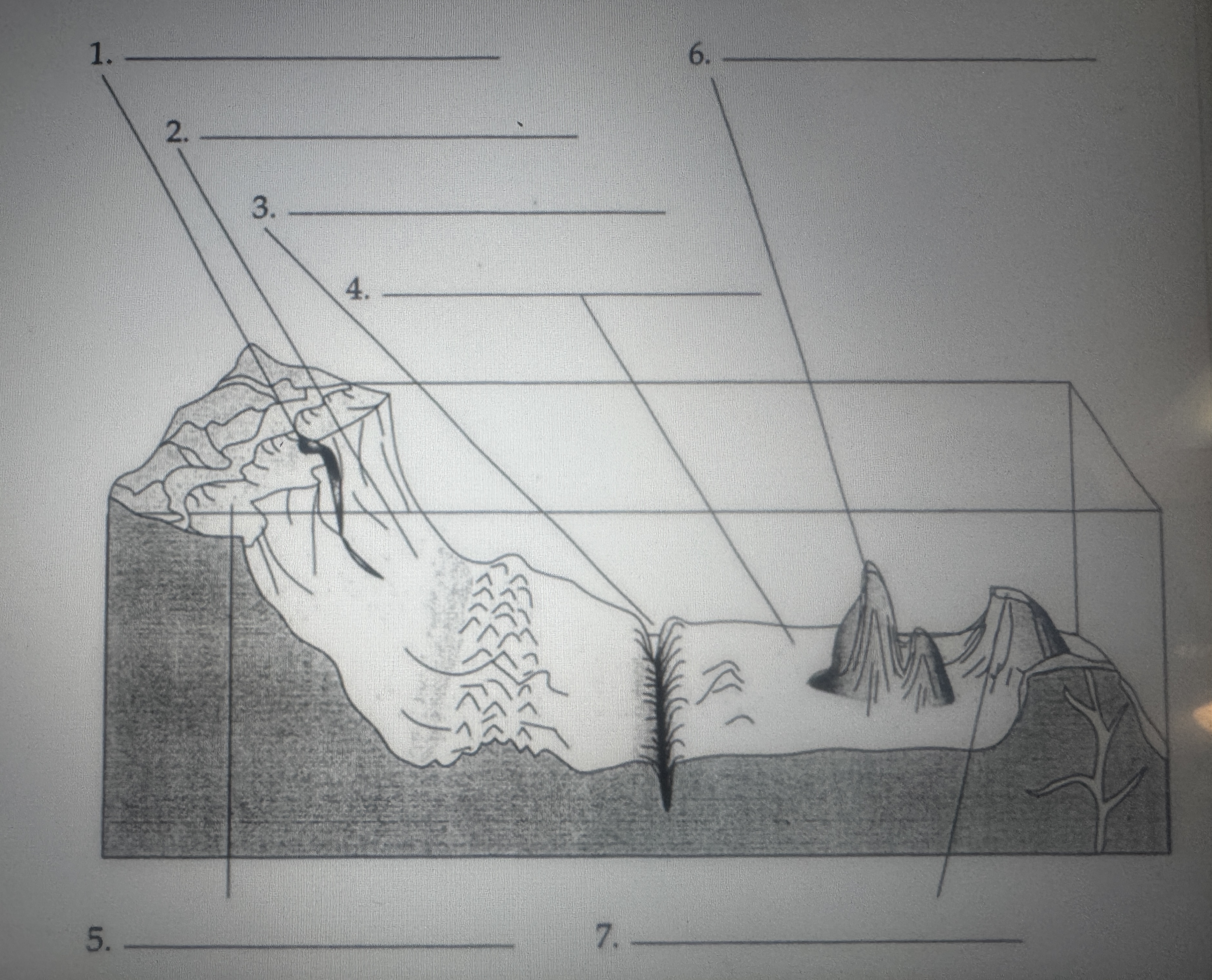
What feature is number 2?
continental slope

What feature is number 3?
trench

What feature is number 4?
abyssal plain
What feature is number 5?
continental shelf

What feature is number 6?
seamount

What feature is number 7?
guyot
A string of coral islands that forms a circle and it is surrounded by a lagoon. What term is this?
Atoll
A coral reef that grows farther offshore. They are separated from the island by a channel or lagoon. What term is this?
Barrier Reef
A small, low island made mostly of sand and coral. What term is this?
Key (Cay)
The theory that Earth's continents were once joined together and slowly moved to their current positions. It was discovered that it was not completely correct and that its name is Plate tectonics. What term is this?
Continental Drift
The accumulation of mudslide sediments at the base/bottom of a continental slope creates a slightly elevated region called the…
Continental Rise
Transfer of heat in a liquid or gas that causes the molten magma to rise up through the mantle and into the crust, forming an oceanic ridge/breezes. What term is this?
Convection Current
The churning of the magma creates a force that generates great pressures upward into Earth's surface layer (above mantle). What term is this?
Crust
sediments carried by the river are deposited along the shore, producing a fan-shaped feature called a…
Delta
Crack in Earth's crust that occurs at the margin of two plates. What term is this?
Fault
Narrow inlet from the sea that is both steep and deep and it is formed by the action of glaciers. What term is this?
Fjord
A coral reef that grows a few kilometers offshore parallel to the mainland. What term is this?
Fringing Reef
The study of the physical characteristics of the lithosphere, which includes the planet's seafloor and continents. What term is this?
Geology
Area of intense geologic activity in the crust where a seamount forms. What is this term?
Hot Spot
an area in the rift zone at which hot springs emerge. What is this term?
Hydrothermal Vent
Groups of volcanic islands that form an arc near an ocean trench. What is this term?
Island Arc
Hot molten material within Earth's mantle and it is called lava at Earth's surface. What is this term?
Magma
Region of geologic activity between Earth's core and crust. What is this term?
Mantle
Segments of Earth’s crust that float (with the continents on top) on the mantle. A large piece of Earth's outer layer that moves slowly. What term is this?
Plate
A crack in the seafloor through which molten rock from the mantle is expelled. Runs along the crest of the mid-ocean ridge. Place where new seafloor is continually being created. What term is this?
Rift Valley
The process in which magma rises, cools, and forms new oceanic crust. What term is this?
Seafloor Spreading
The process in which one tectonic plate moves beneath another plate. What term is this?
Subduction

The denser oceanic plate sinks beneath the less dense continental or oceanic plate (one tectonic plate moves underneath another plate and sinks into the mantle)
This creates a trench, earthquakes, and volcanic activity (magma rises from the sub-ducting plate). It recycles old oceanic crust into the mantle.
Movement: Towards each other, and the oceanic plate subduct under the continental plate.
What type of plate boundary is this?
Subduction Boundary (one continental plate and one oceanic plate)
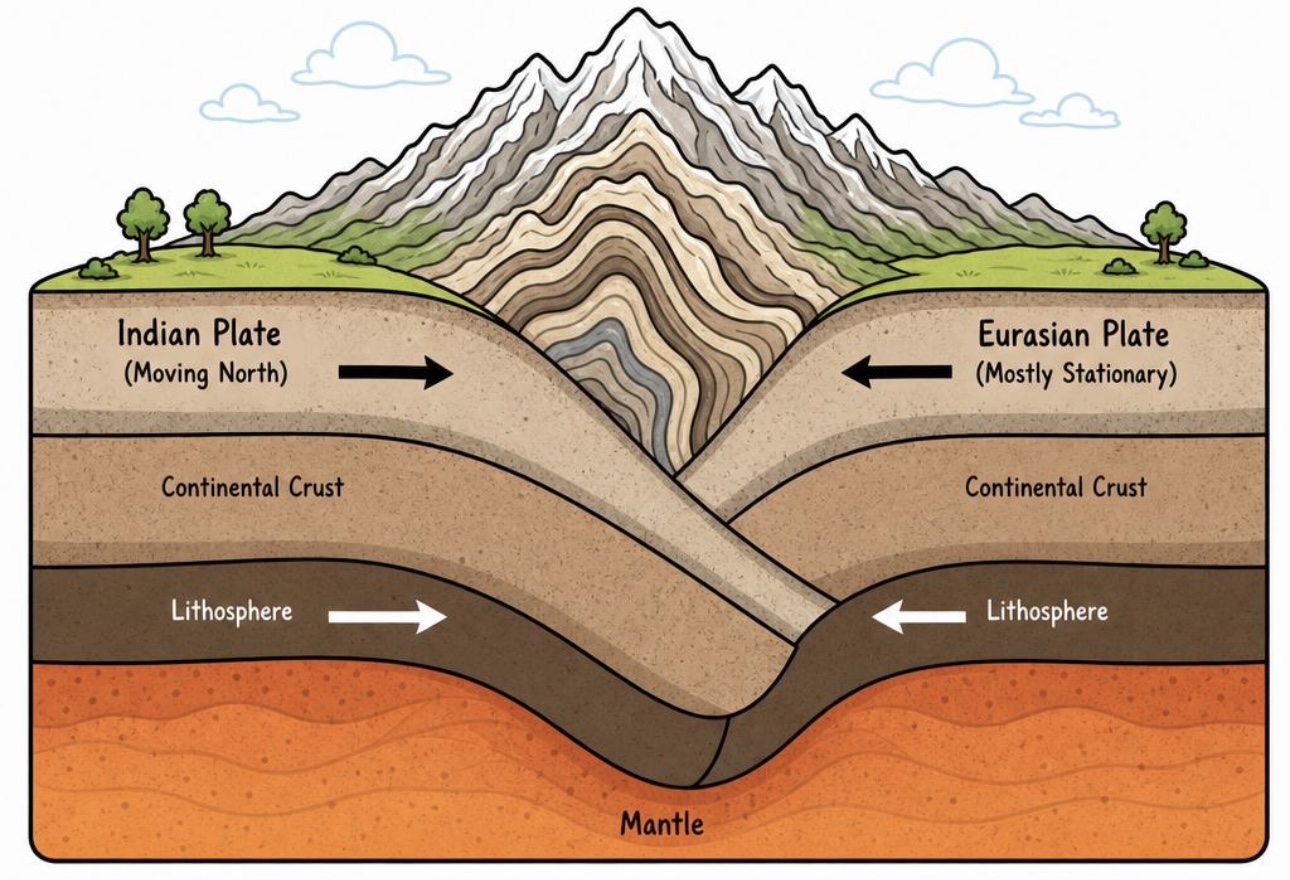
Two continental plates move toward each other. The crust crumples, folds, and becomes thicker.
This creates large mountain ranges and strong earthquakes. No volcanism because there's no subduction of oceanic crust.
Movement: Towards each other, creating fold mountains
What type of plate boundary is this?
Collision Boundary

Two plates move away from each other. Magma rises (volcanoes), cools, and forms new oceanic crust. This creates mid-ocean ridges (in oceans) or rift valleys (on land) and shallow weak earthquakes.
Movement: Away from each other
What type of plate boundary is this?
Divergent Boundary

Two plates slide past each other horizontally. This creates earthquakes, but no volcanism. The crust is neither created nor destroyed.
Movement: Side-by-side, in opposite directions or the same direction
What type of plate boundary is this?
Transform Boundary
The Formation of Earth
Earth formed approximately 4.6 billion years ago from the…
solar nebula
Heat from collisions of space debris. Radioactive decay of elements. Gravitational compression. What are these reasons?
Reasons why the early Earth was a molten mass.

The Formation of Earth
1) The heaviest elements (iron, nickel) sank to form…
2) Lighter materials rose to form the…
1) Earth's core
2) Mantle and crust
First single-celled life forms. Development of photosynthesis leading to oxygen accumulation. What Era is this?
Precambrian (4.6 billion - 541 million years ago)
Development of hard-shelled organisms. First fish, land plants, insects, and amphibians. Formation of Pangaea supercontinent. What Era is this?
Paleozoic Era (541 - 252 million years ago)
"Age of Dinosaurs". Breakup of Pangaea. First mammals and flowering plants. What Era is this?
Mesozoic Era (252 - 66 million years ago)
Rise of mammals and modern plants. Current ice age cycles. What Era is this?
Cenozoic Era (66 million years ago - present)
Occurred approximately 541-530 million years ago. Represents one of the most significant events in Earth's history. Rapid diversification of complex, multicellular organisms. What explosion is this?
Cambrian Explosion
Increased oxygen levels in oceans and atmosphere
"Arms race" between predators and prey
Environmental changes and new ecological niches
What are these possible causes?
Possibles causes of Cambrian Explosion