hydrogen atom emission spectra and bohrs model
 Call Kai
 Learn
 Practice Test
 Spaced Repetition
 Match
 Flashcards
 Knowt Play
1/17

There's no tags or description
Looks like no tags are added yet.
18 Terms
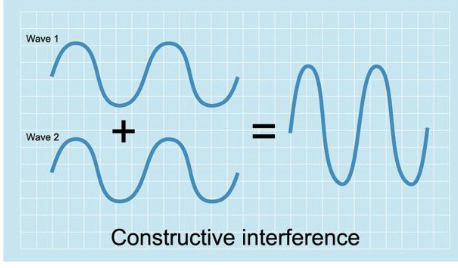
constructive interference
two waves match up and result in an increased amplitude due to the sum of the two waves amplitudes
destructive interference
peaks and troughs of a wave are mismatched, resulting in lower amplitude —> can completely cancel out resulting in zero amplitude

diffraction
the bending of waves around obstacles or through openings, leading to interference patterns.
blackbody radiation
continuous electromagnetic radiation from heated objects
photon
particle that is the basic unit of light
A system can absorb or emit n photons of energy (hv)
plancks constant

energy quantization
the principle that certain systems—such as electrons in an atom or electromagnetic radiation—can only possess specific, discrete values of energy rather than a continuous range
wave particle duality
light and electrons—exhibit both wave-like and particle-like properties depending on how they are measured

atomic absorption spectrum
atoms can absorb wavelengths of light at the same discrete wavelengths

atomic emission spectrum
atoms can emit light at specific discrete wavelengths
bohr model of H atom
broadband spectrum
continuous spectrum
discrete or line spectrum
energy level diagram
excited state
ground state
electronic transition