Chapter 6 Test
 Call Kai
 Learn
 Practice Test
 Spaced Repetition
 Match
 Flashcards
 Knowt Play
1/118

There's no tags or description
Looks like no tags are added yet.
119 Terms
What is responsible for the resilience of cartilage?
water
Why does cartilage heal slowly?
avascular; aging cartilage cells lose the ability to divide
perichondrium
dense irregular connective tissue that surrounds cartilage to resist its outward expansion when it gets compressed
chondrocytes
mature cartilage cells
What is the most abundant skeletal cartilage type?
hyaline
What are the functions of the bones of the skeletal system? (short answer on test)
support, protection, movement, mineral storage, blood cell formation, fat storage
What are the two major divisions of the human skeleton?
axial and appendicular
long bones
bones that are longer than wide, make up appendages
short bones
bones that are roughly as long as they are wide, include bones of wrist and ankle
flat bones
bones that are thin and flat; make up most of the skull and sternum, ribs, and scalpula
The vertebrae and hip bones are considered to be what type of bone?
irregular bones
What are the characteristics of spongy bone?
trabeculae and open spaces
Trabeculae and open spaces are characteristic of what type of bone?
spongy bone
trabeculae
little beams of bone in spongy cells
diaphysis
name for shaft or tubular structure that forms the long axis of a long bone
medullary cavity
hollow cavity in the middle of the shaft of a long bone
The yellow bone marrow is largely what substance?
fat
epiphyses
expanded ends of a long bone
What is the function of the articular cartilage?
cushions and absorbs stress between opposing bone ends at joints
epiphyseal line
region between the end of bone and shaft of bone if a person has stopped growing
epiphyseal plate
region between end of bone and shaft of bone if a person is still growing; where bone growth takes place
periosteum
protective tissue that covers bone on the outside
What is the outer fibrous layer of periosteum composed of?
dense irregular connective tissue
What is the inner layer of periosteum composed of?
osteoblasts and osteoclasts
sharpey’s fibers or perforating fibers
collagen fibers of dense connective tissue that secures periosteum to bone
endosteum
internal lining of marrow cavity, trabeculae, and canals of bone
hematopoiesis
formation of red blood cells
Where does the formation of red blood cells occur in bone?
red marrow
diploe is another name for what?
spongy bone of flat bone
osteoblasts
cell responsible for secreting bone matrix
osteocytes
mature bone cell that maintains bone matrix
lacunae
small spaces in bone tissue where osteocytes live
osteoclasts
cells responsible for resorption or dissolving of bone tissue
osteon
functional or structural unit of compact bone
The osteon system is part of what type of bone?
compact bone
What do the lamellae of an osteon resemble?
hollow tubes or growth rings on a tree
lamellae
layers or concentric rings or tubes of calcification in bone
What is the purpose of the central canal in the core of each osteon?
contains blood vessels and nerves for each osteon cell
canaliculi
small channels that radiate through matrix of bone to allow blood supply to the cells
What is the first part of how a long bone receives its blood supply?
blood from periosteum travels into the bone by perforating canals
What is the second part of how a long bone receives its blood supply?
the blood runs up and down in the central canal in the center of each osteon cell
What is the third part of how a long bone receives its blood supply?
the blood travels out through canaliculi to the lacunae where the cells live
What is the order of how a long bone receives its blood supply?
periosteum, perforating canal, central canal, canaliculi, lacunae, osteocytes
The trabeculae of spongy bone appear to be randomly oriented but they’re not they’re actually oriented how?
aligned along lines of stress
osteoid
organic part of bone matrix
What are the parts, characteristics, and function of organic matrix and inorganic matrix of bone?
organic matrix of bone has cells and osteoid that make it flexible to resist tension and twisting. inorganic matrix of bone has mineral salts that make it hard to resist compression

What part of the flat bone is A?
spongy bone

What part of the flat bone is B?
compact bone

What part of the flat bone is C?
trabeculae

What part of a long bone is A?
epiphysis

What part of a long bone is B?
diaphysis
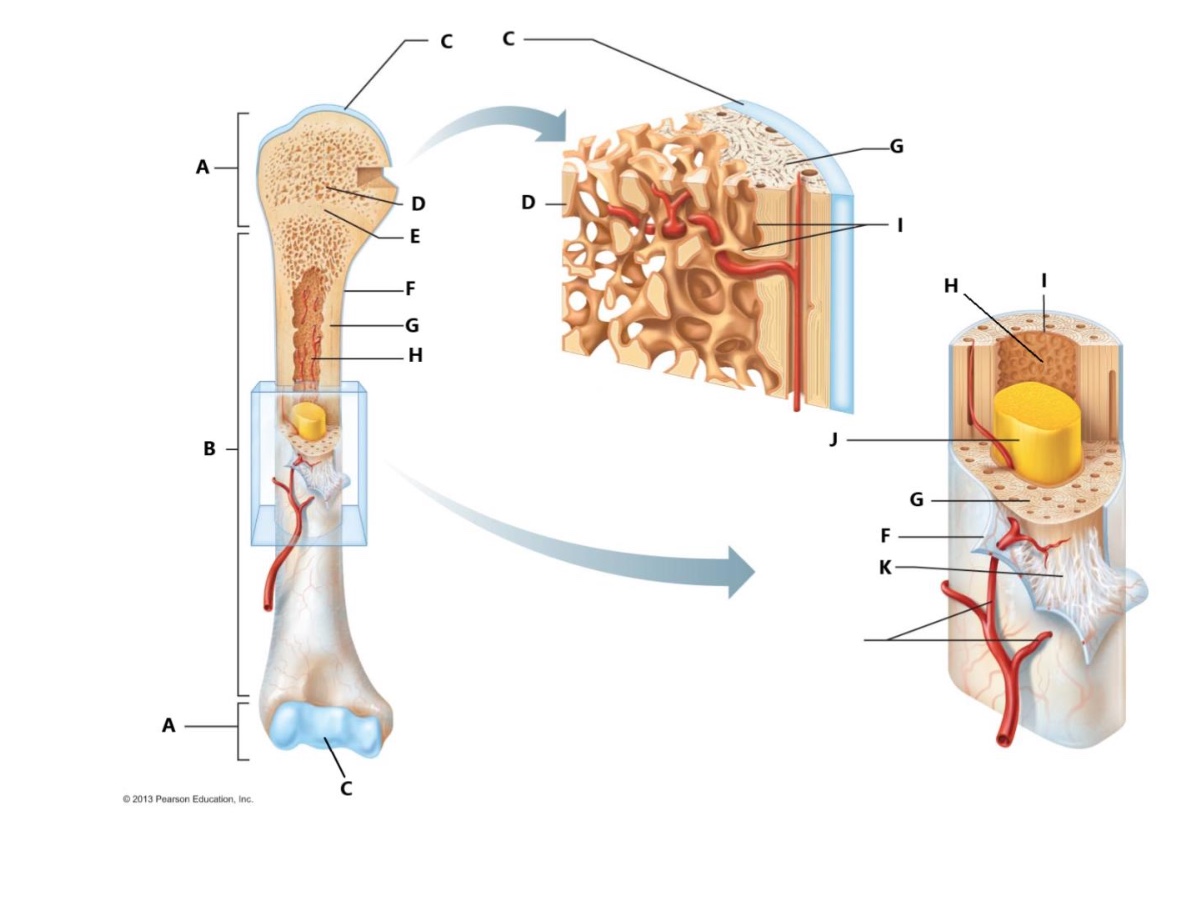
What part of a long bone is C?
articular cartilage

What part of a long bone is D?
spongy bone

What part of a long bone is E?
epiphyseal line

What part of a long bone is F?
periosteum

What part of a long bone is G?
compact bone
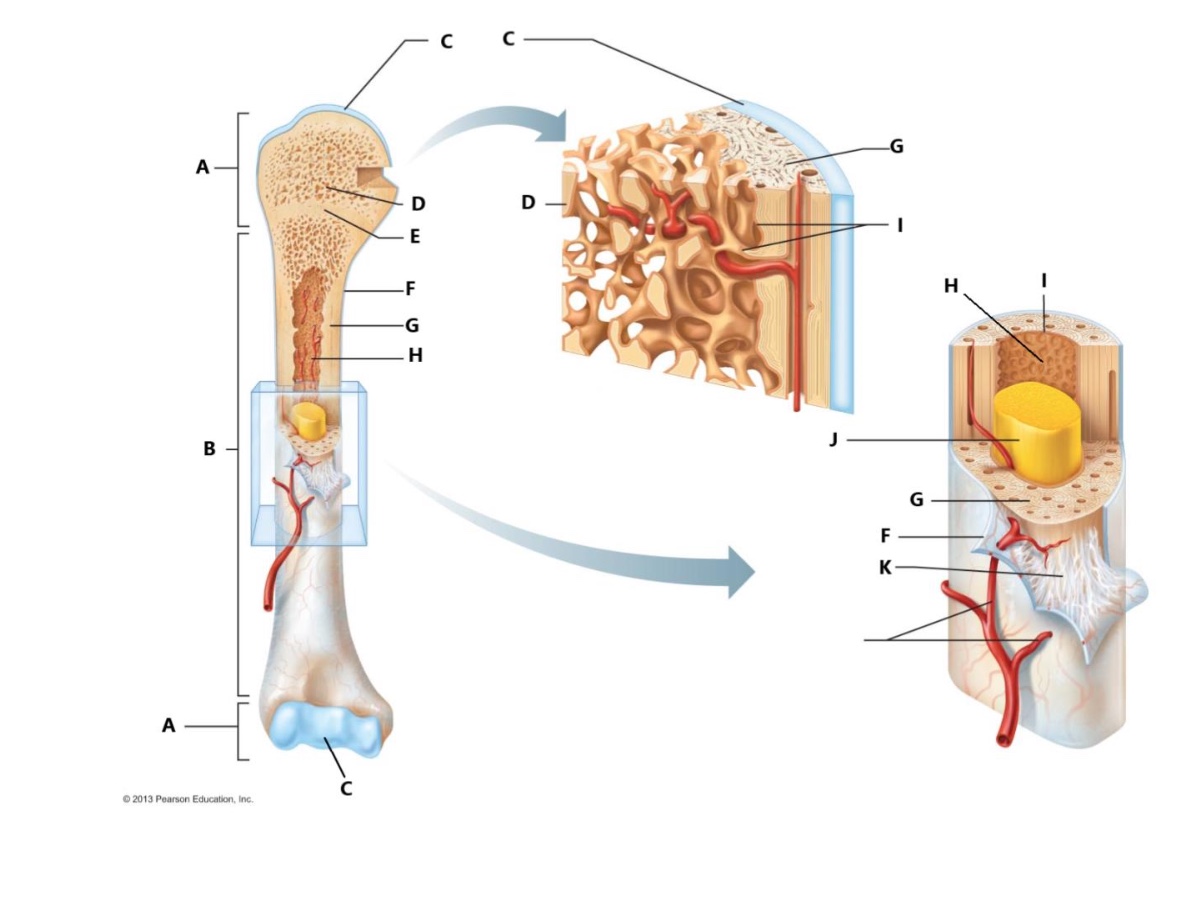
What part of a long bone is H?
medullary cavity

What part of a long bone is I?
endosteum

What part of a long bone is J?
yellow marrow

What part of a long bone is K?
perforating fibers

What microscopic structure of a long bone is A?
central canal

What microscopic structure of a long bone is B?
osteon

What microscopic structure of a long bone is C?
circumferential lamellae

What microscopic structure of a long bone is D?
lamellae

What microscopic structure of a long bone is E?
perforating canal

What microscopic structure of a long bone is F?
central canal

What microscopic structure of a long bone is G?
lacunae

What microscopic structure of a long bone is H?
osteocyte

What microscopic structure of a long bone is I?
canaliculi

What microscopic structure of a long bone is J?
interstitial lamella
In intramembranous ossification of bones, what connective tissue does it start with?
mesenchyme
Which bones form from intramembranous ossification?
skull bones and clavicles
What is the first step of intramembranous ossification?
ossification center forms from mesenchyme
What is the second step of intramembranous ossification?
bone matrix is secreted by osteoblasts
What is the third step of intramembranous ossification?
spongy bone and periosteum form
What is the last step of intramembranous ossification?
compact bone collar forms on outside and red marrow forms inside
What type of connective tissue is the starting tissue for endochondral ossification?
hyaline cartilage
Which bones form from endochondral ossification?
all bones from base of skull down except clavicles
What is the first step of endochondral ossification?
a bone collar forms around diaphysis of hyaline cartilage model
What is the second step of endochondral ossification?
cartilage in the center of diaphysis calcifies and cavitates
What is the third step of endochondral ossification?
the periosteal bud invades the internal cavities and spongy bone forms
What is the fourth step of endochondral ossification?
the diaphysis elongates and medullary cavity forms
What is the last step of endochondral ossification?
the epiphyses ossifies
What must happen in order to ossify the epiphyses of long bones?
secondary ossification centers form in epiphyses
appositional growth
bones increase in width or diameter
Explain how bones increase in diameter?
osteoblasts add bone on periosteal surface; osteoclasts remove bone on endosteal surface
longitudinal growth
bones grow in length
Describe how long bones increase in length
cartilage cells divide and form new cartilage on the epiphyses side of epiphyseal plate; chondrocytes die and cartilage calcifies and erodes in the middle; osteoclasts destroy cartilage and osteoblasts deposit bone on the diaphysis side of the epiphyseal plate
What nutrients are necessary for normal bone formation and growth?
calcium, phosphate, and protein with help of vitamin c, d, a
parathyroid hormone
hormone that increases osteoclast activity and causes release of calcium into blood
parathyroid gland
gland that produces a hormone that increases blood calcium levels
calcitonin
hormone that decreases osteoclast activity and causes calcium to be removed from blood and deposited in bone
thyroid gland
gland that produces a hormone that decreases calcium levels in blood
Wolff’s law
bone grows or remodels in response to demands placed on it; greatest stresses - thick bone; no stress - can hollow out
displaced fracture
bone ends are out of alignment
nondisplaced fracture
bones end are in alignment
complete fracture
bone is broken all the way
incomplete fracture
bone is partially broken
transverse fracture
perpendicular to long axis of bone
linear fracture
parallel to long axis of bone