6. epithelial pathology pt 2 ✅
 Call Kai
 Learn
 Practice Test
 Spaced Repetition
 Match
 Flashcards
 Knowt Play
1/31

There's no tags or description
Looks like no tags are added yet.
32 Terms
SQUAMOUS CELL CARCINOMA
most common malignancy in the oral cavity
Oral cancer, <3% of all US cancers
90% are squamous cell carcinomas
Approximately 54,540 new cases of oral or oropharyngeal cancer cases diagnosed annually
11,580 deaths from oral/oropharyngeal cancer each year
Risk increases with age
Male-to-female gender ratio 3:1
lateral boarder = most common
causes of SCC
Multifactorial
Extrinsic factors - Tobacco *most important, alcohol (only in combination w tobacco), syphilis
Sunlight (vermilion cancers only) precursor = actinic cheilitis
Intrinsic factors - systemic states, malnutrition or iron-deficiency anemia
Heredity does not play a major etiologic role
SCC- Clinical Presentation
Leukoplakic, erythroplakic
Erythroleukoplakic
Leuko / erythroplakic early cases - No mass / ulceration
Exophytic (protruding out) - Irregular / papillary, normal color to red to white
Endophytic - Depressed, irregular, ulcerated, "rolled” border (deep seated ulcer)
if ulcer doesnt heal can be SCC as d/d
very deceptive
shallow type of ulcer
aphthous ulcer
Differential diagnosis for endophytic SCC
Deep fungal infections (e.g. histo or blasto) (no trauma + doesnt smoke
Tuberculosis
Syphilis
Traumatic granuloma (behaves like scc, deep seated + can last a while, if they dont smoke + had trauma)
ALL OF THESE DEPEND ON HISTORY
3 DD for deep nonhealing ulcer are SCC, trauma or pathogen
Lip Vermilion Carcinoma
Chronic ultraviolet radiation
Almost 90% on lower lip
Vermilion carcinoma crusted, non tender, indurated ulceration
Slow growing, late to metastasize
INTRA-ORAL SCC
90% - Floor of mouth, soft palate, anterior tonsillar pillar complex, ventral / lateral tongue
Most common - Posterior lateral & ventral surfaces of tongue followed by floor of mouth
Only 4% on dorsum (rare)
SQUAMOUS CELL CARCINOMA on floor of the mouth
Carcinoma of oral floor 35% of intraoral cancers.
Most common site is midline near the frenum
SQUAMOUS CELL CARCINOMA: gingival/ alveolar carcinoma
Mimics benign inflammatory / reactive lesions
Clinically evident after tooth extraction
SQUAMOUS CELL CARCINOMA: STAGING
Tumor size and extent of metastatic spread
Staging protocol is tumor-node-metastasis (TNM) system
T - Tumor size (cm)
N - Spread to local lymph nodes
M- Presence or absence of distant metastasis
Higher stage worse prognosis
Histopathologic Features: “Grading“
Degree of tumor resemblance to parent tissue (squamous epithelium) & production of normal product (keratin)
Lesions graded as I to IV
Low-grade (I)
well-differentiated tumors closely resemble tissue of origin, grow slower, metastasize later
High-grade (III/IV)
poorly differentiated, or anaplastic tumor - very pleomorphic cells, little or no keratin, difficult to identify, enlarge rapidly, metastasizes early
what dictates the prognosis? stage or grade?
stage, size and spread!!
higher stage = worse ;(
Metastasis
Spread through lymphatics to ipsilateral cervical lymph nodes
Perforates nodal capsule, node becomes "fixed"
2% have distant metastases at diagnosis
Most common sites : Lungs, liver, bone
Ca of lower lip / floor to submental nodes
Posterior tumors to superior jugular / digastric nodes
Delay in diagnosis, approx. 21% cervical metastases
Treatment and Prognosis
Treatment guided by stage of disease
Wide excision, radiation therapy or both
Single treatment modality for smaller carcinomas
Larger lesions or lesions with palpable lymph nodes - Combined therapy including either a modified or radical neck dissection
VERRUCOUS CARCINOMA (Snuff Dipper's Cancer)
Low-grade variant of SCC, predominantly in men 55+
More frequent in users of spit tobacco / snuff
Mandibular vestibule, buccal mucosa, hard palate
Extensive, often present for 2-3 years prior to diagnosis
Diffuse, well demarcated, painless thick white / pink, papillary
Leukoplakia or tobacco pouch keratosis on adjacent mucosal surfaces
good prognosis
if not from smoking or drinking it is from HPV 16
verrucous carcinoma histopathology
Deceptively benign microscopically (no dysplasia + doesnt cross basement membrane)
can turn in to SCC if not removed
Wide / elongated rete ridges push into underlying tissue
“Parakeratin plugging" between surface projections
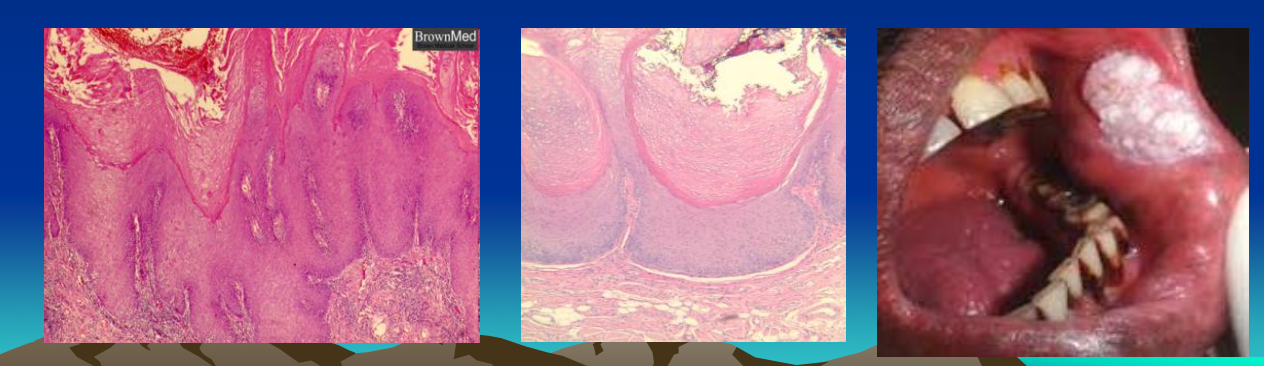
KNOW THIS HISTOPATHOLOGY
verrucous carcinoma Treatment and Prognosis
Metastasis extremely rare
locally invasive
Surgical excision w/o radical neck dissection
90% are disease-free after 5 years
Radiotherapy effective, less popular
Have transformed after radiation into poorly differentiated carcinoma
BASAL CELL CARCINOMA (Rodent Ulcer)
most common skin malignancy on the SKIN, not in oral cavity
Locally invasive, slowly spreading malignancy
Arises from basal cell layer of skin
500,000 new cases diagnosed annually, 80% of all skin cancers
Chronic exposure to ultraviolet radiation
Does not occur intraorally
Epithelial islands demonstrate palisading of peripheral cells

*histopath will be asked
Nevoid Basal Cell Carcinoma Syndrome:
Sun-exposed and protected areas of skin
multiple basal cell carcinoma lesions, Hundreds of lesions
seen in areas of no sun exposure + in younger populations
BASAL CELL CARCINOMA characteristics
Adult whites
Firm, painless papule
Central depression with rolled border, ulceration in central depressed area
Telangiectatic vessels over rolled border
Destruction of underlying bone / cartilage possible
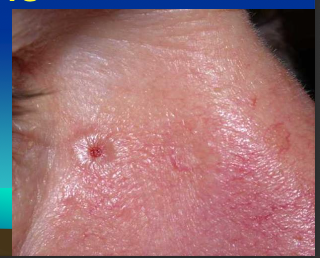
Metastasis extremely rare, invades deep locally
BASAL CELL CARCINOMA treatment
Depends on size and site of lesion
Radical surgery and radiation for large or aggressive lesions
Small lesions (<1 cm), routine surgical excision or curettage
Cure rate 95-98%
MELANOMA (Malignant Melanoma)
Malignant neoplasm of melanocytic origin
Arises from benign melanocytic lesion or de novo or congenital nevi
UV - Major causative factor
Acute sun damage of greater etiologic importance than chronic
Risk of melanoma 2-8x greater with familial history
Fair complexion and light hair
History of painful or blistering sunburns in childhood
History of dysplastic nevus
growth of melanoma( Radial growth phase and vertical growth phase) : radial growth phase
Malignant melanocytes spread horizontally through basal layer
growth of melanoma (Radial growth phase and vertical growth phase): vertical growth phase
Malignant cells invade underlying connective tissue
Five Clinicopathologic Types of melanoma
1. Superficial spreading melanoma
2. Nodular melanoma
3. Lentigo maligna melanoma
4. Acral melanoma
5. Mucosal melanoma
MELANOMA – A, B, C, D, E Rule
Asymmetry (because of its uncontrolled growth pattern)
Border irregularity (often with notching)
Color variegation (shades of brown to black, white, red, and blue)
Diameter greater than 6 mm (diameter of a pencil eraser)
Evolving (changes in size, shape, color, symptoms over tim
Areas with worse prognosis "BANS" (interscapular area of Back, posterior upper Arm, posterior and lateral Neck, and Scalp)
ACRAL LENTIGINOUS MELANOMA
Most common form of melanoma in African-American population
Most common form of oral melanoma
Palms, soles, subungual area, mucous membranes
ORAL MELANOMA
Mostly on hard palate, max gingiva / alveolar mucosa
Begins as brown to black macule with irregular borders
Thickened areas develop as vertical growth is initiated
Prognosis extremely poor
Radical surgical removal
normally metastatic

Treatment & Prognosis
Depth of invasion correlates with prognosis for cutaneous melanoma
Clark system & Breslow classification- Cutaneous melanoma
1-cm margin for small tumors
Larger, invasive tumors - wide surgical excision
Removal of regional lymph nodes with depth of invasion >1.24 mm
Oral – Prognosis dependent on TNM classification
Radical surgery, adjunctive radiation therapy
DD for oral melanoma
melanotic macule
blue nevi
melanoacanthoma