radioactivity
 Call Kai
 Learn
 Practice Test
 Spaced Repetition
 Match
 Flashcards
 Knowt Play
1/56

There's no tags or description
Looks like no tags are added yet.
57 Terms
atoms have a nucleus containing ____ and_____. electrons ____ around the ____ of an atom.
an atom has the same ____ of protons and electrons, so the + and - charges ______ and the atom has no overall _____.
atoms have a nucleus containing protons and electrons. electrons move around the nucleus of an atom.
an atom has the same number of protons and electrons, so the + and - charges balances and the atom has no overall charge.
the atom and the nucleus.
all atoms have a _____. the nucleus is always ______ charged as it contains ____ which have a ________ charge and neutrons which do not have a charge.
the nucleus contains more than 99% of the ____ of the atom.
the total number of protons in an atom’s nucleus must be the same as the total number of _____ in the ____.
electrons in atoms always orbit the _____ and have a ____ charge.
atoms are always ____ because the positive charge from the ____ cancels out the ______ charge from the electrons.
the nucleus of an atom of an element may contain different numbers of _____.
all atoms have a nucleus. the nucleus is always positively charged as it contains protons which have a positive charge and neutrons which do not have a charge.
the nucleus contains more than 99% of the mass of the atom.
the total number of protons in an atom’s nucleus must be the same as the total number of electrons in the shells.
electrons in atoms always orbit the nucleus and have a negative charge.
atoms are always neutral because the positive charge from the protons cancels out the negative charge from the electrons.
the nucleus of an atom of an element may contain different numbers of neutrons.
all the atoms of a particular element have the same number of _____. the number of protons in each atom of an element is called the ______ number.
the total number of protons and neutrons in an atom is the ____ number.
all the atoms of a particular element have the same number of protons. the number of protons in each atom of an element is called the atomic number.
the total number of protons and neutrons in an atom is the mass number.
how to calculate number of neutrons in an atom?
mass number - atomic number
isotopes are atoms with the same number of _____ but different number of _____ of the same element.
isotopes are atoms with the same number of protons but different number of neutrons of the same element.
electrons can move between _____ levels, or they can ____ the atom completely.
electrons can move between energy levels, or they can leave the atom completely.
an electron will move from a ____ to ____ orbit if it absorbs electromagnetic radiation.
an electron will move from a lower to higher orbit if it absorbs electromagnetic radiation.
an electron will move from a higher to lower orbit if it ______ electromagnetic radiation.
an electron will move from a higher to lower orbit if it emits electromagnetic radiation.
atoms become positively charged particles called positive ions when they _____ electrons.
electrons can leave an atom by:
______ electromagnetic radiation of enough _____ so that they can escape the _____ of the nucleus.
being hit by a _____
atoms becomes positively charged particles called positive ions when they lose electrons.
electrons can leave an atom by:
absorbing electromagnetic radiation of enough energy so that they can escape the pull of the nucleus.
being hit by a particle
alpha, beta, ____ radiation are emitted by _____ _____. this process is ______, which means its not possible to determine exactly when any nucleus will decay next.
alpha, beta, gamma radiation are emitted by unstable nuclei. this process is random, which means its not possible to determine exactly when any nucleus will decay next.
some elements are radioactive because their nuclei are _____. this means that they will undergo radioactive ____ and change into other _____. unstable nuclei will decay when ____, ____ or gamma radiation is ____.
some elements are radioactive because their nuclei are unstable. this means that thy will undergo radioactive decay and change into other elements. unstable nuclei will decay when alpha, beta or gamma radiation is emitted.
an alpha particle is a _____ nucleus. it is composed of two _____ and ____ neutrons. it has a charge of ____ and is the _______ of the particles emitted by unstable atoms.
an alpha particle is a helium nucleus. it is composed of two protons and two neutrons. it has a charge of +2 and is the heaviest of the particles emitted by unstable atoms.
a beta particle is an _____. it has a charge of ____.
a positron is an ____-electron and has a charge of ____.
a beta particle is an electron. it has a charge of -1.
a positron is an anti-electron and has a charge of +1.
a gamma-ray is a form of ____-energy e_____ radiation. it has ___ charge.
a gamma-ray is a form of high-energy electromagnetic radiation. it has no charge.
alpha and beta particles and gamma rays can ____ with atoms, _____ them by causing them to ___ _____.
alpha and beta particles and gamma rays can collide with atoms, ionising them by causing them to lose electrons.
alpha particles (3 points)
hint: travel, ionising levels, can be stopped by…
will travel around 5cm in air
very ionising
can be stopped by a sheet of paper
beta particles (3 points)
hint: travel, ionising levels, can be stopped by…
will travel a few metres in air
moderately ionising
can be stopped by aluminium
gamma rays (3 points)
hint: travel, ionising levels, can be stopped by…
will travel a few kilometres in air
weakly ionising
need thick lead to stop them
background radiation are ____-levels of radiation that’s both ____ and ___-____.
background radiation are low-levels of radiation that’s both natural and man-made.
we are always ______ to ionising radiation. this is called ______ radiation.
examples of background radiations are:
_____ gas
g_____ and b_____
m______
n_____ p_____
c_____ r____
f____ and d____
other
we are always exposed to ionising radiation. this is called background radiation.
radon gas
ground and buildings
medical
nuclear power
cosmic rays
food and drinks
other
radon is a radioactive ____ that is produced when ____ in rocks decay. radon decays by emitting an _____ particle. the radon can build up in houses and other buildings and how much of it depends on the ___ of rock in an area.
radon is a radioactive gas that is produced when uranium in rocks decay. radon decays by emitting an alpha particle. the radon can build up in houses and other buildings and how much of it depends on the type of rock in an area.
photographic film and a _____-____ tube can both be used to measure and ____ radiation.
photographic film and a geiger-muller tube can both be used to measure and detect radiation.
the geiger-muller (GM) tube is connected to a counter or ________ which shows the amount of _____ that has been detected.
the geiger-muller (GM) tube is connected to a counter or ratemeter which shows the amount of radiation that has been detected.

the GM tube has a thin ___ in the middle which is connected to a ____ of +400V.
the GM tube contains _____ gas. when radiation enters the tube, the atoms of argon are ___ and electrons travel towards the ____ wire.
as the electrons travel towards the thin wire, more electrons are ____ from atoms and an _____ effect occurs.
the amount of radiation detected is shown by the _____.
the GM tube has a thin wire in the middle which is connected to a voltage of +400V.
the GM tube contains argon gas. when radiation enters the tube, the atoms of argon are ionised and electrons travel towards the thin wire.
as the electrons travel towards the thin wire, more electrons are knocked from atoms and an avalanche effect occurs.
the amount of radiation detected is shown by the ratemeter.

Thomson’s model of plum pudding model was that the atom was like a positively charged ____ with _____ charged _____ embedded in it.
this model showed that both ____ and _____ charges existed in atoms and accounted for the atom being _____.
Thomson’s model of plum pudding model was that the atom was like a positively charged ions with negatively charged ions embedded in it.
this model showed that both positive and negative charges existed in atoms and accounted for the atom being neutral.
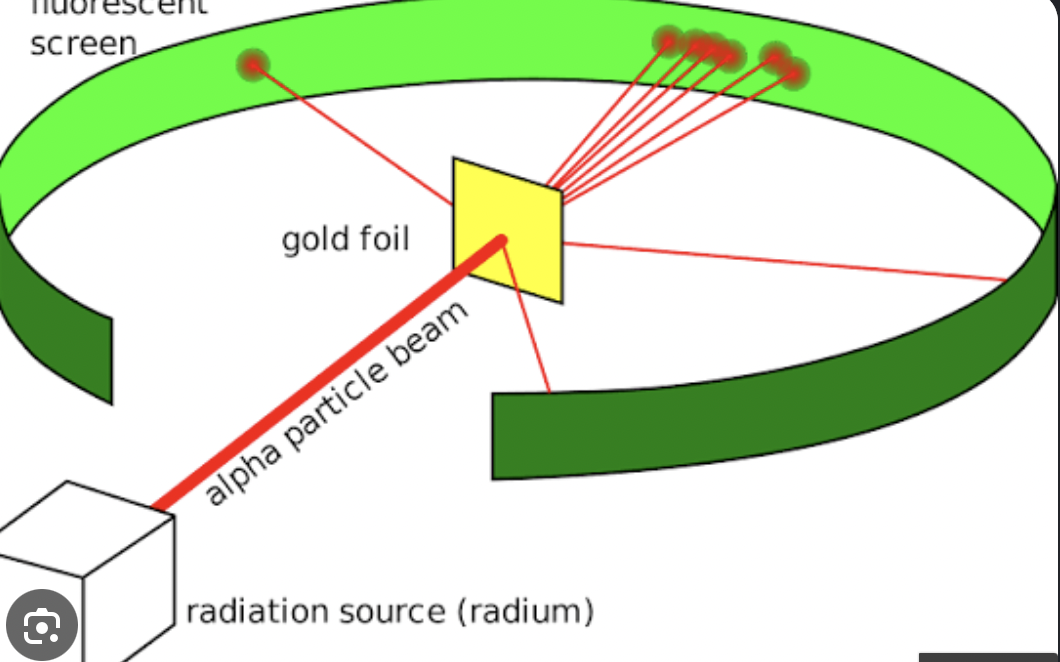
Rutherford proposed that the atom must contain a very ____, positively charged _____ which electrons _____.
his hypothesis was proved to be correct by geiger and Marsden, who fired _____ particles at a gold ____.
some alpha particles are _____ whilst most alpha particles are _____ (passes straight through), showing that most of the atom are ____ space, with a _____ positive nucleus at centre.
Rutherford proposed that the atom must contain a very small, positively charged nucleus which electrons orbit.
his hypothesis was proved to be correct by geiger and Marsden, who fired alpha particles at a gold film.
some alpha particles are scattered whilst most alpha particles are undeflected (passes straight through), showing that most of the atom are empty space, with a small positive nucleus at centre.
the Bohr model then showed (after Rutherford) that electrons had to ____ a positive nucleus in a well-defined ____ ____ or orbits, but could move between energy levels if they ___ or ____ energy.
the Bohr model then showed (after Rutherford) that electrons had to orbit a positive nucleus in a well-defined energy levels or orbits, but could move between energy levels if they gained or lost energy.
in a beta-minus decay, a ____ in the nucleus of an unstable atom decays to become a ____ and _____. the protons stays within the ____, but the ____, which is the beta-minus particle, is _____ from the nucleus at a ____ speed as a ___-moving electron.
in a beta-minus decay, a neutron in the nucleus of an unstable atom decays to become a proton and electron. the protons stays within the nucleus, but the electron, which is the beta-minus particle, is emitted from the nucleus at a high speed as a fast-moving electron.
in a beta-plus decay, a _____ in the nucleus decays to become a _____ and a _____. the ____ stays in the nucleus. the ____, which is the beta-plus particle, is emitted from the nucleus at a very ____ speed, carrying away a ____ charge and a very small amount of the nuclear ____.
in a beta-plus decay, a proton in the nucleus decays to become a neutron and a positron. the neutron stays in the nucleus. the positron, which is the beta-plus particle, is emitted from the nucleus at a very high speed, carrying away a positive charge and a very small amount of the nuclear mass.
alpha radiation:
effect on mass of nucleus
effect on charge of nucleus
nuclear mass -4
positive charged -2
beta plus radiation:
effect on mass of nucleus
effect on charge of nucleus
no change on mass
positive charge +1
beta-minus radiation:
effect on mass of nucleus
effect on charge of nucleus
no change on mass
positive charge -1
gamma radiation:
effect on mass of nucleus
effect on charge of nucleus
no change to both
neutron radiation:
effect on mass of nucleus
effect on charge of nucleus
mass -1
no change to charge
the half-life of a radioactive isotope is the ____ it takes for ___ of the ___ atoms to _____.
the half-life of a radioactive isotope is the time it takes for half of the unstable atoms to decay.
uses of gamma rays:
kill ____ cells: _____ of gamma-rays can be ____ at cancer cells to kill them.
______ surgical instruments: sterilise _____ instruments which cannot be sterilised by _______.
diagnose _____: a _____ solution containing a radioactive ___ that emits gamma-rays is ____ into the body and taken up by cells which are growing _____. the places in the body where the tracer collects are ____ with a gamma ____.
_____ food: food _____ with gamma-rays will last longer as ______ are killed by high-____ gamma rays. the food does not become _____.
uses of gamma rays:
kill cancer cells: beams of gamma-rays can be directed at cancer cells to kill them.
sterilise surgical instruments: sterilise plastic instruments which cannot be sterilised by heating.
diagnose cancer: a tracer solution containing a radioactive isotope that emits gamma-rays is injected into the body and taken up by cells which are growing abnormally. the places in the body where the tracer collects are detected with a gamma camera.
preserve food: food irradiated with gamma-rays will last longer as microbes are killed by high-energy gamma rays. the food does not become radioactive.
smoke alarms contain a source of alpha _____.
smoke enters the smoke _____.
alpha particles ____ the air and these charged particles move across the gap forming a ____.
smoke in the machine will ____ alpha particles and make the current ___.
s_____ will sound when the current falls.
alpha source gives off a constant ____ of alpha particles.
smoke alarms contain a source of alpha particles.
smoke enters the smoke detector.
alpha particles ionise the air and these charged particles move across the gap forming a current.
smoke in the machine will move alpha particles and make the current fall.
siren will sound when the current falls.
alpha source gives off a constant stream of alpha particles.
the _____ transferred by ionising radiation can ____ electrons from atoms to form ____. ions are very _____ and can cause _____ to the ____ in cells. this can lead to ____.
the energy transferred by ionising radiation can remove electrons from atoms to form ions. ions are very reactive and can cause mutations to the DNA in cells. this can lead to cancer.
ionising can also cause damage to cell _____ in the form of radiation burns. when its ______ is high enough, it can also ____ cells.
ionising can also cause damage to cell tissue in the form of radiation burns. when its energy is high enough, it can also kills cells.
people who come into ____ with ionising radiation needs to be _____. they are protected by:
limiting the time of ______
wearing _______ clothing
increasing the _______ from the person to the _______ source.
people who come into contact with ionising radiation needs to be protected. they are protected by:
limiting the time of exposure
wearing protective clothing
increasing the distance from the person to the radioactive source.
the greater the ___ ____ of an ionising source, the _____ it will remain dangerous.
the greater the half life of an ionising source, the longer it will remain dangerous.
______ is ionising radiation from an _____ radioactive source travelling to the body - it is not breathed in, eaten or drunk.
irradiation is ionising radiation from an external radioactive source travelling to the body - it is not breathed in, eaten or drunk.
external contamination occurs when radioactive material ____ ___ _____ with a person’s skin, hair or clothing.
external contamination occurs when radioactive material comes into contact with a person’s skin, hair or clothing.
_____ contamination occurs when a radioactive source is _____ or drunk.
internal contamination occurs when a radioactive source is eaten or drunk.
medical tracers are substances that are used in biological processes in the body and contain a _______.
the patient can ___ or ____ this substance, or it can be ______ into the body.
the ionising radiation emitted by the tracer can be ____ and the biological process _____. doctors can _____ the nature and ____ of any health problems.
medical tracers are substances that are used in biological processes in the body and contain a radioisotope.
the patient can eat or drink this substance, or it can be injected into the body. the ionising radiation emitted by the tracer can be detected and the biological process monitored. doctors can diagnose the nature and location of any health problems.
PET scans are used to produce ___ colour images of the _______ workings of the patient.
the tracer is a ______ material that _____ quickly by emitting ______.
when these positrons come into contact with _____ in the body, the two particles ______ each other, resulting in the formation of _____ ____.
these gamma rays are detected by the PET ____ and processed by a computer, and an image is then displayed.
as the tracers _____ quickly, they need to be ______ close to where they are used.
PET scans are used to produce 3D colour images of the internal workings of the patient.
the tracer is a radioactive material that decays quickly by emitting positrons.
when these positrons come into contact with electrons in the body, the two particles annihilate each other, resulting in the formation of gamma rays.
these gamma rays are detected by the PET scanner and processed by a computer, and an image is then displayed.
as the tracers decays quickly, they need to be produced close to where they are used.
cancer tumours can be treated _____ by using a ______ source that is inside the patient.
the source enters the patient by:
injecting the ________ into the patient
the patient eating or ____ something that contains the radioisotope in solid or ____ form.
cancer tumours can be treated internally by using a radioactive source that is inside the patient.
the source enters the patient by:
injecting the radio isotope into the patient
the patient eating or drinking something that contains the radioisotope in solid or liquid form.
cancer tumours can also be treated ______.
several beams of gamma rays are ____, from different ______, towards the cancer.
each beam is not _____ enough to ____ the tumour, but _____ it.
by moving the beam, the amount of ______ radiation received by the surrounding _____ is reduced.
cancer tumours can also be treated externally.
several beams of gamma rays are fired, from different positions, towards the cancer.
each beam is not energetic enough to kill the tumour, but damages it.
by moving the beam, the amount of ionising radiation received by the surrounding tissues is reduced.
all nuclear reactions can be a source of ____:
______ decay can be in the form of alpha or beta particles, or gamma rays.
nuclear _____: the fusing of _______ nuclei in the sun releases enormous amounts of ____ and ____, some of which we receive on earth.
nuclear _____: ______ nuclei are split by slow-moving neutrons in a nuclear _____, resulting in the release of enormous amounts of _____ energy.
all nuclear reactions can be a source of energy:
radioactive decay can be in the form of alpha or beta particles, or gamma rays.
nuclear fusion: the fusing of hydrogen nuclei in the sun releases enormous amounts of light and heat, some of which we receive on earth.
nuclear fission: uranium nuclei are split by slow-moving neutrons in a nuclear reactor, resulting in the release of enormous amounts of thermal energy.
nuclear power is a highly ____ way of producing ______ energy.
much less nuclear ____ is needed, compared with coal, oil, or gas, to produce the _____ ______ of electrical energy.
however, nuclear power stations do produce radioactive nuclear _____, which needs to be dealt with. some of it is ________ for thousands of _____.
nuclear power is a highly efficient way of producing electrical energy.
much less nuclear fuel is needed, compared with coal, oil, or gas, to produce the same amount of electrical energy.
however, nuclear power stations do produce radioactive nuclear waste, which needs to be dealt with. some of it is radioactive for thousands of years.
advantages of using nuclear power:
nuclear power stations do not produce _____ ____, so they do not contribute to _____ change.
supplies of nuclear ____ will last _____ than supplies of fossil fuels.
advantages of using nuclear power:
nuclear power stations do not produce carbon dioxide, so they do not contribute to climate change.
supplies of nuclear fuel will last longer than supplies of fossil fuels.
disadvantages of nuclear power:
it is difficult and ____ to ____ nuclear waste safely.
an ____ in a nuclear power station can spread _____ material over a large area.
many people think that nuclear power is _____, and do not want new nuclear power stations to be ____.
disadvantages of nuclear power:
it is difficult and expensive to store nuclear waste safely.
an accident in a nuclear power station can spread radioactive material over a large area.
many people think that nuclear power is dangerous, and do not want new nuclear power stations to be built.
in a nuclear ____ reaction, a large unstable _______ nucleus splits into ____ smaller ones.
for example, a uranium-235 nucleus splits up when it absorbs a _____.
the fission of uranium produces two _____ _____, two or more neutrons, and also releases _____.
the two daughter nuclei are also _______.
in a nuclear fission reaction, a large unstable uranium nucleus splits into two smaller ones.
for example, a uranium-235 nucleus splits up when it absorbs a neutron.
the fission of uranium produces two daughter nuclei, two or more neutrons, and also releases energy.
the two daughter nuclei are also radioactive.
a controlled chain reaction is when two of the ______ are absorbed by other materials. only one neutron from each _____ can cause other fissions.
a controlled chain reaction is when two of the neutrons are absorbed by other materials. only one neutron from each fission can cause other fissions.
the ______ released by fission may be ______ by another nuclei. each of these nuclei may undergo _____, and _____ even more neutrons. this is called a _____ reaction.
if it’s not _____, then there will be a nuclear ______.
the neutrons released by fission may be absorbed by another nuclei. each of these nuclei may undergo fission, and produce even more neutrons. this is called a chain reaction.
if it’s not controlled, then there will be a nuclear explosion.
nuclear ____ happens when small nuclei _____ to form larger ones. like all nuclear reactions, they release _____.
nuclear fusion happens when small nuclei join to form larger ones. like all nuclear reactions, they release energy.
nuclei need to get very ____ to each other before fusion can happen. under normal conditions, the positive charges on nuclei ____ each other. this is called _______ repulsion. only at very high _____ and _____ are the nuclei moving ____ enough for them to overcome this electrostatic _____.
nuclei need to get very close to each other before fusion can happen. under normal conditions, the positive charges on nuclei repel each other. this is called electrostatic repulsion. only at very high temperatures and pressures are the nuclei moving fast enough for them to overcome this electrostatic repulsion.