Chapter 19 - Sensory Systems
 Call Kai
 Learn
 Practice Test
 Spaced Repetition
 Match
 Flashcards
 Knowt Play
1/109

There's no tags or description
Looks like no tags are added yet.
110 Terms
What do receptors do in the sensory systems?
transduce energy into an interpretable form
What are the different sensory systems?
touch, taste, olfaction, vision, hearing
What are ways we can classify receptors by their distribution?
receptors can be either somatic and visceral or special senses
What are ways we can classify receptors by their stimulus origin?
exteroreceptors (external), interoreceptors (internal), proprioreceptors (position sensors/3D space)
What are chemoreceptors?
receptors sensitive to specific chemicals
Where can chemo receptors be found?
nose, tongue, blood vessels, digestive tract
What are thermoreceptors?
receptors that detect temperature changes
Where can thermoreceptors be found?
primarily the skin
What are photoreceptors?
receptors that detect light intensity, reflective light, and color
Where can photoreceptors be found?
only in the eyes
What are mechanoreceptors?
receptors that detect pressure, stretch, and vibration
Where can mechanoreceptors be found?
skin
What are baroreceptors?
receptors that detect changes in pressure within structures such as organs and vessels
What are nocireceptors?
receptors that detect painful stimuli, somatic or visceral
Why do we have nocireceptors?
pain allows us to avoid further damage and leads to learning
What are tactile receptors?
receptors that respond to touch, pressure, vibration
Why may some tactile receptors be encapsulated in CT?
allows for better response to sensation
What are the different types of tactile receptors?
free nerve endings and encapsulated receptors
What are free nerve ending tactile receptors?
receptors that are free nerve ending in the dermis, association with hair follicles or tactile discs in the stratum basale
What are the different types of encapsulated tactile receptors?
end bulbs, lamellate corpuscles, bulbous corpuscles, and tactile corpuscles
What are end bulbs?
tactile receptors in the dermis of the skin and mucous membranes of oral and nasal cavities, also in the vagina and anal canal
What are lamellated corpuscles?
tactile receptors that are in the deep debris of skin, subcutaneous tissues of palms, soles, breasts, external genetalia, and the walls of some organs
What are bulbous corpuscles?
tactile receptor in the dermis and subcutaneous tissue, also in joint capsules, tonic
What does tonic mean in relation to a receptor?
responds continuously to stimuli
What are tactile corpuscles?
tactile receptors within the dermal papillae, phasic; lips, palms, eyelids, nipples, genitalia
What does phasic mean in relation to receptors?
sensitivity of the receptor decreases over time
How does the papillary region support corpuscles?
allows corpuscles to be closer to the dermis by having them sit in the ridge areas
What is gustation?
sense of taste
What are papillae?
epithelium and connective tissues within the tongue
What are the 4 types of papillae?
filiform, fungiform, vallate, and folate
What are filiform papillae?
short, hairlike papillae, no tastebuds; help manipulate food food, have a friction surface which helps hold food in the mouth
What are fungiform papillae?
papillae on the tip of the tongue and sides, mushroom shaped, house few taste buds

What are vallate papillae?
least numerous and largest papillae, on the posterior and dorsal surface of the tongue, house many tastebuds
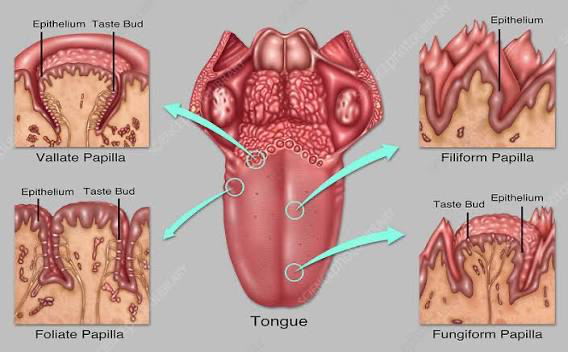
What are folate papillae?
papillae that are posterior and lateral, on the sides of the tongue, few, only seen in infancy and childhood
What are the 5 basic sensations of taste?
sweet (sugars), salty (metal ions), sour (acids), bitter (alkaloids), umami (amino acids)
What cranial nerves are related to gustation?
CN VII (facial) associated with anterior 2/3 of tongue, CN IX (glossopharyngeal) associated with posterior 1/3 of tongue
What is olfaction?
sense of smell
What are olfactory epithelium?
epithelium that lines the superior surfaces of nasal cavities, includes olfactory receptor cells (neurons) that can undergo mitosis
What type of neurons are olfactory epithelium?
bipolar neurons with olfactory hairs that contain receptors for specific molecules, very sensitive
Where do olfactory receptor axons pass through and synapse with?
pass through the cribriform plate of the ethmoid and synapse with neurons in olfactory bulbs (CN I)
What is vision?
detection of EM radiation in 400-700nm range
What is the detector of vision?
eye
What is the integrator of vision?
optic tectum and optic regions of the cerebrum
What is the fibrous tunic?
external layer of the eye that contains the cornea and sclera
What is the cornea?
transparent part of the fibrous tunic, dense irregular CT
What is the sclera?
white part of the fibrous tunic, dense irregular CT
What is the vitreous humor?
liquid that fills the posterior part/main body of the eye
What is the aqueous humor?
liquid that fills the anterior part of the eye
What separates the anterior and posterior compartments of the eye?
lens
What is the vascular tunic?
middle layer of the eye; consists of the choroid, ciliary body, iris, and pupil
What is the choroid?
main part of the vascular tunic, network of capillaries, cells are filled with melanin
What is the ciliary body?
part of the vascular tunic composed of ciliary muscles and processes, alters the shape of the lens
What is the iris?
part of the vascular tunic, pigmented part of the eye
What Is the pupil?
part of the vascular tunic, hole in the eye
What is the retina?
internal layer of the eye, consists of the pigmented and neural layers as well as photoreceptors
What is the pigmented layer?
part of the retina that transports nutrients and oxygen to photoreceptor cells, removes wastes
What is the neural layer?
part of the retina that contains photoreceptors and associated neruons
What are photoreceptors in the retina?
rods that tend to aggregated spherically, cones are more central
What is the fovea centralis?
region in the retina the is dense with cones, has little to no rods
What is the optic disc?
part of the retina, blind spot because this is where CN II enters
What are rods?
photoreceptor cells that are long and narrow, more concentrated in the periphery, detect movement, function under low light, no color
What are cones?
photoreceptor cells that are cone shaped, shorter, concentrated in the center/posterior of the eye, activated by high intensity light and detect color
How are rods and cones arranged in the retina?
“upside down”, more internal while there are neurons on the outside
What cells concentrate light into photoreceptors?
retinal glial cells
What is the auricle/pinna?
cartilage supported structure to help focus sound reception and leads into the auditory meatus
What is the tympanic membrane?
eardrum
What is the middle ear?
tympanic cavity that houses the auditory ossicles
What are the auditory ossicles?
malleus, incus, stapes
What do the auditory ossicles do?
amplify and vibrations on the typmanum
What muscles are associated with the auditory ossicles, what do they do?
tensor tympani and the stapedius, muscles tense in relation to light sound to hear better
What is the oval window?
part of the middle ear in which vibrations are transmitted via the stapes footplate, can amplify or dampen sound
What is the inner ear?
part of the ear that is housed within the temporal bone
What are semicircular canals?
structures in inner ear associated with balance and equilibrium
What is the vestibule?
structure of the inner ear that is continuous with the semicircular canals and cochlea, contains the oval window
What is the cochlea?
coiled structure of the inner ear containing most sensory epithelium, has hair cells and otoliths
What are hair cells?
cells in the cochlea that contain stereoclilia that are sensitive to deflection, bend due to sound and cause an action potential
What are otoliths?
ear stones, made of calcium
How is equilibrium maintained by the ear?
hair cells in the utricle and saccule and semicircular canals → embedded in the otolith/gelatin matrix
head moves the matrix moves against sterocilia which cause neurotransmitter release
action potential is carried through cranial nerve VIII (vestibulochoclear)
How is hearing modulated by the ear?
stereocilia of spiral organ in cochlea is deformed via movement of the tectorial membrane
pressure moves fluid of inner ear → action potential → cochlear branch of CN VIII
What is conjunctivitis?
pink eye; inflammation and reddening of conjunctiva
What is trachoma?
chronic, contagious form of conjunctivitis caused by chlamydia, inflammation due to hypertrophy of conjunctiva
What is a detached retina?
occurs when outer pigmented and inner layers of retina separate, deprivation of nutrients to inner layer since detachment from chorooid
What are floaters?
small particles in vision, symptom of a detached retina
What is pneumatic retinopexy?
treatment for an upper retinal detachment, gas bubble is injected into nitrous humor to push layers back together
What is a posterior vitreous detachment (PVD)?
vitreous humor pulls away from posterior of retina, can mimic detached retina but not as serious
What is macular degeneration?
degeneration of macula of retina, can occur in two forms: dry or wet
What is dry macular degeneration?
macular degeneration with photoreceptor loss and thinning of pigmented layer
What is wet macular degeneration?
macular degeneration similar to dry but also has bleeding, scar tissue, and capillary proliferation
What is the amsler grid?
way of testing a patient to monitor progression of macular degeneration
What are cataracts?
small opacities within lens that over time can obscure it and cause blindness
What is phacoemulsification?
way of removing a cataract where the center of the lens is destroyed and replaced with an artificial lens
What is glaucoma?
disease in which there is incersase pressure in the eye
What is angle-closure glaucoma?
glaucoma in which the angle formed by the corneal-scleral junction is narrowed
What is open angle glaucoma?
glaucoma in which fluid transported out of the anterior chamber is impaired
What is congenital glaucoma?
glaucoma that occurs rarely do to hereditary factors or intrauterine infection
What is emmetropia?
normal vision
What is hyperopia?
farsightedness, “short” eyeball
What is myopia?
nearsightedness, “long” eyeball
What is astigmatism?
unequal focusing and blurred images due to unequal curvature of eye (cornea, lens)
What is presbyopia?
change in lens shape due to increasing age