Wildlife Physio Exam 3
 Call Kai
 Learn
 Practice Test
 Spaced Repetition
 Match
 Flashcards
 Knowt Play
1/42

There's no tags or description
Looks like no tags are added yet.
43 Terms
What is the difference in how Generalists and Specialists deal with temperatures?
*I made this question up bc I had no notes on these graphs*

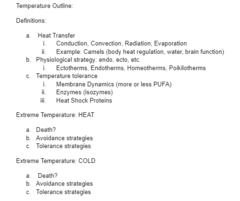
Temperature Outline:

What are the (4 types) of Heat transfer between animals and environment?
1) Conduction
2) Convection
3) Radiation
4) Evaporation
What are the 3 rules for heat transfer between animals and environment?
1. Heat flows from warmer to cooler places
2. The greater the difference in temperature (temp gradient), the greater the transfer of heat (flux)
3. Physical Properties matter (animals with a lot of blubber lose less heat)
What is Conduction?
(one of the 4 types of heat transfer)
Conduction is heat transfer via in direct physical contact.
It depends on...
1) Temperature differential
- if large temp diff, more heat moves
2) Area of contact
- if lizard wants to get more heat it will touch more of the rock (it will flatten itself out)
3) Conductivity of materials
- some conduct more energy than others
- fluffy dog vs. not fluffy dog

What is Conduction + Convection?
(one of the 4 types of heat transfer)
Convection is the bulk movement of fluid.
In Conduction, a hot object heats the area around it, but Convection moves that hot air away.
Convection accelerates heat transfer between solids and fluids (convection increases the heat lost through conduction).
Why does convection accelerate the heat transfer? - bc heat transfer is increased when there is a larger temperature differential (when there is cold air touching the hot air)

What is a Boundary Layer?
Boundary Layer: The thicker the boundary layer, the less heat is lost through conduction (a non-fluffy dog has a smaller boundary layer which makes it lose more heat).
Convection only works outside of the boundary layer.
Size of the boundary layer is influenced by - the size and shape of animal surface roughness fluid speed (air, h2O)

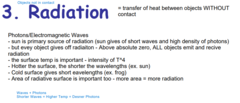
What is Radiation?
(one of the 4 types of heat transfer)
Radiation is the transfer of heat between objects WITHOUT contact.
1) Photons/Electromagnetic Waves
- The sun is primary source of radiation (sun gives of short waves and high density of photons) - but evey object gives off radiaiton - Above absolute zero, ALL objects emit and recive radiation
- The surface temp is important - the intensity of T^4
- The hotter the surface, the shorter the wavelengths (ex. sun)
- Cold surface gives long eavelengths (ex. frog)
- The area of the radiative surface is important too...more surface area = more radiation
What is Evaporation?
(one of the 4 types of heat transfer)
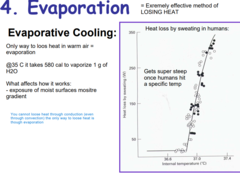
Evaporation is an extremally effective method of LOSING HEAT.
Evaporative Cooling:
When humans hit a specific temperature they begin to produce sweat (sweat is heat lost via evaporation)
@35 C it takes 580 cal to vaporize 1 g of H2O
Only way to lose heat in warm air = evaporation
You cannot loose heat through conduction (even through convection) the only way to loose heat is though evaporation
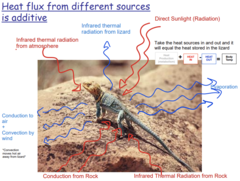
What does it mean to say "Heat flux from different sources is additive"?
If you add the (heat in) and subtract the (heat out) it will equal the heat stored in the lizard (body temp).
+ Heat in - Heat out = Heat Stored (Body Temp)
What is the main example (animal) of Heat Transfer that was discussed in class?
Camels!
They can live in Ta (air temp) that can exceed 50ºC (138 F)
How do they cope with this?
1) Body Heat Regulation
2) Water
3) Brain Function

How do Camels live in such extreme conditions? How do they cope?
1) Body Heat Regulation
2) Water
3) Brain Function

Body Heat Regulation:
(one of the ways camels cope with heat)
Body Heat Regulation:
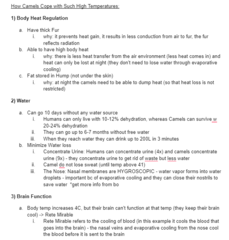
1) Have Thick Fur
2) They are able to have high body heat (body heat can increase above 37C)
3) Fat Stored in Hump (instead of under the skin)
Why do Camels have thick fur?
(form of body heat regulation)
Camels have thick fur bc it prevents heat gain
It results in less conduction from air to fur
The fur reflects radiation
Prevents Evaporation
Look at Photo...
Shaved camel lost more water through evaporation than the unshaved camel

Why do Camels increase their body temp?
(form of body heat regulation)
Camels increase their body temperatures because there is less heat transfer from the air environment (less heat comes in)
Heat can be lost at night, they don't need to lose water through evaporative cooling

Evaporative Cooling:
As a liquid evaporates, its remaining surface cools.
Evaporative cooling examples:
- Sweating
- Panting in dogs
- Wet noses in some animals

Why do Camels Store Fat in their Hump?
(form of body heat regulation)
At night the camels need to be able to dump heat (so that heat loss is not restricted).

Water:
(one of the ways camels cope with heat)
Camels can go 10 days without any water source:
- Camels can go up to 6-7 months without free water
- Humans can only live with 10-12% dehydration, whereas Camels can survive w 20-24% dehydration
They minimize water loss:
- Concentrate Urine (they concentrate urine to get rid of waste but less water)
- Camels do not lose sweat until temp above 41
Camels Noses:
- Nasal membranes are HYGROSCOPIC (water vapor forms into water droplets - important bc of evaporative cooling, and they can close their nostrils to save water.
(Ava remember to get other notes from Bo if he has any)

Brain Function:
(one of the ways camels cope with heat)
Body temp increases 4C, but their brain can't function at that temp (they keep their brain cool) -> Rete Mirable (the cooling of blood in the brain)

What is "Rete mirabile"?
(form of brain function/coping with heat)
Rete mirabile = Counter Current Exchange
It refers to the cooling of blood (in this example it cools the blood that goes into the brain)
The blood goes into nasal veins and evaporative cooling from the nose cools the blood...the blood then travels up into the brain and therefore the brain doesn't get too hot.

Animals that have a Rete mirabile often have a _________________ brain temperature.
Animals that have a Rete mirabile often have a cooler brain temperature.
*look at graph*

What are the Physiological/Thermal Strategies?
(hint: different types of animals)
1) Ectotherms - body temp dependent on extremal heat sources
2) Endotherms - body temp dependent on internally generates metabolic heat
3) Homeotherms - body temp constant
4) Poikilotherms - body temp varies/changes

What does Tb and Ta stand for?
Ta = air temp
Tb = body temp

Thermal Tolerance:
Thermal Tolerance can be Biochemical:
1) Membrane Dynamics
2) Enzymes (isozymes)
3) Heat Shock Proteins
Thermal Preformance Curves:
Each animal has their preferec body temp (thermal preformance curve).
But, when there is an enviornmental temperature shift, the thermal preformance curve (and preferred body temp) changes too.
If the enviornmental shift creates colder temperatures (shifts to the left) the animals preferred temp will be at a colder temperature as well.
and they will eat more foods with higher percentages of unsaturated fats (PUFA) *we will get to this soon*

Membrane Dynamics:
(type of Thermal Tolerance/Acclimation)
The cell membrane made of Lipid Bilayer
Things that Effect Cell Membrane Fluidity:
1) Temperature
2) Unsaturated/Saturated Fats
Unsaturated = More Fluid (has more kinks/double bonds)
Saturated = Less fluid (more stiff)

Are Unsaturated or Saturated Membranes more Fluid?
Unsaturated Membranes are more Fluid.
They have more kinks/double bonds

Are Unsaturated or Saturated Membranes Less Fluid?
Saturated Membranes are less Fluid.

What are the "Kinks" in Unsaturated Membranes?
The "Kinks" are the double bonds in Unsaturated fatty acids (more double bonds = less saturated with hydrogen)
Kinks in membrane change fluidity (more kinks = more fluid)

__________________ also has major effects on cell membrane fluidity (in addition to Unsaturated/Saturated Fats)
Temperature also has major effects on cell membrane fluidity.
Animals that live in Hot Climates have more Saturated Fats
- If you have too many unsaturated fatty acids when its hot it will be too fluid.
Animals that live in Cold Climates have more Unsaturated Fats
- If you have too many saturated fatty acids when its cold it will be too compact.
Look at the table...
*remember in the ratio of Sat/Unsat, higher number means more Saturated Fatty Acids, while lower number means more Unsaturated*

If you live in hot climate, what sort of fatty acids should you have?
In Hot climates, you would want more Saturated Fats.
You want less kinks in them (less fluid), you don't want the fatty acids to fall apart/be too fluid.

If you live in cold climate, what sort of fatty acids should you have?
In Cold climates, you would want more Unsaturated Fats.
You would need to stay fluid in cold temperatures - if you have too many saturated fatty acids when its cold it will be too compact
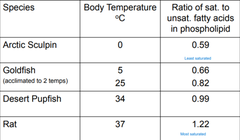
What Ratio of Saturated to Unsaturated fatty acids would an animal have that lives at 0 degrees C?
a. 1.22
b. 0.99
c. 0.82
d. 0.59
*remember in the ratio of Sat/Unsat, higher number means more Saturated Fatty Acids, while lower number means more Unsaturated*
What Ratio of Saturated to Unsaturated fatty acids would an animal have that lives at 0 degrees?
d. 0.59
*remember in the ratio of Sat/Unsat, higher number means more Saturated Fatty Acids, while lower number means more Unsaturated*

What Ratio of Saturated to Unsaturated fatty acids would an animal have that lives at 37 degrees C (hot temp)?
a. 1.22
b. 0.99
c. 0.82
d. 0.59
*remember in the ratio of Sat/Unsat, higher number means more Saturated Fatty Acids, while lower number means more Unsaturated*
What Ratio of Saturated to Unsaturated fatty acids would an animal have that lives at 37 degrees C?
a. 1.22
*remember in the ratio of Sat/Unsat, higher number means more Saturated Fatty Acids, while lower number means more Unsaturated*

Enzymes:
(type of Thermal Tolerance/Acclimation)
Isozymes: Different forms of particular enzymes with different optimal temperatures (different forms of the same enzyme work better at different temperatures)
Example of Isozymes: Lizards with 4 different forms of ATPase (Isozymes) each have a separate thermal preformance curve.
(the isozymes work best near the preferred body temp of the species) *look at graph*

Isozymes are a form of ___________________ not Adaptation
Isozymes are a form of Acclimation not Adaptation:
- They can use Isozymes to acclimate to a specific temperature (it can change day to day)
Think of goldfish even though they have their own performance curve...
- When they are put in a specific temperature, they will eventually acclimate to that temperature (5C to 25C) *look at graph)

Heat Shock Proteins:
(type of Thermal Tolerance/Acclimation)
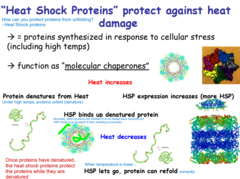
"Heat Shock Proteins" protect against heat damage...
Heat Shock Proteins are produced at high temps to function as a molecular chaperone, and protect proteins while they are denatured.
Step 1) As temperatures increase Protein Denatures (Unfolds) from Heat and Heat Shock Protein Expression Increases
Step 2) Heat Shock Protein binds to denatured (unfolded) protein and protects them from refolding incorrectly (which they would do if they were on their own)
Step 3) Once temperature lowers, Heat Shock Proteins let go and the protein then folds back correctly at the cooler temperatures
Examples: Cataglyphis Ants
Explain how Heat Shock Proteins work in Cataglyphis Ants:
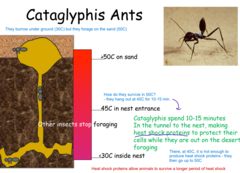
They burrow under ground (30C) but they forage on the sand (50C) and most animals cannot even survive at (50C)...How do they do this?
Cataglyphis spend 10-15 minutes in the tunnel (at 45C), making heat shock proteins to protect their cells while they are out on the desert foraging.
There, at 45C, it is hot enough to produce heat shock proteins. They then go up to 50C.
Heat shock proteins allow animals to survive a longer period of heat shock (prevents the denatured proteins from refolding incorrectly)
When referring to Membrane Dynamics...
What do animals do when it gets colder?
They incorporate more PUFA into their diet
PUFA = Percent Unsaturated Fatty Acids
When referring to Membrane Dynamics...
What do animals do when it gets warmer?
They use less PUFA
PUFA = Percent Unsaturated Fatty Acids
When referring to Enzymes...
What do animals do when it gets colder or hotter?
They change the Isozymes that they use.
Heat Shock Proteins protect against incorrectly refolding from killing cells.
Heat Shock Proteins protect against incorrectly refolding from killing cells.
Temperature Outline: