Hist of Western Art Exam 2
 Call Kai
 Learn
 Practice Test
 Spaced Repetition
 Match
 Flashcards
 Knowt Play
1/95

There's no tags or description
Looks like no tags are added yet.
96 Terms

Oldest/heaviest. Considered masculine and is from the mainland Greeks.
Doric

has roots in the Aegean's and comes from the Ionian mainland Greeks
Ionic

Feminine, did not appear until the 5th century and first appeared on the inside before being used on the outside.
Corinthian

Architrave

Echinus

Pediment

Volute

Abacus

Dentil

Boss

Acanthus

Triglyph

Sterobate

Stylobate

Flute

Metope
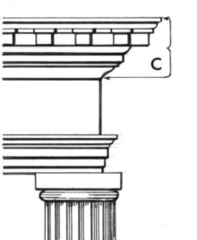
Cornice

Entablature

Frieze
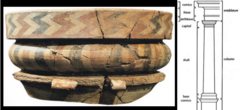
Capital

Necking

Raking Cornice
Name the three orders and their characteristics?
Doric-oldest/heaviest. Considered masculine and is from the mainland Greeks.
Ionic has roots in the Aegean's and comes from the Ionian mainland Greeks.
Corinthian-feminine, did not appear until the 5th century and first appeared on the inside before being used on the outside.
Name some buildings from the Greeks?
Panthenon, Erectheon, Propylaea, Greek theater, ect...
What is unique about their temples?
Greek temples faced outward, by that, they turned their temples inside out with the altar at the front of the building.
Most of the importance was on the concept of the architecture. This idea generally concentrated the efforts to make the temple suitable for the monuments and deities.
Early Archaic temples were long and narrow or roughly 1:3 ratio.
Late Classical temples were roughly 1:2
There are four (4) phases in Greek art, they are?
Geometric, Archaic, Classical, Hellenistic
What does CONTRAPPOSTO mean? Give an example.
CONTRAPPOSTO: to set against…counter balance. Example- Kritios Boy
What is a stereobate?
A solid mass of masonry serving as a foundation for a wall or row of
columns.
What is a peristyle?
A row of columns surrounding a space within a building such as a court or
internal garden or edging a veranda or porch.
What is an echinus?
A rounded molding below an abacus on a Doric or Ionic capital.
What is an entablature?
A horizontal, continuous lintel on a classical building supported by
columns or a wall, comprising the architrave, frieze, and cornice.
What is an architrave?
Trim within the entablature
Give me all and any details about the Parthenon:
Parthenon was built as a Greek temple, but later became a BYZANTINE church, then
Catholic cathedral and finally a MOSQUE.
1687 became a ruin after gunpowder blew up.
Much of the sculpture was removed during the years of 1801-03 by Lord Elgin. Some the British marbles greatest treasures today!
A temple to Athena Parthenos.
The style is a PERIPTERAL STYLE, slightly less half the length.
The NAOS had double row columns for roof support, according to some it had a second story gallery level for viewing the goddess. (Pronaos is the front porch)
The middle of the floor is the highest, for drainage.
PROPYLAEA – WHAT IS IT? WHY IMPORTANT?
Gateway onto the acropolis. The middle columns are spread further for easy access of horses and chariots. Has a mix of two orders, doric outside and ionic inside. Had an area for art and displaying the works of the day.
What is the Kouros?
Greek for young man Archaic Kouroi, nearly always nude, have been identified as various gods, warriors, and victorious athletes.
Male/youth thought of as portraits ARE not the head but that of the body.
free standing and walking forward, seen in the round
What is the Kore?
Greek for the young woman, always clothed and probably presented deities, or priestesses.
Like Kouros (youth/male) they are young, hence their name, which means youth/female.
Both types were produced by the hundred and their general outline “shape” remained for centuries. And they would have been painted!
KRITIOS BOY: WEIGHT SHIFT, WHY IS THIS IMPORTANT?
Has a dramatic transition and marks a turning point from Archaic to Early Classical.
A nonsymmetrical pose.
CONTRAPPOSTO: to set against…counter balance…moving away from Archaic into Classical
Laocoon and Sons – why do we study this sculpture?
Represents the episode of pre-roman history, when the trojan priest warns them of the trojan horse theory
See them being punished by poseidon’s sea serpents
This piece is the first link to the chain of events that lead ot the founding of rome
Feel the pain and desperation
Sensory overload of all the things happening and shift from the classical period
In discovering man, the Greeks discovered and confronted the problems of persistence and change. Their saying was?
•MEN PASS AWAY, BUT MANKIND REMAINS.
Which building had female columns?
Erechtheion
Who created the Discobolus?
Myron
What are the similarities and differences between Egyptian statues and Greek Kouros?
Foot forward stance, pose, 360 view
Talk about their theater?
Stage at bottom, tired seats, slopped terrain, half circle
Which politician rebuilt Acropolis?
Pericles
What does Acropolis mean?
High city
What makes up the Greek architecture? (hint 3 things)
Platform, Column, Entablature
What is a NAOS?
Main room
What is a PRONAOS?
The porch of course!
Which Greek building was a BYZANTINE church, then Catholic cathedral and finally a MOSQUE.
Parthenon
What is a stylobate?
a continuous base supporting a row of columns
What is a Volute?
a spiral scroll characteristic of Ionic capitals and also used in Corinthian and composite capitals.
What determines a portrait in Greek art?
Greek: Full body sculptures
Roman: a bust or a head can be deemed a portrait
Greek Pottery Terms to know?
Amphora
Kantharos
Hydria
Aryballos
Krater
Pelike
Kylix
Skyphos
Volute Krater..
Temple of Portunus (A.K.A. Temple of Fortune)
Oldest preserved Roman temple.
DESCRIBE influences do you see here? Greek how?
Ionic columns, peripteral style
High podium (pronaos), engaged columns
Let’s talk about the Colosseum. Major points of interest?
Think about what when on in the colosseum, think about architectural key components, also think about rank in seating-who sat where.
The Pantheon, what makes it famous?
Largest dome for 1800 yrs, how could this work? 3 types of concrete, Coffered ceilings
Arches: how they work? Think about concrete too.
Concrete: built quickly, make stuff quickly
Roman arches work by distributing weight outward and downward through a curved structure, allowing Romans to build larger openings, doorways, bridges, and buildings without needing a solid wall underneath.
Roman sculptures – what about them is different than the Greeks?
They are freestanding
Romans like Sarcophagi – why? What changed?
Romans shifted from cremation to inhumation (burying the body) around the 2nd century AD, and a body needs a container. Sarcophagi became the showpiece for that.
4 Roman painting styles- be able to know the names
incrustation/masonry
architecture/illusional
ornate
intricate
Sanctuary of Fortuna. How is this a product of Roman genius?
Combines concrete, barrel vaults and arcaded terraces with Hellenistic design. This turned a steep hillside into a grand, axially planned, theatrical complex that Greek builders working in post and lintel could not easily have achieved.
Roman art was “art of the Republic and Empire.” What does that mean?
“Art” created by Roman artists came with the help from Greeks for the Empire.
Think of it as: an art that brings diverse elements together to produce something entirely new. (Greek + Roman= new art)
Name the function of centering
temporary wooden framework that holds the stones in place until the arch is complete and can support itself
Name the functioning of voussoir
a wedge-shaped stone that transfers the load outward and downward through compression
Name the functioning of keystone
central, final voussoir that locks the arch and completes the load path
Name the function of vault
an arch extended or combined to roof a space, which gave the Romans large open interiors without dense columns
Name the function of pier
the sturdy vertical support that takes the arch's weight and thrust down to the foundation
Name the function of barrel vault
a continuous series of arches forming a tunnel-like roof, used for corridors, bridges, aqueducts and terraces
Name the function of raking cornice
Name the function of echinus
Name the function of groin vault
Name the function of abacus
Name the function of dentils
Name the function of buttress
What is the Temple of Portunus (AKA Temples of Fortune)
Oldest preserved Roman temple
Has a Greek feel but is Roman. Greek how?
Ionic columns, peripteral style
High podium (porch), engaged columns
Laying out a Roman city. How were they formed? Who can explain/illustrate it?
North/south road was called?
East /West?
Major points of interest of the Colosseum
The Pantheon, what makes it famous?
Largest dome for 1800 yrs, how could this work?
3 types of concrete
Coffered ceilings
Talk about Roman sculptures/Portraits.
Showed aging
Used bust only
Showed Emperor as majestic
Name 3 distinct phases of the Aegean culture
Crete
Cycladic
Helladic
The king was
Minos
What is the formal name of the European civilization-
Minoan
_______________ uncovered the palaces starting in the 1870s
Heinrich Schliemann
What is about the Minoan fresco painting
Architecture was _________, __________, _____________
complex
comfortable
massive
What was palace life like?
Palace life was communal, so was death
Where did we find most of their art?
in the tombs/palace
Palace was what to them and it was the place for the ___________
the temple
What is the Minotaur theory?
What was the name of the main palace?
What is a fresco?
What seems to be their favorite game to the Aegan’s?
Explain Minoan pottery
What is unique in the Harvester vase?
What is the name of their writing called?
Linear B
Explain the snake goddess