Life Sci 7a - Week 4 Question Bank || 4A: Photosynthesis; 4B: nucleic acid structure, transcription (part 1)
 Call Kai
 Learn
 Practice Test
 Spaced Repetition
 Match
 Flashcards
 Knowt Play
1/57

There's no tags or description
Looks like no tags are added yet.
58 Terms
Write the equation that describes photosynthesis. Which molecules are oxidized and which molecules are reduced?
The overall photosynthetic reaction is 6CO2 + 12H,O→CH1206 + 60½ + 6H20, in which CO2 is reduced to G,H1206 and HO is oxidized to O2.
If you want to produce carbohydrates that contain the heavy oxygen (1°O) isotope, should you water your plants with H,180 or inject C1®O2 into the air?
You should label the oxygen in CO2 (that is, inject C'8O2) because the entire CO2 molecule is used in synthesizing carbohydrates, whereas H2O donates only the electrons needed for the reduction phase of the Calvin cycle. The extraction of electrons from water releases 02 as a by-product.
In what ways are photosynthesis and cellular respiration similar and in what ways are they different?
In photosynthesis, energy from sunlight is captured in chemical forms (NADPH and ATP) that are used to synthesize carbohydrates from CO2. In cellular respiration, carbohydrates are oxidized to CO2, releasing energy that is ultimately used to synthesize ATP. In photosynthesis, H2O is the ultimate electron donor and O2 is produced as a by-product. In cellular respiration, O2 is the ultimate electron acceptor and H2O is produced as a by-product.
How do antenna chlorophylls differ from reaction center chlorophylls?
Antenna chlorophylls transfer absorbed energy from one antenna chlorophyll molecule to another, and ultimately to the reaction center.
Reaction center chlorophylls transter electrons to an electron acceptor, resulting in the oxidation of reaction center chlorophyll molecules.
Why are two photosystems needed when H20 is used as an electron donor?
Photosystem II is needed to pull electrons from water, and photosystem I is needed to raise the energy of these electrons enough that they can reduce
NADP+ to NADPH.
How is energy from sunlight used to produce ATP?
ATP is produced by ATP synthase when there is a high concentration of protons in the lumen compared to that in the stroma. Photosynthetic electron transport results in a high concentration of protons in the lumen in two ways: (1) as a result of splitting water, and (2) from the coupled movement of electrons and protons that involves both plastoquinone and the cytochrome-bof complex. Because sunlight powers the movement of electrons through the photosynthetic electron transport chain, it is the energy source for producing ATP in photosynthesis.
What are the products of linear electron transport and cyclic electron transport? What is the role of cyclic electron transport?
Linear electron transport makes both NADPH and ATP; cyclic electron transport produces only ATP. The role of cyclic electron transport is to increase the production of ATP to the ratio required by the Calvin cycle.
These electrons are routed into an alternative pathway (the cyclic electron transport system), which creates ATP by contributing to the proton gradient that drives the conversion of ADP to ATP by ATP synthase.
What are the major inputs and outputs of the Calvin cycle?
The major inputs of the Calvin cycle are CO2 (from the atmosphere) and ATP and NADPH (from the photosynthetic electron transport chain). The major output of the Calvin cycle are carbohydrates (triose phosphates); ADP and NADPt are also released.
What are the three major phases in the Calvin cycle and the role of the enzyme rubisco?
In the first phase (Carboxylation), CO2 enters the Calvin cycle and is added to the 5-carbon compound RuBP in a reaction catalyzed by the enzyme rubisco, generating 3-phosphoglycerate (3-PGA).
In the second phase (Reduction), the 3-PGA is reduced through conversion of ATP to ADP and NADPH to NADP+ producing triose phosphate. Some of the triose phosphate molecules exit the cycle and are used by the cell to provide energy (by respiration) or to synthesize larger molecules.
In the third phase (Regeneration), triose phosphate molecules are used to regenerate RuBP through reactions that require ATP. Then the cycle starts again with more CO2.
The Calvin cycle requires both ATP and NADPH. Which of these molecules provides the major input of energy needed to synthesize carbohydrates?
NADPH supplies the major input of energy that is used to synthesize carbohydrates in the Calvin cycle.
During photosynthesis, _____ is reduced to _____ .
CO2; sugar
In plants and algae, _____ is the source of the electrons needed for photosynthesis.
H2O
In plants and algae, what is a product of photosynthesis?
Glucose
Which of the answer choices is true when comparing the Calvin cycle and light-harvesting reactions of photosynthesis?
- They take place in different types of cells in the plant.
- They take place in different organelles.
- They take place in different compartments of the same organelle.
- None of the other answer options is correct.
They take place in different compartments of the same organelle.
Where is the photosynthetic electron transport chain located in plant cells?
in the thylakoid membranes of the chloroplast
How does light behave differently when it is absorbed by chlorophyll in a solution compared to when it is absorbed by chlorophyll in a plant cell?
when light is absorbed by chlorophyll in a solution, it is given off as heat and fluorescence, whereas in a plant cell it is transferred to an adjacent chlorophyll molecule.
As electrons flow from one photosystem to another, the amount of energy present in the electrons decreases.
How does the plant cell use the energy lost by the electrons?
The energy is used to maintain a low pH in the thylakoid lumen.
Chloroplast ATP synthases are powered by the flow of protons from the:
thylakoid lumen to the stroma.
Correctly describe the role of rubisco in the Calvin cycle
Rubisco incorporates CO2 from the atmosphere into an organic molecule.
In photosynthesis, the reorganization of triose phosphates to produce RuBP requires:
ATP only
Carbon enters the Calvin cycle in the form of:
CO2
1. What are three key structural features of DNA?
(1) DNA is made up of subunits called bases. (2) DNA is a linear polymer of nucleotides with sugar subunits linked by phosphodiester bonds. (3)
Cellular DNA is a double helix with two strands that are antiparallel to each other.
The letter R is conventionally used to represent any purine base (A or G) and Y to represent any pyrimidine base (T or C). In double-stranded DNA, what is the relation between the number of molecules of R and the number of molecules of Y?
Because R = A or G, number of R = number of A + number of G. Also, because number of A = number of T and number of G = number of C, we can write number of R = number of A + number of G = number of T + number of C. But T or C= Y, so number of T + number of C= number of Y. It follows that number of R = number of Y.
How does the sequence of a molecule of DNA, made up of many subunits of only four nucleotides, encode the enormous amount of genetic information present in living organisms?
Just four nucleotides can give rise to the vast diversity of genetic information because the nucleotides can occur in any order. Any base on a strand of DNA can be followed by any other base (A, I, G, or C), which gives rise to an enormous potential genetic diversity of any given gene.
How are the parental strands in a DNA molecule used in DNA replication?
During DNA replication, the two strands of the double helix unwind and separate, disrupting the hydrogen bonds and base stacking that hold the strands together. Each parental strand serves as a template for a new complementary strand of DNA because of the specific pairing of the bases: an A on the template will always specify a T on the new strand, a Gon the template will always specify a C on the new strand, and so on. The end result of DNA replication is two daughter DNA molecules that have identical sequences to the original parental molecule.
What is the usual flow of genetic information in a cell?
The usual flow of genetic information in a cell is from DNA to RNA to protein.
What are four differences between the structures of DNA and RNA?
Structural differences between DNA and RNA include the following. (1) The sugar in RNA is ribose, whereas the sugar in DNA is deoxyribose. (2) The base thymine in DNA is replaced by uracil in RNA. (3) DNA molecules are usually double stranded, whereas RNA molecules are usually single stranded. (4) DNA molecules are typically very long, whereas RNA molecules are usually much shorter than DNA molecules.
What are the stages of transcription?
Initiation: RNA polymerase (and other proteins) are attached to the double-stranded DNA; DNA is split
Elongation: Successive RNA-nucleotides are added to the 3' end of the RNA primary transcript
Termination: RNA polymerase encounters a sequence on the template DNA that stops transcription and released RNA
How is transcription regulated?
Promoters: small sequence of base pairs on the double helix where RNA polymerase and other proteins bind
Terminators: DNA sequence where transcription stops
How do eukaryotes recognize promoters on the DNA?
1. General transcription factors (a type of protein) bind to the promoters of a gene to start transcription
2. Transcriptional activator proteins bind to specific DNA sequences before the promoters called enhancers; this protein helps control when and in which cells transcription occurs
A segment of one strand of a double-stranded DNA molecule has the sequence 5'-ACTTTCAGCGAT-3'. What is the sequence of an RNA molecule synthesized from this DNA template?
The RNA transcript has the sequence 5'-AUCGCUGAAAGU-3'.
What is the consequence for a growing RNA transcript if an abnormal nucleotide has a 3'-H instead of a 3'-OH? What if the nucleotide has a 2'- H rather than a 2'-OH?
The incorporation of a nucleotide with a 3'-H group rather than a 3'-OH group will stop subsequent elongation because the 3'-OH group is necessary to attack the high-energy phosphate bond of the incoming nucleoside triphosphate. The incorporation of a nucleotide with a 2'-H group rather than a 2'-OH group will have no effect on elongation, as this group is not involved in the polymerization reaction.
The strands in a double helix of DNA are:
antiparallel
complementary
held together via hydrogen bonds
wound around each other with 10 base pairs per turn
Which statement is true of DNA?
- A pyrimidine always forms a complementary base pair with another pyrimidine.
- The percentage of the purine A always equals the percentage of the purine G.
- A phosphate group in a nucleotide is attached to the 5′ carbon in deoxyribose.
- It is used by ribosomes for translation.
- Successive nucleotides in a strand are connected by hydrogen bonds.
A phosphate group in a nucleotide is attached to the 5′ carbon in deoxyribose.
In a double-stranded DNA molecule, the strands are said to be antiparallel because:
one strand runs in 5′ to 3′ direction and the other in 3′ to 5′.
In a DNA strand, phosphodiester bonds are:
Present to help link two nucleotides together.
Which statement about RNA is correct?
- RNA is usually found in single-stranded form, unlike DNA.
- RNA molecules are synthesized in 3′ to 5′ direction.
- The nucleotide at the 5′ end of an RNA molecule is typically a nucleoside bisphosphate.
- RNA molecules are incapable of evolving an enzymatic activity over time.
- RNA molecules are typically longer than DNA molecules.
RNA is usually found in single-stranded form, unlike DNA.
In gel electrophoresis, how would a DNA molecule that is negatively charged compare to another DNA molecule that is negatively charged?
Not enough information is provided.
In gel electrophoresis, DNA fragments migrate toward the positive pole of the electric field. (T/F)
True
Which components are necessary for eukaryotic transcription?
RNA polymerase, general transcription factors, DNA, and RNA nucleotides
In eukaryotes, where do general transcription initiation factors bind?
Promoters
Transcription continues until:
a terminator sequence is encountered
The role of H2O in photosynthesis is analogous to _______ in respiration.
NADH
A plant cell is exposed to a toxin that makes the thylakoid membrane freely permeable to protons. As a result of adding this toxin, the amount of NADPH in the chloroplast would most likely _____ over time.
Increase
A plant cell is exposed to a toxin that inactivates ATP synthase. As a result of adding this toxin, the amount of glucose available for cellular respiration in this cell would most likely _____ over time.
Decrease
A plant cell is exposed to a toxin that inactivates NADP+ reductase (NADPR). As a result of adding this toxin, ATP production would most likely _____ over time.
Decrease

You are studying an herbicide that changes the redox potential of either Fd or NADPR, but you are not sure which one. You treat a plant with the herbicide and observe that NADPR starts accumulating in its oxidized form. Use this information to answer the following questions.
T/F: Based on your results, your herbicide could be changing the redox potential of NADPR from -380 mV to +400 mV.
False
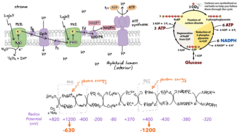
You are studying an herbicide that changes the redox potential of either Fd or NADPR, but you are not sure which one. You treat a plant with the herbicide and observe that NADPR starts accumulating in its oxidized form. Use this information to answer the following questions.
T/F: Based on your results, your herbicide could be changing the redox potential of Fd from -430 mV to +400 mV.
True
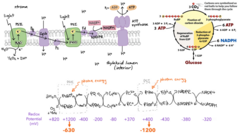
You are studying an herbicide that changes the redox potential of either Fd or NADPR, but you are not sure which one. You treat a plant with the herbicide and observe that NADPR starts accumulating in its oxidized form. Use this information to answer the following questions.
The pH of the thylakoid lumen would ____ after treatment with the herbicide compared to before treatment.
Increase
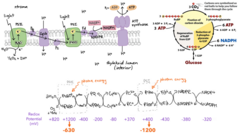
You are studying an herbicide that changes the redox potential of either Fd or NADPR, but you are not sure which one. You treat a plant with the herbicide and observe that NADPR starts accumulating in its oxidized form. Use this information to answer the following questions.
Carbon fixation by the enzyme RuBisCO would ____ after treatment with the herbicide compared to before treatment.
Decrease
A template DNA strand contains the sequence 3'-GATAGCCT-5'. The corresponding sequence in the RNA transcript is:
5'-CUAUCGGA-3'
A template DNA strand contains the sequence 5'-ACGGTCTA-3'. The corresponding sequence in the RNA transcript is:
5'-UAGACCGU-3'

For the following questions, refer to the diagram below which shows a short region of a double-stranded DNA molecule. The horizontal lines indicate the DNA backbones. The numbered boxes refer to potential transcription start sites. The top strand is the template strand for sites 1 and 2, and the bottom strand is the template strand for sites 3 and 4.
What would be the first 12 nucleotides of the RNA molecule if transcription started at start site 1?
5'-UAUGCCCAAUGC-3'

For the following questions, refer to the diagram below which shows a short region of a double-stranded DNA molecule. The horizontal lines indicate the DNA backbones. The numbered boxes refer to potential transcription start sites. The top strand is the template strand for sites 1 and 2, and the bottom strand is the template strand for sites 3 and 4.
What would be the first 12 nucleotides of the RNA molecule if transcription started at start site 4?
5'-CGUAACCCGUAG-3'

For the following questions, refer to the diagram below which shows a short region of a double-stranded DNA molecule. The horizontal lines indicate the DNA backbones. The numbered boxes refer to potential transcription start sites. The top strand is the template strand for sites 1 and 2, and the bottom strand is the template strand for sites 3 and 4.
Which transcription start site would result in an RNA transcript in which the first 12 positions were 5'-AUGCCAAAUGCG-3'?
Start site 3
An organism's genomic DNA is analyzed and found to contain 22% thymine. What percentage of that organism's DNA is guanine?
28%

You are running four different DNA samples (#1, #2, #3, #4) on a gel. For each of the following questions, determine which lane on the gel (A-E) shows the results you would predict to observe.
Lane that shows the results of running Sample #3 only:
Lane C

You are running four different DNA samples (#1, #2, #3, #4) on a gel. For each of the following questions, determine which lane on the gel (A-E) shows the results you would predict to observe.
Lane that shows the results of running Sample #2 and Sample #4 together:
Lane E