PHY 302K Exam 3
 Call Kai
 Learn
 Practice Test
 Spaced Repetition
 Match
 Flashcards
 Knowt Play
1/68

There's no tags or description
Looks like no tags are added yet.
69 Terms
Fundamental vs derived properties
Fundamental is measured (time, length, and mass) while derived has to be calculated (volume)
Measurements are based on
Comparison
What is important with measurements
Accuracy and precision
What to compare measurement to
Standard units (SI) = metric systems
3 most fundamental quantities and their unit and symbol
Length: meter (m) mass: kilogram (kg) Times: seconds (s)
what is position
the location of an object; a point; measured by length [m]

What is displacement?
from start point to the end point; measured by length [+/-m]

What is velocity?
Speed in a given direction (length/time)

what is acceleration
rate of change of velocity; speed (length/time^2)
initial and final position notation
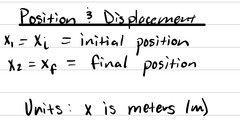
displacement can also be described as
change in position

What is a vector?
arrow that includes magnitude (#) and direction (+ or -)

what is distance in reference to displacement
distance = absolute/positive displacement
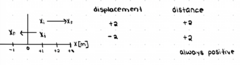
Δx = ?
change in postion
Δt = ?
change in time
average velocity units
meters/second
average speed is always
positive
what does positive and negative velocity look like graphically

how is average velocity different than instantaneous
same average velocity but different instantaneous
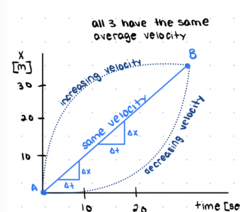
what is instantaneous velocity
the velocity of an object in motion at a specific point in time
instantaneous velocity equation

The smaller the Δt (in instantaneous velocity) the (more/less) instantaneous
more

in changing velocity, instantaneous velocity (=/≠) average velocity
≠
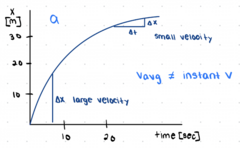
in constant velocity, instantaneous velocity (=/≠) average velocity
=
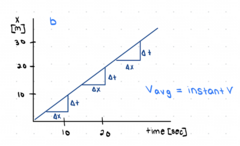
describe the difference between changing and constant velocity graphically

on a velocity graph what is the relationship between speed and slope
direct
What would a graph look like that an object starts moving slow but then speeds up faster

change in velocity =
acceleration

what are the units for acceleration
m/s^2
if velocity is constant and positive then what does the graph for acceleration look like
constant positive acceleration

if velocity is constant and negative then what does the graph for acceleration look like
constant negative acceleration

instantaneous acceleration equation

as velocity has increased but has now plateaued what is the acceleration doing
decelerating; negative slope

as velocity has increased with a positive slope what is the acceleration doing
constant acceleration ; + straight line

in changing acceleration does instant acceleration (=/≠) average acceleration
≠
in constant acceleration does instant acceleration (=/≠) average acceleration
=
What would constant acceleration look like graphically plotted against time
acceleration is always the same

What would constant acceleration look like graphically plotted against velocity and time

what is the final velocity formula w/ constant acceleration

what is the displacement formula (x) with velocity and acceleration

What would a graph look like that plots displacement against time with an object accelerating
shows the displacement and velocity vectors
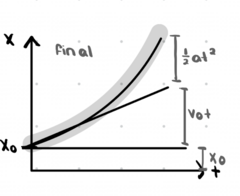
what is the displacement formula w/o time

can an object change its direction of travel while maintaining a constant acceleration (direction of acceleration doesn't change)
yes, gravity always pulls down
at a constant acceleration; velocity changes acceleration doesn't; ball thrown up in the air and the
falls down

at the top of a parabola what the the velocity
0
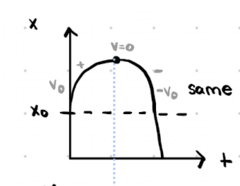
what does displacement, velocity, and acceleration look like graphically for a ball thrown up in the air and falls down (in order)
1) no change in displacement but velocity is (-) and (+)
2) velocity increases, is zero, then decreases
3) acceleration is constant and negative

velocity vector on x and y plane symbol

what axis does gravity affect
Y only (x is not affected by gravity)
how to find Vx from a 2D motion graph
Vx=vcosθ

how to find Vy from a 2D motion graph
Vy=vsinθ

how to find θ from a 2D motion graph
tan^-1 (Vy/Vx)

how to find magnitude (v) from a 2D motion graph

In 2D motion if the resulting vector bends what does it have to have
acceleration/ changing velocity
In 2D motion what does friction change
vector magnitude not the angle of the vector/line
In 2D motion how does gravity behave on a projectile
evenly from the very start

based on pushing a projectile off a surface how do you find the x and y velocities
x velocity is constant (same as initial; a=0 )
y starts as 0 but then is accelerating at -9.8 m/s so use Vy=-gt=at
how does Vy change in a projectile making a parabola
velocity starts at its highest and decreases to 0 as it reaches the peak and then goes negative all due to gravity

how does Vx change in a projectile making a parabola
it doesn't; constant
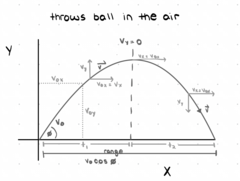
how does the time to reach the peak relate to the time to hit the ground in a projectile making a parabola
t1=t2

horizontal motion equations for 2D

vertical motion equations for 2D

how does the x direction affect the y
they don't; completely independent from each other
how does the launch angle affect the distance launched
(in 2D projectile motion making a parabola; constant force)
higher the angle the higher the initial velocity and more time spent in the air

what is the optimal launch angle
45 degrees
how to find which projectile will be in the air longer and why
the higher peak will spend more time in the air bc they both fall at -9.8m/s so the shorter peak will reach the ground first

Consider the situation shown here. A projectile is pointed at a person hanging from the gutter of a building. The person lets go and at the same time the projectile gets fired. The initial velocity of the projectile is vo. What happens?

how would you graph the monkey with displacement
second example is with just initial horizontal velocity

how to find total velocity when vectors makes right angle
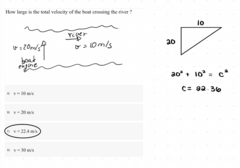
if I have a velocity vs time graph with a positive constant slope was is happening
increasing velocity, constant positive acc

if I have a displacement vs time graph with a positive constant slope was is happening
constant velocity, zero acc
