Organic Chemistry 1 Lab Final Exam
 Call Kai
 Learn
 Practice Test
 Spaced Repetition
 Match
 Flashcards
 Knowt Play
1/184

There's no tags or description
Looks like no tags are added yet.
185 Terms
What is used for the stationary phase in Column Chromatography experiment?
a) Alumina
b) Silica
c) Hexanes
d) Acetone
a) Alumina
What is used when weighing solid reagents?
a) Filter Paper
b) Paper Towels
c) Weigh Boats
d) Round Bottom Flasks
c) Weigh Boats
When assembling glassware, you should:
a) Start from the top and work your way down
b) Start from the bottom and work your way up
c) Start with the biggest piece first
d) Assemble glassware flat on the bench and then raise up the entire apparatus to clamp
b) Start from the bottom and work your way up
When cleaning and drying glassware,
a) Use soap/detergent, and a brush to wash
b) Use acetone or isopropyl alcohol to remove organic residue
c) Dry with a steam of air
d) All of the Above
d) All of the above
*Use soap/detergent and a brush to wash; Use acetone or isopropyl alcohol to remove organic residues; Dry with a steam of air
When liquids are dried, all of the following is true except:
a) The drying agent clumps when water is removed
b) Drying is done to remove water from the solution
c) All of the liquid goes away
d) When the drying agent stops clumping, drying is complete
c) All of the liquid goes away
When transferring liquids with a pipet,
a) Hold the pipet upright
b) Invert the pipet
c) Hold the pipet at the bulb
d) Use your mouth to suck liquids into the pipet
a) Hold the pipet upright
When washing a liquid, do all of the following except,
a) Swirl mixture until gas subsides
b) Frequently vent the solution through the stop cock
c) Vigorously shake for several minutes before venting
d) Remove the stopper to allow layers to separate
c) Vigorously shake for several minutes before venting
When weighing a reagent, do all of the following except:
a) Tare the instrument first
b) Record the mass to the nearest gram
c) Clean any mess you make on the balance
d) Replace the top on the stock bottle
b) Record the mass to the nearest gram
Which of the following is true regarding liquid aqueous and organic mixtures?
a) Organic and aqueous liquids will always combine into one solution
b) Halogenated solvents are less dense than water
c) Non-halogenated solvents are less dense than water
d) You can't predict which layer is which, even if the solvents are known
c) Non-halogenated solvents are less dense than water
True or False:
One large extraction would allow you to separate benzoic acid from acetanilide more efficiently than multiple, smaller extractions.
False
What is the purpose of adding magnesium sulfate to your organic extract before decanting?
To remove as much contaminate from acetanilide as possible. MgSO4 binds to H2O allowing for its removal.
How do you know when to stop adding magnesium sulfate for drying an organic solution?
a) When the magnesium sulfate clumps
b) When the magnesium sulfate no longer clumps
c) When there is a snow-globe affect
d) Both b and c
d) Both b and c
b) When the magnesium sulfate no longer clumps
c) When there is a snow-globe affect
All of the following can help induce crystallization except:
a) Rubbing the tip of a glass stirring rod against the inside of the recrystallization flask
b) Cooling the solution in an ice/water bath
c) Adding a seed crystal
d) Heating the solution until all liquid has vaporized
e) Concentrating the solution then cooling again
d) Heating the solution until all liquid has vaporized
In order to cool the crystallization flask:
a) Place the flask outside the lab
b) Place the flask in a beaker of tap water
c) Place the flask in a beaker of ice
d) Place the flask in a beaker of ice water
d) Place the flask in a beaker of ice water
True or False:
In recrystallization, the solid is dissolved in a solvent at room temperature, then cooled in an ice bath.
False
Melting points should be taken as:
a) A range
b) A single temperature
a) A range
True or False:
Recrystallization is based on the fact that the solubility of a solid increases with the temperature of the solvent.
True
True or False:
Recrystallization is used to purify organic solids.
True
Vacuum filtration is used to:
a) Identify components of a mixture
b) Purify components of a mixture
c) Separate components of a mixture
c) Separate components of a mixture
What glassware should be used to perform a recrystallization?
a) Beaker
b) Round bottom flask
c) Erlenmeyer flask
c) Erlenmeyer flask
What heat source will you use for recrystallization?
a) Hot plate
b) Bunsen burner
c) Heating mantle
c) Heating mantle
What solvent will you use to recrystallize benzoic acid?
a) Acetone
b) Hexane
c) Water
d) Isopropyl alcohol
c) Water
Which of the following are true when choosing the correct recrystallization solvent.
a.) The solvent should be mildly reactive with the solid solute.
b) The solvent should have exactly the same polarity as the solute.
c) The solvent should have a freezing point sufficiently below room temperature.
d) The solvent should readily dissolve the solute at low temperatures but not dissolve the solute at higher temperatures.
e) The solvent should not be excessively hazardous.
f) The boiling point of the solvent should be around the range of 60 °C to 100 °C.
c) The solvent should have a freezing point sufficiently below room temperature.
e) The solvent should not be excessively hazardous.
f) The boiling point of the solvent should be around the range of 60 °C to 100 °C.
After filtering your crystals, you should wash them with a small amount of:
a) Soap and water, room temperature
b) Hot water, regardless of the recrystallization solvent used
c) Cold recrystallization solvent
d) Warm recrystallization solvent
e) Cold water, regardless of the recrystallization solvent used
c) Cold recrystallization solvent
The melting point range you record should be:
a) Higher than expected value
b) Wide and close to expected value
c) Lower than expected value
d) Narrow and close to expected value
d) Narrow and close to expected value
If the melting point is low, this could be an indication of:
a) A perfect sample
b) Impurities within the sample.
c) The worst thing ever!!
b) Impurities within the sample.
Aromatic
Ester
Secondary Amine
What are the 3 functional groups?

Aldehyde
What functional group is in this molecule?
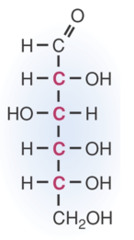
Ketone
Alcohol
Alkene
What are the 3 functional groups?

Carboxylic Acid
Ether
What are the 2 functional groups?

Several groups of hydrogens show up at higher frequency than 3000 cm-1 in an IR spectrum. All of the following show IR bands in this region except:
a) Unsaturated C-H stretches
b) Saturated C-H stretches
c) O-H stretches
d) N-H stretches
b) Saturated C-H stretches
All of the following are indicators of an aromatic compound in the IR spectrum except:
a) Overtones between 1700 and 2000 cm-1
b) C=C stretching between 1430 and 1650 cm-1
c) C-H stretching right above 3000 cm-1
d) C-H stretching right below 3000 cm-1
d) C-H stretching right below 3000 cm-1
An (almost) even doublet right below 1400 cm-1 in an IR spectrum represents a(n):
a) Tert-butyl group
b) Isopropyl group
c) Single methyl
d) Primary amine
b) Isopropyl group
How can you discern an aldehyde from an ester in their IR spectra?
a) Aldehydes will have a Fermi doublet band at a lower wavenumber than the normal C-H band
b) Esters will have two more C-O bonds around 1250 and 1050 cm-1
c) Both a and b are correct
d) Aldehydes and esters cannot be discerned on an IR spectrum
c) Both a and b are correct
a) Aldehydes will have a Fermi doublet band at a lower wavenumber than the normal C-H band
b) Esters will have two more C-O bonds around 1250 and 1050 cm-1
True or False:
Tertiary amines/amides will not have a band above 3000 cm-1 in the IR spectrum.
True
True or False:
The C=O bond in amides absorb at a lower frequency in an IR spectrum than normal ketones due to resonance.
True
True or False:
The C=O bond in esters absorb at a lower frequency in an IR spectrum than normal ketones due to induction.
False
What does the O-H stretch of carboxylic acids resemble in an IR spectrum?
a) A tongue (a strong, broad IR band)
vampire fangs (a broad IR band with two sharp points)
b) A vampire with a fang knocked out (a broad IR band with one sharp point)
c) A hairy beard or cow udder (a strong, very broad IR band with many points jutting out)
c) A hairy beard or cow udder (a strong, very broad IR band with many points jutting out)
What do secondary amines resemble in an IR spectrum?
a) A tongue (a strong, broad IR band)
vampire fangs (a broad IR band with two sharp points)
b) A vampire with a fang knocked out (a broad IR band with one sharp point)
c) A hairy beard or cow udder (a strong, very broad IR band with many points jutting out)
b) A vampire with a fang knocked out (a broad IR band with one sharp point)
What does a signal around 1720 cm-1 represent?
a) Ketone
b) Aldehyde
c) Ester
d) Any of the above
d) Any of the above
a) Ketone
b) Aldehyde
c) Ester
At what point has the reflux begun?
a) when all reagents have been added
b) when bubbling begins
c) when you see dripping from the condenser
d) B and C
d) B and C
b) when bubbling begins
c) when you see dripping from the condenser
Calculate the volume (in mL) of 15 mmol of methyl salicylate.
1.9 mL
What does your starting material, methyl salicylate, smell like?
a) Stinky feet
b) Pumpkin
c) Banana
d) Wintergreen oil
d) Wintergreen oil
What functional group in methyl salicylate is undergoing a change in this reaction?
a) Benzene ring
b) The alcohol
c) The ester
c) The ester
What is heating under reflux used for?
a) To heat reactions without incurring any loss of solvent
b) To separate liquids from each other
c) To separate solids from each other
d) To purify
a) To heat reactions without incurring any loss of solvent
What is the purpose of adding sulfuric acid after the reaction is complete?
a) To protonate the carboxylate ion to give a carboxylic acid
b) To protonate the ester
c) To protonate water to give the hydronium ion
a) To protonate the carboxylate ion to give a carboxylic acid
What recrystallization solvent will you use to purify salicylic acid?
a) Cold water
b) Hot water
c) Cold diethyl ether
d) Hot diethyl ether
b) Hot water
What is the theoretical yield of salicylic acid if you start with 1.4 mL of methyl salicylate and use the procedure outlined in the powerpoint?
1.493 g
All of the following apparatus is necessary for heating under reflux except:
a) Beaker
b) Round bottom flask
c) Condenser
d) Heating mantle
a) Beaker
Heating under reflux is used to do all of the following except:
a) Increase the energy of the reactants
b) Prevent loss of solvent
c) Purify compounds
d) Increase collision and reaction times
c) Purify compounds
Melting point ranges that are __________ show that the compound is impure.
a) Narrow
b) Wide
c) Close to the known value
d) You cannot assess purity from melting point
b) Wide
When choosing a recrystallization solvent, the solvent should have all of the following properties except:
a) Solute should be relatively insoluble in cold solvent
b) Solute should be soluble in hot solvent
c) The solvent should have a high melting point
d) The solvent should have a relatively low boiling point
c) The solvent should have a high melting point
When performing a vacuum filtration, why should you wash the solid with cold solvent (and not room temperature solvent)?
a) So that the solid doesn't dissolve in the washing solvent
b) The temperature of the washing solvent isn't important—room temperature can be used
c) To reduce the concentration of the filtrate
a) So that the solid doesn't dissolve in the washing solvent
While synthesizing salicylic acid, what did you observe after sulfuric acid was added until pH = 2 to the reaction mixture?
a) Nothing
b) Bubbles
c) White solid precipitated
c) White solid precipitated
Why is a beaker not a suitable piece of glassware to perform a recrystallization?
a) Beakers can and should be used for recrystallization
b) Beakers allow too much solvent to evaporate while boiling
b) Beakers allow too much solvent to evaporate while boiling
Why was it necessary to cool the reaction flask in an ice water bath after the addition of sulfuric acid?
a) The compounds were volatile
b) The compounds are unstable at room temperature
c) To increase the formation of the product
c) To increase the formation of the product
How much isopentyl alcohol (in mL) is 150 mmol?
16.2 mL
What three starting materials will be used to produce banana oil?
a) Acetic acid, isopropyl alcohol, sulfuric acid
b) Acetic acid, isopentyl alcohol, hydrochloric acid
c) Acetic acid, isopentyl alcohol, sulfuric acid
d) Acetic acid, isopentyl acetate, hydrochloric acid
c) Acetic acid, isopentyl alcohol, sulfuric acid
True or False:
Distillation is a closed system.
False
Which is used as a separation technique in which a liquid mixture is vaporized and then condensed into a separate flask?
a) Esterification
b) Distillation
c) Recrystallization
b) Distillation
Ferrocene and fluorenone will be separated based on differences in:
size
a) Solubility
b) Polarity
c) Both solubility and polarity
c) Both solubility and polarity
What is TLC used for?
a) Physically separate components
b) Shows a visible separation of components
b) Shows a visible separation of components
What mobile phase is used to elute ferrocene?
a) Hexanes
b) Acetone
c) Alumina
d) A mixture of hexanes and acetone
a) Hexanes
What mobile phase is used to elute fluorenone?
a) Hexanes
b) Acetone
c) Alumina
d) A mixture of hexanes and acetone
d) A mixture of hexanes and acetone
How does the mobile phase move in TLC?
a) Gravity
b) Capillary action
c) By swirling the mobile phase
d) None of the above
b) Capillary action
True or False:
The Rf value is a ratio of the solvent front distance to the distance traveled by the spot.
False
True or False:
The paper wick is used to saturate the container with solvent vapors to increase the rate of development.
True
What can happen if you spot too much sample?
a) Tailing
b) Bearding
c) Overlap
d) All of the above
d) All of the above
What is the advantage of TLC over column chromatography?
a) TLC is faster
b) There is less waste with TLC
c) Both of the above
d) None of the above
c) Both of the above
a) TLC is faster
b) There is less waste with TLC
Extraction
The removal of a compound from a solid or liquid mixture by a solvent
Vacuum filtration
Take a mixture of solid and liquid and use a vacuum to pull the liquid through a Buchner funnel separating the solid from the liquid.
What property of a compound do we utilize in extraction in order to separate compounds?
Their solubility
What is the difference between extraction and recrystallization in terms of separating compounds?
In extractions, the compounds don't need to leave the solution in order to separate
How are compounds separated in extraction? (Not the process)
They partition themselves between two immiscible solvents which are in contact with each other.
Is it more efficient to perform two small extractions or one large one?
Two small ones
What equipment do you need in order to do an extraction?
A separatory funnel
How do you perform an extraction?
Put the unknown into a separatory funnel and add NaOH. Shake and release pressure 5 times. Let the mixture settle until separated and then drain the lower layer. Repeat
benzoic acid
What compound is this?

acetanilide
Which compound is this?
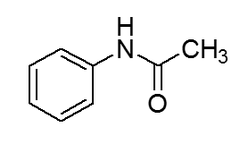
True or False:
Benzoic acid is a polar compound.
True
True or False:
Acetanilide is a non-polar compound.
False
Which is more polar?
a) benzoic acid
b) acetanilide
a) benzoic acid
Why is DCM (dichloromethane) a good organic solvent to solubilize benzoic acid and acetanilide?
Because it is volatile and has the ability to dissolve a wide range of the organic compounds
What are the safety concerns regarding DCM?
Classified as a neurotoxin, DCM has been proven to cause damage to the brain and central nervous system. It has been classified as a probable human carcinogen and high levels of exposure to the chemical has been proven to cause liver and lung cancer in animals.
During extraction, which phase is on the top?
a) organic layer
b) aqueous layer
c) non-organic layer
a) organic layer
During extraction, which layer is on the bottom?
a) organic layer
b) aqueous layer
c) non-organic layer
b) aqueous layer
Why do we need to vent our separatory funnel?
To relieve excess vapor pressure
How does "like dissolves like" relate to extraction experiment?
'Like dissolves like' is the general phrase used as a reminder that compounds of similar polarity are miscible.
What is the partition coefficient K?
The ratio of the compound's concentration in the organic layer compared to the aqueous layer.
Why are more extractions with a small volume much more efficient than one large extraction?
Because extraction is about maximizing surface area contact between the two solutions, and you simply get more surface area contact with smaller volumes.
What is the difference between extraction and washing?
In an extraction, the desired compound moves from an aqueous layer to an organic layer, while in washing the desired compound stays in its current layer.
What reaction is used to make benzoic acid polar, and thus, extractable?
By adding the NaOH to the organic compound mixture (with diethyl ether), you will convert the benzoic acid (uncharged) into sodium benzoate (negatively charged), which is now soluble in aqueous solutions.
sodium benzoate
What is this structure?

How many moles of hydroxide are required to react with one mole of benzoic acid?
One
What is the purpose of acidification of the aqueous phase?
This will result in any charged bases in solution becoming neutralized. Neutralized bases will move from the aqueous layer (where charged molecules are soluble) into the organic layer (where non-charged molecules are soluble).
How do you calculate the percent composition?
mass of element/mass of compound x 100%
salicylic acid
Which of these is the compound shown?

Is salicylic acid polar or non-polar?
Polar, but the benzene rings lower its polarity making it less ready to dissolve in water.
What is recrystallization?
Recrystallization, also known as fractional crystallization, is a procedure for purifying an impure compound in a solvent.
What does the concept of minimum volume mean in a recrystallization?
To obtain a good recovery of purified material, the use of unnecessarily large volumes of solvent must be avoided. The amount of pure material lost will be minimized if the substance is dissolved in the smallest amount of hot solvent.