Genetic Distances, Rate Variation, and Amino Acid Substitution Matrices
 Call Kai
 Learn
 Practice Test
 Spaced Repetition
 Match
 Flashcards
 Knowt Play
1/41

Earn XP
Description and Tags
Vocabulary practice flashcards covering site-to-site rate variation models (Gamma correction), synonymous versus non-synonymous substitution classifications, PAML codon evolution parameters, and protein substitution matrices including PAM, BLOSUM, JTT, GONNET, and membrane-specific scoring systems.
42 Terms
Synonymous substitution
A nucleotide substitution within a coding sequence that preserves and codes for the same amino acid.
Non-synonymous substitution
A nucleotide substitution within a coding sequence that alters the encoded amino acid.
Gamma Distribution Parameters - modeling rate variation across sites using a Gamma distribution, how are the shape parameter (alpha) and rate/scale parameter (beta) defined for biological purposes, and what does alpha determine?
Defined as alpha = u^2 / Var(u), where u is the observed mean. It determines the shape of the distribution curves (with larger alpha approaching a constant rate).

what happens to Jukes cantor with gamma distributed rates when the Hamming distance very small?
Hamming distance and DJC are proportional; when the Hamming distance is small, DJC is also small.

(picture) models tested to be used to estimate distances

Synonymous and non-synonymous substitution
synonymous - does not change amino acid
non-synonymous - does change amino acid

Four-fold degenerate site
A third codon position where all nucleotide changes are synonymous regardless of which nucleotide is present (e.g., GUN coding for Val across all four nucleotides; accounts for 32 of the third positions in 61 sense codons).
Two-fold degenerate site
A third codon position where only one possible nucleotide change is synonymous (e.g., CAY coding for His regardless of pyrimidine Y; accounts for 24 of the third positions in 61 sense codons).
Non-degenerate site
A codon position where all possible nucleotide substitutions result in non-synonymous changes (e.g., third positions in AUG for Met and UGG for Trp, as well as all second codon positions).
Gamma (Γ) distribution
A continuous probability distribution fitted to observed substitution changes across sequence sites to model rate variation among sites, avoiding negative values that are biologically impossible in evolution.
Shape parameter (α)
The parameter of the Gamma distribution that determines its shape and the extent of site-to-site rate variation, calculated for biological sequences as α=Var(μ)μ2, where μ is the observed mean and β=α.
Corrected Jukes-Cantor distance with Gamma (DJC)
The nucleotide distance formula accounting for Gamma-distributed site rate variation: DJC=43α{(1−34D)−1/α−1}, where D is the observed Hamming distance.
PAML
A widely used phylogenetic analysis software package that implements codon-based substitution models (3 nucleotides not a nucleotide), treating the codon as the unit of change and measuring transition probabilities between all pairs.
- used bc the other models assume equal rates of frequencies of nucleotide substitutions for all sites
Therefore, PAML accounts for codon changes
κ (Kappa)
A parameter in codon substitution models used within PAML to measure transition/transversion substitution bias.
ω (Omega)
A parameter in codon models that measures the ratio of non-synonymous substitution rate to synonymous substitution rate (dN/dS).
(picture) - different conditions regarding ω (Omega)

Purifying selection
Negative natural selection that removes deleterious non-synonymous mutations to avoid amino acid changes, characterized by ω<1.
Neutral selection
A condition in which amino acid substitutions accumulate at the same rate as synonymous substitutions, characterized by ω=1.
Positive selection
Natural selection favoring amino acid diversification where non-synonymous substitutions occur more frequently than expected, characterized by ω>1 (common in immunity, defense, and sensory perception genes).
Jukes Cantor being applied to amino acids
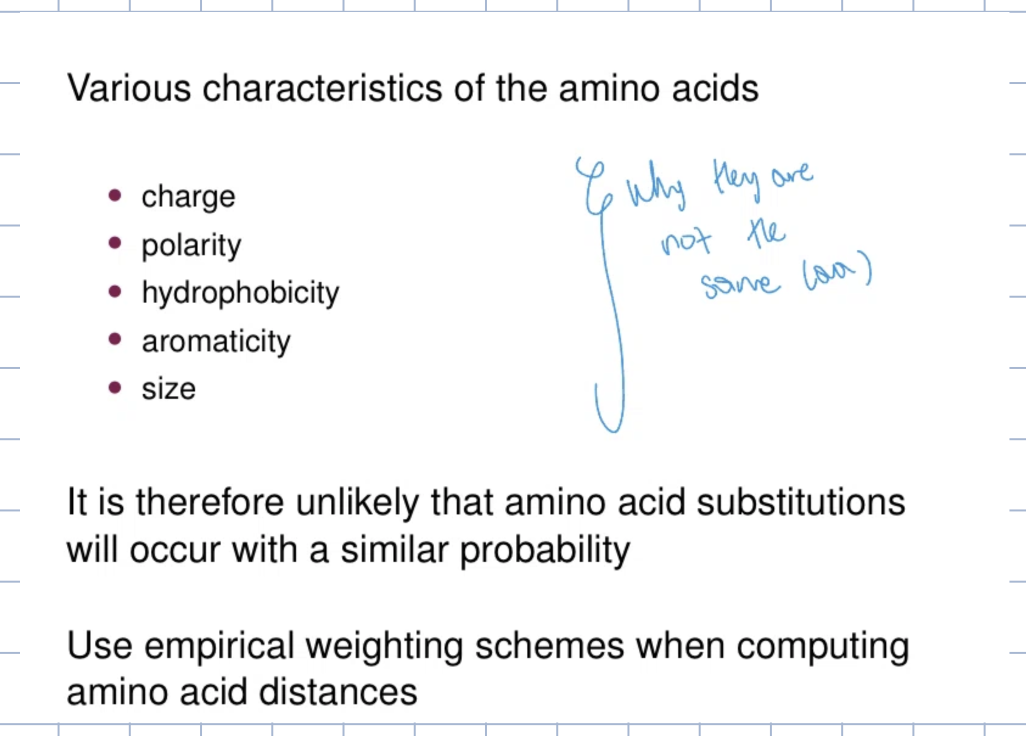
PAM (Percent Accepted Mutation)
An empirical amino acid substitution matrix system developed by Margaret Dayhoff et al. (1978) based on cataloging accepted mutations in closely related globular proteins.
PAM steps - 7

does PAM measure divergence or time?
divergence because its not symmetrical
PAM1
The baseline PAM transition matrix reflecting an evolutionary divergence corresponding to approximately 1% of sequence positions having undergone amino acid substitution.
what is PAM250 used for more (distant or close distances?)
used for distant comparisons
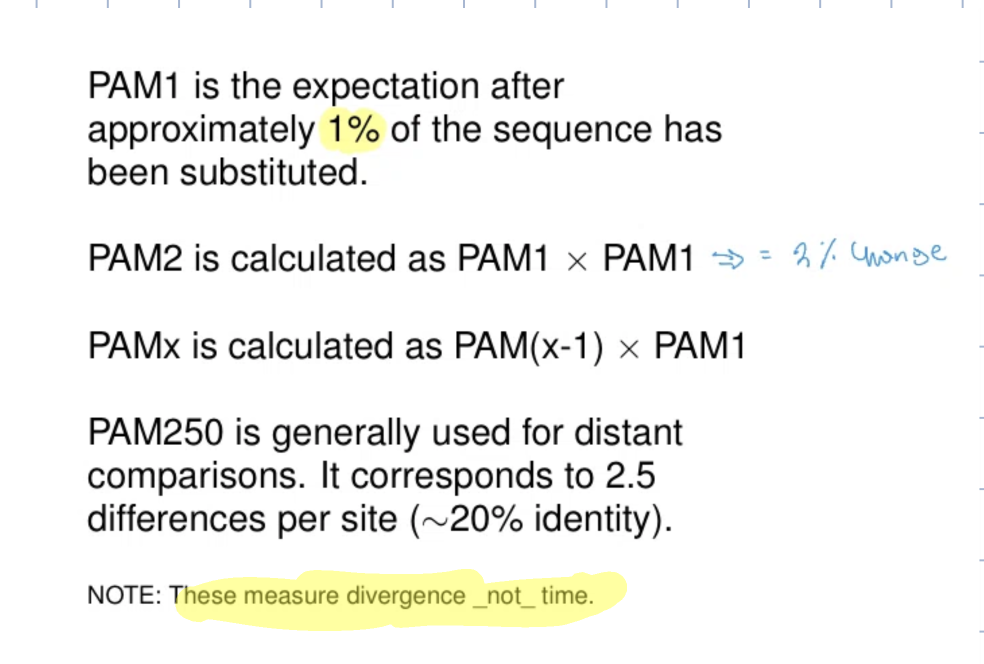
PAM250
A PAM scoring matrix extrapolated for comparing distant protein sequences, corresponding to 2.5 substitutions per site (approximately 20% sequence identity).
PAM Transition Matrix
An asymmetrical matrix representing the directional probabilities of moving from one amino acid state to another, where the probability of moving from a frequent residue to a rare residue differs from the reverse.
PAM Scoring Matrix
A symmetrical log-odds matrix (Sij=logpjMij (observed frequency vs expected frequency) that measures the likelihood of two amino acids exchanging relative to chance, omitting directional information.
PAM scoring matrix - log of odds rules (3 types)

2 uses for a scoring matrix
transition
scoring
Bigger number for PAM = longer distances (more distant)

Two different ways to write out PAM

JTT matrix
An updated empirical amino acid substitution model of PAM developed by Jones, Taylor, and Thornton (1992) based on the PAM methodology, predominantly used as a transition matrix.
what is JTT mostly used for? scoring or transition
transition

BLOSUM (BLOcks SUbstitution Matrix)
An amino acid substitution matrix derived directly from conserved sequence alignments in the BLOCKS database, serving as the default scoring matrix in BLAST and FASTA.
is BLOSSUM or PAM preferred for long distances
BLOSSUM
BLOSUM score (sij)
The log-odds value defined as sij=2log2(eijqij), which equals 0 when observed substitutions match chance expectation, positive when observed exceed expectation, and negative when observed fall below expectation.
what is the BLOSSUM matrix less tolerant to and more tolerant to?
less tolerant of substitutions to or from hydrophilic amino acids
more tolerant of substitutions from hydrophilic amino acids
divergence patterns in BLOSSUM & PAM
Larger PAM(X) = larger divergence
Larger PAM(X) = smaller divergence
NCBI’s recommendations for PAM and BLOSSUM matrix based on nucleotide size

GONNET matrix
A protein substitution matrix constructed by iteratively generating alignments using classical distance measures, recalculating empirical distance matrices, realigning, and modeling gap penalties.
STR matrix
A specialized amino acid scoring matrix that incorporates protein tertiary structural information to compare very distantly related protein sequences.
SLIM and PHAT matrices
Specialized amino acid substitution matrices (ScoreMatrix Leading to Intra-Membrane and Predicted Hydrophobic and Transmembrane) explicitly optimized for membrane-bound proteins rather than soluble proteins.