Science bio Evolution
 Call Kai
 Learn
 Practice Test
 Spaced Repetition
 Match
 Flashcards
 Knowt Play
1/33

Earn XP
Description and Tags
year 10 EXAM prep semester 2
34 Terms
acquired trait
A feature that is gained during an individual's lifetime
Acquired traits, such as scars and learned skills, cannot result in the evolution of a population.
adaptation
A genetic trait that helps an organism survive in its environment
Better adapted organisms have a greater chance of reproducing and passing their genes to the next generation.
antibiotic
A medicine that kills bacteria or prevents their growth
Antibiotics are used to treat diseases caused by bacteria. They have saved countless lives since their discovery.
antibiotic-resistant
Able to survive in the presence of antibiotics
Some bacteria have evolved antibiotic resistance and are known as superbugs.
behavioural adaptation
A behaviour or action that helps an organism survive
Behavioural adaptations include migrating, burrowing and building dams or nests.
common ancestor
A species that two or more other species have evolved from
The common ancestor of humans and sharks lived about 470 million years ago.

competition
The struggle between organisms for resources, such as food or mates
Competition means that many organisms will not survive long enough to reproduce.
evolution
A change in the genetic traits in a population over many generations
Evolution occurs over generations through repeated genetic variation, natural selection and reproduction.

evolutionary tree
A diagram that shows how species are related
An evolutionary tree shows how related species evolved from common ancestors.

extinction
The dying out or complete disappearance of a species
A species is said to be extinct when the last individual of that species has died.
genetic diversity
The amount of genetic variation in a population
Genetic variation is needed for evolution because it makes some individuals better adapted to the environment than others.
genetic trait
A feature that can be passed down by genes to the next generation
Genetic traits, such as neck length and fur colour, can result in the evolution of a population.
mutation
A small random change in an organism's DNA
Mutations can be passed on to offspring through reproduction, increasing the genetic variation in a population.
natural selection
The survival of organisms that are better adapted to their environment
Over generations, natural selection causes a population to evolve in response to its environment.
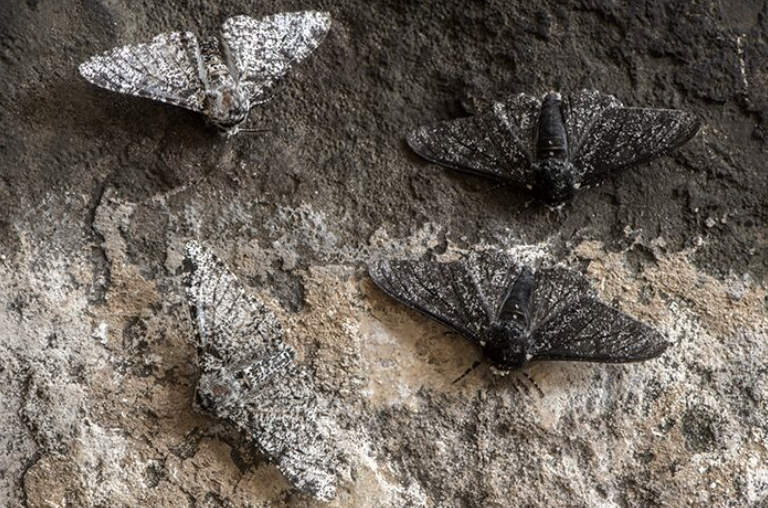
physiological adaptation
An internal bodily process that helps an organism survive
Physiological adaptations include production of venom and regulation of body temperature.
population
A group of organisms of the same species living in the same place
Different populations of the same species can be found in different regions around the world.
selection pressure
A challenge that affects an organism's ability to survive and reproduce
Selection pressures include hunting by predators, access to resources, diseases and weather conditions.
speciation
The formation of a new species
Speciation occurs when a population splits into two isolated populations that evolve under different selection pressures.

species
A group of similar organisms that can breed to produce fertile offspring
The ability to reproduce allows a species to continue to exist and evolve.
structural adaptation
A physical feature of the body that helps an organism survive
Structural adaptations include scales, fur, feathers, long tails and bright colours.
variation
A difference in traits between individuals of the same species
Variations in genetic traits arise because of mutations. Some traits provide an advantage for survival or reproduction.
Explain how bacteria could spread even in the presence of an antibiotic.
Regular bacteria are harmed or killed by antibiotics. Antibiotic-resistant bacteria have evolved to survive antibiotic treatments, so could spread even in the presence of an antibiotic.
List two genetic and two acquired traits for the person in the photo.
Answers will vary. Some examples are:
Genetic:
Eye colour
Skin colour
Height
Nose shape
Hair colour, if natural
Acquired:
Pierced ears
Shaved head
Spiky hair
Mohawk
Tattoos
Explain how mutations lead to variation in populations.
Offspring inherit genetic traits from their parents. This means that they will share many of the same genes. However, in each generation, new mutations occur. These are random changes in DNA and can produce new traits, increasing the genetic variation in a population.
In 1896, the global mean height of men was 162 cm. In 1996, the global mean height of men was 171 cm.
Explain if this change is an example of evolution.
This is an example of evolution because change in height, which is a genetic trait, has occurred to a whole population over many generations.
“Evolution cannot occur without genetic variation.” Explain if this statement is true or false.
This statement is true. To change the frequency of a genetic trait in a population, there must first be genetic differences (variation) in that trait.
Describe what is meant by natural selection.
Natural selection is the process by which organisms that are better adapted to their environment are more likely to survive and reproduce.
Stinging nettles are extremely high in nutrition and are an ideal source of energy for many herbivores. They have evolved stinging cells to deter grazing herbivores from eating them. Describe the events that would have led to their evolution.
In the original nettle population, some individuals had stinging cells while other individuals did not have stinging cells. This variation was brough about by random DNA mutations.
Herbivores ate the nettles, preferring to target those without stinging cells. Natural selection resulted in nettles with the stinging cells trait surviving and reproducing more than nettles without stinging cells.
This led to more offspring with stinging cells, as they inherited the trait from their successful parents. Over several generations, the frequency of nettles with stinging cells increased in the population.
Describe how bacteria can evolve to be antibiotic-resistant. Use the following terms in your answer: variation, selection pressure, generations, adaptations, natural selection and reproduction.
A population of bacteria has variation in genetic traits from random mutations in DNA. One variation allows an individual to develop adaptations to resist antibiotic treatments.
In the presence of a selection pressure like antibiotics, antibiotic-resistant bacteria are more likely to survive, while non-resistant bacteria are not. Reproduction rates for antibiotic-resistant individuals will also be higher.
Over generations, the process of natural selection leads to a population of antibiotic-resistant bacteria.
When faced with a predator, most squid will release ink as they jet away. Identify the types of adaptations involved in this process.
The production of ink is a physiological adaptation.<p> Jetting away is a behavioural adaptation.
Describe two types of evidence scientists use to support the theory of evolution.
The fossil record includes body parts or traces of organisms left behind when they died, which can be examined and compared to other species. The more similar the structures between two organisms, the more closely related the organisms are likely to be.
DNA analysis involves comparing the DNA of different organisms. The more similar the DNA, the closer the relationship.
Analyse the section of the tree of life provided in your Stile X booklet.
a Describe the relationship between humans, chimpanzees and bonobos.
Explain your response in terms of time and common ancestors.
b Explain how a scientist could use DNA to construct this family tree.
a Chimpanzees and bonobos share the most recent common ancestor, which makes these two species the most closely related on this tree. As you move back in evolutionary history, humans, chimpanzees and bonobos also share a common ancestor.
b If two species have a recent common ancestor, they will have similar DNA. If two species have a more distant common ancestor, they will have less similar DNA. This is because mutations in DNA accumulate over time. A scientist could compare the amount of similar DNA between each of the species and the average rate of mutation to determine when they last shared a common ancestor, and thereby determine relatedness and build this tree.
Cocker spaniels and poodles can be bred to produce a fertile breed of dog called a spoodle/cockapoo. Explain whether cocker spaniels and poodles are different species.
Cocker spaniels and poodles are not different species as they can interbreed to produce fertile offspring.
On the South Island of New Zealand, there are two large parrots species, the Kaka and the Kea. Both species share a common ancestor: the Proto-kaka. About 5 million years ago, the Southern Alps began to develop. A population of the Proto-kaka moved into the alpine environment and evolved into the Kea, while the other population remained at low altitudes and evolved into the Kaka.
Describe the events that led to the evolution of the two species, the Kaka and the Kea. In your answer, include the terms isolation, genetic variation, population, selection pressures, fertile and natural selection.
Two populations of proto-kaka experienced reproductive isolation when a portion of this population moved into the alpine area about 5 million years ago. Random mutations led to genetic variation in the two populations. The two populations were subjected to different selection pressures. For instance, the alpine area was significantly colder and had different availability of food and resources. Natural selection over several generations meant some organisms were better suited to their environment than others, thus more likely to survive and reproduce. This led to different adaptations in the populations evolving over time.
Eventually, the alpine population (Kea) and the low altitude population (Kaka) were so genetically different that they could no longer interbreed to produce fertile offspring.