Anatomy: Lecture 7-9/Lab 9 -10 Objectives
 Call Kai
 Learn
 Practice Test
 Spaced Repetition
 Match
 Flashcards
 Knowt Play
1/77

There's no tags or description
Looks like no tags are added yet.
78 Terms
What is the vertebral formula in dogs?
C7T13L7S3Cd20
What are the parts of a typical vertebra?
body, arch (4 parts), vertebral foramen, intervertebral foramen, and processes
What are the different processes on a vertebra?
spinous process, transverse process, cranial articular process, and caudal articular process

What is number 1?
Spinous Process

What is number 2?
Lamina

What is number 3?
Pedicle

What is number four?
Transverse Process

What is number 5?
Body

What is number 6?
Caudal articular process
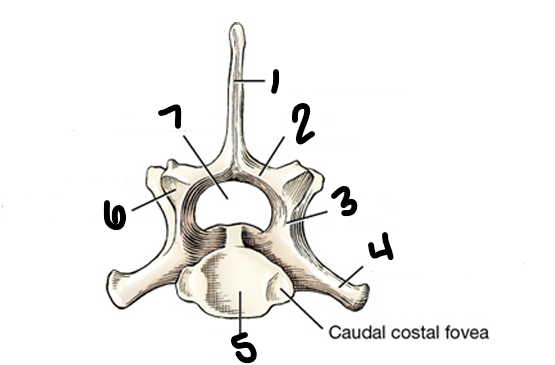
What is number 7?
vertebral foramen
Where does the cervical vertebrae and thoracic vertebra interact with the ribs?
Cervical touch a rib head while thoracic articulate with rib tubercles
What is unique about the sacral vertebrae?
fused as the sacram
What is the range of caudal vertebrae that can be present?
20 to 23
What is the anatomic peculiarities of C1?
atlas: reduced body, transverse process (wings), and lateral vertebral foramina
What is the anatomic peculiarities of C2?
Axis: long spinous process and dens
What is the anatomic peculiarities of C6?
expanded ventral laminae on the transverse process
What is the anatomic peculiarities of C7?
articulates with 1st pair of ribs
What unique structure is only present in the cervical region?
transverse foramen
What is the anatomic peculiarities of T11?
Anticlinal vertebra because it is a radiographic landmark
The spinous process of T1 to T10 incline in which direction?
caudally
The spinous process of T12 and T 13 incline in which direction?
cranially
What are the two joints with special names?
alanto-occipital joint (b/w skull and atlas) and atlantoaxial joint ( b/w atlas and axis)
What type of joints are the alanto-occipital joint and alantoaxial joint?
synovial
the atlanto-occipital joint involves what structures?
occipital condyles of skull and atlas
What is the action of the alanto-occipital joint?
extension and flexion
the atlanto-axial joint involves which structures?
atlas and axis
What is the action of the alantoaxial joint?
rotary
Where are the intervertebral discs located?
found in joints that exist between adjacent vertebral bodies
What is the function of the intervertebral discs?
stabilize adjacent bony structures and act as cushions
What is the structure of intervertebral discs?
made of fibrocartilage and have an outer anulus fibrosus and an inner nucleus pulposus (soft interior)
What joints are present in C3-C6 and L1-L7?
2 cartilaginous joints at the end of each body, 2 synovial joints with right and left cranial articular processes, and 2 synovial joints with right and left caudal articular processes
How many joints does C7 have?
8 joints (gains two more with rib heads)
What joints are present in T1-T9?
12 joints: 2 joints at each end of body, 2 joints with right and left cranial articular process, 2 joints with right and left caudal articular processes, 2 joints with rib heads cranially, 2 joints with rib heads caudally, and 2 joints with rib tubercles at transverse processes
What are the different parts of a rib?
rib head, rib tubercle, and costal cartilage
Where do the rib heads articulate?
with vertebral bodies either at the joint with IV discs (1-10) or alongside one vertebral body (11-13)
Where do the rib tubercles terminate?
transverse processes of thoracic vertebrae (synovial)
Where does the costal cartilage of ribs articulate?
with the sternum or adjacent costal cartilages (synovial)
what is the joint associated with the proximal end of the typical rib?
costovertebral joint
the costovertebral joint is where what meets what?
head of rib meets vertebral body
what is the joint associated with the distal end of a typical rib where it meets the costal cartilage?
costochondral junction
the costotransverse joint is where what meets what?
rib tubercle meets transverse process
what is the joint associated with the distal end of a typical rib where it meets the sternum?
sternocostal joint
What ribs are classified as sternal?
first 9 rib pairs that articulates with the sternum
What ribs are considered costal arch?
asternal ribs 10-12 that touch the costal cartilage
asternal ribs have costal cartilages that do not what?
touch the sternum
What is a floating rib?
13th rib pair that contacts nothing
Why are T11-13 more susceptible to IVDD?
they are missing two articulations and the intercapital ligament
What are the four long ligaments of the vertebral column?
Dorsal longitudinal, ventral longitudinal, supraspinous, and nuchal ligaments
Where is the location and attachments of the dorsal longitudinal ligament?
inside the vertebral foramen and extends from C2 to the Sacrum
Where is the location and attachments of the ventral longitudinal ligament?
on the underside of the neck running from C2 to the sacrum
Where is the location and attachment of the supraspinous ligament?
on top of the spinous process from T1 to the sacrum
Where is the location, attachment, and function of the nuchal ligament?
on the back of the neck in cervical region from C2 to T1 and is made of elastic tissue to help muscles pull the head up
What are the short vertebral ligaments?
Infraspinous ligament, yellow ligament, and intercapital ligament
What is the function of the intraspinous ligament?
between the spinous processes and most prominent in the thoracic region
What is the function of the yellow ligament?
elastic tissue that is between the vertebral arch and functions as the indicator before you reach the spinal cord
What is the function of the intercapital ligament?
from rib head to rib head on rib heads 2-10
Where are the epaxial and hypaxial muscles in relation to the transverse process?
epaxial muscles are above the transverse process while hypaxial muscles are below the transverse process
What are the hypaxial muscles?
longus capitis, longus colli, sternocephalicus, sternohyoideus, and sternothyroideus
What hypaxial muscles or of the neck?
longus capitis, sternocephalicus,
What are the thoracic hypaxial muscles?
scalenus, serratus dorsalis cranialis, external intercostals, and inter intercostals
What hypaxial muscles are of the abdominal wall?
external abdominal obliques, linea alba, internal abdominal obliques, transversus abdominus, and rectus abdominus
What is the function of the hypaxial muscles of the neck?
pulls ribs cranially
What is the function of the hypaxial thoracic muscles?
pull ribs forward
which hypaxial muscles are responsible for inspiration?
scalenus, serratus dorsalis cranialis, external intercostals internal intercostals, and diaphragm
which hypaxial muscles are responsible for expiration?
serratus dorsalis caudalis
What is the muscle direction of the external intercostal muscles?
Caudoventrallly
What are the muscle fiber direction of the internal intercostal muscles?
cranioventrally
What are the three epaxial muscle systems?
Transversospinalis, Longissimus, and Iliocostalis
What are the actions of the epaxial muscles?
extend the vertebral column or flex it laterally
What are the attachments of the epaxial muscles?
Transversospinalis is from skull to sacrum, Longissimus extends from the skull to the ilium, and illiocostalis is from rib 1 to the ilium
What is the order form medial to lateral?
transversospinalis, longissimus, and iliocostalis
What is the visceral pleura?
pleura that originates form mesothelium that surrounds the lungs
What is the costal pleura?
pleura that lines the ribs
What is the mediastinal pleura?
pleura that lines the mediastinal
What is the diaphragmatic pleura?
lines the diaphragm
What is mesothelium lining the thoracic cavity?
pleura
What is mesothelium lining cavity surrounding the heart?
pericardium
What is mesothelium lining the abdominal and pelvic cavities?
peritoneum