Topic 5 - Enzyme Catalysis
 Call Kai
 Learn
 Practice Test
 Spaced Repetition
 Match
 Flashcards
 Knowt Play
1/43

There's no tags or description
Looks like no tags are added yet.
44 Terms
Enzyme
A biological catalyst that accelerates reactions without being permanently changed.
Enzyme composition
Most enzymes are proteins; some contain RNA.
Substrate
A specific molecule upon which an enzyme acts.
Enzyme specificity
An enzyme typically acts on only one or a few types of substrate.
Enzyme fidelity
Enzymes rarely recognize improper substrates or produce incorrect products.
Active site
The small region of an enzyme where substrate binds and the reaction occurs.

Substrate binding
Substrates bind reversibly at the active site through multiple weak interactions.
Transition state
The highest-free-energy form along a reaction pathway, with bonds forming and breaking.
Activation free energy
The free-energy difference between reactants and the transition state; it determines reaction rate.
Enzyme effect on activation energy
Enzymes lower activation energy by stabilizing the transition state.
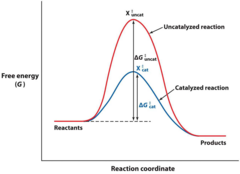
Enzyme effect on equilibrium
Enzymes accelerate attainment of equilibrium without changing the equilibrium constant.
Enzyme effect on reaction free energy
Enzymes do not change the free-energy difference between reactants and products.
Proximity and orientation
Enzymes bring substrates together and align them for productive reactions.

Catalytic proton transfer
Active-site groups can donate or accept protons during catalysis.
Transition-state analogues
Compounds resembling transition states that bind tightly and act as competitive inhibitors.
Cofactor
A metal ion or coenzyme required for or enhancing an enzyme's activity.

Enzyme pH optimum
Each enzyme has an optimal pH; extreme pH can alter catalytic groups or denature it.
Enzyme temperature optimum
Reaction rate rises with temperature until the enzyme becomes unstable.
Chymotrypsin
A pancreatic serine protease that hydrolyzes peptide bonds during digestion.

Chymotrypsin specificity
It cleaves peptide bonds after phenylalanine, tryptophan, or tyrosine residues.
Serine protease catalytic triad
Serine, histidine, and aspartic acid cooperate in catalysis.

Chymotrypsin: initial attack
Histidine removes a serine proton, enabling serine to attack the peptide carbonyl.
Chymotrypsin: peptide bond cleavage
A tetrahedral intermediate breaks down, releasing the carboxyl-terminal peptide fragment.

Acyl-enzyme intermediate
The amino-terminal peptide fragment is covalently attached to chymotrypsin's serine.

Chymotrypsin: deacylation
Histidine activates water to attack the acyl-enzyme, releasing the remaining peptide fragment.
Oxyanion hole
Stabilizes the oxyanion formed in chymotrypsin's tetrahedral intermediates.
Zymogen
An inactive enzyme precursor that can be activated by cleavage.
Serine protease zymogen activation
Cleavage causes a conformational change that enables substrate binding and aligns catalytic residues.
Enzyme kinetics
The study of how factors such as substrate concentration influence reaction rates.
Initial velocity, v₀
The reaction rate measured before much product has formed.
Substrate saturation
At high substrate concentration, the enzyme approaches its maximum reaction rate.
Michaelis-Menten equation
v₀ = Vmax[S]/(KM + [S]).
Vmax
The maximal reaction velocity at a given enzyme concentration.
Vmax and enzyme concentration
Doubling enzyme concentration doubles Vmax.
Michaelis constant, KM
The substrate concentration at which the reaction rate is half Vmax.
KM and substrate affinity
A lower KM corresponds to higher substrate affinity.
KM and enzyme concentration
KM is independent of enzyme concentration.
Lineweaver-Burk plot
A plot of 1/v₀ against 1/[S] that linearizes Michaelis-Menten data.
Reversible inhibition
An inhibitor binds noncovalently and can be removed from the enzyme.
Irreversible inhibition
An inhibitor forms a covalent bond with the enzyme, permanently blocking activity.
Competitive inhibition
An inhibitor competes with substrate for binding at the enzyme's active site.
Competitive inhibition kinetics
Competitive inhibition increases KM without changing Vmax and can be overcome by excess substrate.
Allostery
Binding at one protein site alters activity at another, often distant, site.
Allosteric feedback
A pathway product can inhibit an earlier enzyme, reducing pathway activity.