Psych Midterm 2
 Call Kai
 Learn
 Practice Test
 Spaced Repetition
 Match
 Flashcards
 Knowt Play
1/72

There's no tags or description
Looks like no tags are added yet.
73 Terms
Developmental Psycholody
Study of psychological changes that occur with aging
Nature vs Nurture
Continuity vs Discontinuity (stages of development)
Is change gradual or abrupt?
Timing
Are there critical periods where changes must occur (critical period) or times when they are more likely to occur (sensitive period)
Continuity vs Stage model
View changes as uniform and gradual, vs view them as qualitatively different stages that are irreversible
Piaget’s model of Cognitive Development
Stages of development, children can only think concretely at first, and then culminating in the ability to display abstract, symbolic thinking
Most likely underestimated capacities of kids, role of social interaction and culture, probably also more complex
Exploration Curiosity and Play
Cognitive development is driven by a child’s active attempt to manipulate physical objects
(purely personal curiosity develops change
Schemes Assimilation and Accommodation
Behavior is controlled by schemas that represent objects and what one can do with them
Assimilation: process of applying an existing schema to a new object
Accomodation: Process of modifying a schema to understand what you can do with an object
Sensorimotor stage
From birth to 2 years
Infants understand the world solely thru sensory experience, therefore must be physically present (no object permanence)
Cant mentally represent object according to Piaget
Preoperational stage
2-7yo
Can mentally represent objects but cant transform them yet (based only what it looks)
Milestones:
Language
Defecits:
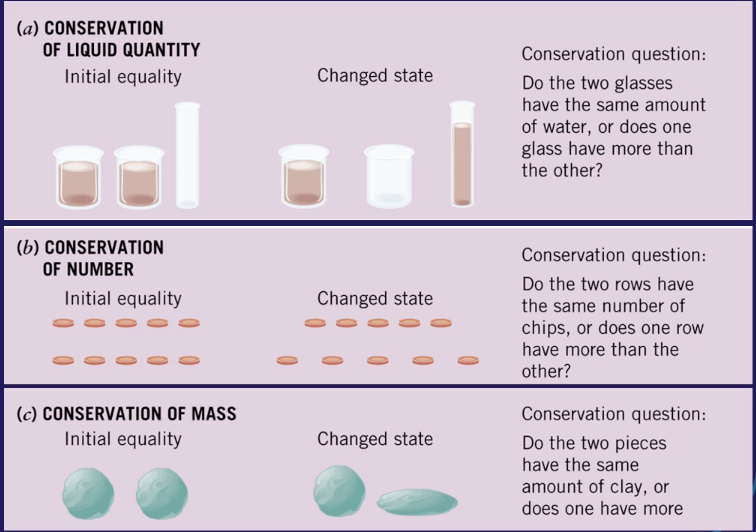
Conservation:
when objects undergo transformations, not good at conserving them
Reversibility:
Things arent reversible
Egocentrism:
Not good at understanding that not everyone shares their visual perspective
Concrete Operational stage
7-12 yo
Can perform basic mental operations concerning problems that involve tangible objects
Understand reversibility and conservation, dont understand abstract, hypothetical things
Formal Operational stage
12-adult
Have basically full reasoning capabilities
Not everyone reaches this
Freud Contributions (no need to remember)
Importance of early childhood experiences
Benefits of talking about a problem
Interpretation of dreams
Slips of the tongue
Defense mechanisms
Sexuality and human nature
Freuds Theories
Structure of mind and brin
Personality
Personality development
Psychodynamics
Psychopathology
Methods of analysis
Psychotherapy
Psychoanalytic Theory
People have basic needs that are present from birth and continue throughout life
Two forces prevent us from fulfilling them all the time (ID)
reality (danger) (EGO)
morality (right and wrong) (SUPEREGO)

ID definition
Basic Needs
Eros
all life sustaining needs and desires (food, water, sensory, pleasure, sexual gratification, safetly)
Thanatos
desire to end life and return to an inanimate state
Unmet needs are aversive there is a desire to be rid of them.
Personality according to freud
Each person’s mode of satisfying basic animal needs in a world that discourages their direct gratification
Most of the experience that create personality arise very early in life and remain inaccessible to consciousness
Freud structure of mind
Conscious mind
Thoughts and images that are currently in awareness
working memory
Preconscious
Thoughts and images that can be easily brought into consciousness
long-term memory
Unconscious
thoughts, feelings, and desires that are actively kept out of awareness
the unconscious is the source of all human motivation
implicit memory

ID
Source of all motives, needs, and desires
Present at birth
Entirely unconscious
Seeks immediate gratification without seeking reality
Associated with limbic system

Ego
Seat of Reason, rationality and logic (executive control)
Not present at birth but emerges early in life
Mostly conscious or preconscious
Takes reality into account
Associated with prefrontal cortex

Superego
Source of morality, conscience, and ideal behavior
Begins to develop ~4yo
Unconscious, preconscious, conscious
Unconscious moral repulsions in ventromedial prefrontal cortex
Deliberate moral judgement DLPFC

Personality
Distinctive and relatively enduring patterns of thinking, feeling, and behaving, along with the processes that influence them
Distinctive- Not trivial
Patterns- Looking of characteristic patterns
Any aspect of psychological life
Explanations for why you are the way you are
Human nature
What ways are we all similar?
Individual differences
How are we different from others but similar to others?
Personal Uniqueness
Each of us is unique
Traits
Distinctive and relatively enduring patterns of thinking, feeling and behaving (personality)
Why are traits important:
basic unit of personality
relevant to all three levels of personality
People use traits to describe personality
We are naive trait theorists
Traits are continuous, bipolar dimensions
Trait Development
Traits are formed by
biological structures and processes
Formed by genes and evolution
Early Childhood Experiences and Relationships
Learning
5 factor model
Thousands of traits, but maybe only a few small clusters or factors
Extraversion
Oriented toward drawing energy from external world
Neuroticism
Prone to experience a wide range of negative emotional states
Conscientiousness
Tendency to be disciplined, goal oriented, organized, and persistent
Agreeableness
Tendency to be good natured, easy-going, and cooperative
Openness to experience
A tendency to embrace novelty and change and try new things

Types approach
Types are broader, categorical dimensions, often combining traits
Hippocrates and Galen
Personalities Type:
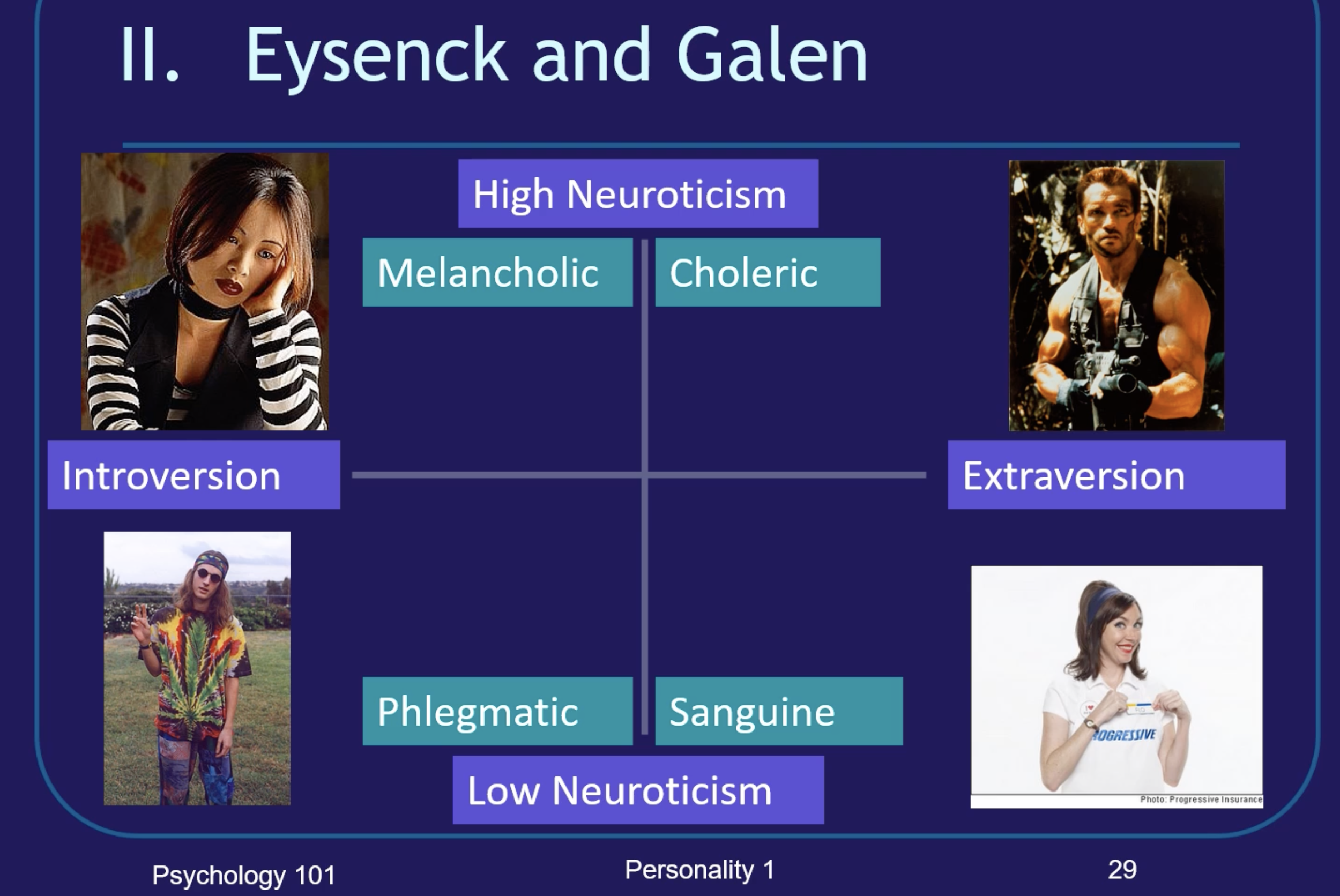
Sanguine
Blood
Sring
Bold, courageous, passionate, optimistic
Choleric
Yellow Bile
Summer
Ill-tempered, belligerent
Melancholic
Black Bile
Autumn
Despondent, irritable, anxious
Phlegmatic
Phlegm
WInter
Even tempered, calm, apathetic

Eysenck and Galen
See chart
Trait stability
Are average levels of traits stable across time (ie. attractiveness)?
Is there rank order stability (ie. a young pretty person likely to be a pretty elderly person)?
Mean levels change over time, but rank order stability is found after 30
Behavioral genetics
Protein creating DNA sequences change behavior/personality
Branch of genetics that studies the relative contributions of heredity and environemnt to personality
Main assumption
Genotype underlies personality
Environmental factors encourage/discourage the expression of inherited tendencies
Temperament
Inherited tendencies that underlie personality
Activity Level
extraversion, openness to experience
Emotionality
Neuroticism, openness to experience (negative)
Sociability
Extraversion, agreeableness
Impulsivity
Conscientiousness, openness to experience
Nature of Inheritance
Parents give you chromosomes which have DNA which have nucleotides which make Codons which make Amino acids which make up proteins which make me
A gene is a DNA molecule segment that specifies the production of a protein
Modeling Variability
How much does DNA variation predict variation in personality?
Can only predicting variability not mean levels
Assessment Techniques
Twin Studies comparing monozygotic twins with Dizygotic twins Comparing
Adoption Studies comparing adopted children and their biological versus adoptive parents or siblings
Twin Adoption Studies Comparing split MZ twins vs non split MZ twins
Findings
Genes matter MZ have similar personalities
Growing up together doesnt really make a difference
Environment is highly unimportant
Conclusion
Personality is heritable (40% of variability based on genetics)
Personality is not the same as character
Family resemblance is stronger for traits that tap moral behaviors

Evocative Parenting
Parental behavior influences personality, but differences in the ways parents treat their children matter more than the similarities
Each child has a slightly different parent
Personalty Psychology vs Self Psychology
Self-psychology is
self concept- who you think you are
self esteem- how you feel about yourself
how these thoughts and feelings develop and how they influence you
Self Psychology is phenomenological
What you think is what you perceive
People think they are more important than they are
Success comes with beliefs about themselves as important as actual talent
Many personality scales are self report
pretty accurate for unimportant qualities, inaccurate for socially valued qualities
People believe they are better than they actually are
Identity
A collection of self conceptions
Social Identity
Group memberships and social classification
Nouns
Personal Identity
Beliefs about your attributes and values
Usually adjectives
Not easy to tell which is which
Erik Erikson
Believed development involved 8 psychosocial stages instead of freud’s 5 psychosexual states that shape identity throughout life
Has generated lots of research
Personality develops thru lifetime
Identity Crisis in adolescence
Impact of social, cultural, personal, and situational forces in forming personality
Criticisms
vague
not well established
identity self determination is mainly for the affluent
8 Psychosocial stages of develop
Each stage involves a conflict or crisis
if the conflict is resolved successfully a strength is acquired
If not resolved successfully a weakness is acquired
Epigenetic Principle
Stages can be revisited
Stage 1:
Birth to 18 months
Trust vs Mistrust
Hope
Stage 2:
18months to 3 years
Autonomy vs Shame and Doubt
Will and determination
Stage 3:
3-6 years
Initiative vs guilt
Purpose
Stage 4:
6- puberty
Industry vs Inferiority
Competence
Stage 5:
Puberty-20
Identity vs Role confusion
Fidelity- sense of community
Stage 6:
20s and 30s
Intimacy vs Isolation
Love
Stage 7:
40s and 50s
Generativity vs Stagnation
Care
Stage 8:
60s and above
Integrity vs Despair
Wisdom

Adolescent Identity Crisis
Adolescence is characterized by establishment of a firm identity from a conflict
occupation
identity
sexuality
Marcia’s models of Identity Crisis
Moratorium- in a crisis but no commitment
Identity Achieved- in a crisis but then figured it out
Foreclosed- no crisis but a commitment made
Diffused- no crisis no commitment
Stranger Anxiety
Distress over contact with unfamiliar people
Emerges at about 7 months end by 18 months
Separation Anxiety
Distress over being separated from a primary caregiver
Peaks around 12-16 months, resolves between 2-3 years of age
Why do people form attachments?
Hulls drive-reduction model
we believe out caregivers because they reduce biological drive
Harry Harlow
Tried to refute this
Monkey are raised with two mother monkey surrogates
One provides nourishment and one provides warm fuzzies
Harlow found that monkey liked warm fuzzies
Psychological needs not biological needs underlie infant attachment
Attachment bonds
Serve a paradoxical function
if secure, you are free to roam
Early childhood parent relationship because a schema that influences how we feel about ourselves and others throughout life
Strange situation
14 months infants come into a stimulus rich laboratory with their mom
does the infant separate to play with toys and share them with mom?
Stranger enters and mom suddenly leaves
How distressed does infant become?
Mom returns
Is infant easily consoled and warm toward mom?
Infant attachment styles
Style:
Securely attached
separate easily
distressed but not inconsolable when mom leaves
comforted and warm to mom when returns able to separate again
happens when parents are consistently and appropriately responsive and nurturing
Insecure anxious/ambivalent
Troups separating, will only explore only if mom goes with
very upset when mom leaves
not consoled when she returns, either punitive or clingy
happens when parents are inconsistently availible
Insecure avoidant
separates but doesn’t share
seemingly unaffected by separation
punitive or unconcerned when mom returns
consistently unavailible
Adult attachment styles
Secure attachment
capable of forming close love relationships and willing to trust others
Insecure ambivalent
insecure relationships characterized by excessive dependence, fear of abandonment, and jealousy
Insecure avoidant
fears getting close to others, cynical about relationships and distrusting of others
Social Psychology
The scientific study of how people think about, affect, and relate to one another
think about, social cognition
Affect, social influence
Relate to, interpersonal relationships
Principal Principles
Subjective Perceptions lead to behavior
Phenomenology - as it appears leads to behavior
Subjective perceptions influenced by
personality
Situations
Anything that isnt personality
Most likely a blend of personality and situations
Gestalt psychology
Perception depends on context
Motives wishes and needs do not influence perception
Pragnanz
We try to achieve a perfect visual endstate because disorder creates tension
Causal Attributions
Explanations we give for why things happen
We attribute behavior to a cause, always an inference
Attributions guide our psychological lives
People are naive theorists, respond to the why more than the what
First impression
Determined by:
physical features
Non verbal behavior
Stereotypes
Lead to Behavior
Behavioral confirmation effects
When something you heard about someone leads you to behave in a certain way which confirms it to what youve heard.
Heider’s Theory
Perceived Behavior (PB) is an additive function of dispositional causes (D) and situational ones (S)
Dispositional causes
Attributions to a persons enduring character, nature, or ability
Situational Causes
Any factor that is temporary or contextual
PB=f(D+S)

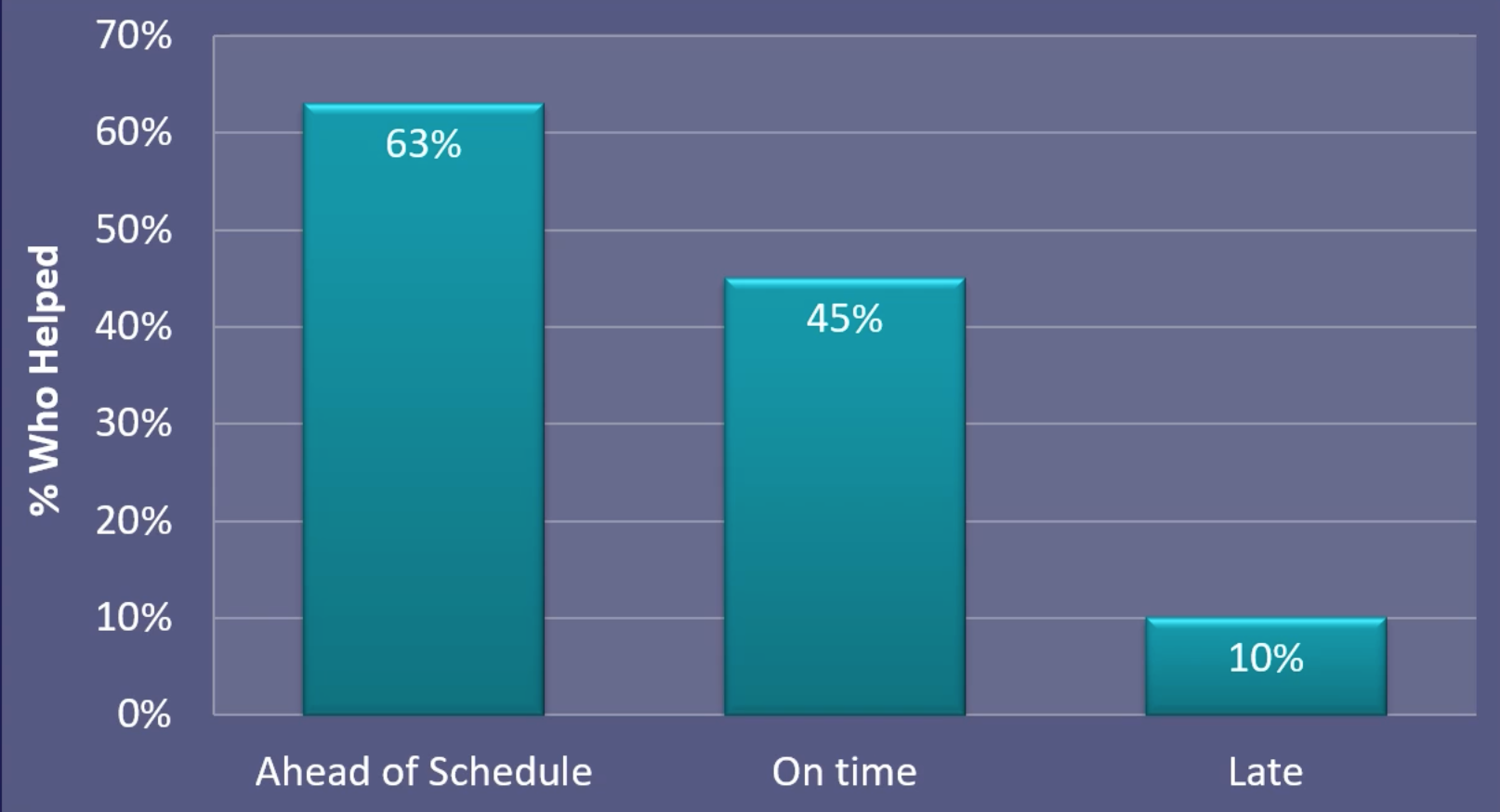
Darley and Batson
Subjects were seminary students who were on their way to deliver a lecture across campus
some were told theyre late
some told they were on time
some were told they are very early
As they leave they see a homeless man in the doorway
would they stop to help?
Small situational variables can have large behavioral consequences
Fundamental Attributional Error
Tendency to use dispositional causes rather than situational ones to explain behavior
We are personality psychologists, not social psychologists
Qualifications:
Actor-observer effect
People commit FAE more when talking about other people
Self serving attributional bias
People commit FAE when successful, and situational attributions for failures
Attitudes
Evaluative reactions to people, issues, or objects
Beliefs
matters of opinion or faith (not evaluative)
Values
Broad principles that represent what people care about
Value expressive function of attitudes
Gun control
Learning and attitude and formation
Classical Conditioning
Advertisers pair pretty people/celebrities with their product, assuming your positive feelings for person will transfer to product
Modeling
Many children model parents attitudes
Instrumental Learning
Politicians bring money to their constituents
Mere exposure effect
The more times were exposed to a stimulus, the more we like it
Exposure can be subliminal
Must begin with neutral stimulus
After 14 exposures no more liking, with 25 or more exposures, temporary disliking but then a rebound effect
Tri Component model
Attitudes are made of the three in a cycle.
Cognitive- beliefs a person has about an attitude object
Affective- a person’s emotional reaction to an attitude object
Behavioral- Persons behavioral response to an attitude object.
CAB is common.
Attitudes are cognitively complex but affectively simple
Beliefs (cognitions) change more readily than emotions (affect)

Cognitive Dissonance THeory
People do not always act in accordance with their attitudes
Sometimes they are hypocritical
Cognitive Dissonance theory is how people deal with the attitude behavior discrepancies
Cognitive Dissonance
Two or more cognitions can be consistent with one another, or inconsistent with one another, or unrelated
Holding two inconsistent cognitions creates an aversive state of arousal people are driven to reduce
Ways to reduce dissonance
Change behavior
Change attitude
Add a cognition
Rationalize, justify, excuse
Historical Perspective
First theory that believed cognitions motivate behavior
Made counter intuitive predictions that were often directly opposite to preductions learning theory makes
Illustrative Research
Insufficient Justification
People who act hypocritically will change their attitudes if they cant justify behavior
Lead subjects to behave in hypocritical manner, giving some justification and others none
Predict that people will change if justification is sufficient
Festinger and Carlsmith
All subjects work on a very boring task
some are then asked to tell the next subject the task is interesting
Some are given 1 dollar and some 20 dolalrs to lie
Learning theory
Large rewards produce more liking
Dissonance Theory
Small rewards will produce greater liking because people must justify their behavior
Small rewards produced more liking for an aversive task than did large rewards

Post Decision Dissonance Reduction
Dissonance arises whenever a person is forced to choose between two alternatives of near equal attractiveness
Immediately after choice is made, dissonance is reduced by
Decreasing the value of the chosen alternative
Increasing the value of the chosen alternative
Social Influence
The thoughts by which people influence the thoughts, feelings, and behavior of others
Four forms of social influence
Imitation
behavior change in absence of any social pressures
Conformity
behavior changeIn response to real or imagined social pressure
Compliance
Behavior change in response to a direct request
Obedience
Behavior change in response to a direct command

Conformity
behavior changeIn response to real or imagined social pressure
Motive: Why people conform
To be right/correct
Informational influence
do same in Public vs Private
Personal Variable - ignorance or uncertainty
Influencing agent quality - expertise
To be liked
Normative influence
Wont do in private
Personal Variable - Need of approval
Influencing agent quality - Status
To be like someone
Identity influence
Will do in private and public
Personal Variable - Identity Confusion
Influencing agent quality - Attractive identity
Easier to distinguish normative influence

Deficits and Power
The stronger our need, the more likely we are to be influenced by other people
The more powerful the person, the more likely to be influenced
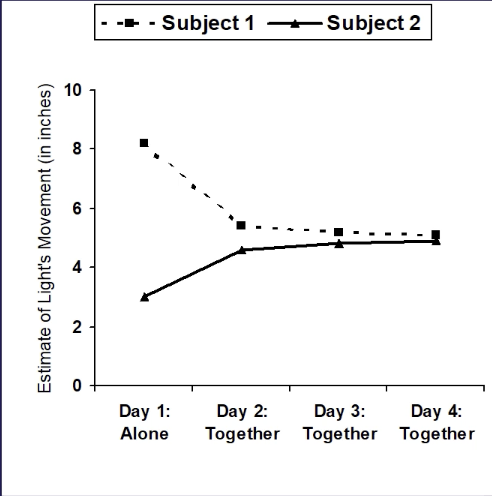
Sherifs Study
Transmission of norms
Autokinetic Effect
Procedure
Very ambiguous stimulus
Finding
subjects converge on norm
In a very ambiguous situation, people rely on the judgements of others to form a belief
Because behavior persists in private, information influence seems to be operating
Asch Study
Disagreed with Sherif’s interpretation
In gestalt psychology, motives can’t influence basic perceptual processes
Asch believed ambiguity were the key
Used very unambiguous stimulus
Procedure:
Some enter room with many other fake subjects with only one open chair
Uneventful beginning Trials to give certainty, and then gave fake answer
75% went along on at least 1 of the 12 trials
Unambiguous people still conformed, if written down
In an unambiguous situation, conformity arises from normative influence since don’t conform in private
Faction size, find that once 4 people say it before, maximum produces conformity
Role of Unanimity
Conformity drops to almost zero even if one person desists the group (not even same choice).
Milgrams study of obedience
subjects are cast in role of a teacher who is going to punish a learner
Learner starts to complain of chest pains and discomfort
If fake subject balks at giving more shock, the experimenter says, the experiment must continue
Learner eventually falls silent
Will subjects continue shocking a nonresponsive learner
More than 70% of subjects continued shocking a nonresponsive learner, and only 20% stopped when the learner began to scream, subjects were just following orders.