Test 2
 Call Kai
 Learn
 Practice Test
 Spaced Repetition
 Match
 Flashcards
 Knowt Play
1/28

There's no tags or description
Looks like no tags are added yet.
29 Terms
The Kylonian Affair, 632 BCE, Megara, Olympic Games, Acropolis, Athena’s, escaped, instability, religious
The _____ _____
Definition: Attempted coup by Kylon to become tyrant of Athens
Date: ___ BCE
Context: Kylon had support from ____ and attempted to seize power during the ____ ____
What happened:
Kylon and supporters occupied the ____ and sought sanctuary at ____’s temple
Kylon ____, abandoning his supporters
Supporters left the sanctuary with a rope connecting them to Athena’s statue for protection, but it broke and they were killed
Significance:
Shows aristocratic factionalism and political ____
Demonstrates ____ importance
Helps explain later concerns about tyranny and political reform
Peisistratos, 6th, 561 BCE, attacked him, 558 BCE, Athena, 546 BCE, Kept, loans, agora, Panathenaia
_______
Definition: Athenian tyrant from the coastal region of Attica
Period: ____ century BCE
Three attempts to gain power:
First in ___. Claimed rivals __ ___ and demanded club-bearing bodyguards. Used them to seize the Acropolis
Second in ___. Returned to Phye with a woman dressed as ____, presenting his return as divinely supported
Third in ____. Returned from exile with military support and finally took over power
Policies and achievements:
____ exisiting laws and institutions
Provided low-interest ___ to poorer farmers
Developed public buildings and the ____
Expanded the _____ with musical and athletic compeittions
Significance
Was not necessarily a ____ tyrant
Public projects and festivals strengthened athenian ___
Kleisthenes’ Reforms, 508 BCE, tyranny, tribal system, 10, trittyes, demes, boule, 50, Ekklesia, Pnyx, democracy, civic
_____ _____
Definition: Reorganization of Athenian government that established foundations for democracy
Date: ___ BC
Context: Response to the threat of ____
____ system:
Replaced the four traditional tribes with __ tribes
From the cost, inland, and city
Used ___ (regional thirds) and ____ (local civic units)
Weakened old regional power blocs
Council of 500 (___):
__ members per tribe
Selected annually by lot
Prepared the assembly’s agenda and managed daily government
____ (Assembly)
Assembly of all male citizens
Met at the ___
Debated and voted on public matters
Significance:
Established the foundations of athenian ____
Encouraged ____ pariciaption
Archons, Solon’s reforms, 594 BCE, classes, Eponymous, Basileus, Polemarch
_____
Definition: Magistrates responsible for important administrative, judicial, political, and religious affairs
Context: ____’s reforms in ___ BCE
Eligibility:
Initially associated with aristocratic birth, but solon opened eligibility to the wealthiest property ____
Three principal archons
_____ Archon; Gave his name to the year, supervised civic affairs
Archon ____: Oversaw religious and certain legal matters, not an actual king
_____: Originally responsible for military affairs
Significance:
Shows movement from hereditary privilege toward property-based eligibility
Illustrates the development of Athenian civic institutions
Political participation expanded, but offices still remained restricted by class
Ionian Revolt, 499 BCE, Asia Minor, Athens, Eretria
_____ _____
Definition: Revolt of Greek cities in Ionia against Persian rule
Date:
Location: Western coast of ___ ___
Key events:
Aristagoras of Miletus helped lead the revolt
____ and ____ provided support
Rebels and allies burned Sardis, an important Persian administrative center
Persians defeated the rebels
Miletus was captured
Significance:
Major cause of the Greco-Persian wars
Darius I sought to punish Athens and Eretia for their involvement
Helped lead to the Persian expedition of 490 BCE and the battle of marathon
Battle of Marathon, 490 BCE, supporting, earth, water, captured, did not, defeated
____ of ____
Definition: Greek victory over the Persians during the first Persian invasion of Greece
Date: ___ BCE
Context: Darius I sought to punish Athens and Eretria for ____ the Ionian revolt
Key events:
Persians demanded “____ and ____” symbols of submission
Persians ____ Eretria and landed at Marathon
Athens requested Spartan assistance, but Sparta __ ___ arrive in time
Athenians, aided by Plataeans, ____ the Persian force
Greek hoplites fought in formation against Persian troops
Athenians hurried back to protect Athens from a possible naval attack
Significance
Demonsrated the effectiveness of seeing the Greek type of warfare
Increased athenian confidence and civic pride
Became a lasting symbol of resistence to Persian imperial power
Did not end the persian threat- there was another invasion followed in 480 BCE
Battle of Thermopylae, 480 BCE, Thermopylae, 300, Ephialtes
_____ of _____
Definition: Greek defensive battle against the Persian invasion led by Xerxes I
Date: ___ BCE
Location: Narrow mountain pass at _____
Key events:
Leonidas led ___ Spartan citizens alongside other Greek troops
Narrow terrain helped the Greek phalanx resist the larger Persian force
____ revealed a route around the pass
Leonidas dismissed many troops and remained with a smaller force
Spartans, Thespians, and Thebans fought in the final stand
Greeks withdrew from Artemisium; Athens was evacuates
Significance:
Became a symbol of courage, sacrifice, and resistance
Demonstrates both Greek cooperation and the challenges of unity
Though a Persian victory, the resistance became central to Greek collective memory
The ____ of ____
Definition: Major Greek naval victory over Persia during Xerxes’ invasion
Date: ____
Key figure: ____, Athenian political and military leader
Key events:
Delphi’s oracle referred to “____ ____”
Themistocles interpreted this as a reference to ships
Athens was evacuated
Greeks fought the Persian fleet near Salamis
Greek triremes used the narrow waters to their advantage
Persian fleet suffered a decisive defeat
Greek victories at Plataea and Mycale in 479 BCE helped end the invasion
Significance:
Turning point in the Persian Wars
Demonstrated the importance of naval strategy and geography
Strengthened Athenian naval power and prestige
Helped establish conditions for Athens’ later leadership in the Greek world
____ of _____ inscription
Definition: Epitaph commemorating the Athenian tragedian Aeschylus
Dates: c. 525–456 BCE
Location: Gela, Sicily, where Aeschylus died
Important details:
Identifies Aeschylus as the son of Euphorion and an Athenian
Emphasizes his participation in the Battle of Marathon
Says Marathon and the long-haired Persians could testify to his courage
Does not emphasize his literary achievements
Literary context: Seven tragedies survive, including the Oresteia and The Persians
Significance:
Shows the importance of military service and civic honor
Demonstrates Marathon’s lasting place in Athenian memory
Reveals that service to the polis could define public identity more than artistic achievement
Aeschylus’ The Persians
Definition: Greek tragedy about the Persian defeat at Salamis, told from the Persian perspective
Author: Aeschylus
Date: 472 BCE; eight years after Salamis
Setting/context: Performed at the Greater Dionysia in Athens
Key characters and events:
Queen Atossa and the Persian elders await news
Ghost of former king Darius criticizes Xerxes
Xerxes’ defeat is presented as the result of excessive ambition and hubris
Literary significance:
Earliest surviving tragedy based on relatively recent historical events
Explores hubris, divine justice, imperial power, and suffering
Historical/cultural significance:
Shows how Athenians remembered the Persian Wars
Demonstrates tragedy’s role in Athenian civic and religious life
Encourages reflection on the consequences of war and excessive power
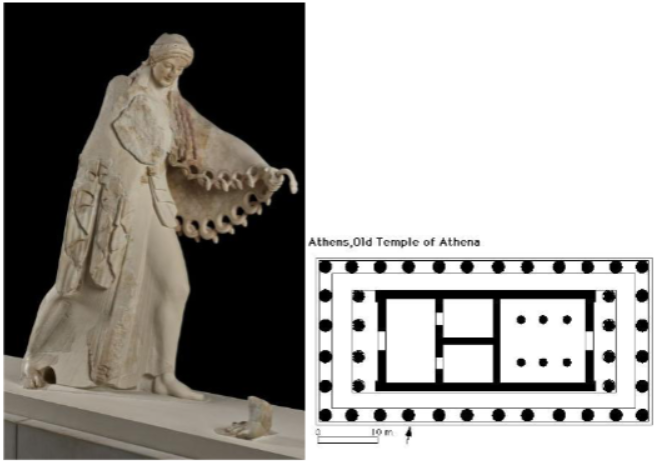
Marble statue of the goddess athena in the temple of athena, 6th, Gigantomachy, olympic gods, giants, patron
Identification: Marble statue of the goddess ____ in the temple of ____
Date: Archaic period, approximately late ___ century BCE
Subject: Central pediment depicting the _____ (Battle of the Giants)
Important features:
Athena is represented as a goddess participating in the battle against the Giants
The Gigantomachy depicts the conflict between the ___ ____ and the ____
Significance:
Demonstrates the importance of Athena as Athens’ ____ goddess
The Gigantomachy represents the triumph of divine order over disorder
Shows the role of mythology and religious sculpture in decorating sacred buildings
Connects Athenian identity with the power and protection of Athena
Deification of Herakles, archaic period, athena leads herakles, apotheosis, hera’s, small, peisistratos
Identification: Pedimental sculpture depicting the _____ of _____
Date: ____ period; exact date needs to be looked up oops
Subject: ____ leads ____ to Olympus to be received by Zeus and Hera
Important features:
____ means the elevation of a mortal to divine status
____ presence is significant because she traditionally opposed Herakles
Her presence at his reception can suggest acceptance of his new divine status
The sculpture is relatively ____; its original building is uncertain
Significance:
Illustrates Greek beliefs about the relationship between mortals and gods
Shows how myth could communicate divine favor and legitimacy
Connection to _____: His return to Athens with Phye dressed as Athena similarly presented his return as divinely supported

Harmodius, Aristogeiton, Tyrannicides, 477, Hipparchus, Hippias,
Identification: Sculptural group of _____ and _____, known as the _____
Date: Original Athenian bronze group commissioned around ___ BCE; surviving examples include Roman copies
Historical context:
Harmodius and Aristogeiton killed ______ in 514 BCE
Hipparchus was the brother of the tyrant _____
Hippias remained in power until his expulsion in 510 BCE
Important features:
The pair were celebrated in Athens as tyrant-killers
Their statues commemorated their actions and became public political symbols
Significance:
Became symbols of Athenian freedom and opposition to tyranny
Helped shape the later democratic memory of Athens
Their reputation simplified a more complicated historical story: killing Hipparchus did not immediately end the tyranny

Eponymous Heroes, 5th century, agora of athens, ten, public notices,
Identification: Monument of the ____ _____
Date: Late ___ century BCE in its developed form; associated with the democratic tribal system introduced by Kleisthenes
Location: Ancient ____ of ____
Important features:
Marble podium or enclosure supporting bronze statues of the ___ tribal heroes
____ _____ concerning each tribe were displayed near its corresponding hero
Served as a central location for civic announcements and information
Significance:
Made the ten-tribe system visible in the civic center
Connected Athenian political organization with heroic and mythological tradition
Shows how public monuments supported communication and participation in civic life
Demonstrates the importance of the Agora as a political and social gathering place

Old bouleuterion in the ancient agora, bouleuterion, buildings, bouleurion, tholos
Old ____ in the ____ _____
Identification: Civic buildings in the Ancient Agora associated with Athenian government
Location: Ancient Agora of Athens
Important ____ and functions:
Old ____: Earlier meeting place of the Council of 500, the Boule
____: Round building used by the prytaneis, the rotating executive group drawn from the Council
Significance:
Demonstrates that Athenian democracy required permanent administrative spaces
The Boule prepared business for the Assembly and helped manage daily government
The Tholos supported the continuous operation of the state
The Metroon illustrates the importance of records and public documentation in civic administration

Kleroterion, classical, athens
The ____:
Date: ____ period, especially the 5th–4th centuries BCE
Location: _____
Function:
Citizens inserted identifying tokens into slots in the machine
A randomizing mechanism determined which citizens were selected
Used for jury selection and associated with selection for certain public offices
Important concept: Sortition = selection by lot rather than election
Significance:
Helped limit the influence of wealth, popularity, and powerful political families
Reflected the democratic principle that eligible citizens could participate in government
Demonstrates how Athenians used practical mechanisms to organize democratic institutions
Participation was still limited to eligible citizens, not the entire population

Pnyx, Pnyx, Athens, Ekklesia, bema
Description/name: ____
Location: ___, ____
Historical context: Classical Athens and the development of direct democracy
Important features:
The Pnyx was the principal meeting place of the _____
The Ekklesia was the Assembly of male Athenian citizens
Citizens gathered to hear speakers, debate public issues, and vote
The ____ provided a place from which speakers addressed the assembly
Significance:
Represents direct citizen participation in Athenian democracy
Public speaking and persuasion were important political skills
Shows how physical spaces helped facilitate democratic decision-making
Political participation excluded women, enslaved people, and resident foreigners

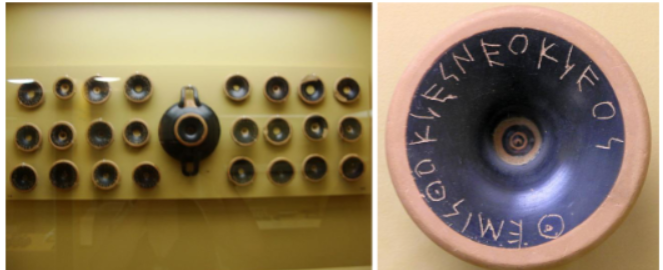
Ostraka, (ostraka), 5th
Definition: ____
Identification: Broken pottery shards (____) used as voting tokens
Date: Classical Athens, beginning in the ____ century BCE
Key term: Ostracism = temporary exile of a citizen by a civic vote
How it worked:
Citizens scratched the name of a person onto a pottery shard
The votes were counted to determine whether a citizen would be exiled
The Assembly considered annually whether to hold an ostracism
If the decision was to proceed, a separate vote followed
A successful ostracism generally resulted in ten years of exile
Purpose: Help prevent the return of tyranny or the concentration of excessive political power
Significance:
Demonstrates how Athenians tried to protect their political system
Shows the use of ordinary materials in democratic voting
Could be used against prominent political figures
Illustrates the tension between protecting democracy and using political power against individuals
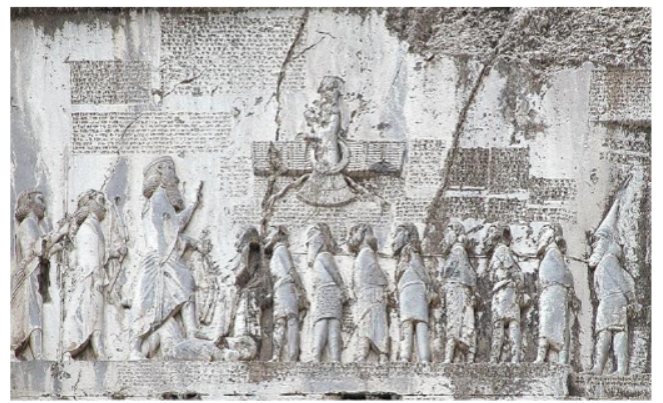
Behinstun Inscription, 520 BCE, limestone, Old Persian, Elamite, Babylonian,
Definition/ID: _____ Inscription
Date: c. ___ BCE
Location: Behistun (Bisotun), in present-day western Iran
Important physical features:
Carved high on a ____ cliff, approximately 100 meters above the ground
Inscription written in three languages:
Old ___
____
____ (Akkadian)
Relief depicts Darius asserting authority over defeated enemies
Content:
Darius presents his rise to power and military victories
Describes rebellions against his rule and their suppression
Claims that Gaumata, identified as an impostor or “False Smerdis,” falsely claimed royal authority
Connects Darius’ legitimacy to his royal lineage and the support of Ahura Mazda
Portrays rebellion as wrongdoing that deserves punishment
Significance:
Demonstrates how rulers used monumental inscriptions to legitimize their authority
Presents rebellion as a threat to political order and divine favor
Provides important evidence about the Achaemenid Persian Empire
The multilingual inscription later helped scholars decipher ancient cuneiform writing
Theatre of Dionysus in Athens, 6th,
Theatre of ____ in _____
Date: Dramatic performances developed here during the ____ century BCE; the theatre underwent major changes during the Classical period and later
Location: Southern slope of the Acropolis in Athens
Historical and cultural context:
Associated with the City/Greater Dionysia, a major religious festival
Hosted competitions in tragedy and, in later developments, comedy and other performances
Associated with playwrights such as Aeschylus, Sophocles, and Euripides
Important features:
Seating arranged around a performance area
Space for actors, chorus, and audience
Developed from earlier performance spaces into a more substantial theatre
Significance:
Demonstrates the connection between religion, drama, and civic life
Theatre helped Athenians explore politics, morality, mythology, and social relationships
Dramatic competitions were public events, not simply private entertainment
Shows the importance of collective participation and shared cultural identity in Athens
Solon’s reforms, 594 BCE, wealthy landowners, cancelled, reorganized, balance.
Identification: ____ _____ in Athens
Date: c. ____ BCE
Location: Athens, Greece
Context:
Athens faced social and economic conflict between ____ _____ and poorer citizens.
Debt and dependence threatened the freedom of poorer Athenians.
Key details:
Solon _____ debts and addressed debt bondage.
He ____ political participation according to wealth.
He attempted to _____ the interests of rich and poor.
Significance:
Reduced social tensions and changed Athenian law.
Laid groundwork for later democratic developments, although Athens was not yet a full democracy.

solon, poetry, 6th, dominate, power, balanced.
Identification: ____ defending his political reforms through ____
Date: Early ____ century BCE
Location: Athens
Context:
Solon explains how he tried to serve the people without allowing either rich or poor to _____.
Key details:
He claims to have given the people sufficient _____ without excessive privilege.
He resisted both popular demands for more power and elite attempts to control the state.
His goal was to create a _____ political order.
Significance:
Shows how Solon justified his reforms and presented himself as a mediator.
Demonstrates the importance of poetry as a way to communicate political ideas

Kleisthenes, 508 BCE, trust, reforms, tribes, boule, three, weakened, participation, foundations
Passage 4 — _____’ Reforms
Date: ____ BCE
Location: Athens, Greece
Context:
Kleisthenes gained the people’s ___ after the overthrow of the tyrants.
He introduced _____ during the archonship of Isagoras.
His goal was to mix the population and give more people a share in the constitution.
Key details:
Reorganized the population into 10 _____ instead of 4.
Expanded the _____ (Council) from 400 to 500 members, with 50 from each tribe.
Divided Attica into _____ regions: the city (asty), coast (paralia), and inland (mesogeios).
Combined demes from different regions into tribes to mix the population.
Made demes the basis for identifying citizens, replacing the use of fathers’ names.
Established demarchs to lead the demes.
Preserved traditional clans, phratries, and priesthoods.
Named the tribes after ten eponymous heroes.
Significance:
_____ the influence of old family and regional loyalties.
Broadened citizen _____ in Athenian government.
Established important _____ for Athenian democracy .

Herodotus’, Io, origins, 5th, differently, phoenician, argos, abducted.
Identification: _______’ account of the abduction of _______ and competing stories about the _______ of conflict between Greeks and Persians
Date: Herodotus wrote in the _______ century BCE; the story concerns mythical, legendary events
Location: Argos and the eastern Mediterranean, including Phoenicia
Context:
Herodotus begins his account of the long history of hostility between Greeks and non-Greeks.
Different peoples explain the origins of conflict _______.
Key details:
_______ traders arrive at Argos.
Io, the daughter of the king of _______ , is _______.
The account describes competing explanations for the abduction and subsequent retaliations.
Significance:
Illustrates how different cultures tell conflicting stories about the origins of war.
Introduces the theme of reciprocal abduction and revenge in Greek-Persian relations.
Shows Herodotus presenting traditions rather than treating every story as certain fact.

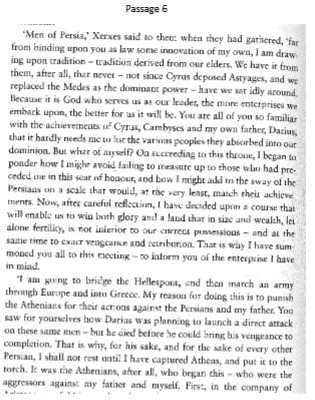
Xerxes, invading Greece, 480, Persian, wealth,
Identification: ______’ justification for ______ ______
Date: ______ BCE
Location: ______ Empire; planned invasion across the Hellespont into Greece
Context:
Xerxes is addressing Persian leaders before his campaign against Greece.
He refers to the expansion of the Persian Empire under Cyrus, Cambyses, and Darius.
Key details:
Xerxes wants to expand the empire and gain ______ and glory.
He plans to cross the Hellespont and march into Greece.
He claims he wants to punish Athens for its actions against Persia and his father, Darius.
Significance:
Explains Xerxes’ stated reasons for the Persian invasion.
Illustrates how imperial ambition and revenge are used to justify war.
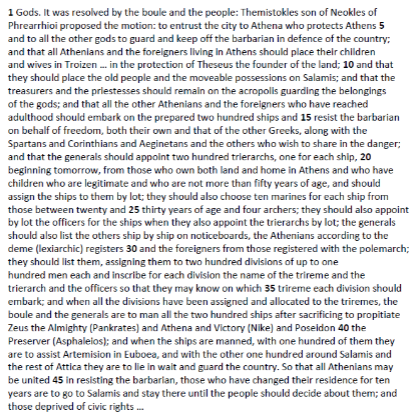
decree, evacuation, 480 bce, xerxes’
Identification: Athenian ____ organizing the ____ and defense of Athens during the Persian invasion
Date: ____ BCE
Location: Athens and the surrounding Greek world
Context:
____ ’ Persian army was invading Greece.
Athens had to decide how to protect its population and continue resisting.
Key details:
The decree calls for the protection of the city and its people.
Women, children, and other noncombatants were to be moved to safer locations.
The fleet and military forces were central to the defense strategy.
The decree lays out responsibilities for organizing ships and personnel.
Significance:
Shows that Athens planned to preserve its population while continuing the war.
Demonstrates the central role of the navy in Athenian strategy.
Connects to the Greek victory at Salamis in 480 BCE.
Herodotus, response, 480 BCE, advancing, abandon, ships
Identification: _____’ account of Athenian preparations and the Greek _____ to the Persian invasion
Date: _____ BCE
Location: Athens and the Greek mainland
Context:
The Persian army was _____ through Greece.
The Athenians were preparing to _____ the city and rely on their fleet.
Key details:
The passage describes the Athenians’ actions as the Persian threat approached.
The population and military forces were directed toward the planned defense.
The Athenians’ strategy depended on their _____ rather than holding the city itself.
Significance:
Highlights the sacrifices and strategic choices made during the Persian Wars.
Shows the importance of evacuation and naval planning to the survival of Athens.
Helps explain the circumstances leading to the Battle of Salamis.

Themistocles, Xerxes, Salamis, 480 BCE, near, straits, less, misrepresented, trap, smaller, victory.
Identification: _____’ deceptive message to _____ before the Battle of _____
Date: _____ BCE
Location: Salamis and the waters near Athens
Context:
The Greek fleet was gathered _____ Salamis.
Themistocles wanted the Greeks to fight in the narrow _____, where the Persian fleet’s numerical advantage would be _____ effective.
Key details:
Themistocles sent a message to Xerxes that _____ the Greek situation.
The message encouraged the Persians to act in a way that would _____ their fleet in the narrow waters.
The Greeks were able to fight under conditions more favorable to their _____ fleet.
Significance:
Contributed to the Greek _____ at the Battle of Salamis.
Shows Themistocles’ use of deception and strategic planning.
Demonstrates how geography could offset a larger military force

Hippocrates, 5th
Identification: _____ ’ explanation of how geography and climate influence human physical characteristics and temperament
Date: ___ century BCE (Hippocratic tradition)
Location: Ancient Greece; compares mountainous, low-lying, and high-altitude environments
Context:
The author examines how differences in climate, water, and landscape affect populations.
The passage attempts to explain variations in people’s bodies, appearance, and behavior through environmental conditions.
Key details:
Mountainous areas with high elevations and abundant water produce people described as large, hardy, brave, and physically strong.
Low-lying, marshy areas with still water and changing weather produce people described as fleshy, dark-haired, and less courageous.
People living at high elevations with strong winds and rain are described as tall and having relatively consistent physical characteristics.
Places with limited seasonal and weather changes are said to produce people with more consistent bodies and temperaments.
The author argues that bravery and hardship are not entirely natural traits and can be developed through training.
Significance:
Illustrates ancient Greek environmental determinism: the belief that geography and climate shape human characteristics.
Shows an early attempt to explain human differences through natural causes rather than solely through ancestry or divine influence.
Reflects ancient medical and geographical theories, not scientifically established conclusions about populations.
