Geological structures
 Call Kai
 Learn
 Practice Test
 Spaced Repetition
 Match
 Flashcards
 Knowt Play
1/31

There's no tags or description
Looks like no tags are added yet.
32 Terms
primary vs secondary structures
Primary structures = structures formed as the rock is being made
E.g. bedding and cross bedding in sedimentary rock
Secondary structures = change to primary structure to make a new structure
Normally due to deformation
what are orogens
Mountain belt / orogen belt / orogens = occurrence of mountains as a part of linear ranges
what is Orogeny
process of forming mountains
collision of plates cause sediment and crust of plate to be pushed up and form mountains
Type of deformation
Strongly deformed = higher mountains
Folds = squishing and stretching of crust
Faults = cracks between rock
Types of deformation
Translation | Change in location |
Rotation | Change in orientation |
Distortion / Strain | Change in shape |
Brittle and ductile behaviour during deformation
Brittle deformation |
|
Ductile deformation |
|
Parameters determining brittle or ductile behaviour
Temperature |
|
Composition |
|
Strain rate |
|
Types of strain
Stretching | Increasing the length of one dimension parallel to stretching |
Shortening | Increasing length of dimension perpendicular to shortening |
Shear strain | Change in angle between dimensions of a rock |
how do we measure strain

Relationship between stress and strain
Strain is the consequence of deformation
Stress causes deformation
Stress is the force per unit area
Large stress = large deformation
Small stress = small deformation
list the types of stress
Tension
Compression
Shear stress
Pressure
types of stress that occurs due to different strains
Tension | Occurs when a rock is stretched/elongated
|
Compression | Occurs when a rock is shortened
|
Shear stress | Develops due to shear strain -> when one side of a rock body moves sidesways past the other side
|
Pressure | Same stress in all direction
|
Fault vs fracture
Both break the rock
Faults show offset/displacement of strata
Fractures show no offset/displacement of strata
Discontinuities in rock on a very small scale

Types of faults
Slip-dip faults
Strike-slip faults
Oblique-slip faults
what are Dip-slip faults
Sliding occurs up or down the slope of fault/dip
No lateral movement
Footwall block vs hanging block
In non-vertical faults
Hanging wall block = rock above the fault plane
Footwall block = rock below the fault plane
type of slip dip faults
Thrust faults and reverse faults = hanging-wall block moves up the slope
Thrust fault = dip less than 35°
Gentle slope
Reverse fault = dip greater than 35°
Steep slopes
Accommodate shortening
Normal faults = hanging wall block moves down the slope of the fault
Accommodate lengthening
what are Strike-slip faults
One block slides past another block, parallel to the strike of the fault plane
No vertical movement
type of strike-slip faults
Based on relative movement of one block with respect to another
Left-lateral strike-slip fault (sinistral) = block on the far side slips to the left
Right-lateral strike-slip fault (dextral) = block on the far side moves right
what are Oblique-slip faults
Sliding occurs diagonally on the fault plane
Oblique slip faults have a combination of dip-slip and strike-slip sliding
Both vertical and lateral movement
types of oblique-slip faults
Left-lateral reverse fault
Hanging-wall block moves up the slope with a left component of displacement
Right-lateral normal fault
Hanging block moves down the slope with a right component of displacement
Fault symbols on the map
fault
normal fault
reverse/thrust
strike slip
Fault = thick solid line
Normal fault = rectangle/circle is added in the direction the hanging rock is moving downwards
Reverse/thrust fault = triangle is added in direction hanging rock is moving up
Strike-slip = antiparallel arrows next to thick solid line
what are shear zones
wide areas of ductile rock deformation
Further down from surface
Ductile equivalents of fault zones
faults vs shear zones
here is a transition between brittle and ductile deformation with depth
Increased depth = increased temperature = ductile deformation
Lower depth = cooler temperature = brittle deformation
Faults = areas of brittle rock deformation
Close to surface
Shear zones = wide areas of ductile rock deformation
Further down from surface
Ductile equivalents of fault zones
Impact of stress type on the type of faults formed
Convergence |
|
Continental collision |
|
Continental rifting |
|
define folds
Consists of curving rock layers
Structure formed by ductile deformation
Buckling or bending of rock layers
what are Parts of folds
Hinge = portion of folds where curvature is greatest
Tip top
Limbs = side of fold with minimal curvature
Sloped sides
Axial plane/surface = imaginary surface that encompasses hinges of successive layers
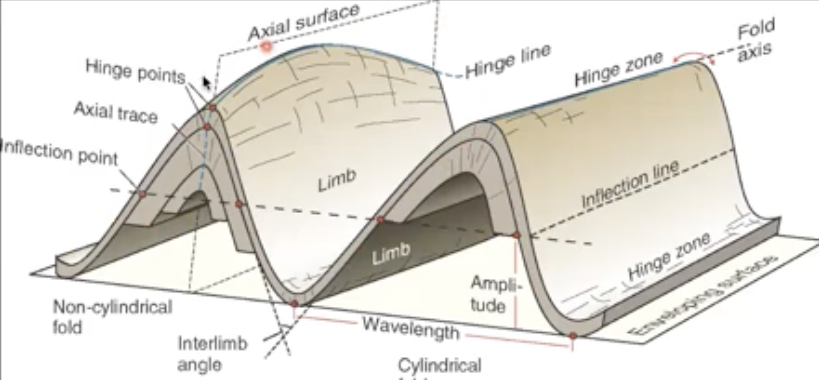
Types of folds
Steepness of fold | Open |
Tight | |
Isoclinal | |
Shape of fold | Anticline |
Syncline | |
Monocline | |
Hinge orientation | Non-plunging |
Plunging |
fold types based on Steepness of fold
Open | Angle between limbs are large |
Tight | Angle between limbs is small
|
Isoclinal | Limbs are parallel
|

fold types based on shape of fold
Anticline | Arch-like shape -> Limbs dip away from hinge
Rock age relationship:
If age of rock is unknown = use the term antiform |
Syncline | Fold that have a U-like shape -> Limbs dip towards hinge
Rock age relationship:
If age of rock is unknown = use the term synform |
Monocline | Only one limb that dips away from hinge -> other limb is horizontal |
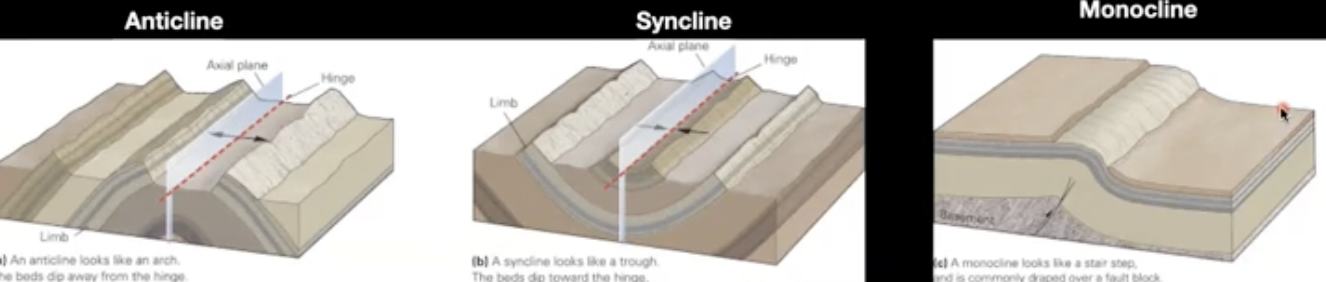
fold types based on hinge orientation of fold
Non-plunging | Hinge is horizontal, flat line Appearance on map
|
Plunging | Hinge is tilted Appearance on map
|
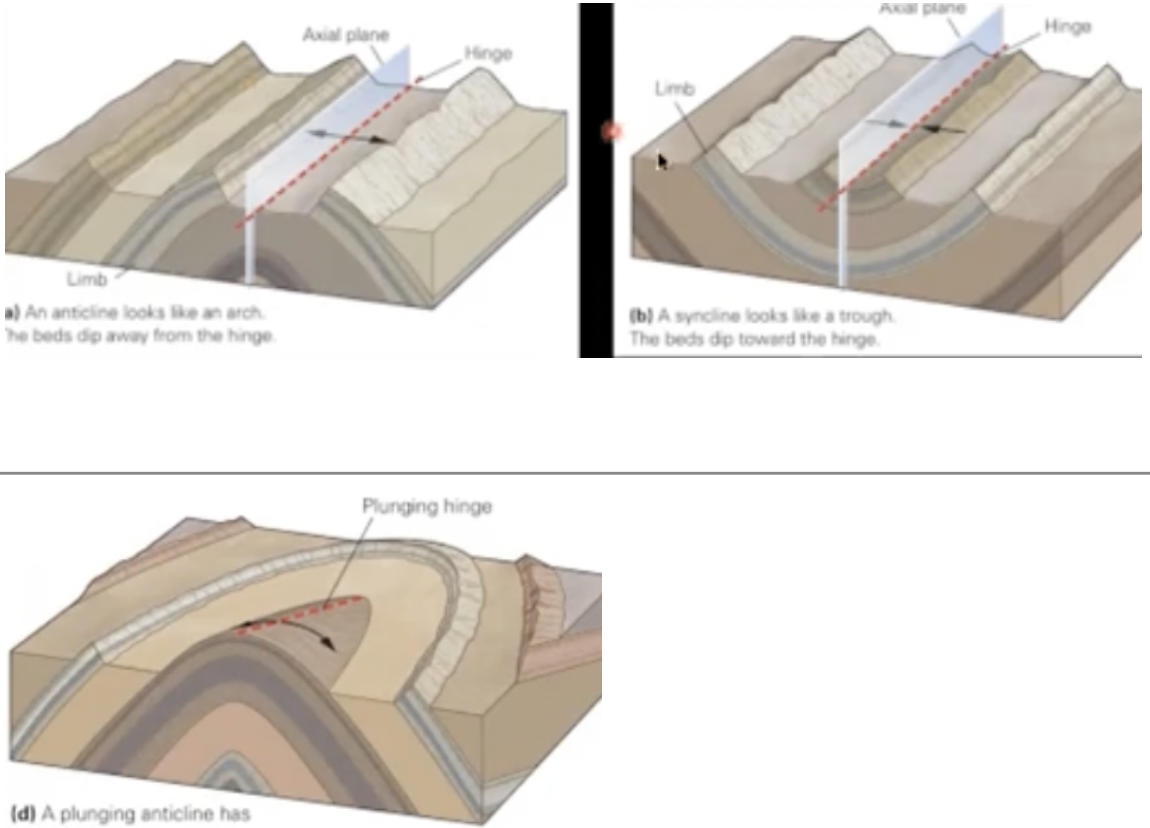
foliation relationship with folding
Cannot have foliation without folding
Foliation occurs when rock is sheared and folded
Foliation includes
Slaty cleavage
Schistosity
Gneiss foliation
what is tectonic foliation
Layering created by the alignment of deformed and/or reoriented grains
Foliation forms in response to flattening and shearing in ductilely deformed rock
I.e. foliation indicated that the rock is strained
Tends to be parallel to axial plane of folds that developed alongside foliation