ITM 301 - Week 11
 Call Kai
 Learn
 Practice Test
 Spaced Repetition
 Match
 Flashcards
 Knowt Play
1/105

Earn XP
Description and Tags
Module 11: Security in Network Design
106 Terms
What are Security Policies?
Defines an organization’s security goals, risks, roles, and responsibilities.
Specifies what users are allowed to do and expected security practices.
Defines procedures for responding to security breaches.
Avoids specific hardware/software configuration details that may change over time.
Written policies communicate security requirements to users.
Technically enforce those requirements, such as password rules in Active Directory
What are the goals for Security Policies?
Ensure authorized users have appropriate access to resources.
Prevent unauthorized access to networks, systems, applications, and data.
Protect sensitive data from internal and external threats.
Prevent accidental or intentional damage to hardware and software.
Ensure systems can respond to and recover from security threats.
Define each employee’s security responsibilities.
Inform employees about monitoring of company systems and accounts
How do you develop a Security Policy?
Form a security committee with managers, administrators, and key stakeholders.
Assign a security coordinator to lead policy development.
Align security measures with business needs and potential impacts.
Conduct a posture assessment to identify vulnerabilities and evaluate risk.
Define responsibilities for managing identified risks.
Address key areas such as personal devices, acceptable use, and sensitive data protection.
What is BYOD?
(bring your own device) refers to the practice of allowing people to bring smartphones, laptops, or other technology
What does BYOA stand for?
bring your own application
What does BYOC stand for?
bring your own cloud
What does BYOT stand for?
bring your own technology
What does CYOD stand for?
choose your own device
Part of a BYOD policy might include what?
on-boarding and off-boarding procedures that can be handled automatically by MDM (mobile device management) software
What is an AUP (Acceptable Use Policy)?
it explains to users what they can and cannot do while accessing a network’s resources
also explains penalties for violations
What are some of the restrictions of AUP?
Use company resources to fulfill job obligations and not for personal tasks
Be aware that activities on the network can be and are monitored
Immediately report any suspected compromise of confidential data
Always sign off or lock a device
Don’t do anything illegal using company devices
Don’t try to circumvent network security restrictions
Don’t forward spam email
Don’t violate the rights of any person or organization
What is a NDA?
a document that defines what confidential and private means to the
organization, (Non-Disclosure Agreement)
Where would a NDA come into place?
If you work in an environment such as a hospital, a security policy should classify information in degrees of sensitivity that correspond to how strictly its access is regulated
What are Physical Security?
Restrict and control physical access to critical network components.
Allow only authorized personnel into secure computer/data rooms.
Use preventive controls such as locked doors and access controls.
Use detection measures to identify unauthorized access or security breaches
What are some acess control technologies?
keypad/cipher lock
access badge/smart card
biometrics
access control vestibule
locking rack/cabinet
smart locker
What is a Keypad/Cipher Lock?
Requires a code to gain access.
What is an Access Badge/Smart Card?
Provides electronic access to authorized users.
What is Biometrics?
Uses unique physical characteristics, such as a fingerprint or face.
What is an Access Control Vestibule?
Uses two controlled doors to restrict entry.
What is a Locking Rack/Cabinet?
Protects servers and network devices from unauthorized physical access.
What is a Smart Locker?
Provides controlled access to equipment, devices, or sensitive materials
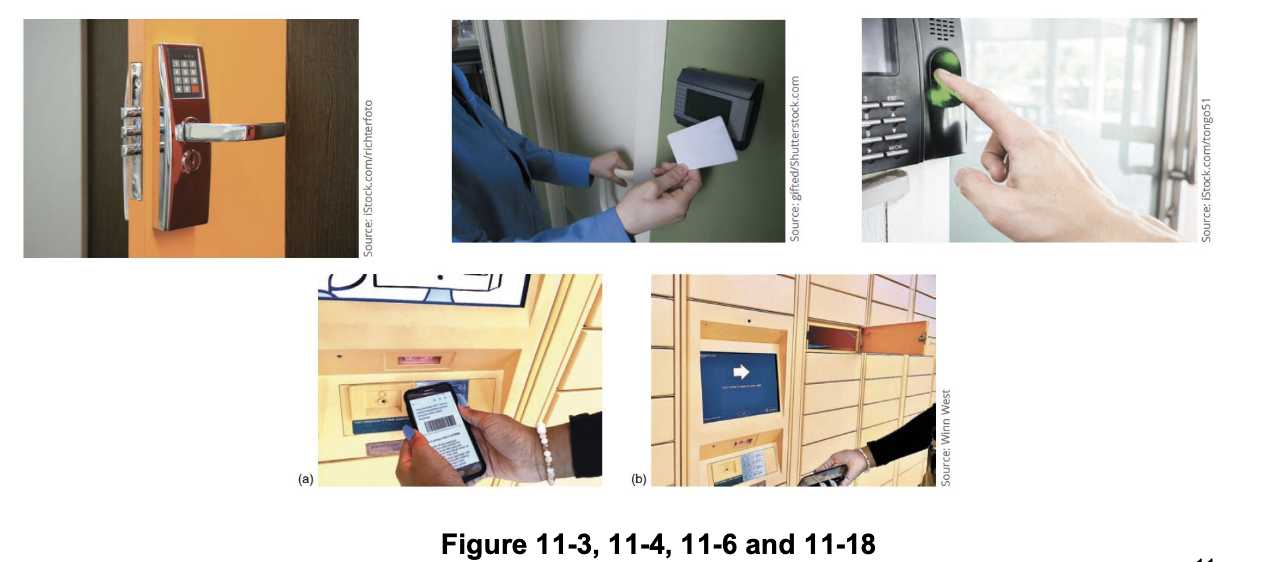
What are these figures?
Physical Prevention Methods
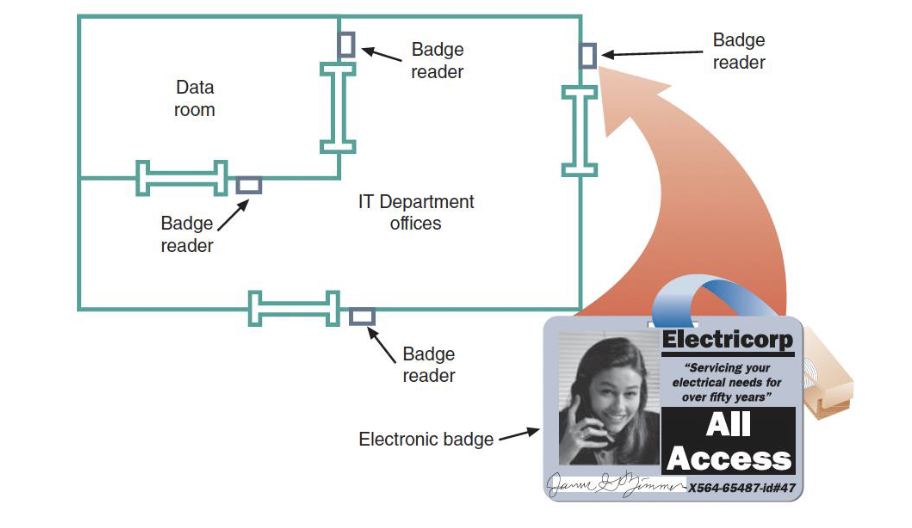
What is this figure?
Badge access security system
What are some methods of detecting physical intrusions?
Motion detection
Cameras
Tamper detection
Asset tags

What is this figure?
A single-use, plastic security seal
What kind of software can be used to secure employee-owned devices?
MDM
Which of the following is more of a detective security technology than a preventive technology?
Camera
What is a NAC (network access control)?
Controlling logical access to a network and its resources
What is an IAM (identity and access management)?
Access to all kinds of systems is managed using a framework
IAM (identity and access management) consists of what 3 major elements?
Authentication
Authorization
Accounting
What is Authentication?
The process of verifying user’s credentials to grant user access to secured resources
What is Authorization?
Determines what the user can and cannot do with network resources
What is Accounting?
To keep an account of the client’s system or network usage
Properties of Authentication?
A user can be authenticated to the local device or to the network
Local authentication process are performed on the local device
With local authentication, every computer on the network is responsible for securing its own resources
Network Authentication and Logon Restrictions
You can harden your network by requiring secure passwords to authenticate to the network
In Authentication: Usernames and passwords are stored locally which has the following advantages and disadvantages?
Low security
Convenience varies
Reliable backup access
In Windows, you can switch from local authentication to network authentication on the domain using the what?
System Properties dialog box
Additional authentication restrictions that strengthen network security include the following?
Time of day
Total time logged on
Source address
Unsuccessful logon attempts
Geographic location (geofencing)
What is Local Authentication?
Each computer or server maintains its own user accounts and passwords.
What is Network Authentication?
User accounts are centrally managed, such as through Active Directory (AD) in a Windows domain.
What is easier to manage and secure as the network grows?
Centralized authentication
What is one of the easiest and least expensive ways an organization can enforce password policies?
a secure password
users create passwords conforming to certain restrictions
What are some tips for making and keeping passwords secure include the following?
Change default passwords
Avoid personal information
Avoid real words
Don’t use sticky notes
Update passwords
Don’t reuse passwords
Use a password manager
Long is strong
Increase complexity
What is Hashing?
it means to transform data through an algorithm that reduces the amount of space needed for the data
What is the most commonly used hashing algorithm?
SHA (Secure Hash Algorithm)
What is SHA (Secure Hash Algorithm) primary advantage?
its resistance to collisions
What are the different versions of SHA?
SHA-0
SHA-1
SHA-2
SHA-3
Which two SHAs are often implemented together for increased security?
SHA-2 and SHA-3

What is this figure?
Encryption can be reversed; hashing cannot
User access to network resources falls into one of two categories?
The privilege or right to execute, install, and uninstall software
Permission to read, modify, create, or delete files and folders
What is the most popular authorization method?
RBAC (role-based access control)
With RBAC, a network administrator assigns what?
privileges and permissions necessary for users to perform their roles (duties)
Administrators create groups associated with certain roles
With role separation, each user can only be a member of a single group
What is Separation of Duties (SoD)?
Distributes sensitive responsibilities among multiple people to prevent misuse
What is Log Monitoring?
Uses tools such as Windows Event Viewer to identify suspicious events.
What is SIEM?
Collects and analyzes log data from multiple systems to identify significant security events.
SIEM rules should be fine-tuned to what?
match the organization’s security needs and manage data efficiently
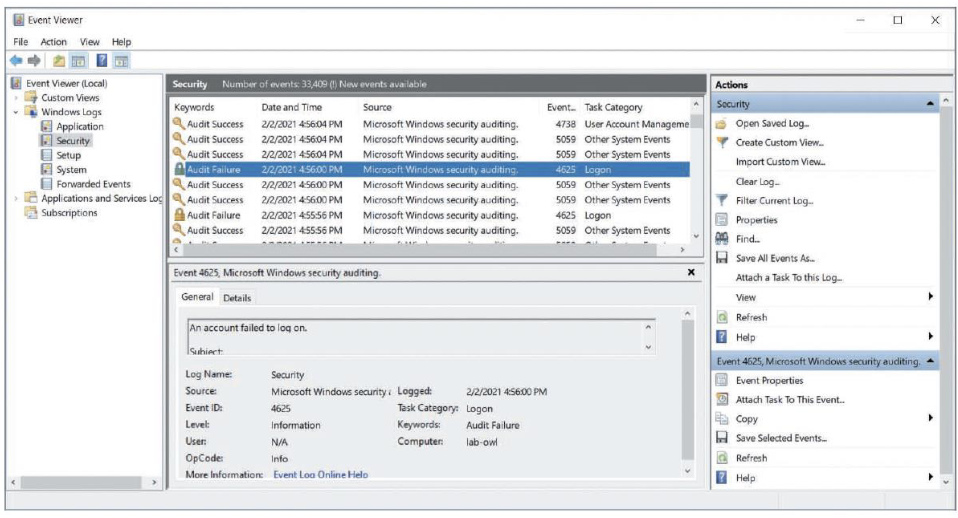
What is this figure?
Windows Event Viewer displays a security audit event
Which access control technique is responsible for detection of an intruder who succeeds in accessing a network?
Accounting
Which authorization method will allow Nancy, a custodian, to access the company’s email application but not its accounting system?
RBAC
What is SSO?
a form of authentication in which a client signs on one time to access multiple systems or resources
What is the primary advantage of SSO?
covenience
What is the biggest disadvantage of SSO?
once authentication is cleared, the user has access to numerous resources
In a 2FA (two-factor authentication) scenario, a user must do what?
provide something and know something
What is MFA (multifactor authentication)?
a process that requires two or more pieces of information
What are the 5 categories of authentication factors?
Something you know – password or PIN
Something you have – ATM or smart card
Something you are – fingerprint or facial pattern
Somewhere you are – location in a specific building
Something you do – specific way you type or speak
MFA requires what?
at least one authentication method from at least two different categories
What is a security token
a device or application that stores or generates information known only to its authorized user
What is Directory Services?
Maintains a database of account information, such as, usernames, passwords, and other authentication credentials
What are some examples of directory services?
AD (Active Directory) in Windows
OpenLDAP
389 Directory Server
All these options are built to be LDAP compliant
What is LDAP (Lightweight Directory Access Protocol)?
a standard protocol for accessing an existing directory
AD is configured to use what?
the Kerberos protocol
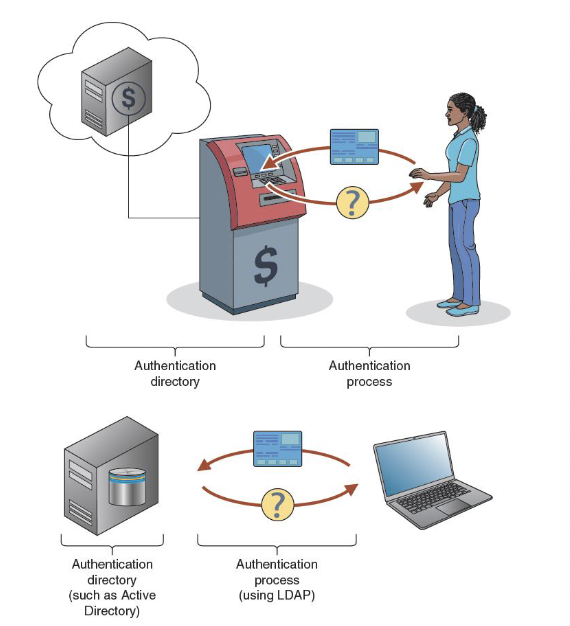
What is this figure?
The data and process of authentication
What is Kerberos?
a cross-platform authentication protocol that uses key encryption to verify client identity and to securely exchange information after the client logs on
Kerberos is an example of what?
a private key encryption service
Terms related to Kerberos include the following:?
Principal, KDC (Key Distribution Center), and ticket
A Kerberos server runs two services, which are?
AS (authentication service)
TGS (ticket-granting service)
What is an AS (authentication service)?
initially validates a client
What is a TGS (ticket-granting service)
an application running separate from the AS that also runs on the KDC
TGS alleviates the need for what?
the client to request a new ticket from the TGS each time it wants to use a different service on the network

What is this figure?
The ticket-granting service offers a client a ticket for each network service it needs access to
What is a RADIUS (Remote Authentication Dial-In User Service)?
a cross-platform, open-source standard
RADIUS runs in the _________ layer and can use either _____ or _______ in the _________ layer.
application, UDP, TCP, transport
RADIUS can operate as what?
an application on remote access server or on dedicated RADIUS server
RADIUS is highly ________ and can be used to ________?
scalable
authenticate wireless, mobile, and remote users
RADIUS services are often combined with what?
other network services on a single machine
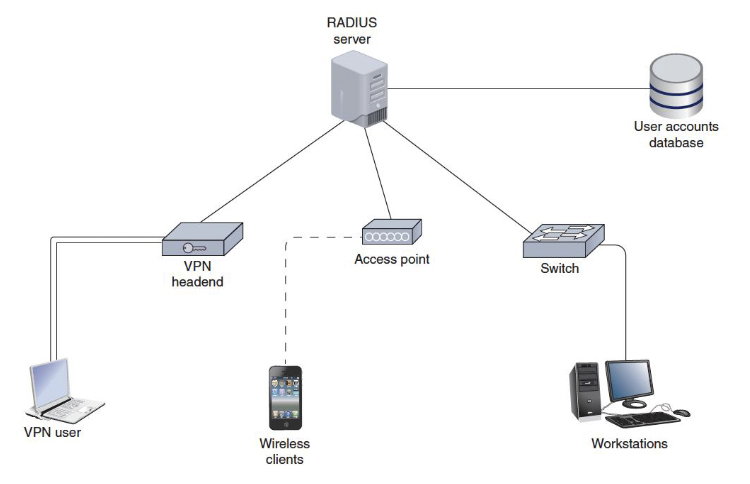
What is this figure?
A RADIUS server on a network servicing various types of user devices

What is this figure?
RADIUS and Active Directory can work together to support different types of clients
What is TACACS+ (Terminal Access Controller Access Control System Plus)?
it offers the option of separating authentication, authorization, and auditing capabilities
TACACS+ differs from RADIUS in that it does the following:?
Relies on TCP, not UDP, at the Transport layer
Proprietary protocol developed by Cisco Systems, Inc.
Is typically used to authenticate to network devices such as routers and switches rather than workstations or servers
Is most often used for device administration access control for technicians
Encrypts all information transmitted for AAA
What is an IdPs (Identity Providers)?
Service that stores user identities and authenticates users for other applications.
What do IdPs (Identity Providers) do?
Enables users to sign in to multiple services using existing credentials.
What is SAML?
Standard that allows an IdP to securely send authentication information to a Service Provider (SP)
The SP does not directly access or store the user’s credentials.
What are benefits of Third-Party IdPs (Identity Providers)?
better user experience, reduced password support, secure credential storage, and MFA support.
Which authentication protocol is optimized for wireless clients?
RADIUS
Traditional perimeter-based security is what?
no longer sufficient
What is Zero Trust?
Never automatically trust users or devices, even inside the network.
What is SASE (Secure Access Service Edge)?
Combines networking and security services in the cloud to provide secure access for users, devices, branches, and cloud resources.
What is a Zero trust security model?
where everything in or out of the network is considered untrustworthy until proven otherwise
Zero trust security relies on what?
certain principles that define limited access rights to individual resources
Attack surfaces
Segmentation
Authentication
Access management
Observability
Zero trust security model is implemented in a what?
ZTA (zero trust architecture), it ensures that traffic and access requests are evaluated at the most granular level available
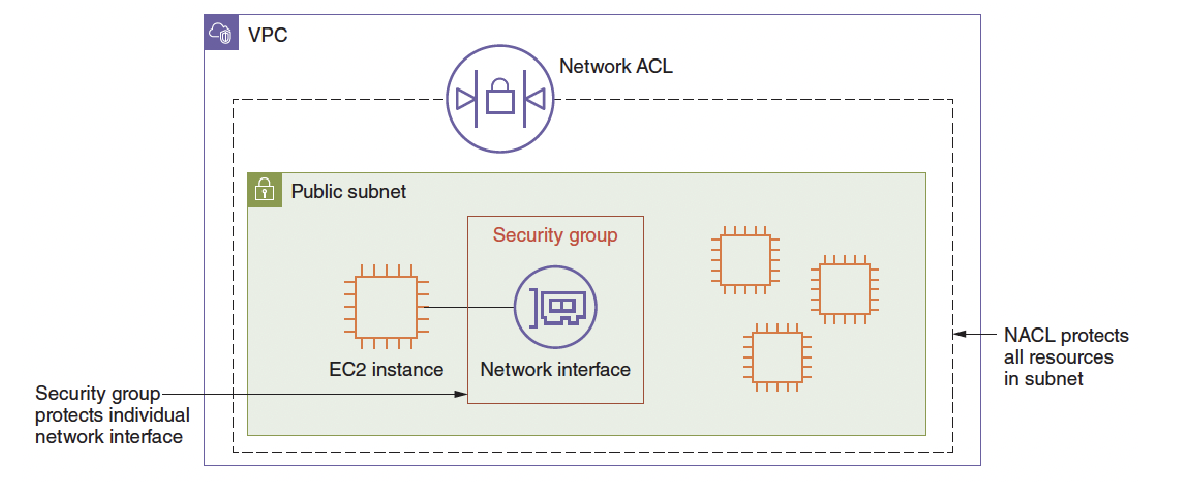
What is this figure?
Security groups offer granular filtering for individual interfaces, while NACLs filter traffic for an entire subnet