Functional Groups in Organic Chemistry
 Call Kai
 Learn
Learn Practice Test
 Spaced Repetition
 Match
Match Flashcards
 Knowt Play
1/20

Earn XP
Description and Tags
Vocabulary flashcards covering the major functional groups in organic chemistry, including their general formulas, naming rules, and examples.
Name | Mastery | Learn | Test | Matching | Spaced | Call with Kai | Chat |
|---|
No analytics yet
Send a link to your students to track their progress
21 Terms
Alkane
A hydrocarbon functional group.
These compounds contain only single bonds between carbon atoms.

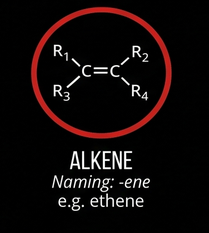
Alkene
A hydrocarbon functional group.
Alkenes are unsaturated hydrocarbons and can participate in addition reactions.
Alkyne
A hydrocarbon functional group.
Contains at least one triple bond between carbon atoms.

Alcohol
A simple oxygen heteroatomic functional group.
It contains a hydroxyl group (–OH) bonded to a carbon atom, making it polar and capable of forming hydrogen bonds.

Ether
A simple oxygen heteroatomic functional group.
Ethers consist of an oxygen atom bonded to two alkyl or aryl groups. They are commonly used as solvents and in synthesis.

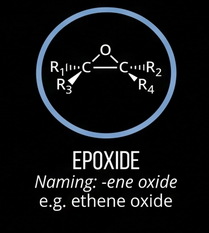
Epoxide
A simple oxygen heteroatomic functional group consisting of a three-membered cyclic ether.
Epoxides are highly reactive due to the strain in their three-membered ring structure. They can undergo ring-opening reactions in the presence of nucleophiles.
Haloalkane
A halogen heteroatomic functional group with the general formula R-X, where X represents any halogen atom. Haloalkanes are characterized by the presence of one or more halogen atoms (such as fluorine, chlorine, bromine, or iodine). They are commonly used in pharmaceuticals and as solvents.

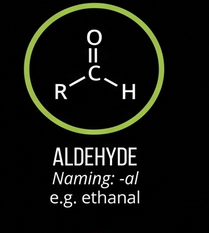
Aldehyde
A carbonyl compound containing a carbonyl group bonded to a hydrogen atom and an R group. Aldehydes are typically found at the end of carbon chains and are known for their distinctive odors, often used in fragrances and flavorings.
Ketone
A carbonyl compound containing a carbonyl group. Ketones are typically characterized by their distinctive aroma and are commonly found in solvents and various biological processes.

Carboxylic Acid
A carbonyl compound featuring a carbonyl group bonded to a hydroxyl group.
It’s typically a weak acidic in nature.

Acid Anhydride
A carbonyl compound composed of two acyl groups linked together by an oxygen atom. Acid anhydrides are derived from carbocyclic acids and can react with water to form acids.

Ester
A carbonyl compound containing a carbonyl group bonded to an alkoxy group. Esters are typically formed from the reaction of an alcohol and a carbocyclic acid, resulting in the loss of water.

Amide
A carbonyl compound featuring a carbonyl group bonded directly to an amine group. Amides are derived from carboxcylic acids and are significant in biological systems as they form peptide bonds between amino acids.

Acyl Halide
A carbonyl compound consisting of a carbonyl group bonded to a halogen atom.
Acyl halides are typically derived from carboxylic acids, where the hydroxyl group is replaced by a halide.

Amine
A nitrogen-based functional group.
Amine contains a nitrogen atom attached to one or more carbon atoms, typically classified as primary, secondary, or tertiary based on the number of carbon groups attached.

Nitrile
A nitrogen-based functional group.
It is found in compounds such as acetonitrile.

Imine
A nitrogen-based functional group.
It is formed by the reaction of an aldehyde or ketone with an amine, resulting in a carbon-nitrogen double bond.

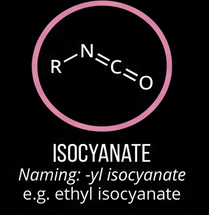
Isocyanate
A nitrogen-based functional group.
Often used in the synthesis of polymers.
Azo Compound
A nitrogen-based functional group.
It is often used as dyes in coloring materials.

Thiol
A sulfur-based functional group.

Arene
An aromatic functional group.
They consist of one or more benzene rings and have alternating double bonds.
