Growth L6 P2
0.0(0)
Studied by 0 people Call Kai
 Learn
Learn Practice Test
 Spaced Repetition
 Match
Match Flashcards
 Knowt Play
Card Sorting
1/79

There's no tags or description
Looks like no tags are added yet.
Last updated 11:53 PM on 10/5/26
Name | Mastery | Learn | Test | Matching | Spaced | Call with Kai | Chat |
|---|
No analytics yet
Send a link to your students to track their progress
80 Terms
1
New cards
What is bacterial growth in terms of cell division
An increase in cell size followed by an increase in the number of cells
2
New cards
How do most prokaryotes divide
By binary fission
3
New cards
What is generation time
The time required for one cell to divide into two cells
4
New cards
What happens to the number of cells with each generation
The number of cells doubles
5
New cards
What factors can affect generation time
The species of bacterium and the environmental conditions
6
New cards
What is the usual range of bacterial generation times
About 20 minutes to 3 hours
7
New cards
What is exponential growth
Growth where the number of cells increases exponentially because cells repeatedly double
8
New cards
What is a growth curve
A graph showing how a microbial population changes over time
9
New cards
Why are growth curves usually plotted using the logarithm of cell number
Because bacterial populations become very large, making them difficult to plot on a regular linear scale
10
New cards
What is mean growth rate
The number of generations per unit of time; it is the inverse of generation time, r = 1/g
11
New cards
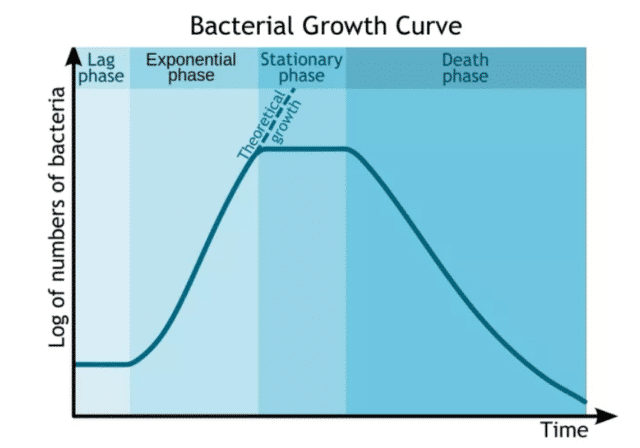
What are the four phases of a typical bacterial growth curve
Lag phase, exponential phase, stationary phase, and decline phase
12
New cards
What is a batch culture
A culture grown in a closed vessel containing a single batch of growth medium
13
New cards
What happens during the lag phase
Cells adapt to the growth conditions before rapidly dividing

14
New cards
What happens during the exponential phase
Cells divide at a regular rate and the population increases exponentially

15
New cards
Why is the growth rate highest during the exponential phase
The generation time is lowest and cells are dividing regularly
16
New cards
What does the note “more growth than death” mean during exponential growth
The number of new cells produced is greater than the number of cells dying
17
New cards
What happens during the stationary phase
The number of cells stops increasing
18
New cards
What causes the stationary phase
Essential nutrients become depleted and/or waste products accumulate
19
New cards
Why are many microbes in the real world usually in the stationary phase
Their natural environments often limit nutrients or cause waste to accumulate
20
New cards
What happens during the decline phase
Cells begin dying, causing the population to decrease

21
New cards
What are the four main methods used to measure bacterial growth
Microscope counts, plate counts, most probable number, and turbidity
22
New cards
Which bacterial growth measurement methods are direct methods
Microscope counts, plate counts, and most probable number (MPN)
23
New cards
Which bacterial growth measurement method is indirect
Turbidity, measured using a spectrophotometer
24
New cards
What is a microscope count
Directly counting bacterial cells using a microscope and a counting chamber with a known volume
25
New cards
What is an advantage of microscope counts
They are very fast because no incubation is required
26
New cards
What is a disadvantage of microscope counts
They count both living and dead cells
The bacteria must be still, or move very slowly to count.
27
New cards
How is the number of bacteria per mL calculated from a microscope count
Number of cells counted ÷ volume of the area counted
28
New cards
What is a viable count
A direct method that estimates living bacteria by counting the colonies they produce
29
New cards
What is the basic idea behind a plate count
Each viable bacterial cell produces a visible colony, so colonies are counted to estimate viable cells
30
New cards
What is the goal of a plate count
To spread bacteria out enough that individual cells form separate visible colonies
# of colonies = # of bacteria
31
New cards
What are colony-forming units (CFU)
Units representing viable cells that can grow into colonies
32
New cards
How are viable cells reported from a plate count
As colony-forming units per millilitre (CFU/mL)
33
New cards
What is a spread plate
A method where bacteria are spread across the surface of a solid medium
34
New cards
What is a pour plate
A method where bacteria are mixed throughout molten solid medium
35
New cards
What is an advantage of viable plate counts
They count only living cells that can grow into colonies
36
New cards
What is a disadvantage of viable plate counts
They require incubation, so they are slower
37
New cards
Why are serial dilutions needed before plating many bacterial samples
An undiluted sample may produce too many colonies to distinguish individually
38
New cards
What is a bacterial lawn
A plate completely covered with bacterial growth, making individual colonies indistinguishable
39
New cards
What is the recommended countable range for a plate
About 20–200 individual colonies
40
New cards
What is the purpose of serial dilutions
To reduce the number of bacteria to a countable level
41
New cards
What is added to the diluent during the first step of a serial dilution
A known amount of the original sample
42
New cards
What happens after making the first dilution
A known amount of the first dilution is transferred into more diluent
43
New cards
Why is the serial dilution process repeated
To progressively reduce the bacterial concentration
44
New cards
What is a dilution factor
The reciprocal of the dilution made
45
New cards
What is the dilution factor for a 1/10 dilution
10
46
New cards
What does CFU stand for
Colony-forming unit
47
New cards
How is the original bacterial concentration calculated
CFU/mL = (number of colonies × dilution factor) ÷ plating factor
48
New cards
What does the number of colonies represent in a CFU/mL calculation
The number of colonies counted on the plate, usually from a countable plate
49
New cards
What is the plating factor
The volume of the bacterial suspension plated, expressed per mL or g
50
New cards
What is the formula for an individual dilution
Amount transferred from the previous dilution ÷ total final volume
51
New cards
If 1 mL of sample is added to 9 mL of diluent, what is the dilution
1/10
52
New cards
What is the dilution factor for a 1/10 dilution
10
53
New cards
If 1 mL of a 1/10 dilution is added to 9 mL of diluent, what is the new dilution
1/100
54
New cards
What is the dilution factor for a 1/100 dilution
100
55
New cards
Why is the dilution factor the reciprocal of the dilution
It converts the diluted concentration back to the original concentration
56
New cards
What colony range should be used for calculating CFU/mL
About 20–200 colonies
57
New cards
What is the formula for original bacterial concentration
Original concentration = (colonies × dilution factor) ÷ plating factor
58
New cards
What happens if the undiluted bacterial sample is plated
It usually produces a bacterial lawn with indistinguishable colonies
59
New cards
Why are very small samples difficult to use for plate counts
They may contain too few bacteria to produce enough colonies for accurate counting
60
New cards
What is the Most Probable Number (MPN) method
A statistical method used to estimate the number of microorganisms in a sample
61
New cards
When is MPN especially useful
For samples with low microbial counts, spreaders, or interfering particles
62
New cards
What is done during an MPN test
Serial dilutions are prepared and tubes are observed for microbial growth
63
New cards
What must be true about the microorganism for MPN to work
The microorganism must be capable of growing in the laboratory
64
New cards
How is a positive MPN tube identified in your lab
By a change in colour and production of gas
65
New cards
How is an MPN result determined
The number of positive tubes is matched to a specific MPN table
66
New cards
What do the confidence limits of an MPN result tell you
The range in which the actual number of bacteria is expected to fall
67
New cards
In the lecture's MPN example, what was the positive-tube pattern
5–3–1
68
New cards
What was the most probable number in the lecture's example
110 bacteria per 100 mL, with 95% confidence
69
New cards
What is one advantage and one disadvantage of MPN
Advantage: high statistical confidence; disadvantage: requires incubation and only works for some bacteria
70
New cards
What is spectrophotometry used for in measuring bacterial growth
It indirectly estimates cell numbers by measuring light scattering
71
New cards
What is turbidity
The cloudiness of a bacterial culture caused by cells scattering light
72
New cards
What happens to turbidity as the number of bacteria increases
The solution becomes more turbid
73
New cards
How is turbidity measured
Using a spectrophotometer
74
New cards
Why is light scattering used instead of light absorption to measure bacterial growth
Light absorption can vary with culture conditions and bacterial species
75
New cards
What is one advantage of using turbidity to measure bacterial growth
It is very quick and useful for routine analysis
76
New cards
What are two disadvantages of turbidity measurements
They require a standard curve and cannot measure very low cell numbers
77
New cards
Does turbidity distinguish between living and dead cells
No. Both living and dead cells contribute to the measurement
78
New cards
Why can turbidity measurements usually only be used with a pure culture
Different bacterial species scatter light differently
79
New cards
What is a standard curve used for
To determine an unknown concentration by comparing it with measurements from known samples

80
New cards
How can OD measurements be used to determine generation time
OD can be converted to CFU/mL using a standard curve, then used to create a growth curve and determine generation time