Physiology Block 2
 Call Kai
 Learn
Learn Practice Test
 Spaced Repetition
 Match
Match Flashcards
 Knowt Play
1/127

There's no tags or description
Looks like no tags are added yet.
Name | Mastery | Learn | Test | Matching | Spaced | Call with Kai | Chat |
|---|
No analytics yet
Send a link to your students to track their progress
128 Terms

Oligodendrocytes:
form myelin sheaths around the axons of CNS neurons

Dendrites
receive chemical signals and conduct a graded impulse toward the cell body

Sensory Neurons
conduct impulses from sensory receptors to the CNS • to the brain (afferent)

Activation or opening of ________ gated sodium channels located along dendrites can depolarize the cell membrane
ligand

If a positively charged ion, a (?) , moves into a cell, the membrane potential will become less or more negative. If a negatively charged ion , an (?) moves into the cell, the membrane potential will become more negative.
If a positively charged ion, a cation , moves into a cell, the membrane potential will become less negative. If a negatively charged ion , an anion moves into the cell, the membrane potential will become more negative.

In a resting cell, the membrane permeability to sodium is: low or high and the membrane permeability to potassium is: higher than or lower than sodium
In a resting cell, the membrane permeability to sodium is low and the membrane permeability to potassium is higher than sodium

Ion channels can be open or closed by different types of gating signals. A channel that is open or closed by a molecule binding the channel is called a ______ gated channel. A channel that is opened or closed by a specific change in voltage is called a _______ gated channel.
a ligand gated channel, a voltage gated channel.

Are any potassium channels open at rest?
Yes, only leaky potassium channels; other potassium channels closed

Are any sodium channels open at rest?
No; membrane is not permeable to sodium
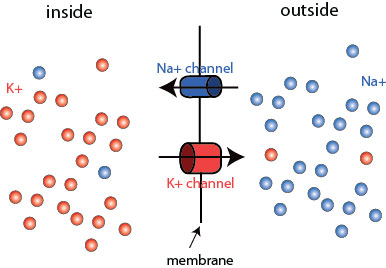
Characteristics of K+ in Resting membrane potential
- K+ leak channels always open (even at rest) - K+ “leak” channels open so a few (+) charges leave cell down concentration gradient - But K+ does not rush out due to electrical gradient

Which of the following is SIMILAR between ligand and voltage-gated sodium channels?
both channels are opened by chemical stimuli
both channels are opened by a change in membrane potential
both channels allow sodium influx
Both channels allow sodium influx

Depolarization
(less (-) than rest) - occurs when positive ions enter the cell (usually Na+)

Hyperpolarization
(more (-) than rest) - occurs when positive ions leave the cell (usually K+) or negative ions (Cl−) enter the cell.

Depolarization (less -) excitatory or inhibitory? Why
excitatory

Hyperpolarization (more -) excitatory or inhibitory? why?
inhibitory

Where are ligated gated channels located?
cell membrane

Where are voltage gated channels located?
axon

Change in charge (increase or decrease?) with distance
from channel that opened
decrease

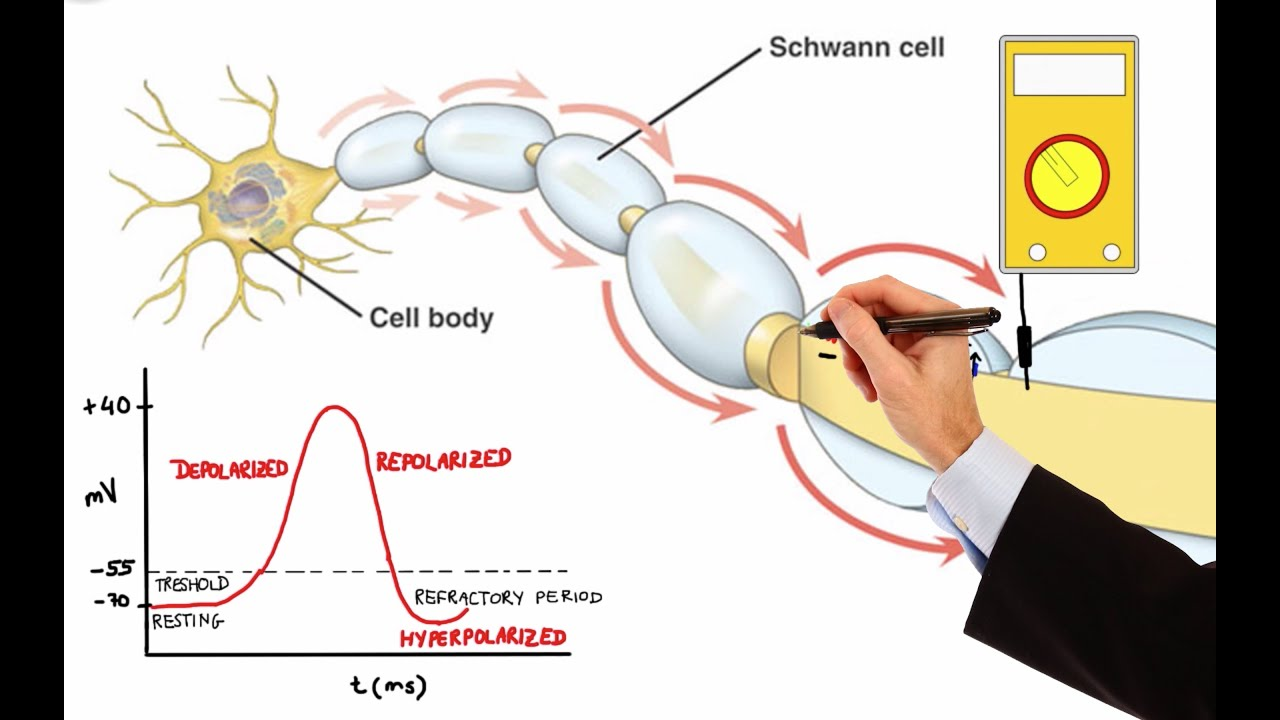
Action potential
a rapid, temporary change in the electrical voltage across a neuron’s cell membrane that acts as an electrical signal to carry information down the axon
Summation of small signals…?
leads to a bigger change
in membrane potential

Summation of depolarizing potential in cell body…?
activates the neuron to initiate Action Potential

Can be (?) (Na+) or
(?) (K+ or Cl-) depending
on what ligand-gated ion channel
opened
depolarizing, hyperpolarizing

Ligand gated Na+ channels allow (little or lot?) Na+ in each time
little

Voltage Na+ channel allows (little or lot?) Na+ in
lot

Summation: Releasing more neurotransmitter can do what?
can keep a ligand gated channel open longer or open multiple channels in close-proximity

Opening of first V.G. Na+ channel results in what?
successive opening of VG+ channels down the axon
Resulting in a train of action potentials down axon

Voltage gated Na+ channels open if…? what is this called?
the membrane potential depolarizes to −55mV nearby, called the threshold

Voltage-Gated Na+ Channels actions
• Sodium rushes into the cell.
• Membrane potential rapidly rises.
• These channels are inactivated at
+30mV.
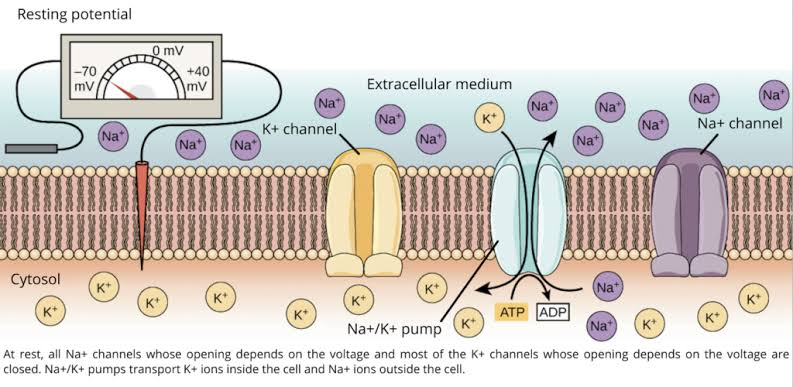
Voltage-gated Na+ Channel
have two gates, can be opened or closed, gives us 3 states, closed at rest (-70mV), activation and inactivation gate

What kind of channel is this? How do you know? What kind of transport does it use?
Ligand gated because there’s a receptor and a channel, no specific voltage required, uses facilitated diffusion

Resting Membrane Potential underlying causes (3 of them)
Asymmetric Ion Distribution, Differential Membrane Permeability, Na+/K+ATPase Pump

Rapid Depolarization phase of action potential : A _____ shifts the membrane to a threshold value (approx. ___ mV). This voltage change causes the _____ gates of ______-gated Na+ channels to snap open rapidly. ____ rushes into the cell driven by both its ______ and ______ gradients, shooting the membrane potential toward ____ mV
A stimulus shifts the membrane to a threshold value (approx. -55 mV). This voltage change causes the activation gates of voltage-gated Na+ channels to snap open rapidly. Na+ rushes into the cell driven by both its concentration and electrical gradients, shooting the membrane potential toward +30 mV
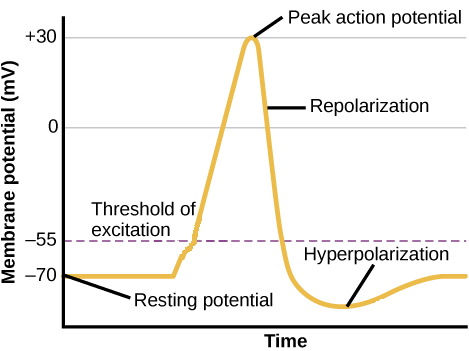
Repolarization phase of action potential: At the peak potential, the time-dependent _____ gates of the ______-gated ___ channels close automatically, halting ____ influx. Simultaneously, slower-acting ____-gated _____ channels open completely. ____ exits the cell swiftly, restoring the internal ______ environment
At the peak potential, the time-dependent inactivation gates of the voltage-gated Na+ channels close automatically, halting sodium influx. Simultaneously, slower-acting voltage-gated K+ channels open completely. K+ exits the cell swiftly, restoring the internal negative environment

Hyperpolarization phase of action potential: Because the ____-gated ___ channels are slow to close, excess _____ leaks out before they shut fully. This drives the membrane voltage slightly below the standard RMP (approaching -____ mV. The cell returns to resting baseline via normal leak channel activity and the Na+/K+ pump
Because the voltage-gated K+ channels are slow to close, excess potassium leaks out before they shut fully. This drives the membrane voltage slightly below the standard RMP (approaching -90mV . The cell returns to resting baseline via normal leak channel activity and the Na+/K+ pump

_____ ____Period: The period during ______ and early ________ when no second action potential can be triggered, regardless of stimulus strength. This occurs because voltage-gated Na+ channels are either already wide open or stuck in their locked, inactivated state.
The period during depolarization and early repolarization when no second action potential can be triggered, regardless of stimulus strength. This occurs because voltage-gated Na+ channels are either already wide open or stuck in their locked, inactivated state.

Relative Refractory Period: The period during late _____ and ______ when a second action potential can fire, but it requires a substantially _______ stimulus. This is because the cell is _______ (further from threshold) and some _____-gated _____ channels remain open, counteracting new ______ signals.
The period during late repolarization and hyperpolarization when a second action potential can fire, but it requires a substantially stronger stimulus. This is because the cell is hyperpolarized (further from threshold) and some voltage-gated K+ channels remain open, counteracting new depolarizing signals.

At around ___mV, voltage-gated K+ channels open,
and ____ rushes out of the cell. This makes the cell ______ back toward the resting membrane potential
+30, K+, repolarize
![<p><span>A [____________] [</span><em>graded </em><span>or</span><em> action</em><span>] potential is a small change in localized membrane potential that varies in magnitude relative to the triggering event.</span></p>](https://assets.knowt.com/user-attachments/36462a1e-cc1e-4eab-af24-d8806413d92c.png)
A [____________] [graded or action] potential is a small change in localized membrane potential that varies in magnitude relative to the triggering event.
graded
![<p><span>[</span><em>Graded</em><span> or </span><em>action</em><span>] [_______] potentials are large changes in localized membrane potential that are either all or none and once initiated, will travel the distance of the axon.</span></p>](https://assets.knowt.com/user-attachments/32d21177-3aa2-4ac3-b417-3d0e1d404dd7.png)
[Graded or action] [_______] potentials are large changes in localized membrane potential that are either all or none and once initiated, will travel the distance of the axon.
action
True or False and why: Once initiated in a presynaptic neuron, an action potential will be directly transmitted to the post-synaptic neuron.
false, the pre-synaptic neuron must be converted to a chemical signal to pass through the synaptic space and bind to a ligand gated channel on the cell body/dendrites of the post-synaptic nerve
(ACH or ACHE) ______ is the neurotransmitter that is released from lower motor neurons and binds and opens ligand gated sodium channels on the skeletal muscle membrane.
_______ is the enzyme that breaks down and inactivates the neurotransmitter at the neuromuscular junction
ACh, AChE
True or false and why: Voltage-gated sodium channels open any time the membrane depolarizes
false: The depolarization must reach threshold

When a neuronal cell becomes (depolarized/hyperpolarized?)
it makes the cell more excited. When a neuronal cell becomes (depolarized/hyperpolarized?) it inhibits the cell
depolarized, hyperpolarized
Voltage gated sodium channels open when the membrane potential increases above ___ mV
-70mV
When a voltage gated sodium channel opens, so much _____ rushes into the cell that the sodium concentration ____ the cell gets close to the _____ concentration _____ the cell.
sodium, inside , sodium, outside
Action potential size will be _____ to the signal size
relative

label the action potential phases (re-, hyper-, or rapid de-)
Rapid depolarization 2. repolarization 3. hyperpolarization
Refractory Periods
Periods when the membrane can’t respond or is less sensitive to depolarizing stimuli

Absolute refractory period:
no action
potential capability

Relative refractory period: _____
stimulus strength is needed to produce
an _____ potential because membrane
potential is _____
increased stimulus strength is needed to produce an action potential because membrane potential is hyperpolarized

The action potential at one location
serves as the ______ stimulus
for the next region of the axon
depolarization
When an action potential occurs at a
given point on a neuron membrane,
________ channels open as
a wave down the length of the axon
voltage-gated Na+

There is a _______ period after each
action potential when that part
of neuron cannot become
excited again
refactory

The ____ _____ period
occurs during the action
potential. Na+ channels are
inactivated (not just closed)
absolute refractory
_______ _____ period is
when K+ channels are still open.
A very strong stimulus can
overcome this.
relative refractory
Once threshold has been reached, an ____ ____ will happen
action potential
The ____ of the stimulus will not affect the size of
the action potential; it will always reach ___ mV
size, +30
The size of the stimulus will not affect action
potential duration, but more stimulus at cell body
can make action potentials occur ____ frequently
more

Oligodendrocytes: myelinate in (CNS or PNS)
Schwann cells: myelinate in (CNS or PNS)
Oligodendrocytes = CNS
Schwann Cells = PNS

saltatory
conduction
Action potentials “leap” from
node to node

Myelin provides ______,
improving the speed
insulation
Action conduction potential Increased ____ of the neuron. This
reduces ____ to the spread of charges
diameter, resistance
What do leaky potassium channels set?
Resting membrane potential
Lab Activity; Voltage gated sodium channel: Where is the voltage sensor? How does it “sense” the depolarization to open the activation gate?
inside the cell, electrostatic repulsion (change in charge) is how it senses the depolarization
Lab Activity; Voltage gated sodium channel: How was a chemical signal received from another cell and turned into an electrical signal?
Ligand gated channel (comes BEFORE voltage gated)
Which gates on the voltage-gated sodium channel must be open for sodium to enter the cell?
Both activation and inactivation
Where are voltage-gated sodium channels located in a neuron? How is the next voltage gated sodium channel opened?
down the axon, action potential (depolarization) of a vgNa channel is depolarization stimulus for the next channel
What is the purpose of the channel having 2 gates?
to regulate sodium influx and allow the cell to reset
At resting membrane potential, what is the status of the voltage-gated sodium channel and its gates?
closed
When is the voltage gated sodium channel open?
opens at threshold (-55mV), rapid depolarization
When is the voltage gated sodium channel inactivated and what is the status of its gates?
activation = open inactivation = closed
When the membrane is in absolute refractory, what is the status of the voltage-gated sodium channel? When is this? Can another action potential be triggered? What is the purpose of the absolute refractory period?
inactivated, begins at repolarization and lasts 2ms, no other action potential can be triggered, purpose to keep the action potential in one direction
Select all that are TRUE of a voltage-gated sodium channel
Group of answer choices
the activation gate is open at a membrane potential greater than -55 mV
the inactivation gate closes at +30 mV
the gate opens in direct response to acetylcholine binding
the inactivation gate is closed at -70 mV
the voltage sensor has a positive charge
the activation gate is open at a membrane potential greater than -55 mV
the inactivation gate closes at +30 mV
the voltage center has a positive charge
Match the following: Glutamate, acetylcholine, acetylcholinesterase, nicotinic acetylcholine receptor
with options: degrades acetylcholine , released from upper motor neuron , released from lower motor neuron , localized at neuromuscular junction and causes depolarization of skeletal muscle membrane
Glutamate = released from upper motor neuron
acetylcholine = released from lower motor neuron
acetylcholinesterase = degrades acetylcholine
Nicotinic acetylcholine receptor = localized at neuromuscular junction and causes depolarization of skeletal muscle membrane
whats a synapse
a functional connection between a neuron terminal and a target cell

The speed at which an action potential is conducted down the axon depends on
the axon diameter
What is the relative diameter of the somatic motor neurons?
Large
Are the somatic motor neurons myelinated?
yes
What is the benefit of myelination?
fast propagation of action potential

Which type of glial cells myelinate the upper motor neuron?
Oligodendrocytes (central)
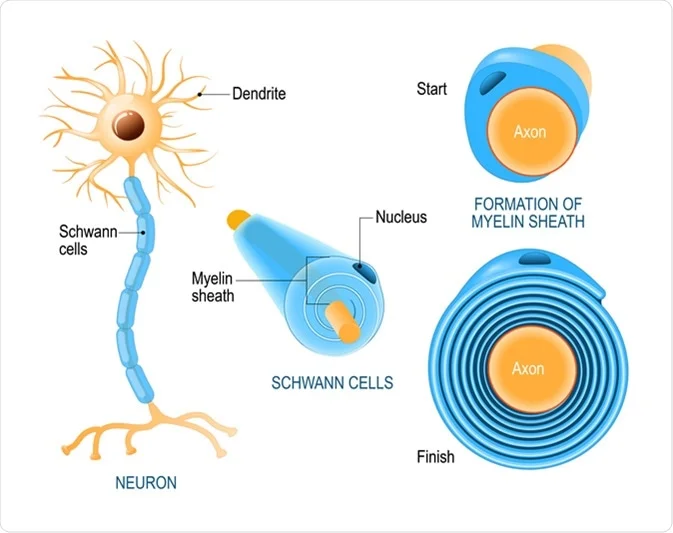
Which type of glial cells myelinate the lower motor neuron?
Schwann cells (peripheral)

What are the two main classes of cholinergic receptors?
Nicotinic (ligand-gate channels;
excitatory); Muscarinic (excitatory and inhibitory)

What neurotransmitter binds to cholinergic receptors?
acetylcholine

Where are the two types of receptors predominately found?
Nicotinic – skeletal muscle cells and
autonomic ganglia; Muscarinic – cardiac and smooth muscle.

Sequence the events involved in excitation-contraction coupling in skeletal muscle cells.
Identify the steps which are associated with a chemical signal, an electrical signal, and
which steps directly result in muscle cell contraction which would be classified as a
mechanical effect.
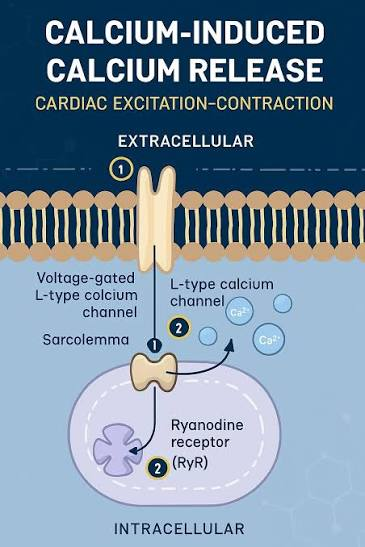
Ca2+ released via RyR at SR Ca2+ binds troponin, Ach released to NMJ, AP in membrane/T-tubule, muscle contraction, Ach bind nAchRs, Myosin binds actin
1) Ach released to NMJ, Ach bind nAchRs
2) AP in membrane/T-tubule
3) Ca2+ released via RyR at SR
4) Ca2+ binds troponin
5) Myosin binds actin
6) muscle contraction
What is the role and source of calcium and ATP in contraction and relaxation of skeletal muscle
cells?
Calcium from sarcoplasmic reticulum; ATP required for detachment/energy for myosin
cross-bridge cycling and for SERCA (calcium reuptake)

What happens to the utilization of ATP during exercise?
Substantial need for ATP for muscle
contraction/relaxation

Why is it advantageous that GLUT4 transporters move to the muscle cell membrane
independent of insulin during exercise?
Allows uptake of glucose in skeletal muscle cells –
independent of insulin (fed state) – for ATP synthesis.

Steps of connecting an action potential to muscle contraction
somatic motor neuron —→ ACh released —→ binds to nicotonic ACh receptors, opens ligand-gated channels —→ Na+ diffuses in, producing depolarizing stimulus —→ action potential produced

T-tubules do what?
bring action
potentials into interior
of muscle fiber

What activates muscle contraction?
Calcium (Ca)

Myosin has _____ filaments
thick
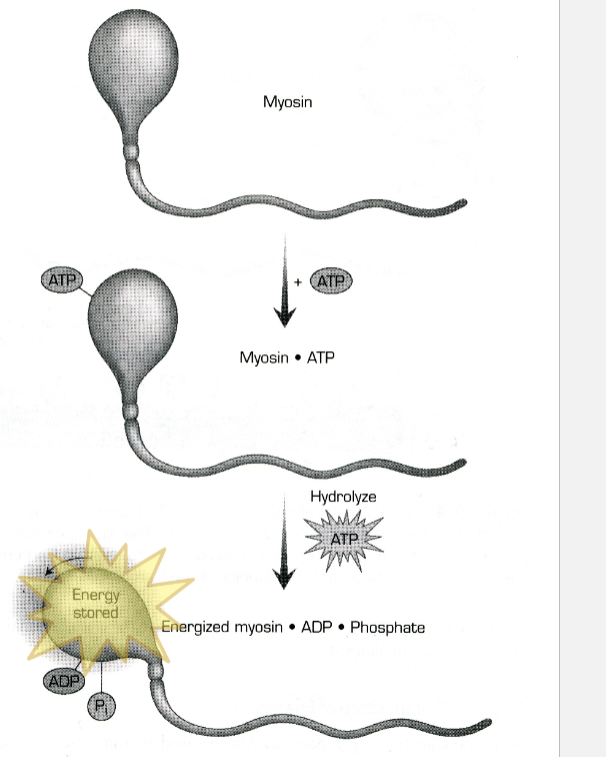
Myosin ATPase sequence
globular head of myosin binds ATP and splits off its terminal phosphate —→ ATP ADP + Pi energizes globular myosin head, causing it to pivot —→ energized myosin is ready to bind actin

At rest (relaxed): thin filament regulatory proteins prevent
interaction between ____ and ____
thin filament regulatory proteins prevent
interaction between actin and myosin
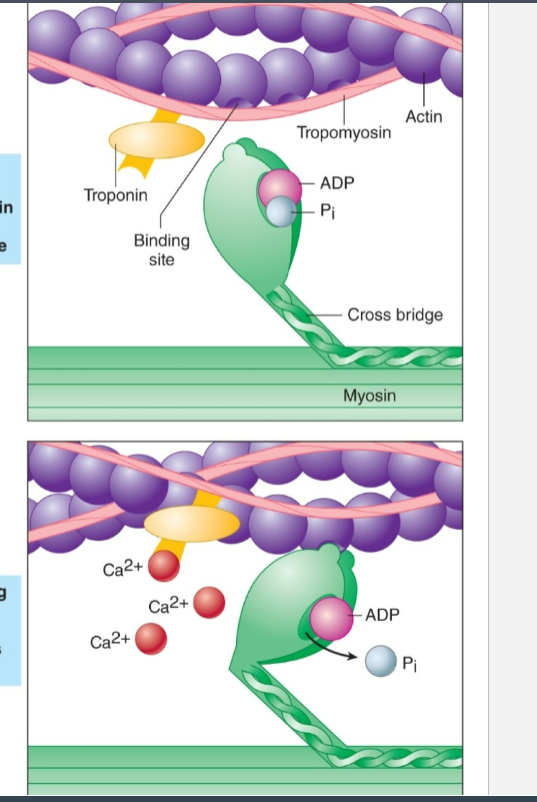
what prevents binding to actin?
tropomyosin
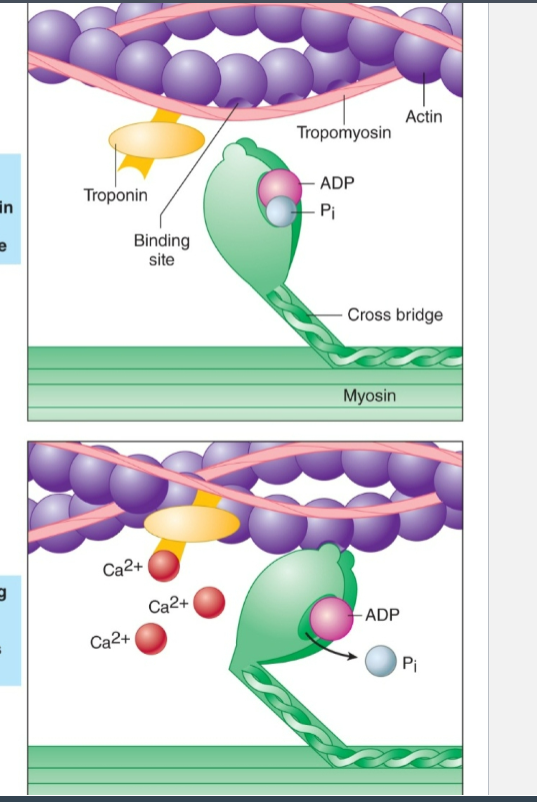
Contraction I sequence (3 steps)
2) Calcium binds to troponin
troponin moves tropomyosin away
from the myosin-binding site on actin,
Thin Filament activation by Ca2+
1) Ca2+ released into cytosol
3) Myosin allowed to bind actin

_____ filament is ready for contraction at rest
thick filament is ready for contraction at rest
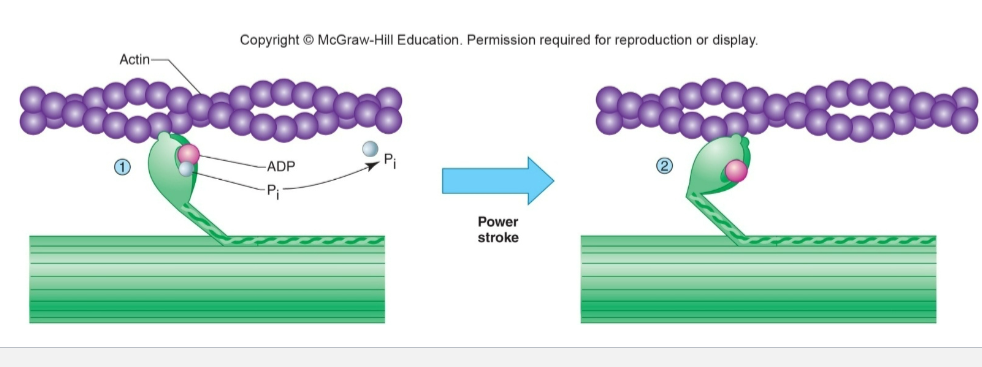
Release of ___
pulls the trigger,
producing a
powerstroke
which pulls thin
filament towards
the center
Release of Pi
pulls the trigger,
producing a
powerstroke
which pulls thin
filament towards
the center

Contraction is dependent on
_______ activating the thin
filament to allow myosin to
bind actin.
calcium

The TENS unit Does what?
Stimulates lower motor neurons