Head and Neck Staging
 Call Kai
 Learn
 Practice Test
 Spaced Repetition
 Match
 Flashcards
 Knowt Play
1/113

There's no tags or description
Looks like no tags are added yet.
114 Terms
What structures make up the supraglottis?
Epiglottis (lingual and laryngeal)
Aryepiglottic folds (laryngeal)
Arytenoids
False cords
Ventricles
What structures make up the glottis?
Extends from the ventricle → ~0.5-1.0 cm below the free level of the true vocal cords
Includes anterior and posterior commissures
What structures make up the subglottis?
Regions extend from the lower border of the glottis
1 cm BELOW the true vocal cords → True margin/Inferior rim of the cricoid cartilage
What is the anatomical position of the vocal cords?
False vocal cords — More superior
(Ventricle)
True vocal cords — More inferior
What defines pT1 for supraglottic cancer?
Limited to one subsite of the supraglottis WITH normal vocal cord mobility
What defines pT2 for supraglottic cancer?
Invades the mucosa of more than one adjacent subsite of the:
Supraglottis
Glottis, OR
A region outside the supraglottis
Ex. Base of tongue mucosa, vallecula, or medial wall of the pyriform sinus
WITHOUT fixation of the larynx
What defines pT3 for supraglottic cancer?
Limited to the larynx with vocal cord fixation and/or invasion of the:
Postcricoid area
Pre-epiglottic space
Paraglottic space
Inner cortex of the thyroid cartilage
What defines pT4a for supraglottic cancer?
Moderately advanced local disease
Invades through the outer cortex of the thyroid cartilage and/OR
Invades tissues beyond the larynx, such as:
Trachea
Soft tissues of the neck
Deep extrinsic muscles of the tongue
Strap muscles
Thyroid, or
Esophagus
What defines pT4b for supraglottic cancer?
Very advanced local disease
Invades the:
Prevertebral space
Encases the carotid artery, OR
Invades mediastinal structures

What is this showing?
Supraglottid tumor
What defines pT1a for glottic cancer?
Limited to one vocal cord
WITH normal vocal cord mobility
What defines pT1b for glottic cancer?
Involves both vocal cords
Normal vocal cord mobility
What defines pT2 for glottic cancer?
Extends to the:
Supraglottis and/or
Subglottis and/or
Causes impaired vocal cord mobility
What defines pT3 for glottic cancer?
Limited to the larynx with vocal cord fixation and/OR
Invasion of the paraglottic space and/OR
Inner cortex of the thyroid cartilage
What defines pT4a for glottic cancer?
Moderately advanced local disease
Invades through the outer cortex of the thyroid cartilage and/OR
Invades tissues beyond the larynx, including the:
Trachea
Cricoid cartilage
Soft tissues of the neck
Deep extrinsic muscles of the tongue
Strap muscles
Thyroid, or
Esophagus
What defines pT4b for glottic cancer?
Very advanced local disease
Invades the:
Prevertebral space
Encases the carotid artery, OR
Invades mediastinal structures

What is this showing?
Gross of glottic tumor
What defines pT1 for subglottic cancer?
Limited to the subglottis
What defines pT2 for subglottic cancer?
Extends to the vocal cord(s) with normal OR impaired mobility
What defines pT3 for subglottic cancer?
Limited to the larynx with vocal cord fixation and/OR
Invasion of the paraglottic space and/OR
Inner cortex of the thyroid cartilage
What defines pT4a for subglottic cancer?
Moderately advanced local disease
Invades the cricoid or thyroid cartilage and/OR
Invades tissues beyond the larynx, including the:
Trachea
Soft tissues of the neck
Deep extrinsic muscles of the tongue
Strap muscles
Thyroid, or
Esophagus
What defines pT4b for subglottic cancer?
Very advanced local disease
Invades the:
Prevertebral space
Encases the carotid artery, OR
Mediastinal structures
What defines pN1 for laryngeal cancer?
Mets in a single ipsilateral lymph node, ≤ 3 cm
With NO extranodal extension (ENE−)
NOTE: Midline nodes are considered ipsilateral nodes
What defines pN2a for laryngeal cancer?
Either:
Mets in a single ipsilateral lymph node, ≤ 3 cm with ENE(+)
OR
Mets in a single ipsilateral lymph node, 3 cm < x ≤ 6 cm with ENE(−)
What defines pN2b for laryngeal cancer?
Mets in multiple ipsilateral lymph nodes, ≤ 6 cm
With ENE(−)
What defines pN2c for laryngeal cancer?
Mets in bilateral or contralateral lymph nodes, ≤ 6 cm
With ENE(−)
What defines pN3a for laryngeal cancer?
Mets in a lymph node, >6 cm
With ENE(−)
What defines pN3b for laryngeal cancer?
Any of the following:
Metastasis in a single ipsilateral lymph node, >3 cm with ENE(+).
Multiple ipsilateral, contralateral, or bilateral lymph nodes with ANY ENE(+).
A single contralateral lymph node of ANY size with ENE(+)
What defines pM1 for laryngeal cancer?
Distant mets
How many regional LNs should be submitted for laryngeal specimens?
At least 6 LNs
What is the typically number of LNs present in a neck dissection?
Usually include 10 or more nodes
What are the include neck nodal groups?
Submental
Submandibular
Upper jugular
Middle jugular
Lower jugular
Posterior triangle
Anterior compartment
Superior mediastinal
What tumors and structures are included in oral cavity staging?
SCC and neuroendocrine
Wet mucosa of lip, tongue
What are examples of oral cavity tumor resections?
Excision
Glossectomy
Buccal mucosal resection
Mandibulectomy
Maxillectomy
Palatectomy
Neck (LN) dissection
What are the oral cavity tumor sites?

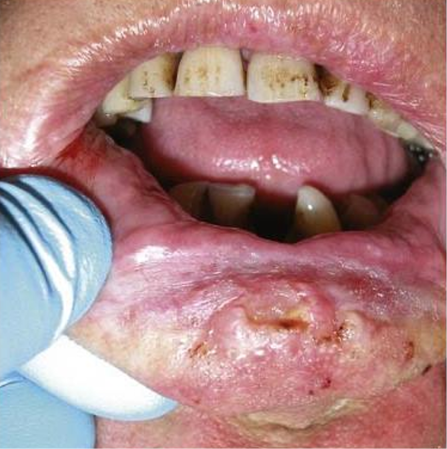
Where is this SCC located?
Wet lip mucosa

Where is this SCC located?
Gingival

Where is this SCC located?
Tongue
What defines pT1 for oral cavity cancer?
≤ 2 cm size
≤ 5 mm DOI
What defines pT2 for oral cavity cancer?
Either:
≤ 2 cm size, >5 mm DOI; OR
2 cm < x ≤ 4 cm, ≤10 mm DOI
What defines pT3 for oral cavity cancer?
Either:
2 cm < x ≤ 4 cm, > 10 mm DOI; OR
>4 cm, ≤ 10 mm DOI
What defines pT4a for oral cavity cancer?
Moderately advanced local disease
Either:
>4 cm, >10 mm DOI; OR
Tumor invades adjacent structures, such as:
Through the cortical bone of the mandible or maxilla
Involves the maxillary sinus
The skin of the face
What defines pT4b for oral cavity cancer?
Very advanced local disease
Tumor invades the:
Masticator space
Pterygoid plates
Skull base and/or
Encases the internal carotid artery
What defines pN1 for oral cavity cancer?
Mets in a single ipsilateral lymph node, ≤ 3 cm
With ENE(−)
What defines pN2a for oral cavity cancer?
Either:
Mets in a single ipsilateral lymph node measuring 3 cm or smaller with ENE(+); OR
Mets in a single ipsilateral lymph node, 3 cm < x ≤ 6 cm
With ENE(−)
What defines pN2b for oral cavity cancer?
Mets in multiple ipsilateral lymph nodes, ≤ 6 cm
With ENE(−)
What defines pN2c for oral cavity cancer?
Mets in bilateral or contralateral lymph nodes, ≤ 6 cm
With ENE(−)
What defines pN3a for oral cavity cancer?
Mets in a lymph node >6 cm
With ENE(−)
What defines pN3b for oral cavity cancer?
Any of the following:
Mets in a single ipsilateral lymph node >3 cm with ENE(+).
Multiple ipsilateral, contralateral, or bilateral lymph nodes with ANY ENE(+).
A single contralateral lymph node of ANY size with ENE(+)
What defines pM1 for oral cavity cancer?
Microscopic confirmation of distant metastasis
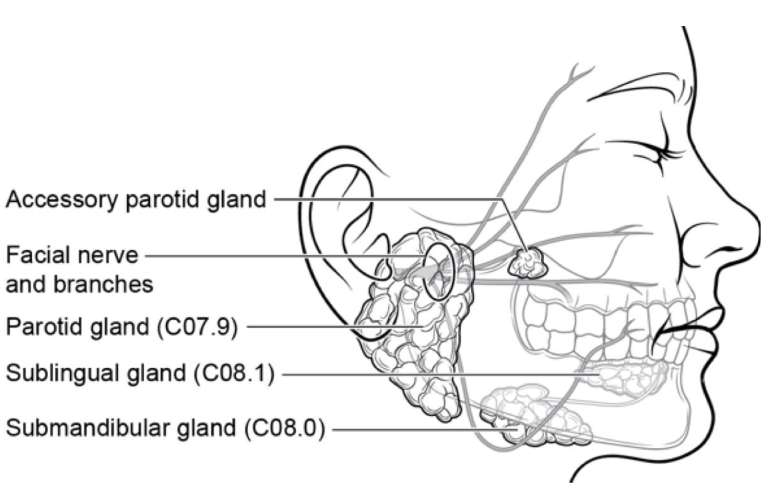
Which major and minor salivary glands locations use TNM staging?
Parotid
Submandibular
Sublingual
Minor glands
Which major and minor salivary glands tumors/locations do NOT use TNM staging?
Sarcoma
Bronchial or lung
External ear
Mucosal melanoma
Neuroendocrine
Hematologic malignancies
What defines pT1 for salivary gland cancer?
≤ 2 cm WITHOUT extraparenchymal extension
What defines pT2 for salivary gland cancer?
2 cm < x ≤ 4 cm WITHOUT extraparenchymal extension
What defines pT3 for salivary gland cancer?
>4 cm and/or
Gross extraparenchymal extension (for major salivary glands)
What defines pT4a for salivary gland cancer?
Invades any immediately adjacent structures, including:
Skin
Bone
Cartilage
Solid organ parenchyma
Esophagus
Trachea
Named nerve
What defines pT4b for salivary gland cancer?
Invades beyond adjacent structures, including:
Encases carotid artery
Base of skull invasion (except nasopharynx)
Spinal column invasion
Intracranial invasion
Orbital apex
Prevertebral space
Mediastinal structures
Masticator space

What is this?
Salivary mucoepidermoid carcinoma
What defines pN1 for salivary gland cancer?
1–3 LN
WITHOUT definitive pathological extranodal extension
What defines pN2 for salivary gland cancer?
Either:
>3 LNs; OR
Involvement of any lymph node(s)
With definitive pathological extranodal extension
What defines pM1 for salivary gland cancer?
Microscopic confirmation of distant metastasis
Understand the location of the salivary gland sites
What tumors are included for nasal cavity and paranasal sinuses TNM staging?
SCC
Sinonasal carcinoma
Adenocarcinoma
Neuroendocrine carcinoma
Small and large cell
What defines pT1 for maxillary sinus cancer?
Limited to the maxillary sinus mucosa
With no erosion or destruction of bone
What defines pT2 for maxillary sinus cancer?
Causes bone erosion or destruction, including:
Extension into the hard palate and/or
Middle nasal meatus
EXCEPT extension to the posterior wall of the maxillary sinus and pterygoid plates
What defines pT3 for maxillary sinus cancer?
Tumor invades any of the following:
Bone of the posterior wall of the maxillary sinus
Subcutaneous tissues
Floor or medial wall of the orbit
Pterygoid fossa
Ethmoid sinuses
What defines pT4a for maxillary sinus cancer?
Moderately advanced local disease
Tumor invades:
Anterior orbital contents
Skin of the cheek
Pterygoid plates
Infratemporal fossa
Cribriform plate
Sphenoid or frontal sinuses
What defines pT4b for maxillary sinus cancer?
Very advanced local disease
Tumor invades:
Orbital apex
Dura
Brain
Middle cranial fossa
Cranial nerves OTHER THAN the maxillary division of the trigeminal nerve (V2)
Nasopharynx
Clivus
What defines pT1 for nasal cavity and ethmoid sinus cancer?
Restricted to any one subsite
With or without bony invasion
What defines pT2 for nasal cavity and ethmoid sinus cancer?
Invades two subsites in a single region, OR
Extends to involve an adjacent region within the nasoethmoidal complex
With or without bony invasion
What defines pT3 for nasal cavity and ethmoid sinus cancer?
Extends to invade the:
Medial wall or floor of the orbit
Maxillary sinus
Palate
Cribriform plate
What defines pT4a for nasal cavity and ethmoid sinus cancer?
Moderately advanced local disease
Tumor invades:
Anterior orbital contents
Skin of the nose or cheek
Minimal extension to the anterior cranial fossa
Pterygoid plates
Sphenoid or frontal sinuses
What defines pT4b for nasal cavity and ethmoid sinus cancer?
Very advanced local disease
Tumor invades:
Orbital apex
Dura
Brain
Middle cranial fossa
Cranial nerves OTHER THAN V2
Nasopharynx
Clivus
What defines pN1 for nasal cavity and paranasal sinus cancer?
Mets in a single ipsilateral lymph node, ≤ 3 cm
With ENE(−)
What defines pN2a for nasal cavity and paranasal sinus cancer?
Either:
Mets in a single ipsilateral lymph node, ≤ 3 cm with ENE(+); OR
Mets in a single ipsilateral lymph node, 3 cm < x ≤ 6 cm
With ENE(−)
What defines pN2b for nasal cavity and paranasal sinus cancer?
Mets in multiple ipsilateral lymph nodes, ≤ 6 cm
With ENE(−)
What defines pN2c for nasal cavity and paranasal sinus cancer?
Mets in bilateral or contralateral lymph nodes, ≤ 6 cm
With ENE(−)
What defines pN3a for nasal cavity and paranasal sinus cancer?
Mets in a lymph node >6 cm
With ENE(−)
What defines pN3b for nasal cavity and paranasal sinus cancer?
Any of the following:
Mets in a single ipsilateral lymph node, > 3 cm with ENE(+).
Multiple ipsilateral, contralateral, or bilateral lymph nodes with ANY ENE(+).
A single contralateral lymph node of any size with ENE(+)
What defines pM1 for nasal cavity and paranasal sinus cancer?
Distant mets
Understand pharyngeal diagrams

What is the oropharynx?
Portion of the continuity of the pharynx extending from the plane of the superior surface of the soft palate → superior surface of the hyoid bone or floor of the vallecula
What are the contents of the oropharynx?
Base of tongue, NOS
Lingual tonsil
Soft palate, NOS
Uvula
Tonsillar fossa
Tonsillar pillar
Tonsil, NOS
Vallecula
Lateral wall of oropharynx
Posterior pharyngeal wall
What defines pT1 for nasopharyngeal cancer?
Confined to the nasopharynx, OR
Tumor extension into:
Oropharynx
Nasal cavity
Without parapharyngeal involvement
What defines pT2 for nasopharyngeal cancer?
Tumor extends into the:
Parapharyngeal space; OR
Adjacent soft tissues involving the:
Medial pterygoid
Lateral pterygoid, or
Prevertebral muscles
What defines pT3 for nasopharyngeal cancer?
Tumor with unequivocal infiltration into:
Skull base
Include pterygoid structures
Paranasal sinuses
Cervical vertebrae
What defines pT4 for nasopharyngeal cancer?
Tumor with any of the following:
Intracranial extension
Unequivocal radiological and/or clinical involvement of cranial nerves
Hypopharynx
Orbit
Include the inferior orbital fissure
Parotid gland
Extensive soft tissue infiltration beyond the anterolateral surface of the lateral pterygoid muscle
What defines pN1 for nasopharyngeal cancer?
Unilateral cervical lymph node(s), OR unilateral/bilateral retropharyngeal lymph node(s)
AND all of the following:
≤ 6 cm
Above the caudal border of the cricoid cartilage
Without advanced ENE
What defines pN2 for nasopharyngeal cancer?
Bilateral cervical lymph node involvement with ALL of the following:
≤ 6 cm
Above the caudal border of the cricoid cartilage
Without advanced ENE
What defines pN3 for nasopharyngeal cancer?
Uni/Bilateral cervical lymph node involvement with ANY of the following:
>6 cm
Extension below the caudal border of the cricoid cartilage
Advanced radiologic ENE involving adjacent:
Muscles
Skin, and/or
Neurovascular bundle
What defines pM1a for nasopharyngeal cancer?
Microscopic confirmation of ≤3 metastatic lesions
In one or more organs or sites
What defines pM1b for nasopharyngeal cancer?
Microscopic confirmation of >3 metastatic lesions
In one or more organs or sites

What is this?
Gross of nasopharyngeal carcinoma
What defines pT1 for HPV-associated oropharyngeal cancer?
≤ 2 cm
What defines pT2 for HPV-associated oropharyngeal cancer?
2 cm < x ≤ 4 cm
What defines pT3 for HPV-associated oropharyngeal cancer?
>4 cm OR extension to the lingual surface of the epiglottis
What defines pT4 for HPV-associated oropharyngeal cancer?
Tumor invades any of the following:
Larynx
Deep/extrinsic muscles of the tongue (genioglossus, hyoglossus, palatoglossus, or styloglossus)
Medial and/or lateral pterygoid muscles
Hard palate
Mandible
Medial and/or lateral pterygoid plates
Nasopharynx
Skull base
Encases the carotid artery
What defines pN1a for HPV-associated oropharyngeal cancer?
1 LN
Without definitive pathological ENE
What defines pN1b for HPV-associated oropharyngeal cancer?
2–4 LNs
Without definitive pathological ENE
What defines pN2 for HPV-associated nasopharyngeal cancer?
Either:
1–4 LNs with definitive pathological ENE; OR
>4 LNs without definitive pathological ENE