Lesson 106 - Management of pruritic diseases: Part II
 Call Kai
 Learn
 Practice Test
 Spaced Repetition
 Match
 Flashcards
 Knowt Play
1/104

There's no tags or description
Looks like no tags are added yet.
105 Terms

What kind of pyoderma is this?
deep (interdigital furunculosis)
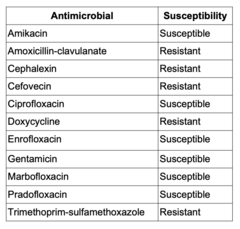
What antibiotic would you pick for this deep pyoderma (interdigital furunculosis)?
ciprofloxacin or enrofloxacin
What adjunctive therapy would you do with antibiotics for deep pyoderma (interdigital furunculosis)?
topical or systemic steroids, antiseptic wash, and photobiomodulation
What factors contribute to the presence of pseudomonas?
environmental contamination and opportunistic secondary infection

What kind of pyoderma is this?
superficial

How would you treat this superficial pyoderma?
topical therapy
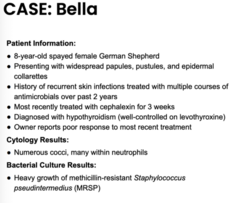
What factors contributed to the development of methicillin-resistant Staphylococcus pseudintermedius (MRSP)?
mutiple courses of antibiotics
What should you recommend to the owner to reduce the risk of zoonosis for methicillin-resistant Staphylococcus pseudintermedius (MRSP)?
good hand hygiene

What antibiotics should be used if systemic therapy is needed?
doxycycline or minocycline
What is canine atopic dermatitis (cAD)?
IgE mediated allergy to environmental allergens (similar to humans)
What is feline atopic syndrome (FAS)?
spectrum of hypersensitivity disorders (allergic dermatitis, asthma/respiratory and GI diseases)
What is feline atopic skin syndrome (FASS)?
allergic skin disease associated with environmental allergens
Why is there no "atopic dermatitis" in cats?
no consensus on role of IgE in development of the hypersensitivity to environmental allergens
What does FASS include?
patients who have IgE (extrinsic) and those without IgE (intrinsic) against environmental allergens
What are the presentations of feline atopic syndrome (FAS)?
1. cutaneous
2. gastrointestinal
3. respiratory
What is the respiratory presentation of FAS?
feline asthma
What are the cutaneous presentations of FAS?
1. flea allergy dermatitis (FAD)
2. feline atopic skin syndrome (FASS)
3. feline food allergy (FFA)
What is the gastrointestinal presentation of FAS?
feline food allergy (FFA)
What factors lead to a diverse clinical presentation of canine atopic dermatitis and feline atopic skin syndrome?
1. genetic factors
2. extent of lesions
3. stage of disease
4. secondary microbial infections
What is the pathogenesis of canine atopic dermatitis and feline atopic skin syndrome?
1. Not fully understood
2. Complex interaction between genetic and environmental factors
3. Strong breed predispositions support genetic basis
4. Etiology in cats is suspected to be similar to dogs
5. Allergic Type I hypersensitivity (IgE)
6. Immune dysregulation: Th2 dominant immune response
7. Skin barrier dysfunction
What are the most common allergens associated with allergic type I hypersensitivities?
1. mites
2. pollens
3. molds
4. epithelial cells
What is a clinically relevant consequence of intrinsic FASS?
IgE serum allergy testing will be negative
What are the key pro-inflammatory and pruritogenic cytokines produces in TH2 dominant immune responses?
interleukins (ILs) 4, 5, 6, 13, and 31
What pro-inflammatory and pruritogenic cytokines mediate chronic disease?
Th1, Th2, Th17, and Th22
What is Thymic stromal lymphopoietin (TSLP)?
from keratinocytes promotes inflammation
What makes up the normal skin barrier?
1. keratinocytes and lipids
2. ceramides (40-50%)
3. cholesterol (25-35%)
4. free fatty acids (10-15%)

What is this?
normal lipid layer shown with an electron micrograph

What is this?
disrupted lipid layer in cAD shown with an electron micrograph
What happens when the skin barrier is disrupted with atopic dermatitis?
allergens and pathogens are able to penetrate the skin
What happens to microbial diversity with canine atopic dermatitis?
decreased microbial diversity and overgrowth of bacteria and yeast
What is the purpose of a healthy, diverse microbiome?
prevents pathogen invasion
What do pathogens have that further damage the skin barrier?
proteases
What is the typical age of onset for canine atopic dermatitis?
between 6 months and 6 years
What is the seasonality of canine atopic dermatitis?
clinical signs often start as seasonal then non-seasonal with chronicity
What is the clinical presentation of cAD?
1. Highly variable amongst individual dogs and dog breeds
2. Key uniting feature is pruritus
3. Earliest stages of disease, may only see pruritus (alesional skin)
4. Erythema, alopecia, salivary staining, excoriations, lichenification +/- hyperpigmentation
5. Secondary bacterial and Malassezia infections common and cause papules, pustules, epidermal collarettes, crusts, scale malodour
What are the most commonly affected areas for cAD lesions?
1. Glabrous regions: axilla, ventrum
2. Face: muzzle, periocular, concave pinnae
3. Cubital flexors and feet
4. Perianal area
What is the age of onset for feline atopic skin syndrome (FASS)?
young adults (median 2-3 years), though can range from 6 months to 15 years
What is the sex predilection for feline atopic skin syndrome (FASS?
females slightly overrepresented (~58% females vs. 42% males)
What is the seasonality of feline atopic skin syndrome (FASS)?
1. Predominantly non-seasonal (70-75%)
2. Often summer/autumn
What is the clinical presentation of feline atopic skin syndrome (FASS)?
1. one or more "cutaneous reaction pattern"
2. Feline pruritus manifests at scratching and/or overgrooming and is often unobserved
3. Lesions are nonspecific and may be present for a prolonged duration before being noticed

What is this?
eosinophilic granuloma

What is this?
indolent ulcer

What is the lesion on the left?
linear granuloma

What is the lesion on the right?
eosinophilic granuloma

What is this?
eosinophilic plaque
How is cAD/FASS clinically diagnosed?
exclusion
What are the steps to diagnosing cAD/FASS?
1. Rule out ectoparasites
2. Identify and treat secondary infections
3. Investigate CAFR with strict elimination diet
What can be used to support an atopic dermatitis diagnosis?
Favrot's criteria
What is Favrot's diagnostic criteria set 1 for cAD?
1. Age at onset < 3 years
2. Mostly indoor
3. Corticosteroid-responsive pruritus
4. Chronic or recurrent yeast infections
5. Affected front feet
6. Affected ear pinnae
7. Non-affected ear margins
8. Non-affected dorsolumbar area
What is the sensitivity and specificity for Favrot's diagnostic criteria set 1 for cAD?
sensitivity 85.4% and specificity 79.1% with 5 criteria met
What is Favrot's diagnostic criteria set 2 for cAD?
1. Age at onset < 3 years
2. Mostly indoor
3. Pruritus with no visible lesions at onset
4. Affected front feet
5. Affected ear pinnae
6. Non-affected ear margins
7. Non-affected dorsolumbar area
What is the sensitivity and specificity for Favrot's diagnostic criteria set 2 for cAD?
sensitivity 42% and specificity is 93% with 6 criteria met
What is the diagnostic criteria for non-flea hypersensitivity dermatitis in cats?
1. Presence of at least two body sites affected
2. Presence of at least two clinical patterns (symmetrical alopecia, miliary dermatitis, eosinophilic dermatitis, head/neck erosions)
3. Presence of symmetrical alopecia
4. Presence of any lesion on the lips
5. Presence of erosions/ulcerations on chin or neck
6. Absence of lesions on the rump
7. Absence of non-symmetrical alopecia on rump or tail
8. Absence of nodules or tumors
What is the sensitivity and specificity for the diagnostic criteria for non-flea hypersensitivity dermatitis in cats?
75% sensitivity and 76% specificity with 5 of 8 criteria met
What is the diagnostic criteria for non-flea hypersensitivity dermatitis in cats not useful for?
differentiating between non-flea hypersensitivity dermatitis and feline cutaneous adverse food reactions
What is a consequence of cAD and FASS being lifelong diseases?
affects quality of life and human-animal bond (sometimes severely)
What is the goal of cAD and FASS treatment?
improve and maintain quality of life for the pet and their caregiver
What are the pharmacological treatment options to treat clinical signs of cAD and FASS?
1. antipruritics (AP)
2. antiinflammatories (AI)
3. immunosuppressives (IS)
What are the immunologic treatment options for difinitive treatment of cAD and FASS?
1. subcutaneous (SCIT)
2. sublingual (SLIT)
3. transdermal (TVIT)
4. intralymphatic (ILIT)
What is the onset of action of glucocorticoids?
rapid relief but significant side effects
What are the side effects of glucocorticoids?
PU/PD, polyphagia, panting, behavior changes, GI ulceration, muscle wasting, calcinosis cutis, increased liver enzymes, immunosuppression
What are the contraindications of glucocorticoids?
1. infections (incl. history of demodicosis)
2. drug interactions (NSAIDs)
3. diabetes
4. cardiac disease
What is cyclosporine?
calcineurin inhibitor that decreases synthesis of inflammatory and pruritogenic cytokines (via inhibition of T-cell activation)
What is the onset of action of cyclosporine?
4-6 weeks (slow)
What are the common side effects of cyclosporine?
vomiting, diarrhea, inappetence in 25% of dogs and cats
How can you counteract the common side effects of cyclosporine?
give with meal, freeze capsules, maropitant (Cerenia), probiotics
What are the uncommon side effects of cyclosporine?
hirsutism, viral papillomas, gingival hyperplasia, psoriasiform lichenoid dermatosis
What are the contraindications of cyclosporine use?
liver disease

What is this?
papillomas

What is this?
gingival hyperplasia
How do JAK inhibitors work?
block pruritogenic cytokine signaling (IL-31)
What is the onset of action of JAK inhibitors?
4-6 hours (rapid)
What reduces the efficacy of JAK inhibitors?
secondary bacterial and/or Malassezia infections
What are the uncommon side effects of JAK inhibitors?
mostly GI with occasional reports of anemia and leukopenia
What are the contraindications of JAK inhibitors?
puppies (
What can JAK inhibitors cause at high doses?
immunosuppression
What is the only species JAK inhibitors are FDA approved for use in?
dogs
What species are JAK inhibitors used in off label?
cats and horses
What is important about the used of oclacitinib (JAK inhibitor) in cats?
1. No long-term safety studies available
2. Require a higher dosage and increased frequency
3. Use as a last resort
What are IL-31 monoclonal antibodies?
caninized monoclonal antibody against IL-31 that reduce circulating IL-31 and reduce pruritus
What reduces efficacy of IL-31 antibodies?
secondary bacterial and/or Malassezia infections
Which pharmacological treatment can be used in puppies
IL-31 monoclonal antibodies
What is the onset of action of IL-31 antibodies?
rapid, most dogs respond within first 1-5 days
What are the side effects of IL-31 monoclonal antibodies?
generally well-tolerated, vomiting, diarrhea, injection site soreness, hypersensitivity reactions, anaphylaxis, immune-mediated drug reactions
What are the contraindications of IL-31 monoclonal antibodies?
none
Why is lab monitoring not required for IL-31 monoclonal antibodies?
degraded and eliminated in the bloodstream, bypassing liver and kidneys
What species should IL-31 monoclonal antibodies never be used in?
cats
What pharmacological therapies can be used for acute flares?
glucocorticoids
What pharmacological therapies can be used for chronic management?
cyclosporine A
What pharmacological therapies can be used for both acute and chronic management?
1. Ilunocitinib (Zenrelia)
2. Atinvicitinib (Numelvi)
3. Oclacitinib (Apoquel)
4. Lokivetmab (Cytopoint) (dogs only)
5. Tirnovetmab (Befrena) (dogs only)
What is essential for immunotherapy?
allergy testing to identify allergens (not to diagnose)
When is allergy testing recommended?
if owners are interested in pursuing life-long allergen-specific immunotherapy after you've obtained a diagnosis of cAD or FASS
What are the methods of allergy testing?
1. intradermal allergy testing (IDT) or serum (IgE) allergy testing
2. lack standardization and results must be interpreted in light of clinical history
3. positive reactions found on either test are considered supportive rather than diagnostic
4. false positives and negatives occur (10-30%)
What are the characteristics of intradermal testing (IDT)?
1. Aqueous allergen extracts relevant to specific animal and geographical region injected into the dermis
2. Measures cutaneous mast cell reactivity
3. Direct observation of skin reactions
4. Scoring size, erythema, turgidity
5. Requires sedation with alpha 2 agonists, certain drug treatment withdrawals (antihistamines, glucocorticoids) and clipping
6. cats often require fluorescein injection to facilitate visualization of wheals
7. Requires significant skill to perform and interpret, so refer to veterinary dermatologist
8. Adverse reactions rare
What are the characteristics of allergen-specific IgE serology?
1. RAST, ELISA
2. Measures circulating allergen-specific IgE
3. Results do not always correlate well with IDT
4. No sedation required
5. Can be performed during treatment
6. No difference in results of hyposensitization
7. May be used when skin testing not possible/available
What are the characteristics of allergen specific immunotherapy?
1. Regular inoculation of small quantities of allergen subcutaneously, sublingually, transdermally or intra-lymphatically
2. "Desensitizes" immune system by promotion of T regulatory cells to induce tolerance
3. Only therapy that can induce a long term change in immune response
4. Customized to the patient's test results and known exposures
5. Success rate is 60-70%, but can take up to 9-12 months or longer to see results
6. Success: decrease adjunct medications, reduce flares of pruritus and secondary infections
7. Well-tolerated with very low risk of anaphylaxis Serious reactions rare (
What adjunct therapies can be used for cAD and FASS?
1. specialized dermatologic diets
2. supplements
3. antihistamines
What topical adjunct therapies can be used for cAD and FASS?
1. short term glucocorticoids
2. barrier support
3. antimicrobials
A 2-year-old Labrador presents for chronic pruritus affecting the feet, pinnae, and ventrum. Initially seasonal, now year-round. Cytology reveals cocci and Malassezia. Flea control is consistent. The dog improves partially with antibiotics but relapses.
What is the most appropriate next step?
initiate an 8-12 week elimination diet trial
A dog with suspected cAD is started on oclacitinib. Pruritus improves rapidly, but severe pododermatitis persists with draining tracts and malodor.
What best explains the lack of response?
presence of secondary infection reduces drug efficacy