Chapter 18: Ethers & Epoxides; Thiols & Sulfides
 Call Kai
 Learn
Learn Practice Test
 Spaced Repetition
 Match
Match Flashcards
 Knowt Play
1/42

There's no tags or description
Looks like no tags are added yet.
Name | Mastery | Learn | Test | Matching | Spaced | Call with Kai | Chat |
|---|
No analytics yet
Send a link to your students to track their progress
43 Terms
Ether
an oxygen bonded to 2 Carbon atoms

Naming Ethers
Name both alkyl groups, then write ether. EX: Ethyl methyl ether
IUPAC name: Parent chain is propane, substituent is methoxy, 2-methoxypropane
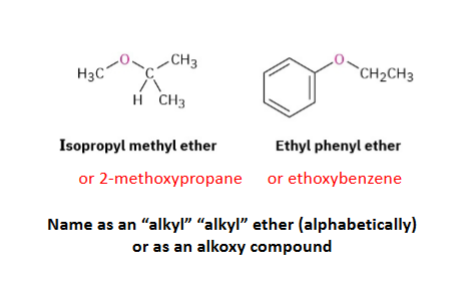
Alkoxy group
An oxygen attached to an alkyl group

Naming Ethers with other functional groups
If another functional group has higher naming priority, the ether becomes a substituent instead of the main name. The ether is then named as an alkoxy substituent (methoxy, ethoxy, etc.).
sp³ Hybridization
The oxygen atom in an ether is sp³ hybridized. Because oxygen has 2 lone pairs, the molecule is bent, not straight.
Polar aprotic Solvent
polar
has no O-H or N-H bond
cannot donate a hydrogen bond
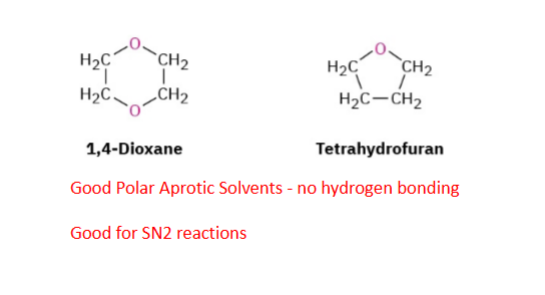
EX: THF, diethyl ether, acetone, DMSO
Ethers are polar because: oxygen is very electronegative.
It pulls electrons toward itself.
Why don't ethers hydrogen bond to each other?
Because there is no O–H bond.
The oxygen can accept hydrogen bonds, but it cannot donate one.
This is why ethers such as THF are excellent solvents for SN2 reactions.
Polar aprotic solvents help nucleophiles stay reactive.

Preparing Ethers: Acid Route
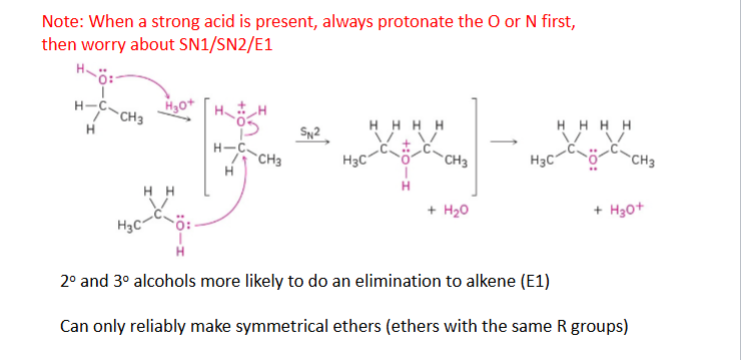
Two alcohol molecules can react together under strong acidic conditions to form an ether.
(arrows always start at a negative and head towards a positive charge)
The acid protonates the oxygen.
This converts OH, which is a poor leaving group, into H2O, which is a good leaving group
When a strong acid is present, always protonate O or N first, THEN think about SN1, SN2, E1, or E2.
1° alcohols tend to undergo substitution and form ethers.
2° and 3° alcohols are much more likely to undergo elimination (E1) and make alkenes instead.
This method reliably makes symmetrical ethers only.
Preparing Ethers: Williamson Ether Synthesis (basic route)
A reaction that forms an ether by reacting:
an alkoxide ion (RO⁻)
with an alkyl halide (R-X)
using an SN2 mechanism.
An alkoxide is simply an alcohol that has lost its hydrogen (making iit much more reactive) NaH and THF are used to prepare an alkoxide ion, then the oxygen atom attacks the C in the alkyl halide
Alcohol, NaH removes the H, the alkoxide attacks using SN2
Br leaves, now you have an ether
Strong bases make alcohols into stronger nucleophiles.
Negative charges usually make better nucleophiles than neutral molecules.
Williamson Ether Synthesis —> NaH —> Makes alkoxide —> SN2 = ether

which molecule should be the alkoxide and which should be the alkyl halide?
You have to choose the correct carbon for the SN2 attack. To make an alkyl halide, you need a methyl or a primary carbon for a Williamson, otherwise it is too crowded.

"How would you synthesize this ether?"
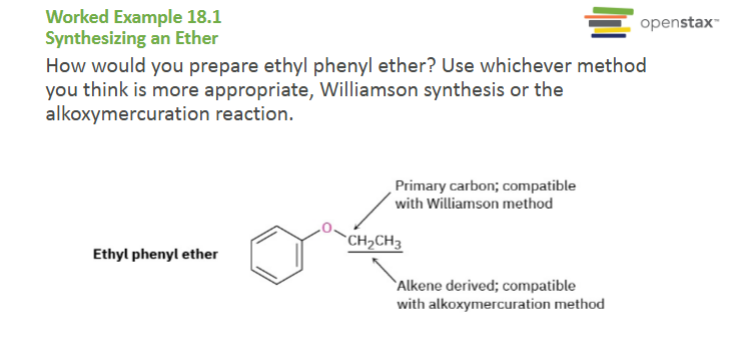
Split the ether at oxygen. Then ask, Which side should be the alkyl halide? Answer: Usually the smaller side.
Preparing Ethers by Alkoxymercuration
This is another way to make ethers. Instead of using an alkyl halide, You start with
an alkene. Your solvent is now alcohol, making an ether product.
Markovnikov
The oxygen attaches to
the more substituted carbon.

Alcohol solvent
ether product
water solvent
alcohol 9
Summary (Part 1)
The three biggest ideas are:
Ethers have the structure R–O–R.
Williamson Ether Synthesis is the most important way to make ethers.
Alkoxymercuration makes ethers from alkenes using Markovnikov addition.
Ether = R–O–R
✅ Alcohol = R–OH
✅ Williamson Ether Synthesis = SN2
✅ NaH converts ROH → RO⁻
✅ Use methyl or primary alkyl halides in Williamson synthesis
✅ Tertiary alkyl halides usually give E2, not SN2
✅ Alkoxymercuration follows Markovnikov addition

How would you prepare ethyl phenyl ether?
Your choices are:
Williamson Ether Synthesis
Alkoxymercuration
When solving synthesis problems
Step 1
Find oxygen.
↓
Step 2
Cut the bond.
↓
Step 3
Ask
Which side should be the alkoxide?
Which side should be the alkyl halide?
Phenol
more acidic than regular alcohols. The negative charge after losing H can spread into the benzene ring. That's called Resonance Stabilization. Because phenol is more acidic, you can use NaOH, you don’t need NaH
Phenols: NaOH
Alcohols: NaH
Acid Cleavage pt 1
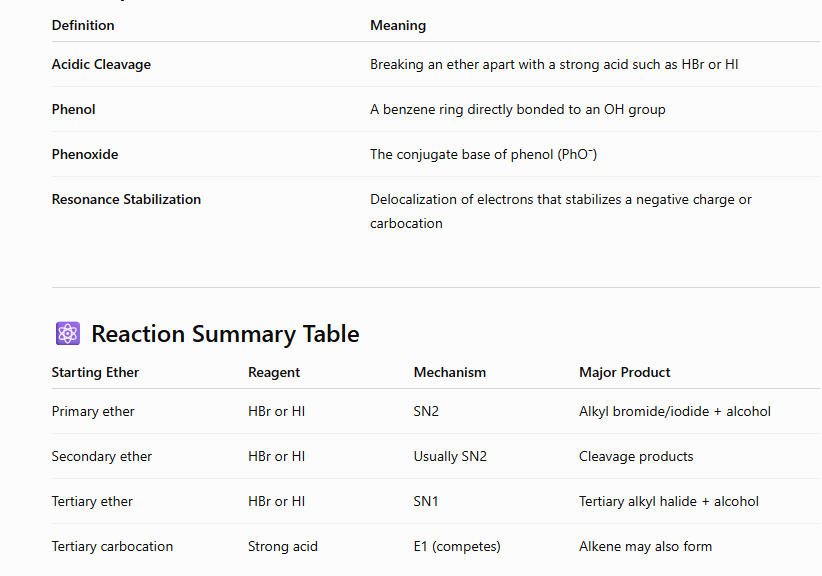
Ethers are basically unreactive, except for strong acids. Acid cleavage is breaking an ether apart using a strong acid.
Strong acids listed
HBr
HI
H₂SO₄
HCl/ZnCl₂
Acid protonates the oxygen, making it easier to remove

Acid cleavage pt 2
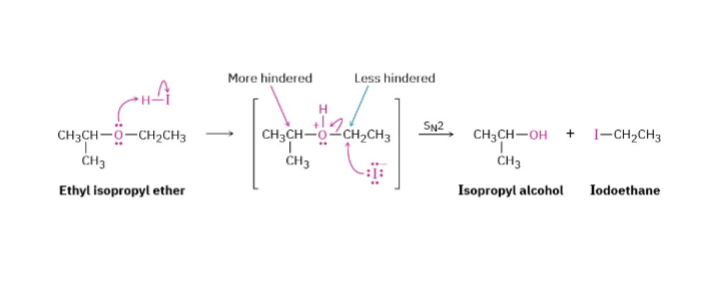
Now we actually break the ether. After protonation, Br- attacks.
Mechanism:
Protonate oxygen, making it a good leaving group
Br- attacks, making it an SN2 reaction.
Ether breaks
Which carbon gets attacked? Br attacks the least substituted Carbon. This is Williamson in reverse. Earlier, oxygen attacked Carbon, now Br attacks Carbon
Acid Cleavage pt 3
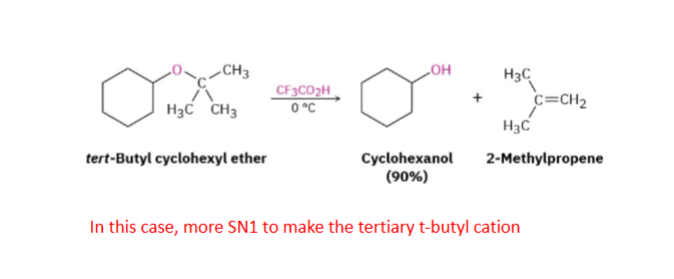
What if a carbon is tertiary? Now SN2 cannot happen, as it is too crowded. Instead, oxygen leaves and forms tert-butyl carbocation, then Br attacks.
Mechanism:
Protonate Oxygen
Leaving group leaves, making carbocation, this is SN1
Br attacks
Tertiary (ether) Carbon —> Sn1
Primary (ether) or Secondary —> usually SN2
Summary (part 2)
The three biggest ideas are:
Ethers are generally unreactive except in strong acid.
Strong acid protonates oxygen first, creating a better leaving group.
The mechanism depends on the carbon: primary = SN2, tertiary = SN1.
✅ Ethers are mostly unreactive.
✅ HBr and HI are the most important reagents for ether cleavage.
✅ Always protonate oxygen first.
✅ Primary ether → SN2
✅ Tertiary ether → SN1
✅ SN1 reactions can also produce E1 products.
✅ Phenol is more acidic than a regular alcohol, so NaOH can make phenoxide, while ordinary alcohols usually require NaH or NaNH₂.
Cyclic Ether
an ether whose oxygen is part of a ring

Epoxide
a three membered cyclic ether, one oxygen and two carbons
Ring strain: Extra energy caused by forcing atoms into uncomfortable bond angles.
Epoxide is very reactive because of its ring strain. Nucleophiles love to attack epoxides.
How do we make Epoxides from alkene
reagent: mCPBA, alkene to epoxide, this is a syn addition.
Syn: both new bonds go on the same side of the alkene

when a strong acid is present
protonate the oxygen first

Acid-Catalyzed Epoxide Opening
the nucleophile opens the ring (opening the ring removes the strain). When the ring opens, one carbon gets attacked and the oxygen stays

Acid opening changes depending on substitution
Tertiary = SN1-like (partially)
Primary or Secondary = SN2-like (partially)

Backside Attack
Attack opposite, the leaving group, like SN2, the result —> trans product
Acid opening —> Backside attack —> Trans product

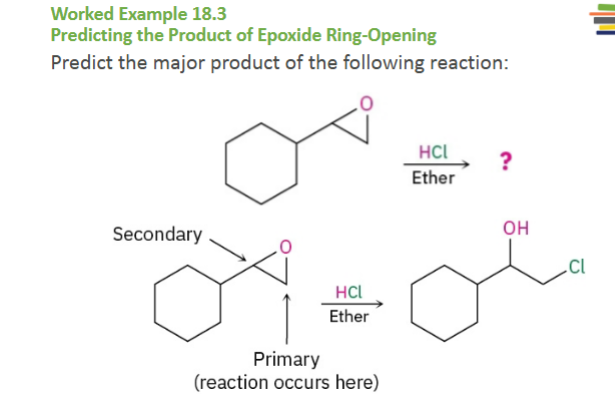
Predict the major product of the following rxn:
Acid or base?
Where does the attack occur?
Draw product
A base opening is SN2-like no matter what:
Summary (part 3)
A cyclic ether is an ether in which the oxygen atom is part of a ring.
Examples:
THF (tetrahydrofuran)
Epoxides
An epoxide is a 3-membered cyclic ether consisting of:
2 carbon atoms
1 oxygen atom
Because the ring is so small, epoxides are much more reactive than normal ethers.
Ring strain is the extra energy created when atoms are forced into uncomfortable bond angles.
Normal bond angle:
109.5° (sp³ carbon)
Epoxide bond angle:
About 60°
Since the atoms are forced into these small angles, the ring is unstable and wants to open.
More ring strain = more reactivity.
A polar solvent has an uneven distribution of electrons because oxygen is more electronegative than carbon.
This creates:
Oxygen = partially negative (δ–)
Carbon = partially positive (δ+)
An aprotic solvent is a solvent that does NOT contain an O–H or N–H bond, meaning it has no acidic hydrogen.
Examples:
Ether
THF
Acetone
DMSO
Polar aprotic solvents help make SN2 reactions occur faster because they do not strongly hydrogen bond to nucleophiles.
SYN addition means both new bonds are added to the same side of a double bond.
During epoxide formation from an alkene:
Both C–O bonds form simultaneously.
The stereochemistry of the alkene is preserved.
An intramolecular reaction is a reaction that occurs within the same molecule.
Instead of reacting with another molecule, one part of the molecule reacts with another part of itself.
A nucleophile is an electron-rich species that donates a pair of electrons to form a new bond.
Example:
O⁻
Br⁻
OH⁻
An electrophile is an electron-poor atom or molecule that accepts a pair of electrons.
After protonation, the carbons of an epoxide become better electrophiles.
Protonation means adding H⁺ (a proton) to a molecule.
In acidic epoxide opening, oxygen is protonated first, making the ring much easier to open.
summary continuation of part 3
Epoxides as Solvents
Epoxides are polar aprotic solvents.
Polar aprotic solvents favor SN2 reactions because nucleophiles remain strong.
Why Epoxides Are Reactive
Regular ethers:
Very stable
Rarely react
Epoxides:
High ring strain
Much more reactive
Easily undergo ring-opening reactions
Making Epoxides Method 1: From an Alkene
Alkene + mCPBA
↓
Epoxide
Key point:
Formation occurs by SYN addition.
From a Halohydrin
Strong base
OH becomes O⁻
O⁻ performs an intramolecular SN2 attack
Ring closes
Epoxide forms.
Acid-Catalyzed Epoxide Opening
When a strong acid is present:
Always protonate the oxygen first.
Protonating oxygen:
Makes oxygen positively charged.
Makes the ring much more reactive.
Makes the carbons better electrophiles.
Allows the ring to open more easily.
Under acidic conditions, the reaction is SN1-like.
This means the carbon with more positive character is attacked.
Therefore:
The nucleophile attacks the MORE substituted carbon.
If a tertiary (3°) carbon is present, the reaction is more SN1-like because that carbon can better stabilize positive charge.
If only primary (1°) and secondary (2°) carbons are present, the reaction is more SN2-like, even though it is still an acid-catalyzed ring opening.
summary part 3 continuation of continuation
✅ Epoxides are 3-membered cyclic ethers.
✅ Epoxides are much more reactive than regular ethers because of ring strain.
✅ Ring strain is caused by atoms being forced into approximately 60° bond angles instead of the preferred 109.5°.
✅ Epoxides are polar aprotic molecules.
✅ Polar aprotic solvents favor SN2 reactions.
✅ Epoxides can be made:
From an alkene using mCPBA (SYN addition).
From a halohydrin by intramolecular SN2.
✅ Under acidic conditions:
Protonate the oxygen first.
The ring becomes activated.
The nucleophile attacks.
The ring opens.
✅ Acid-catalyzed opening is SN1-like, so the nucleophile usually attacks the more substituted carbon.
Polar aprotic —> powerful SN2 rxn
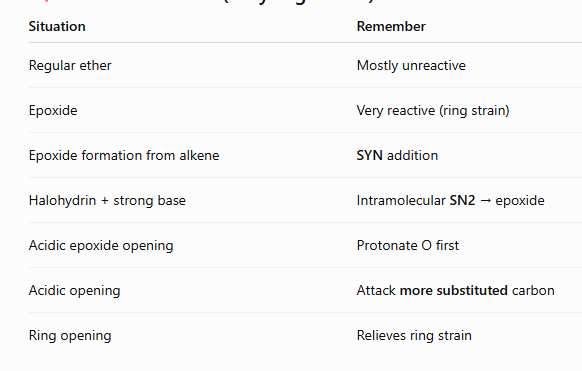
Base-Catalyzed Epoxide Opening
A reaction where a strong nucleophile attacks an epoxide directly, opening the ring.
Examples of nucleophiles:
OH⁻
RO⁻
CN⁻
RMgBr (Grignard)
Unlike acidic opening there is NO protonation first. The nucleophile attacks immediately.
Mechanism:
Nucleophile attacks carbon
C-O bond breaks
Ring opens
(Often) H2O or acid workup protonates the oxygen
Under basic conditions, the reaction is always SN2-like, so the nucleophile attacks the less substituted Carbon because it is less crowded.
It doesn't matter whether the carbons are 1°, 2°, or 3°—base-catalyzed epoxide opening is SN2-like.
Base = Backside attack = Less substituted carbon
Acid vs Base
see image

Grignard Reactions with Epoxides
Grignard Reagent
A Grignard reagent has the form:
RMgBr, it behaves like R⁻ (a carbon nucleophile). The carbon attacks the epoxide by an SN2-like mechanism.
The ring opens.
After acidic workup, an alcohol is formed.
Grignard + Epoxide
↓
Adds two carbons to the carbon chain (when reacting with ethylene oxide) and produces an alcohol after workup. The slide's main emphasis is that Grignard nucleophiles react with epoxides SN2-like.
Crown Ethers
A crown ether is a cyclic molecule containing several oxygen atoms that can surround and bind a metal ion. Crown ethers help dissolve ionic compounds in nonpolar solvents. The inside of the crown is polar (oxygen atoms bind the metal ion).
The outside is nonpolar, allowing the complex to dissolve in less polar solvents

Thiols
Thiols are sulfur versions of alcohols. Replace OH with SH. General formula: R-SH. thiols can be prepared by SN2 substitution from alkyl halides, just like alcohols.

Oxidation
two thiols —> oxidation —> disulfide —> R-S-S-R

Reduction
Disulfide —> two thiols

Sulfides
Sulfides are sulfur versions of ethers.
Replace oxygen with sulfur. R-S-R
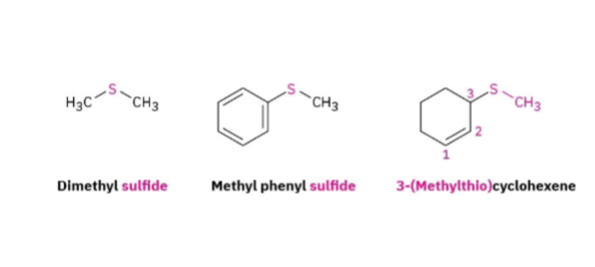
Preparation of Sulfides
Prepared by an SN2 reaction, just like the Williamson ether synthesis—but using sulfur instead of oxygen.

Spectroscopy of Ethers
Ethers do not have an O-H peak, instead, look for a C-O stretch around 1,100 cm-1

1 H NMR
Hydrogens on carbons next to oxygen are shifted downfield, typically around 2–4 ppm (the slide specifically shows about 3.4 ppm for dipropyl ether). There is no unique ¹H NMR or ¹³C NMR signal that definitively identifies an ether or epoxide. Instead, look for carbons or hydrogens next to oxygen being shifted downfield.

Summary (part 4)
Ethers
Mostly unreactive.
Cleaved only by strong acids like HBr or HI.
Epoxides
3-membered cyclic ethers.
Very reactive because of ring strain.
Acidic Epoxide Opening
✔ Protonate oxygen first.
✔ Attack the MORE substituted carbon.
✔ SN1-like.
Basic Epoxide Opening
✔ No protonation first.
✔ Attack the LESS substituted carbon.
✔ Always SN2-like according to the slides.
Crown Ethers
Bind metal ions.
18-Crown-6 → K⁺
15-Crown-5 → Na⁺
Thiols
Sulfur version of alcohols.
Functional group = –SH
Oxidation forms disulfides (R–S–S–R).
Sulfides
Sulfur version of ethers.
Made by SN2, similar to Williamson ether synthesis.
Spectroscopy IR
❌ No O–H peak (~3500 cm⁻¹).
✅ C–O stretch near 1100 cm⁻¹.
¹H NMR
Hydrogens next to oxygen appear downfield (~2–4 ppm).
Ethers are mostly unreactive except with strong acids.
Epoxides are reactive because of ring strain.
Acidic epoxide opening → protonate oxygen first → attack the MORE substituted carbon.
Basic epoxide opening → SN2 → attack the LESS substituted carbon.
Thiols = sulfur alcohols (–SH), Sulfides = sulfur ethers (R–S–R).
