Lecture 4: Analysis of Single Loci and Chromosomal Haplotypes - Using Complementation Tests and Family Data
 Call Kai
 Learn
Learn Practice Test
 Spaced Repetition
 Match
Match Flashcards
 Knowt Play
1/16

There's no tags or description
Looks like no tags are added yet.
Name | Mastery | Learn | Test | Matching | Spaced | Call with Kai | Chat |
|---|
No analytics yet
Send a link to your students to track their progress
17 Terms
t/f: our genetic and genealogic ancestors are the same
false: the vast majority of genealogical ancestor are not your genetic ancestors
t/f: The further back in time you, your genetic ancestors are a smaller and smaller a subset of your genealogical ancestors
true: because the further back you go the more and more people we are related too
genetic ancestors
an individual from whom you have directly inherited a specific segment of DNA
genetic model organism
yeast, fruit fly, mouse, E.coli
why are genetic model organism so good?
can be crossed and experimentally manipulated in labe
short generation time
large numbers of progeny
why are pedigree useful?
allow for the investigation of genetic diseases in closely related individuals
is a way of deducing inheritance when information is limited
ex: used for rare gentic diseses
t/f: in a disease pedigree we can assume that unrelated indiviuals marrying into a family are homozygous wild-type
true: unless otherwise mentioned shown
t/f: recessive disease traits show a pattern of unaffected parents having an affected child
true: both parents must be heterozygous if child is affected
x-linked recessive trait
are most common in males bc they only get one x chromosome from mom while females can get it from either mom or dad
t/f: If an X-linked disease is associated with a dominant allele, affected males produce all affected daughters and no affected sons.
true
t/f: autosomal dominant traits appear in each generation.
true
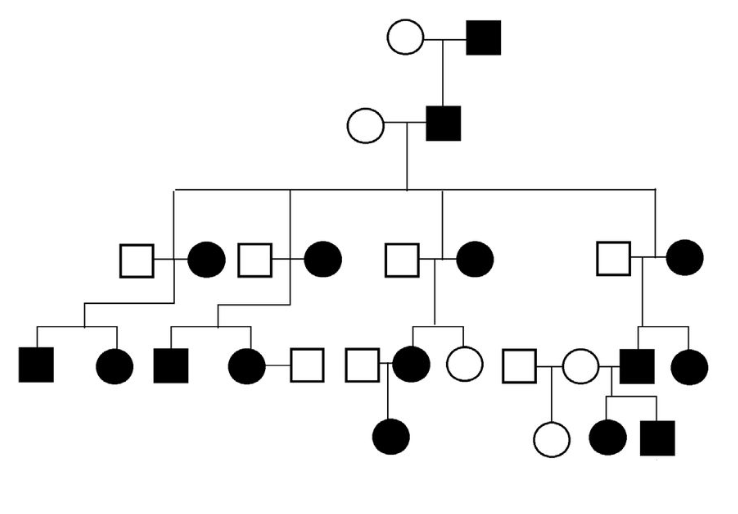
what is the forward genetic approach
Start with a weird trait, then find the gene that caused it.
make or find mutants with traits of interest
find mutant gene in the genome (via genetic mapping)
Study the gene to learn how it normally functions
auxotrophs
organisms that cannot survive in minimal media
complementation test
crossing two auxotrophic mutations to see if the mutations are in different genes
if they are then the diploid would be able to synthesize arginine
With respect to a trait, if two mutant strains fused result
in a mutant diploid, this indicates that the strains had
mutations in the same gene relevant to the trait
prototroph
organisms that can survive in minimal media
supplementation test
supplementing auxotrophic mutants with different substrates in the Arginine Biosynthesis Pathway to see which genes are relevant to which steps/enzymes in the in the Arginine Biosynthesis Pathway
genealogical ancestor
any biological individual who occupies a specific spot on your family tree, regardless of whether you inherited their DNA