3.1.4 Proteins
 Call Kai
 Learn
 Practice Test
 Spaced Repetition
 Match
 Flashcards
 Knowt Play
1/14

There's no tags or description
Looks like no tags are added yet.
15 Terms
What are proteins made of
Proteins are polymers made up of the monomers amino acids
Protein polymer chains (peptides) are created on ribosomes then further folded and modified in the golgi apparatus
General structure of amino acids
Central carbon
Amine group (NH2)
hydrogen atom
carboxyl group (COOH)
variable group (R group)
Each amino acids has a different R group

Glycine
Simplest amino acid

2 sulfur-containing amino acids
cysteine
methionine
Types of proteins
Basic - more bases than acids
Acidic - more acids than bases
Neutral - same number of acids and bases
How amino acids bond to form a protein
Peptide bond formed between the carbon and nitrogen
One condensation reaction

Dipeptides
= two amino acids bonded together formed by the condensation of two amino acids
Polypeptides
= formed by the condensation of many amino acids
Primary structure
amino acids added to dipeptide forming polypeptide chain via condensation reactions
proteins consist of one of more polypeptide chains folded in a specific 3D shape
the sequence of amino acids is determined by DNA
the order of amino acids will alter where bonds occur and how the protein folds
primary structure determines the final 3D shape and protein’s function

Secondary structure
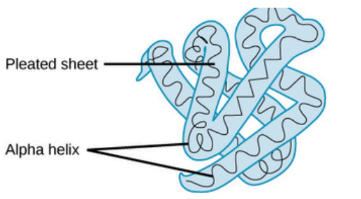
the sequence of amino acids cause parts of a protein molecule to coil into an alpha helix or fold into beta pleated sheets
hydrogen bonds form between the carboxyl groups of one amino acid and the amine group of another, these hold the secondary structure in place

Tertiary structure
secondary structure folded into a precise, unique, globular 3D shape, held in place by hydrogen bonds, ionic bonds and disulfide bonds (which only occur between R-groups on sulfur-containing amino acids)
the type of elements in the chain depend on the type of bonds that form to stabilise them. E.g. lots of hyrdrogen and oxygen atoms → hydrogen bonds, disulphate bridges form between sulfur atoms, oppositely charged groups form ionic bonds
Describing the tertiary structure of a protein:
The further folding of the secondary structure
To create a unique 3D structure
Held in place by hydrogen, ionic and disulfide bonds
Quaternary structure
a protein made up of more than one polypeptide chain
hydrophobic interaction and same bonds as tertiary structure (hydrogen, ionic, disulfate) holds the quaternary structure together
e.g. haemoglobin, has 4 polypeptide chains
Globular proteins
regular, repetitive sequence of amino acids
compact, spherical shape
relatively unstable structure
soluble
plays an important role in metabolism e.g. enzymes, hormones, haemoglobin
Fiborous proteins
long parallel strands
stable structure
cross linked chains as they provide additional strength
insoluble
for support and structural function
e.g. keratin and collagen
Biuret test for proteins
Add biuret reagent to sample
It will turn from blue to purple if proteins are present
For this test to work, there must be at least two peptide bonds present in any protein molecule, so if the sample contains only amino acids or dipeptides, the result will be negative