lecutre 16 immunology: immunological memory
 Call Kai
 Learn
Learn Practice Test
 Spaced Repetition
 Match
Match Flashcards
 Knowt Play
1/43

There's no tags or description
Looks like no tags are added yet.
Name | Mastery | Learn | Test | Matching | Spaced | Call with Kai | Chat |
|---|
No analytics yet
Send a link to your students to track their progress
44 Terms


steps in B cell differentiation
antigen recognition induces expression of effector molecules by T cell, which activates B cell
B cell proliferation
differentiation to resting memory cells and antibody secreting plasma cells
germinal centers types:
Mantle Zone
Dark Zone (AID, mutation & proliferation)
Light Zone (Selection and differentiation)
T-Cell Zone (Paracortex) (Tfh cells, T cell area)

mantle zone
Naïve B cells pushed aside by proliferating activated B cells.
dark zone
Populated by rapidly proliferating B cells.
Clonal expansion of activated B cells.
Somatic hypermutation in immunoglobulin variable region genes.
outcome: Generates BCR diversity to improve antigen binding.
light zone
Contains non-dividing B cells, follicular dendritic cells (FDCs), and Tfh cells.
Affinity selection: B cells test their newly mutated BCRs against antigen displayed on FDCs.
Competition for Tfh help (CD40L, cytokines).
Outcome: High-affinity B cells survive, while low-affinity or autoreactive clones undergo apoptosis.
T-Cell Zone (Paracortex) (Tfh cells, T cell area)
Adjacent area rich in CD4⁺ T cells (especially Tfh precursors).
Provides help (CD40L, IL-21, IL-4) to B cells entering or within the germinal center.
Memory B cell responsible for?
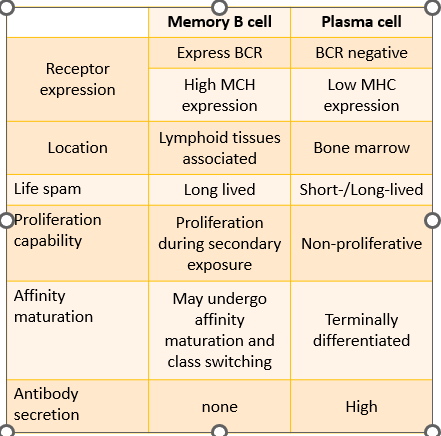
responsible for anamnestic (secondary) responses to repeated exposures
plasma cells?
terminally differentiated B lymphocyte, able to secrete antibody and bc of that are responsible for antibody-mediated immunity.
Terminally differentiated
cells that have acquired effector functions, and in the process have lost their plasticity (ability to become something else).
E.g.: a memory B cells can be activated, and its daughter cells may become either memory cells or plasma cells. But a fully differentiated plasma cell cannot revert to being a memory cell.
memory B cell vs plasma cell
how are B cells dynamic?

what does re-exposure change?
changes in the amount and in the composition of antibodies

affinity maturation is driven by the?
competition for antigens
T cell activation?
naive T cell encounters antigen
most activated T cell becomes effector cell, some
short lived by apoptosis
activated/effector cells become long lived memory cells
cytokines required for survival
most important phenotypes to characterize T cells
CD45 receptor (tells u if T cell has seen antigen; RA naive, RO activated)
CD62L ( helps T cells migrate to lymph nodes)
CCR7 (guides T cells to lymph nodes and secondary lymph organs)
what can their phenotype (which is a set of expressed markers) reveal about the aspect of T cell role?
migration
localization
differentiation
activation and function
central localization
LN

peripheral localization
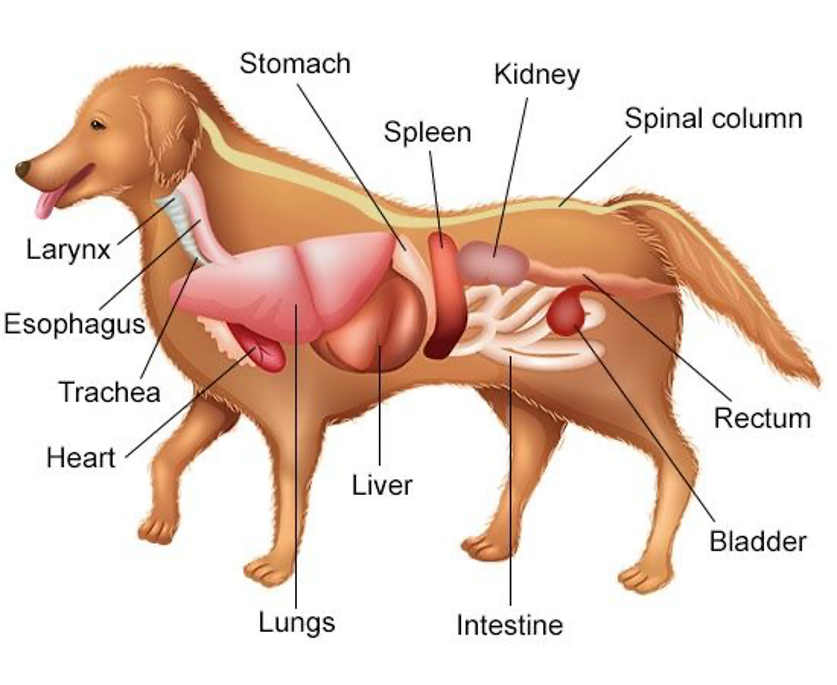


lymphoid tissue (central localization)
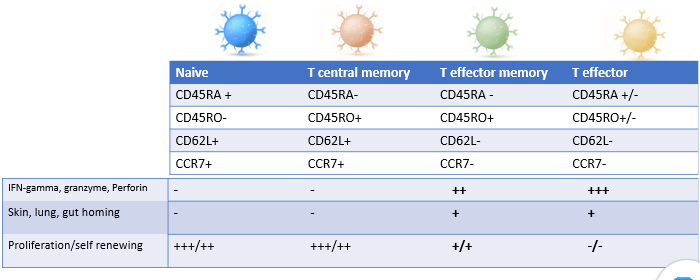
CD62L and CCR7 are +
CD45RA + in naive T cell and - in T central memory cell
CD45RO “ “- and + “ “
peripheral localization
CD62L and CCR7 are - (NEGATIVE)
CD45RA - in T effector memory cell and + in T effector cell
CD45RO ‘ ‘ +, “ “ -
CD45
transmembrane tyrosine phosphatase with three variable exons (A, B, and C) that encode part of its external domain
Shorter spliced receptor (CD45RO)
goes toward interactions with TCR and more efficient signal transduction
CD45RO switching to a more efficient signal transduction signifies?
exposure to cognate anigen and priming
memory cell function
poor effector function
Effector cells function
cytokine production and activation markers (IFN-gamma, Granzyme, CD69, CD25)
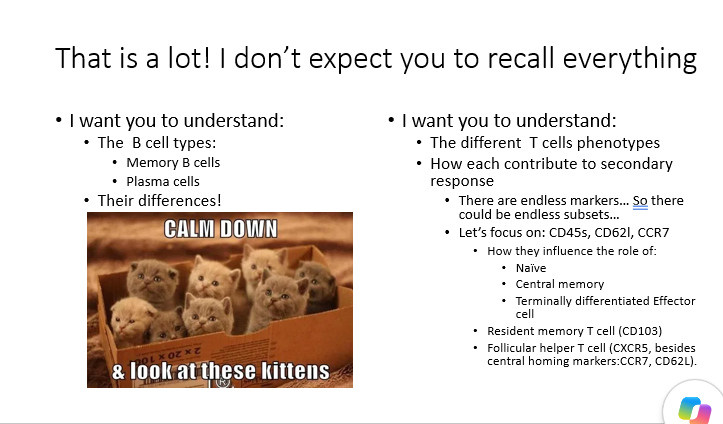
Follicular helper T cell
T (Tfh) cells are specialized providers of T cell help to B cells, and are essential for germinal center formation, affinity maturation, and the development of most high affinity antibodies and memory B cells.
live in lymph nodes (CCR7 and CD662L +)
homing to B cell follicles (express CXR5 (downregulate CCR7)
how can we tell apart effector vs memory
using other activation receptors, but not the same ones we use for other T cells.