REAL ECOLOGY TEST 3
 Call Kai
 Learn
 Practice Test
 Spaced Repetition
 Match
 Flashcards
 Knowt Play
1/30

Earn XP
Description and Tags
Lets LOCK IN
31 Terms

What will be the outcome?
Species 2 excludes species 1
What does each alpha value represent?
Alpha = 1 → intraspecific competition = interspecific competition
Alpha > 1 → intraspecific competition < interspecific competition
Alpha < 1 → intraspecific competition > interspecific competition

What will the result be?
Either species 1 or 2 wins - we dont have enough info to predict accuralty

What will the result be?
Competive coexisting conditions, both species below their carrying capacity
What is one hypothesis that explains the success of invasive species?
Enemy release hypothesis:
Absence of natural enemies in invaded environment allows introduced populations to attain greater abundances
What is one hypothesis that explains the downfall of invasive species?
Biotic resistance hypothesis:
Species-rich communities are more resistant to invasion
Why: More niches filled by other species, higher ability to compete,
For Rhizobium bacteria:
What mutualism is it?
What does each party beenfit?
Trophic:
Bacteria converts N2 for plants
Plants provide carbon through photosynthesis to bacteria
What are the five types of mutualism and their basic definition?
Defensive: species recives food/shelter for providing protectionn
Obligate: They both rely on each other for survival and reproduction
Faculative: Both benefit, bot interactions are not needed
Trophic: Partners specialize in complementary ways to obtain energy and nutrients
Dispersal: One takes food, and disperses seeds/pollen
Example of a cheater!!
Orchid flower:
resembles female wasp
Males come to mate with the flower, no reproduction happnes
But wasp took pollen, so now flower can spread pollen
Is the cost of defense higher for slow-growing plants or fast-growing plants?
Fast growing plants!
Qualitative vs Quantitative defense:
Qualitative:
Most effective against generalists
lower concentration → lower effect
Smaller molecular weight compounds
Quantitative:
Most effective against specialists
higher concentration → higher effect
Reduce digestibility
What organism is typically recruited as a biotic defense for plants?
Insects, commonly such as ants.
What is a nonlethal effect of predator on prey?
Reduced feeding
Example: Mayfly nymphs reduce feeding activity due to predators
What is the pattern between garter snake and newt?
The more toxic the newts, the more resistant the snakes
Snakes that are more resistant are slower at moving
In places where newts did not become as toxic due to the possible lack of predators
Interspecific vs Intraspecific competition:
Inter- between members of diff species
Intra- between members of same species
Fundamental niche vs Realized niche:
Fundamental: Range of conditions/resources to which a species is adapted
Realized: Portion of fundamental niche that it can actually live in. The actual range

Draw the lines:
Okay i did it.

What should you know about basic predator-prey model?
It leads to predator-prey population cycles
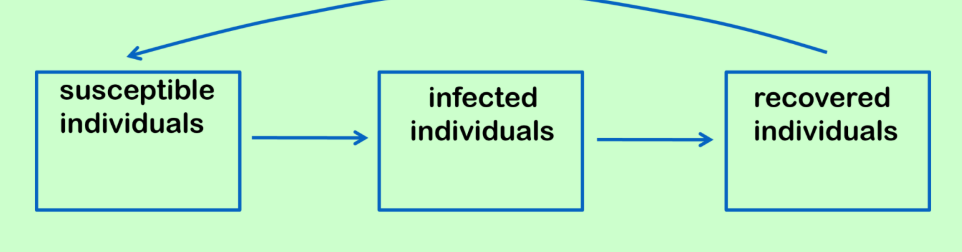
Fill in this model
Did it

DI/dt formula
BetaSI - vI - alphaI - dl
dS/dt formula-
b(S+i+r) - betaSI + yR -dS
dR/dt forumal-
vl - yR - dR
What parameter deals with SIR model and vaccination
S (density of susceptible)
What parameter deals with SIR and culling (disease and predation)
alpha (disease-related death rate)
What parameter deals with SIR and mask-wearing and like that
Beta (transmission rate)
What parameter deals with SIR infection and treating infection
v (recovery rate)
What principle relates to giraffe’s eating leaves?
Competitive Exclusion Principle:
2 species that use a limiting resource in the same way cannot coexist indefinitely
What does each alpha represent?
Alpha = 1 ~ Intraspecific comp = interspecific comp
Alpha < 1 ~ interspecific comp is less intense than intraspecific comp
Alpha > 1 ~ interspecific comp is more intense than intraspecific comp
Parasite and water relationship:
Waterborne transmission
Give an example of a situation in which a parasite can afford to evolve a high level of virulence
If parasites can survive longer in external environemnts:

Draw coexisting grpah
they be coexisting and zero net grtowth
