CSCE452 Exam 1 Jason O'Kane
 Call Kai
 Learn
Learn Practice Test
 Spaced Repetition
 Match
Match Flashcards
 Knowt Play
1/76

There's no tags or description
Looks like no tags are added yet.
Name | Mastery | Learn | Test | Matching | Spaced | Call with Kai | Chat |
|---|
No analytics yet
Send a link to your students to track their progress
77 Terms
The vague definition of a robot has been compared to how you can’t really tell where ____ begins or ends
Mount Fuji
Four general robot traits
Autonomous, Sensor-driven, Physical, Goal-achieving
The fundamental problem of robotics is
that the robot relies on limited/unreliable hardware to sense and interact with an unpredictable and complex world
Robots exist at the intersection of ____, ____, and ____. Thus, solving any one of these three is not sufficient for robotics development.
computing, acting, and sensing
The four core robotics problems are
Navigation and motion planning
Localization and mapping
Manipulation
Exploration and coverage
Describe the Navigation and motion planning problem
Get from A to B
Describe the Localization and mapping problem
Where am I and what’s around me
explain the Manipulation problem
Grasp, transport, assemble, or disassemble objects in the environment
Explain the exploration and coverage problem
Move to see or touch everything in the environment
An ____ is hardware that contributes to motion
actuator
DC motor
High velocity, low torque, low control
Gearhead motor:
Low velocity, high torque
Stepper motor:
small, discrete rotations provide precise rotation control.
Servo motor:
Can sense and control rotor position, but can’t rotate all the way
Linear actuators:
generate translational motion in various ways
A ____ gathers data from the environment
sensor
Encoders
measure the amount of rotation in a joint or wheel
Infrared sensors:
measure distance by emitting IR light and measuring the intensity of the signal reflected back into the sensor
Ultrasonic/sonar sensors:
measure distance by emitting a pulse of sound and measuring its time-of-flight
Lidar:
measures distance using phase shifts in highly coherent light.
Cameras:
Measure intensity and color of light
RGBD (red-green-blue-depth) sensors:
provide RGB images with an extra channel for distance
Compasses:
Measure direction with earth’s magnetic field
GPS Receivers:
Use satellites to measure absolute position
Inclinometers:
Measure the relative direction of gravity
Inertial measurement units (IMUs):
combine 3 accelerometers and 3 gyroscopes to measure linear and angular acceleration.
What are the two main robot design strats
Brute force your problems and keep adding or improving hardware
Use modest hardware and design your algorithms around those limits
Robot software is often ____, meaning different pieces of code are running on different hardware simultaneously to achieve the desired effect. ROS provides networks
distributed
ROS also provides ____ pieces of code for both reliable, commonly-used techniques, and leading-edge research results.
Modular/reusable
ROS allows code that can be used on ____ robots to work with ____ robots too
real; simulated
A ROS node is an ____
executable program
A ROS topic is a ____ way, ____-to-____ channel from ____ nodes to ____ nodes
one; many-to-many; publisher; subscriber
The ROS Graph is a graph with an edge for each ____
publisher-subscriber relationship
A service is a ____, ____-to-____channel between a ____ and ____
two-way; one-to-one; client; server
(ROS) An ____ is how you ask a node to do something
action
A ROS interface is a ____
data type
A package is a ____
collection of related files and executables
A launch file is a program that ____
launches and configures nodes automatically
A ROS parameter is a ____
bit of configuration data associated with a node.
A ROS bag is a ____
file that stores messages to be replayed later.
The state is the ____. Represented by ____ and ____
collection of all aspects of the robot and the environment that can impact the futurel; X; x
The action (robot modeling, not ROS) is a ____. Represented by ____ and ____
choice the robot makes at a particular time; U; u
A state transition equation describes how ____
actions change the state, and models a future state as a function of a current state and a current action, and optionally a variable theta to represent error. (i.e. x_future = f(x_current, u_current, theta))
The observation is ____. Also a tuple, denoted with ____ and ____
information supplied to the robot at a particular time; Y; y
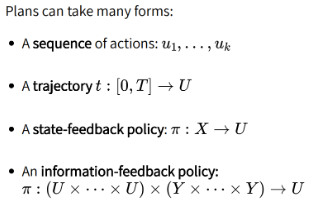
Ways to model plans (robot modeling)
Drive wheels ____
actively move, powered by an actuator
Steer wheels ____
rotate about the axis perpendicular to the ground to influence direction
Passive wheels are ____
any wheels that don't drive or steer
A differential drive robot has ____
two independent non-steered drive wheels along a common axis.
The state space of a differential drive system is ____
(x, y, 𝜃) for position and direction
The action space of a diff drive system is ____
(vl, vr), the velocities of the two wheels
The ICC of a diff drive system is what we call the point where ____
the robot moves about with a constant angular velocity
l in the diff drive equations represent ____
the distance between the wheels
R in the diff drive equations represent _____
Distance from ICC to robot center
Location of ICC formula
C = (x - Rsin(𝜃), y + Rcos(𝜃))
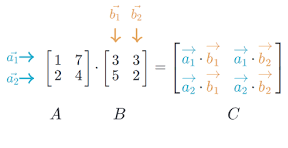
When multiplying matrices, each row of the product matches matrix ____ (A or B) and each column matches matrix ____ (A or B)
A, B
What are the two special cases for differential drive?
If vl = -vr, R=0, i.e., the robot rotates in place
if vl=vr, R is infinite, robot moves forward
A diff drive is a nonholonomic system because it ____
cannot move directly sideways.
How do you find the ICC location for a non differential drive system? What are the four cases and what do they show?
the ICC is the intersection of all the lines perpendicular to the rolling direction of all the wheels
If the lines intersect at a single point, that point is the ICC.
If the lines overlap, the ICC can lie anywhere along that line.
If the lines are distinct and parallel, the ICC is 'at infinity' in that direction.
If the lines do not share any common intersection point and are not all parallel, the robot cannot move.
Bicycle drive has a ____
steered wheel in the front and a non-steered wheel in the back.
Tricycle drive has a ____
steered wheel in the front and two non steered wheels in the back
A synchronous drive robot has ____
All the wheels always ____ and ____.
three steerable drive wheels
point in the same direction
drive at the same speed
Ackerman steering has ____
two steer wheels
What is special about the inner steer wheel in an ackerman steering system? Why is this necessary?
the inside wheel has to turn more than the outer wheel. If they didn’t, i.e. if their rolling directions were always parallel, then the lines perpendicular to their rolling directions would also be parallel, meaning the robot cannot move.
What are the four alternatives to wheels?
Legs
Legs and wheels
Legs that rotate like wheels
Hybrid terrestrial/aquatic locomotion
Describe the bug0 algorithm. Does it always find a solution?
Go directly to the goal
If you hit an obstacle, turn left and wall follow until you can once again go directly to the goal
Repeat
Bug0 is incomplete, it can trap you in an infinite loop
Describe Bug1
Go directly to the goal
If you hit an obstacle, turn left and wall follow, circling the entire obstacle, and recording your distance from the goal the whole way
After returning back to where you first hit the obstacle, wall follow the same obstacle back to the point along the obstacle that was closest to the goal (use the shorter direction left vs right)
Repeat
Describe Bug2
Record a straight line between the start and goal states
Go directly to the goal
If you hit an obstacle, turn left and wall follow until you hit the line
If you are now closer to the goal than when you hit the obstacle, go directly to the goal, else keep following the obstacle
The ____ is where you hit an obstacle, the ____ is where you return to goal seeking
hit point; leave point
What do the variables D, M, p_i, and n_i represent in the bug algorithm formulas represent?
D - upper bound on path length
M - number of obstacles
p_i - perimeter of the ith obstacle
n_i - number of intersection points between the start-to-goal line and the perimeter of the ith obstacle
If each obstacle is a polygon, the visibility graph is a weighted graph with a set of nodes that includes the ____, ____, and all ____
start-state; end-state; obstacle vertices
In a visibility graph, we Include all edges that don’t ____
go through an obstacle
In a visbility graph, for any edge (u, v), it is considered tangent if the infinite line which (u, v) is a segment of does not ____
intersect either polygon that u and v are a part of.
The reduced visibility graph only has ____ edges.
Tangent
How do we know that the shortest path must be along the visibility graph?
Proof by contradiction. Say the shortest path contains some segment that is not an edge in the visibility graph. This means the segment changes direction at a point that is not a node in the graph (i.e. a point in free space or along an edge). This means that the segments leading to and from the point could be connected with a straight line. By reducing two non parallel segments to one straight line, the path has been made shorter. Therefore this cannot be the shortest path. Hence proved.
Does the visibility graph method of finding shortest path apply to 3D navigation problems?
No
Why is the visibility graph method of finding shortest path considered dangerous?
In the real world, having a robot come so close to an obstacle edge or vertex could cause a collision