VITAMIN A
0.0(0)
Studied by 1 person Note
Note Call Kai
 Learn
Learn Practice Test
 Spaced Repetition
 Match
Match Flashcards
 Knowt Play
Card Sorting
1/37

There's no tags or description
Looks like no tags are added yet.
Last updated 2:34 AM on 5/15/23
Name | Mastery | Learn | Test | Matching | Spaced | Call with Kai | Chat |
|---|
No analytics yet
Send a link to your students to track their progress
38 Terms
1
New cards
types of retinoids (preformed vitamin a)
* retinol - alcohol
* retinal - aldehyde
* retinoic acid - carboxylic acid
* retinyl ester - esterified; when fatty acid is attached
* most common type: retinyl palmitate (16-carbon FA)
* retinal - aldehyde
* retinoic acid - carboxylic acid
* retinyl ester - esterified; when fatty acid is attached
* most common type: retinyl palmitate (16-carbon FA)
2
New cards
retinoid sources (preformed vitamin a)
* found in animal foods - mainly as retinyl ester
* dairy and breakfast cereals
* can be oxidized
* in supplements:
* retinyl acetate and retinyl palmitate
* asquasol A - water miscible form for those with fat malabsorption
* dairy and breakfast cereals
* can be oxidized
* in supplements:
* retinyl acetate and retinyl palmitate
* asquasol A - water miscible form for those with fat malabsorption
3
New cards
types of carotenoids considered as pro vitamin A
* beta-carotene
* creates 2 retinal
* alpha-carotene
* 1 retinoid
* beta cryptoxanthin
* 1 retinoid
\*alpha-carotene and beta-cryptoxanthin have half the vitamin A activity of beta-carotene
* creates 2 retinal
* alpha-carotene
* 1 retinoid
* beta cryptoxanthin
* 1 retinoid
\*alpha-carotene and beta-cryptoxanthin have half the vitamin A activity of beta-carotene
4
New cards
carotenoid sources
* bright red, yellow, and orange pigments in plants
* more carotenoids in food than in body
* found mainly in fruits and vegetables - carrots
* common in diet: beta-, alpha-, beta-crypotoxanthin, lycopene, lutein, zeaxanthin
* more carotenoids in food than in body
* found mainly in fruits and vegetables - carrots
* common in diet: beta-, alpha-, beta-crypotoxanthin, lycopene, lutein, zeaxanthin
5
New cards
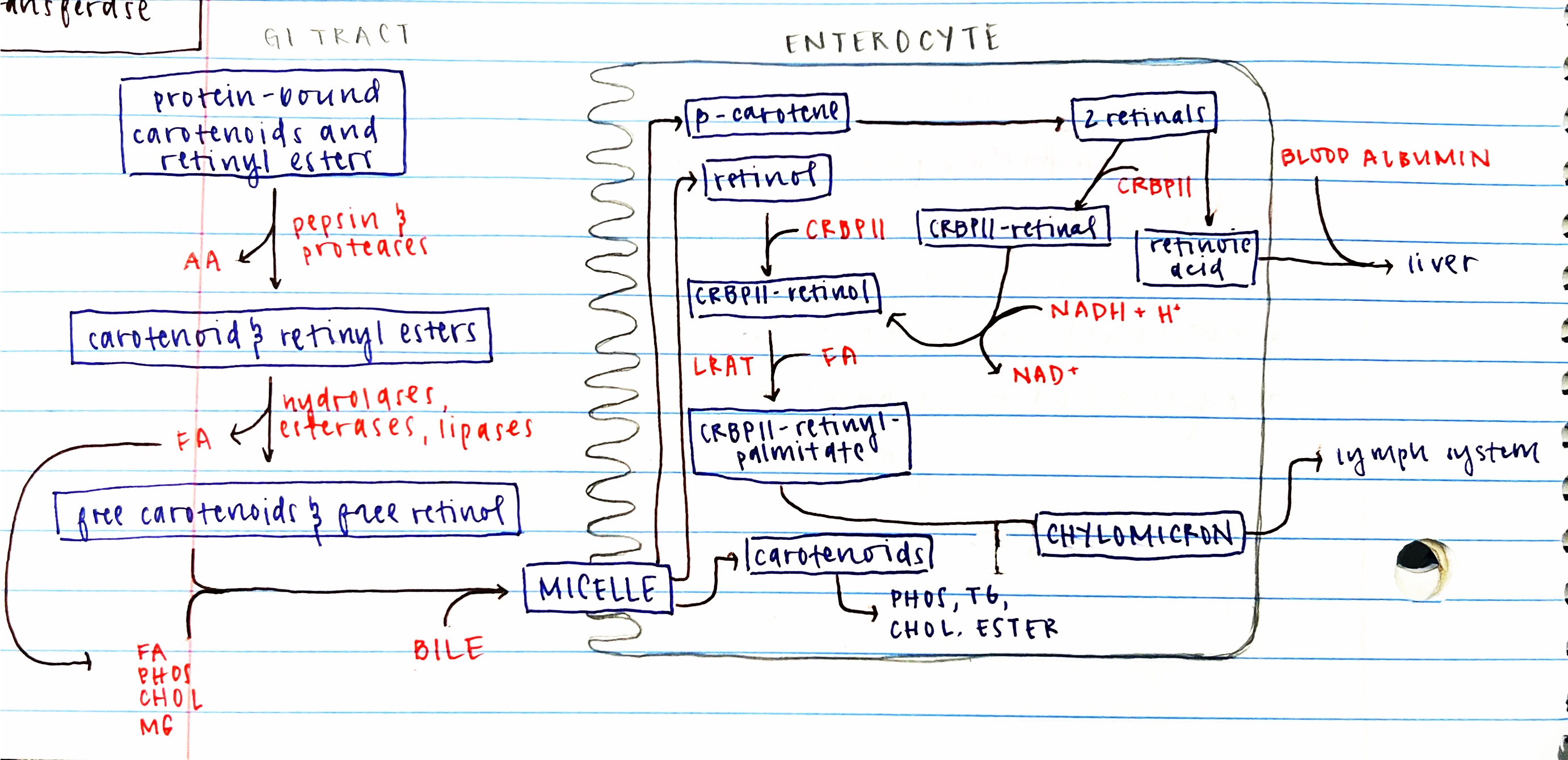
digestion and absorption of retinoids and carotenoids
* carotenoids, FA, and bile enter enterocyte in micelle
1. beta-carotene converts to 2 retinals
1. excess retinals convert to retinoic acid that binds to albumin to travel to liver
2. from 2 retinals, CRBPII creates CRBPII-retinal which is then reduced to CRBPII-retinol
3. LRAT esterifies fatty acid to form CRBPII-retinyl-palmitate
4. retinyl esters along with phospholipids, triglycerols, chol. esters, carotenoids join CRBPII-retinyl-palmitate to enter chylomicron
5. chylomicron enters lymph system
1. beta-carotene converts to 2 retinals
1. excess retinals convert to retinoic acid that binds to albumin to travel to liver
2. from 2 retinals, CRBPII creates CRBPII-retinal which is then reduced to CRBPII-retinol
3. LRAT esterifies fatty acid to form CRBPII-retinyl-palmitate
4. retinyl esters along with phospholipids, triglycerols, chol. esters, carotenoids join CRBPII-retinyl-palmitate to enter chylomicron
5. chylomicron enters lymph system
6
New cards
What is LRAT?
* lecithin retinol acyl transferase
* used in esterification
* CRBPII-retinol → CRBPII-retinyl-palmitate
* used in esterification
* CRBPII-retinol → CRBPII-retinyl-palmitate
7
New cards
What is CRBP?
* cellular retinol-binding protein
* retinol → CRBPII-retinol
* retinol → CRBPII-retinol
8
New cards
important to know in digestion and absorption:
* retinoids and carotenoids have to be free from protein and fatty acids
* they are incorporated into micelles
* retinoids in mucosal cells will be esterified and incorporated into chylomicrons
* beta-carotene will be cleaves into 2 retinals and incorporated into chylomicron
* retinoids travel in the cells bound to a retinol binding protein (CRBPII)
* esterification happens with help of lecithin retinol acyl transferase (LRAT)
* extent to which carotenoids change to vitamin A is dependent on body’s vitamin A status
* lower vitamin A = more conversion/cleaving of carotenoids
* chylomicron remnants take remaining retinoids and carotenoids to liver; some storage in adipocytes
* they are incorporated into micelles
* retinoids in mucosal cells will be esterified and incorporated into chylomicrons
* beta-carotene will be cleaves into 2 retinals and incorporated into chylomicron
* retinoids travel in the cells bound to a retinol binding protein (CRBPII)
* esterification happens with help of lecithin retinol acyl transferase (LRAT)
* extent to which carotenoids change to vitamin A is dependent on body’s vitamin A status
* lower vitamin A = more conversion/cleaving of carotenoids
* chylomicron remnants take remaining retinoids and carotenoids to liver; some storage in adipocytes
9
New cards
Example of protein that binds to retinoids and direct their use in cells
* CRBP, CRABP
10
New cards
How and where are retinoids stored?
* stored as esters mainly in liver stellate cells
* some also stored in kidneys, lungs, and adipocytes
* some also stored in kidneys, lungs, and adipocytes
11
New cards
When needed, what 2 proteins are attached to stored retinol?
* retinol binding protein (RBP) and transthyretin (TTR)
12
New cards
Where are carotenoids stored?
* largely stored in liver, incorporated into VLDL
* also travel in other lipoproteins
* also travel in other lipoproteins
13
New cards
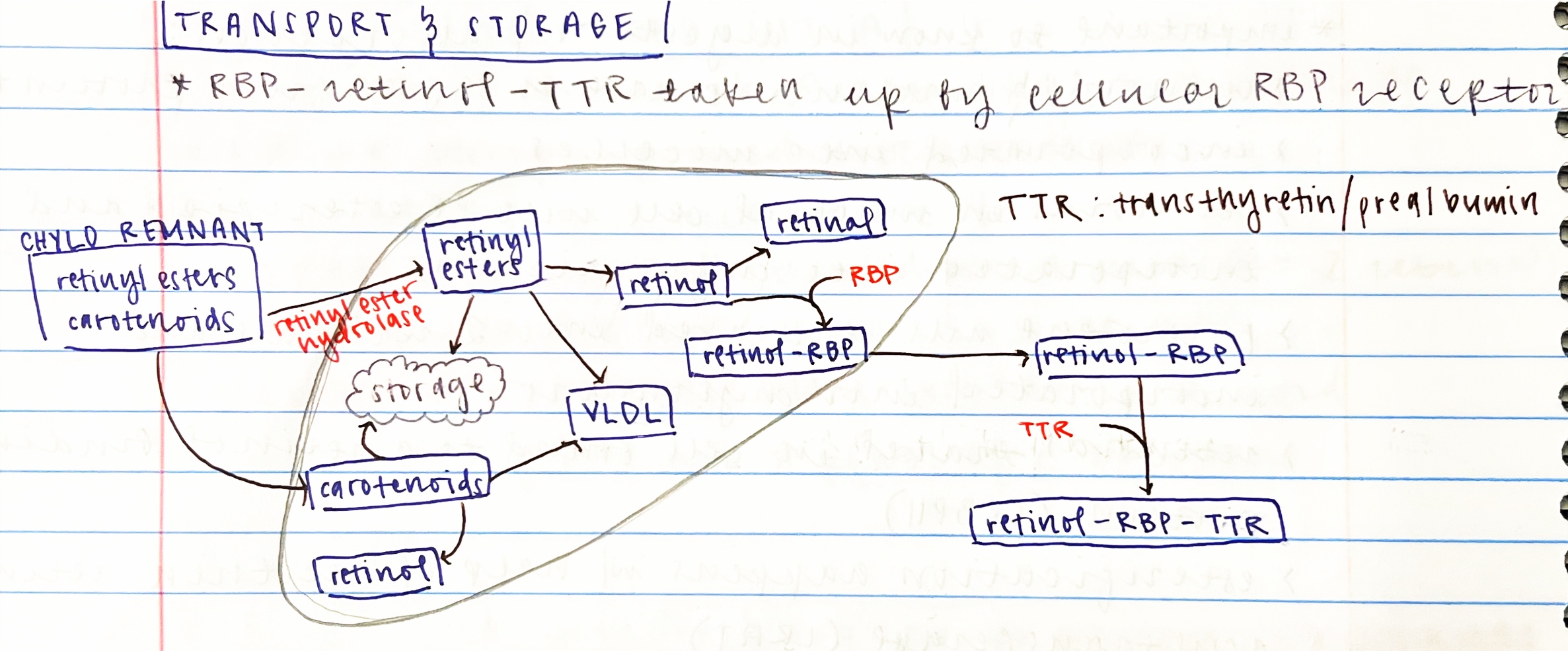
transport and storage of retinyl esters and carotenoids:
1. retinyl esters are taken up into the liver - retinol and FA are released by retinyl ester hydrolase
2. carotenoids freely enter liver - can be made into retinol
3. retinyl esters and carotenoids can either be put into storage or into VLDL
4. retinyl esters can also be made into retinol
5. this retinol can either be made in to retinal or retinol-RBP by RBP
6. retinol-RBP is released into the blood as retinol-RBP-TTR with the addition of TTR
14
New cards
what are the functions of retinoids
* vision - visual cycle
* gene expression
* cellular differenttiation
* growth and reproduction
* bone metabolism: osteoclasts and osteoblasts
* gene expression
* cellular differenttiation
* growth and reproduction
* bone metabolism: osteoclasts and osteoblasts
15
New cards
what are the functions of carotenoids
* antioxidant
* growth and apoptosis
* growth and apoptosis
16
New cards
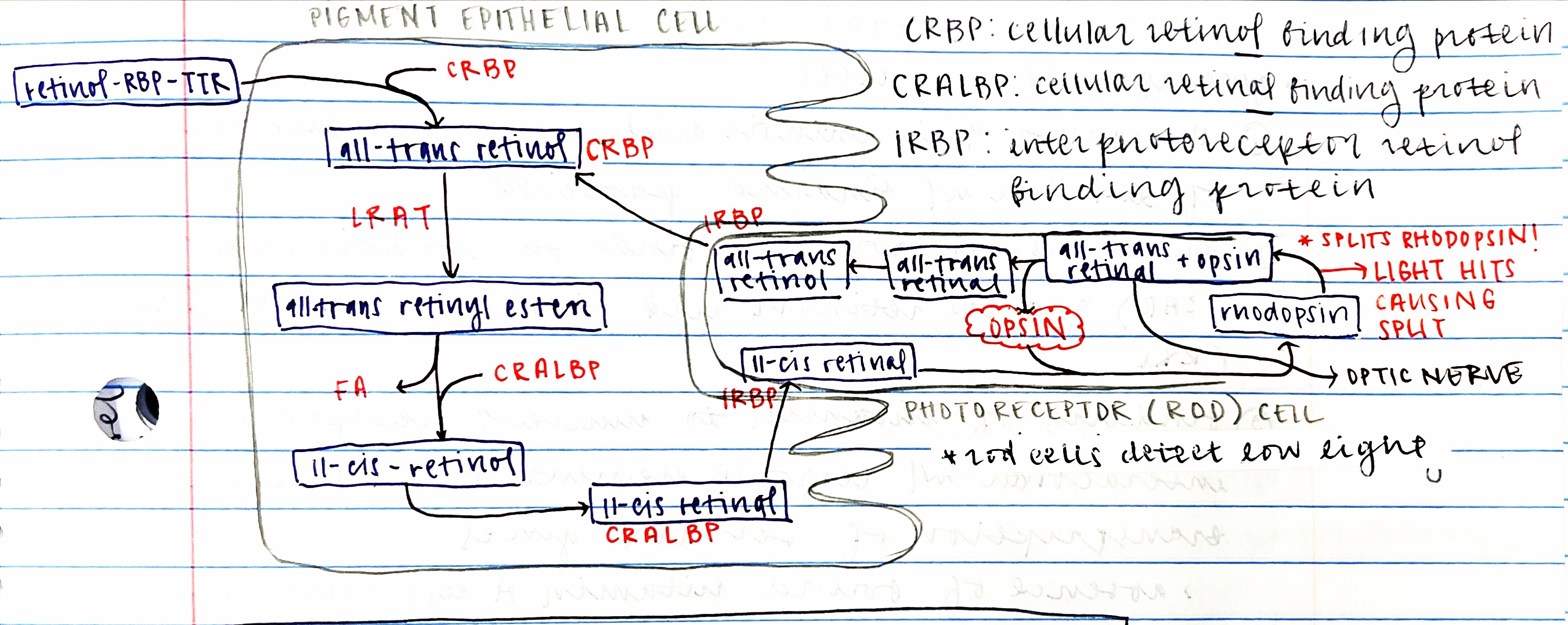
retinoid functions: visual cycle
\*cones - bright light; rods - low light
* retinol-RBP-TTR from blood attached to CRBP in pigment epithelial cell to create all-trans retinol
* all-trans retinol → all-trans retinyl by LRAT
* all-trans retinyl ester → 11-cis-retinol by CRALBP and release of FA
* CRALBP: cellular retinal–binding protein
* 11-cis-retinol converts to 11-cis-retinal
* 11-cis-retinal enters rod cell with IRBP
* IRBP: interphotoreceptor retinol binding protein
* 11-cis-retinal binds to opsin to create rhodopsin
* light hits the rod cell cause cleavage/split of rhodopsin → all-trans retinol + opsin
* trans retinol - opsin → all-trans retinal → all-trans retinol
* all-trans retinol reenters pigment epithelial cells with IRBP - cycle restarts
* retinol-RBP-TTR from blood attached to CRBP in pigment epithelial cell to create all-trans retinol
* all-trans retinol → all-trans retinyl by LRAT
* all-trans retinyl ester → 11-cis-retinol by CRALBP and release of FA
* CRALBP: cellular retinal–binding protein
* 11-cis-retinol converts to 11-cis-retinal
* 11-cis-retinal enters rod cell with IRBP
* IRBP: interphotoreceptor retinol binding protein
* 11-cis-retinal binds to opsin to create rhodopsin
* light hits the rod cell cause cleavage/split of rhodopsin → all-trans retinol + opsin
* trans retinol - opsin → all-trans retinal → all-trans retinol
* all-trans retinol reenters pigment epithelial cells with IRBP - cycle restarts
17
New cards
Vitamin A deficiency effects on vision: NYCTALOPIA
* nightblindness due to impaired production of rhodopsin
18
New cards
Vitamin A deficiency effects on vision: XEROPHTHALMIA
* starts with xerosis (dryness) of conjunctiva
* first symptom: bitot’s spot → sloughed off cells resulting from decreased retinol and glycoproteins in tear fluid
* xerosis of cornea may develop
* severe last stage:
* precorneal film no longer covers the eye
* omea appears opaque and dry, erosions may appear
* worst case: lens pop out through lesion
* first symptom: bitot’s spot → sloughed off cells resulting from decreased retinol and glycoproteins in tear fluid
* xerosis of cornea may develop
* severe last stage:
* precorneal film no longer covers the eye
* omea appears opaque and dry, erosions may appear
* worst case: lens pop out through lesion
19
New cards
retinoid function: gene expression and cellular differentiation
* ___ and _____ help regulate gene expression in the nucleus, controlling cell development
* ___ and _____ help regulate gene expression in the nucleus, controlling cell development
* all-trans and 9-cis retinoic acid (RA) help regulate gene expression in the nucleus, controlling cell development
* start and stop transcription
* transported by binding proteins
* interact with nuclear receptors, retinoic acid receptors (RAR), and retinoid X receptors (RXR)
* genes probably affected: some enzymes, growth factors, transcription factors
* affect a wide variety of cellular porcesses:
* apoptosis, osteogenesis (bone formation), indicuing or inhibiting growth
* RA plays a role in enbryongenesis
* start and stop transcription
* transported by binding proteins
* interact with nuclear receptors, retinoic acid receptors (RAR), and retinoid X receptors (RXR)
* genes probably affected: some enzymes, growth factors, transcription factors
* affect a wide variety of cellular porcesses:
* apoptosis, osteogenesis (bone formation), indicuing or inhibiting growth
* RA plays a role in enbryongenesis
20
New cards
retinoid function: gene expression process
1. all-trans or 9-cis retinoic acid moves into the nucleus of the cell with binding proteins
2. @@**all-trans retinoic acid binds to RAR; 9-cis retinoic acid binds to RXR**@@
3. binding of vitamin to nuclear receptors and interactions with response elements on DNA enhances transcription of several genes
\*absence of bound vitamin A usually results in repression of gene expression
21
New cards
Retinoid functions: stimulates growth and maintains __________
* stimulates the growth and maintains the structure of epithelial cells
* differentiation of keratinocytes
* RA increases the number of growth factor receptors on cells
* deficiency:
* keratin-producing cells replace mucus-secreting cells in some tissues
* differentiation of keratinocytes
* RA increases the number of growth factor receptors on cells
* deficiency:
* keratin-producing cells replace mucus-secreting cells in some tissues
22
New cards
Retinoid function: reproduction
* RA is morphogenic - increased RA → ________
* RA is morphogenic - increased RA → ________
* retinol is involved in reproduction
* RA is morphogenic - increased RA → birth defects
* RA is morphogenic - increased RA → birth defects
23
New cards
Retinoid function: bone development
* regulation of osteoclasts and/or osteoblasts
* deficiency:
* excessive bone deposition (new bone formation)
* decreased osteoclast activity
* in excess:
* decreased bone mineral density
* deficiency:
* excessive bone deposition (new bone formation)
* decreased osteoclast activity
* in excess:
* decreased bone mineral density
24
New cards
Retinoid function: ______ system function
* immune system function
* RA stimulates some immune system activities
* retinoids appear to be needed for antibody response to infections
* deficiency:
* increased risk of infections
* RA stimulates some immune system activities
* retinoids appear to be needed for antibody response to infections
* deficiency:
* increased risk of infections
25
New cards
Carotenoid functions: protects against ____________
* protects against singlet oxidation
* carotenoids are in interior cell membranes and in lipoproteins; able to inactivate free radicals
* can quench singlet oxygen (= bonds of beta- and lycopene)
* singlet molecular oxygen is more reactive than ground state oxygen
* generated by lipid peroxidation of membranes, transfer of energy from light, some enzymatic reactions
* can react with and damage proteins, lipids and DNA
* carotenoids are in interior cell membranes and in lipoproteins; able to inactivate free radicals
* can quench singlet oxygen (= bonds of beta- and lycopene)
* singlet molecular oxygen is more reactive than ground state oxygen
* generated by lipid peroxidation of membranes, transfer of energy from light, some enzymatic reactions
* can react with and damage proteins, lipids and DNA
26
New cards
beta-carotene works with vitamin E in scavenging ____ and inhibiting ________
* beta-carotene works with vitamin E in scavenging free radicals and inhibiting lipid peroxidation
27
New cards
beta-carotene with works on the ____ cell membrane, vitamin E works on the _________
* beta-carotene works on the inner cell membrane, vitamin E works on the outer surface
28
New cards
carotenoids make ____ more resistant to oxidation
* carotenoids make LDL more resistant to oxidation
* why is this important?
* when LDL is deposits into blood vessel wall, it gets oxidized - forms plaque - atherosclerosis
* why is this important?
* when LDL is deposits into blood vessel wall, it gets oxidized - forms plaque - atherosclerosis
29
New cards
carotenoids may protect from ___________________
* may protect from some cancers and heart disease
30
New cards
excess vitamin A interferes with _______ absorption
* vitamin K
31
New cards
high beta-carotene intake may increase/decrease plasma vitamin E
* decrease
32
New cards
____ and ____ influence vitamin A status and transport
* protein and zinc
33
New cards
_______ metabolism interrelated with both carotenoids and vitamin A
_____ is required for conversion of beta-carotene to vitamin A
Vitamin A deficiency may be associated with ____ deficiency anemia
_____ is required for conversion of beta-carotene to vitamin A
Vitamin A deficiency may be associated with ____ deficiency anemia
* Iron
34
New cards
Vitamin A deficiency
* leading cause of blindness in people under 21 worldwide
* common in children under 5 in developing countries - high risk of death
* anorexia
* retarded growth
* increased susceptibility to infections
* obstruction & enlargement of hair follicles (hyperkeratosis)
* keratinization of skin epithelial cells
* improperly formed bones
* impaired reproduction
* testicular atrophy
* loss of estrus cycle
* improper mucus secretion
* common in children under 5 in developing countries - high risk of death
* anorexia
* retarded growth
* increased susceptibility to infections
* obstruction & enlargement of hair follicles (hyperkeratosis)
* keratinization of skin epithelial cells
* improperly formed bones
* impaired reproduction
* testicular atrophy
* loss of estrus cycle
* improper mucus secretion
35
New cards
At risk populations for vitamin A deficiency
* fat malabsorption diseases
* chronic nephritis
* acute protein deficiency
* intestinal parasites
* acute infection (e.g. measles) - measles depresses vitamin A status
* chronic nephritis
* acute protein deficiency
* intestinal parasites
* acute infection (e.g. measles) - measles depresses vitamin A status
36
New cards
Vitamin A toxicity
* vitamin A can accumulate in the liver and other tissues
* as little as 3-4 times the RDA can cause hypervitaminosis A:
* anorexia
* dry, itchy and desquamating skin
* alopecia and coarsening of hair
* ataxia
* headache
* bone and muscle pain
* conjunctivitis
* liver damage
* as little as 3-4 times the RDA can cause hypervitaminosis A:
* anorexia
* dry, itchy and desquamating skin
* alopecia and coarsening of hair
* ataxia
* headache
* bone and muscle pain
* conjunctivitis
* liver damage
37
New cards
_______ (accutane) causes birth defects when taken in early part of pregnancy
* 13-cis retinoic acid
38
New cards
beta-carotene toxicity: not seen, although 30+ mg can cause _________
* beta-carotene toxicity: not seen, although 30+ mg can cause a yellowing of the skin