Regolith & Critical Zone
 Call Kai
 Learn
 Practice Test
 Spaced Repetition
 Match
 Flashcards
 Knowt Play
1/22

There's no tags or description
Looks like no tags are added yet.
23 Terms
define Regolith
all material between bedrock and the atmosphere
Includes: soil, saprolite, transported sediments, duricrusts.
Regolith covers a very large portion of the Australian continent
vertical profile of ground: parts
Soil
Pedolith
Saprolith
Bedrock
define:
Soil
Pedolith
Saprolith
Bedrock
Soil | Organic matter + leached minerals |
Pedolith | No original rock fabric; secondary structures (Fe, Al oxides, clays) |
Saprolith | Weathered rock retaining original textures
|
Bedrock | the hard, solid layer of rock that lies beneath loose surface materials like soil, sand, and grave |
what is:
Pedoplasmation
Cementation fronts
Weathering front
Pedoplasmation | Transformation of saprolith → pedolith |
Cementation fronts | Fe/Al accumulation zones |
Weathering front | Boundary between fresh rock and saprolith |
landscape factors impacting regolith formation
Topography
Bedrock type and structure
Climate
Vegetation and biota
Groundwater flow
Time. / palaeoladnscape
drainage and minerology impact on regolith formation
drainage impacts type of iron oxide formed
Well‑drained → hematite
Poorly drained → goethite
Goethite is found where large pores, while hematite forms in micro-pores
Drainage depends on
Porosity
Permeability
Rock fabric
Slope position
what are Weathering Processes
Mechanical (Physical) Weathering
Frost action
Pressure release / unloading
Salt crystallisation
Biological mechanical weathering
Chemical Weathering
Dissolution
Hydrolysis
Carbonation
Oxidisation
Mechanical (Physical) Weathering
Breakdown without chemical change
Frost action |
|
Pressure release / unloading | Granite batholiths expand when overburden removed Forms sheet joints and exfoliation domes |
Salt crystallisation |
|
Biological mechanical weathering |
|
Chemical Weathering
Breakdown by reactions with water, acids, oxygen
Dissolution |
|
Hydrolysis | Hydrogen ions from water replace positive ions in minerals to make new minerals |
Carbonation | CO₂ + H₂O → carbonic acid → dissolves carbonates
|
Oxidisation | Fe²⁺ → Fe³⁺ → hematite/goethite Forms ferricrete in Australian regolith |
Biological Chemical Weathering
Organic acids from plants
Root ion exchange → clay formation
Clay content of soil increased
Factors that impact weathering rates
Climate
Goldich Weathering Series
Acidity
Particle size
Porosity and Permeability
Topographic Effects
Geomorphology & Tectonics
Regolith Strength
impact of climate on weathering rates
Humid/more water = more erosion
Chemical weathering depth
Tropical: tens of metres
Temperate: moderate
Arid/arctic: centimetres to metres
impact of acidity on weathering rates
Acidity increases rates of chemical weathering
impact of goldich weathering series on weathering rates
Vulnerability to weathering is opposite of Bowen's reaction series
More felsic = more resistant to weathering
More mafic = less resistant
Olivine → Pyroxene → Amphibole → Biotite → Plagioclase → K‑spar → Muscovite → Quartz
Feldspar → kaolinite
Biotite → vermiculite, goethite
Amphibole → smectite
Quartz → remains mostly unchanged
impact of Particle size on weathering rates
Smaller particles are more vulnerable to weathering → increases SA
More weathered particles experience more weathering
More SA = more weathering
impact of porosity and permeability on weathering rates
Porosity = Controls how much rock surface water contacts
Permeability = Controls fluid movement and thus reaction rates
Examples
Granite vs volcanic rocks → different void ratios with depth
Clay = porous but impermeable
Fractured rock = permeable but not porous
impact of topography on weathering rates
Slope positions
Hilltop: stable, thick regolith
Upper slope: erosional, thin regolith
Lower slope: depositional, thick regolith
Valley: thick composite regolith + fluvial erosion
Slope shapes
Concave → landslips
Free-face → resistant caprock collapses
Convex → saprolite erosion exposes basement
impact of … on weathering rates
cuestas
volcanic plugs
drainage evolution
landscape inversion
Cuestas
Resistant strata overlying weaker layers
Dip slope + scarp slope
Formed by differential erosion of tilted beds
Volcanic plugs, quartz veins
Highly resistant → stand as ridges
Drainage evolution
Australian drainage systems range from Proterozoic to Cainozoic.
Landscape inversion
Durable materials (lava flows, ferricrete) become ridges after surrounding weaker rock erodes
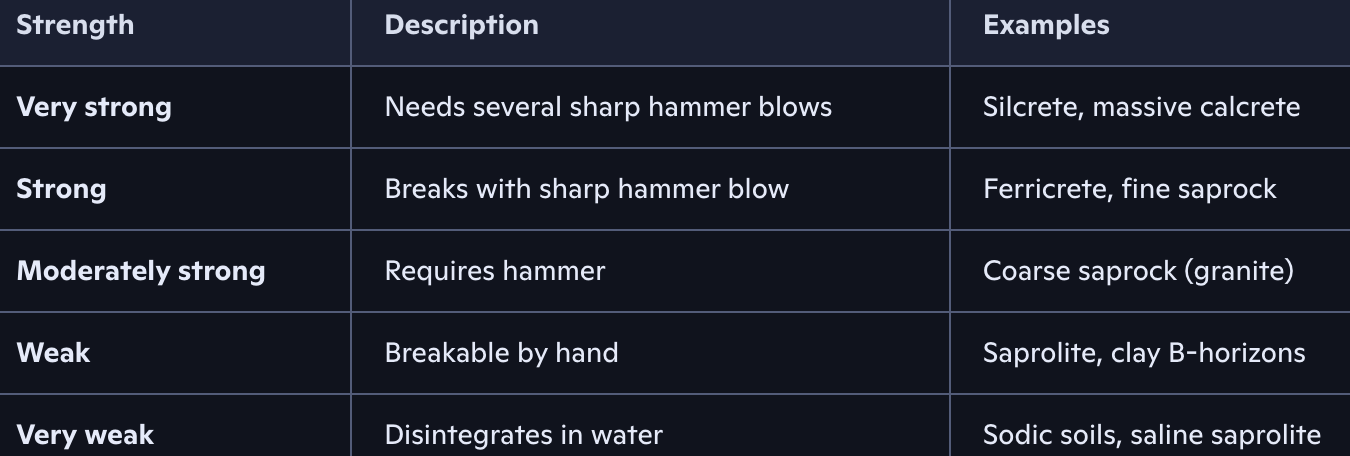
strength of different parts of regolith
Ferricrete Formation Models
Vertical accumulation
Remove 50 m saprolite → 0.5 m ferricrete
Lateral movement
Move Fe from 100 m × 0.5 m saprolite → same ferricrete thickness
Conglomeratic/pisolitic ferricrete
Reworked nodules cemented by Fe oxides
Vesicular ferricrete
Fe-rich groundwater impregnates sands
Ferruginised palaeochannel sediments
Megamottles, pisoliths formed by Fe mobilisation