7. Innate immunity 4: Local inflammation; central to innate immunity and the initiation of adaptive immune responses

0.0(0)
Studied by 1 person
call kaiCall Kai
learnLearn
examPractice Test
spaced repetitionSpaced Repetition
heart puzzleMatch
flashcardsFlashcards
GameKnowt Play
Card Sorting

1/19

encourage image

There's no tags or description

Looks like no tags are added yet.

Last updated 9:12 PM on 10/1/26
Name
Mastery
Learn
Test
Matching
Spaced
Call with Kai
Chat

No analytics yet

Send a link to your students to track their progress

20 Terms

1
New cards

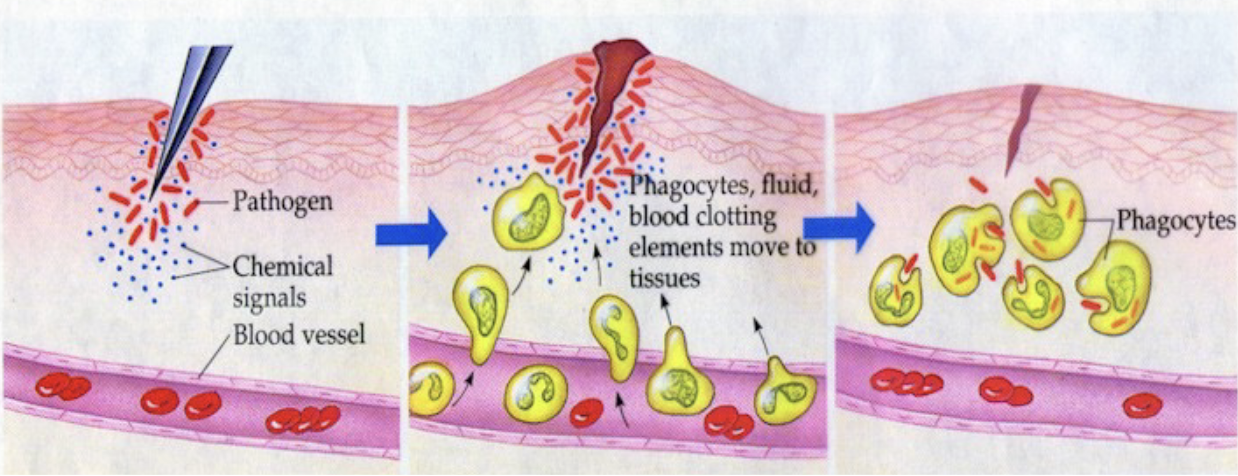
When and how does the body generate local inflammation?

  • Triggered by infection or tissue damage

  • Local production of inflammatory cytokines/chemokines

  • Key activations:

    • IL-1β & TNF-α

    • Caspase-1 inflammasome

    • Complement system

    • Type I interferons

  • Outcomes: Antimicrobial responses + recognition of self-components
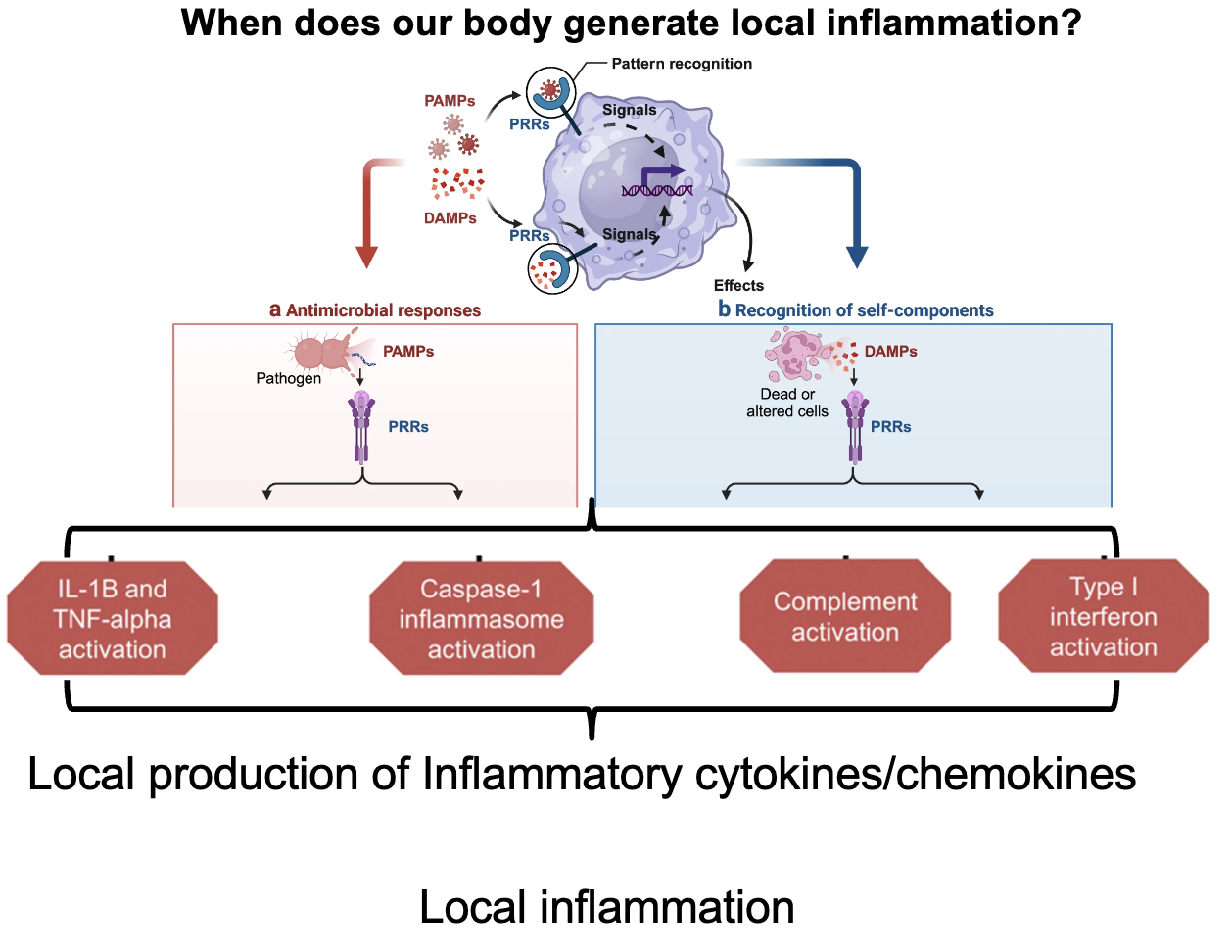

<ul><li><p>Triggered by infection or tissue damage</p></li><li><p>Local production of inflammatory cytokines/chemokines</p></li><li><p>Key activations:</p><ul><li><p>IL-1β &amp; TNF-α</p></li><li><p>Caspase-1 inflammasome</p></li><li><p>Complement system</p></li><li><p>Type I interferons</p></li></ul></li><li><p>Outcomes: Antimicrobial responses + recognition of self-components</p></li></ul><p></p>
2
New cards

Why is local inflammation important for vaccination?

  • Induces innate immunity → adaptive immunity

  • Acts as cornerstone for successful vaccination

  • Cytokine “milieu” at site shapes memory cell response

  • Strength & type of local inflammation influence memory duration (1 yr – 10 yrs or more)

    • Determines successful vs. unsuccessful vaccination
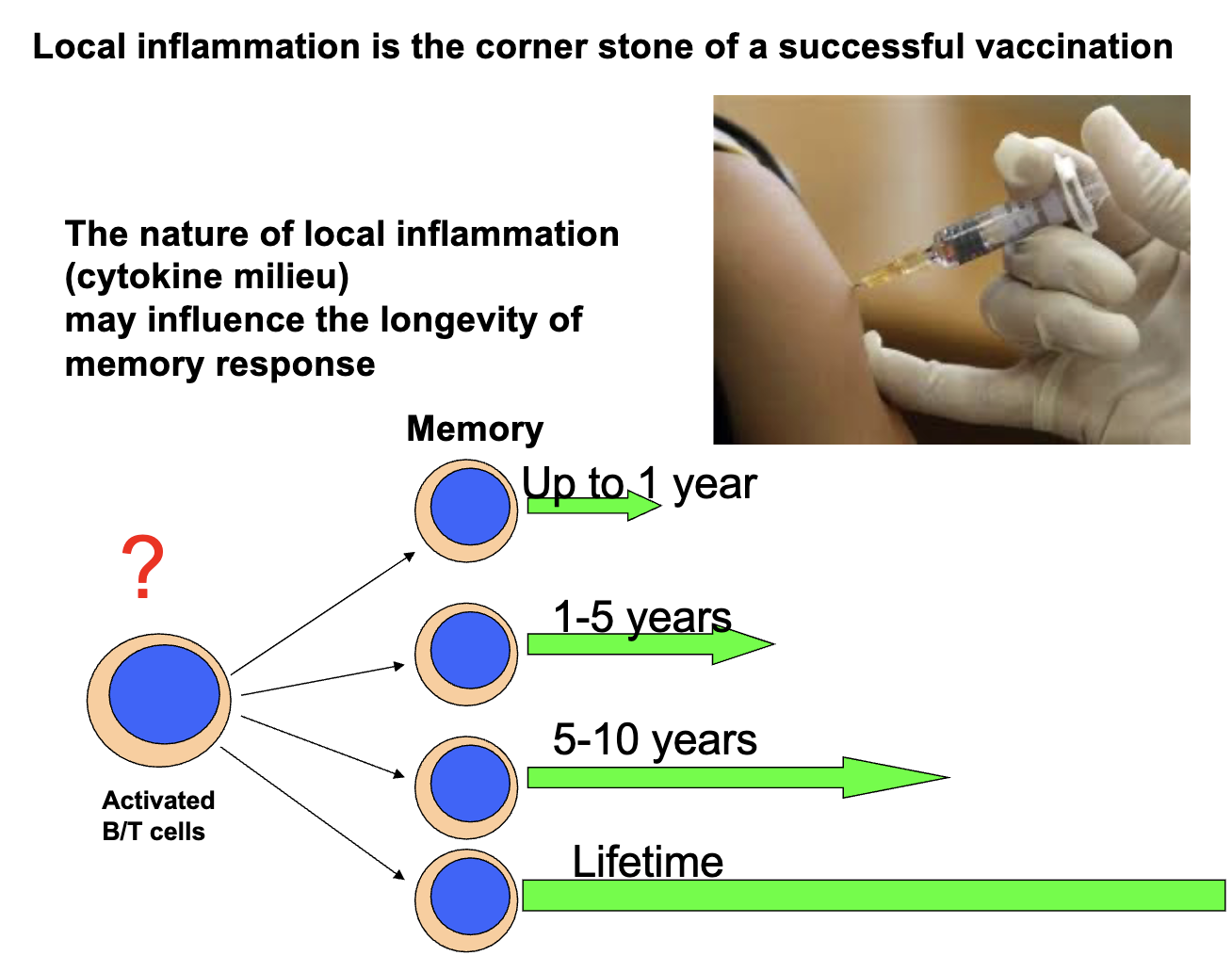

<ul><li><p>Induces innate immunity → adaptive immunity</p></li><li><p>Acts as cornerstone for successful vaccination</p></li><li><p>Cytokine “milieu” at site shapes memory cell response</p></li><li><p>Strength &amp; type of local inflammation influence memory duration (1 yr – 10 yrs or more)</p><ul><li><p>Determines successful vs. unsuccessful vaccination</p></li></ul></li></ul><p></p>
3
New cards

What are cytokines and what are their types?

  • Small proteins (15–25 kDa) released in various cells, act like hormones

  • Functions in intracrine, autocrine, justacrine, paracrine, endocrine, and exocrine manner.

  • Types:

    • Interleukins (IL): from leukocytes

    • Myokines: from muscle cells (ex: IL-15)

    • Adipokines: from fat cells (produce massive amounts of cytokines)

    • Chemokines: chemo-attractant cytokines


4
New cards

What cytokines do macrophages secrete during local infection?

  • Macrophages are ready to receive DAMP/PAMP signals → release cytokines if they can’t kill pathogen

  • Local vs. systemic effects

    • Local: Exocrine and paracrine cytokine action for neighbouring cells

    • Systemic: Endocrine action in circulation → fever (one of the best innate  responses)

  • Important cytokines: IL-1β, TNF-α, TL-6, CXCL8, IL-12

    • IFN-α/β/λ and IL-15 have direct anti-microbial activity
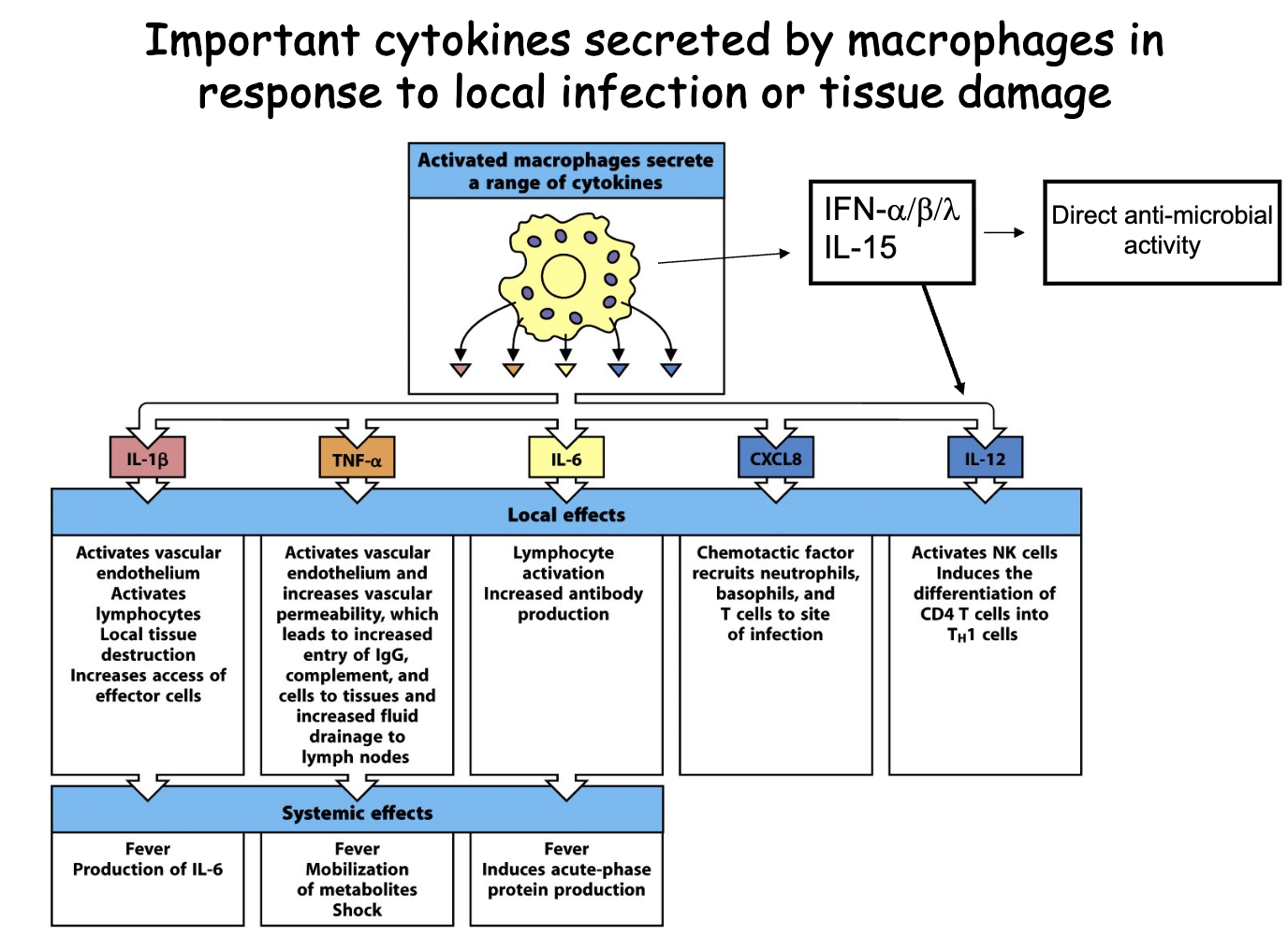

<ul><li><p>Macrophages are ready to receive DAMP/PAMP signals → release cytokines if they can’t kill pathogen</p></li><li><p>Local vs. systemic effects</p><ul><li><p>Local:&nbsp;Exocrine and paracrine cytokine action for neighbouring cells</p></li><li><p>Systemic: Endocrine action in circulation → fever (one of the best innate&nbsp; responses)</p></li></ul></li><li><p>Important cytokines: IL-1β, TNF-α, TL-6, CXCL8, IL-12</p><ul><li><p>IFN-α/β/λ and IL-15 have direct anti-microbial activity</p></li></ul></li></ul><p></p>
5
New cards

What are the four classical signs of local inflammation?

  1. Redness (increased blood flow)

  2. Heat (high temperature due to increased blood flow)

  3. Swelling

  4. Pain


<ol><li><p>Redness (increased blood flow)</p></li><li><p>Heat (high temperature due to increased blood flow)</p></li><li><p>Swelling</p></li><li><p>Pain</p></li></ol><p></p>
6
New cards

How does local inflammation combat infection?

  • Raises local/systemic temperature

  • Delivers additional effectors & molecules to infection site

  • Creates physical barrier to limit spread (blood vessel becomes dilated → plasma fluid gets out of blood → clots into bump)

    • Painful caused by pressure to nerves in the area

  • Triggers adaptive immunity


7
New cards

For an effective immune response, how do immune cells reach the infection site?

  • How do they know? Chemotactic signals (chemokines)

  • How do they get there? Adhesion molecules (addressins) & migration pathways


8
New cards

What are “addressins” in immunity?

Adhesion molecules that guide leukocyte migration:

  • Selectins

  • Integrins

  • Ig family


9
New cards

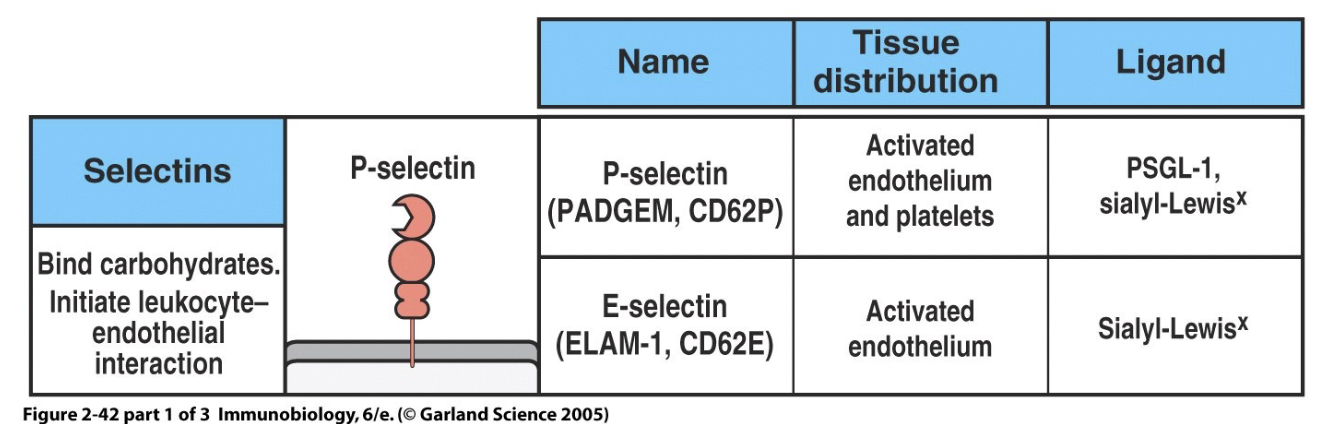
What role do selectins play in leukocyte interaction?

  • Expressed in endothelial cells (cells that line blood vessels)
    Cytokines produced by macrophages activate endothelial cells locally to express those selectins

  • Bind carbohydrates → initiate leukocyte-endothelial contact

  • Examples (don’t need to know):

    • P-selectin: on activated endothelium & platelets

    • E-selectin: on activated endothelium


<ul><li><p>Expressed in endothelial cells (cells that line blood vessels)<br>Cytokines produced by macrophages activate endothelial cells locally to express those selectins</p></li><li><p>Bind carbohydrates → initiate leukocyte-endothelial contact</p></li><li><p>Examples (don’t need to know):</p><ul><li><p><strong>P-selectin:</strong> on activated endothelium &amp; platelets</p></li><li><p><strong>E-selectin:</strong> on activated endothelium</p></li></ul></li></ul><p></p>
10
New cards

What are integrins and where are they expressed?

  • Large family of adhesion molecules

  • Expressed on leukocytes (immune cells)

  • Work with selectins (which are on endothelial cells)

  • Analogy:

    • Highway = blood vessel (endothelium)

    • Vehicles = leukocytes (integrins on them)

  • Low baseline expression → upregulated with cytokines → high integrin levels
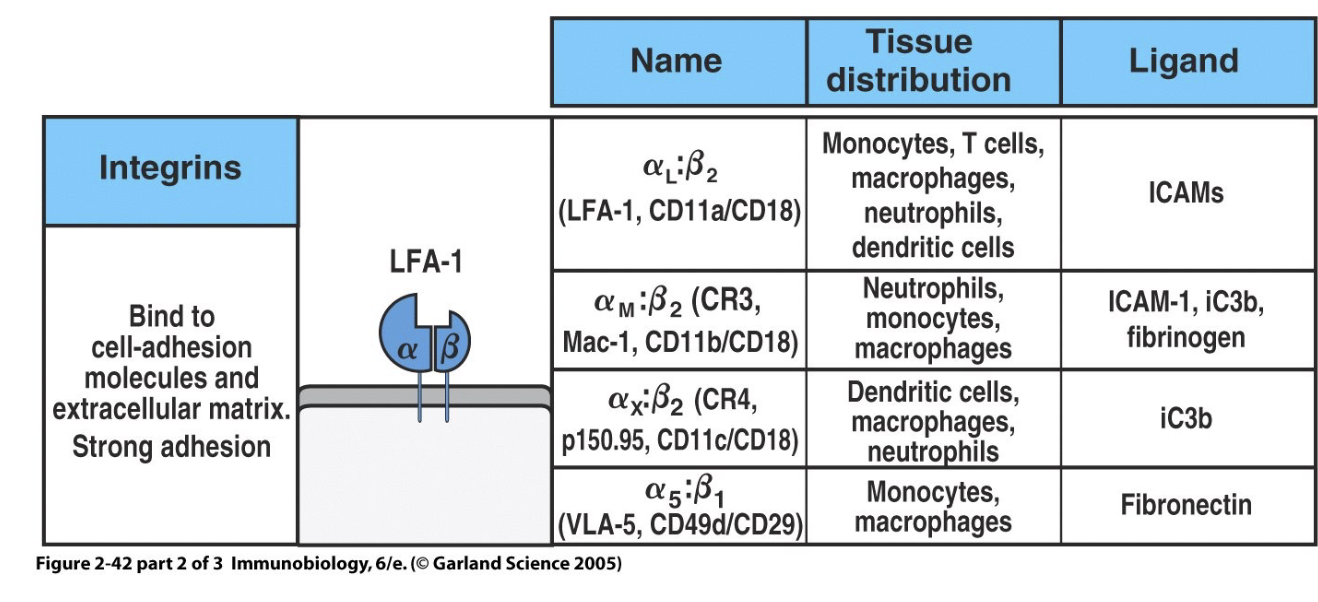

<ul><li><p>Large family of adhesion molecules</p></li><li><p><strong>Expressed on leukocytes (immune cells)</strong></p></li><li><p>Work with selectins (which are on endothelial cells)</p></li><li><p>Analogy:</p><ul><li><p>Highway = blood vessel (endothelium)</p></li><li><p>Vehicles = leukocytes (integrins on them)</p></li></ul></li><li><p>Low baseline expression → upregulated with cytokines → high integrin levels</p></li></ul><p></p>
11
New cards

What are ICAMs/VCAMs and when are they expressed?

  • Belong to Ig superfamily

  • Expressed on endothelial cells

  • Normally low/absent

  • Upregulated during inflammation (triggered by cytokines/chemokines)

  • Act as receptors for integrins on leukocytes

  • 3 key adhesion families:

    • Selectins → endothelial cells

    • ICAMs/VCAMs → endothelial cells

    • Integrins → leukocytes

  • Together mediate leukocyte adhesion + traffic during immune response
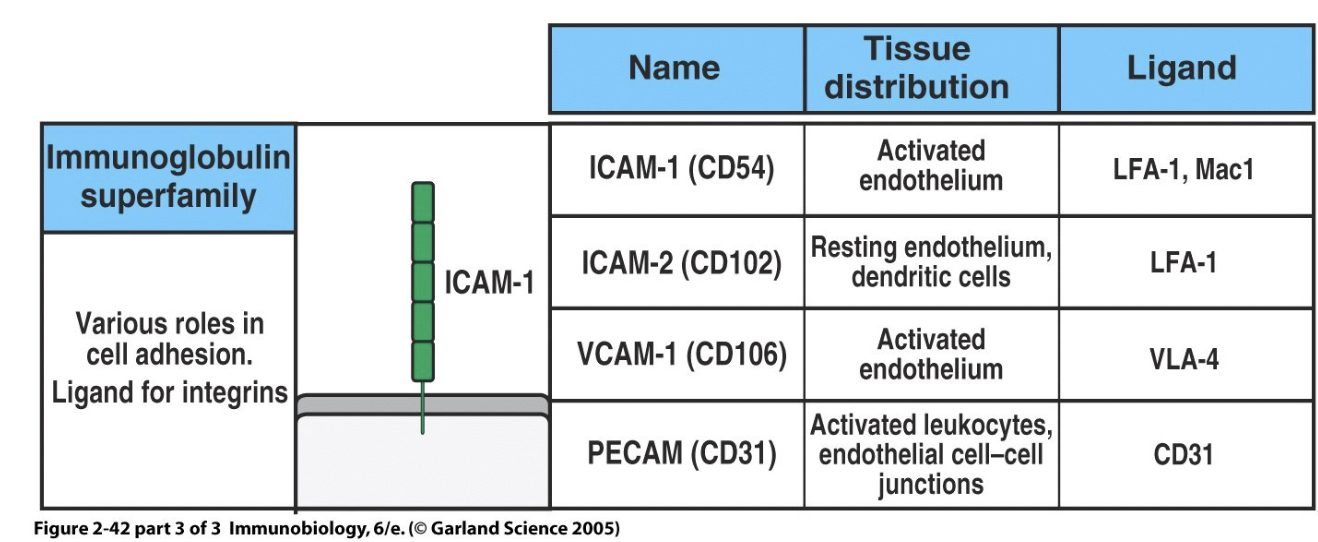

<ul><li><p>Belong to <strong>Ig superfamily</strong></p></li><li><p><strong>Expressed on endothelial cells</strong></p></li><li><p>Normally low/absent</p></li><li><p>Upregulated during <strong>inflammation</strong> (triggered by cytokines/chemokines)</p></li><li><p>Act as receptors for integrins on leukocytes</p></li><li><p>3 key adhesion families:</p><ul><li><p>Selectins → endothelial cells</p></li><li><p>ICAMs/VCAMs → endothelial cells</p></li><li><p>Integrins → leukocytes</p></li></ul></li><li><p>Together mediate leukocyte adhesion + traffic during immune response</p></li></ul><p></p>
12
New cards

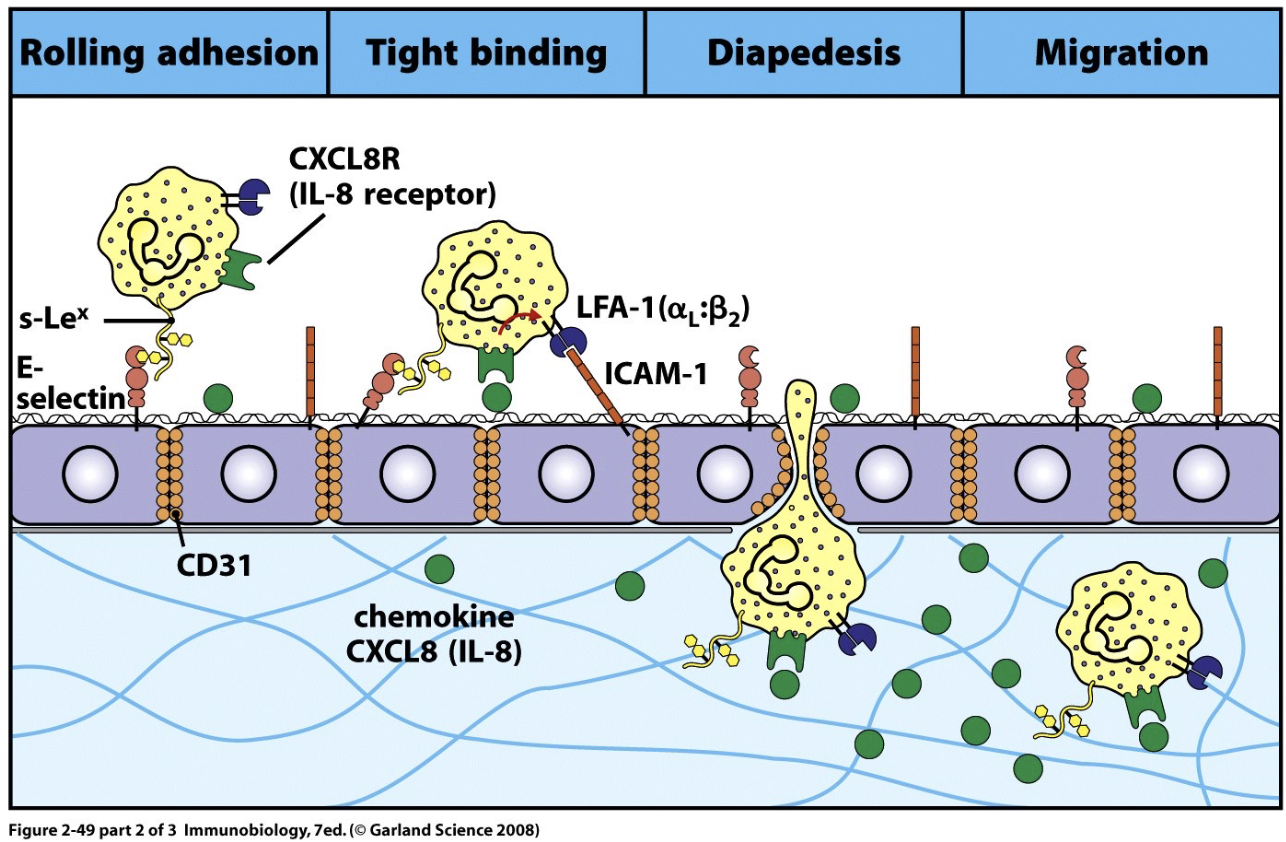
How do selectins help leukocytes migrate?

  • All leukocytes have sugar-like receptor (s-LeX ) that binds to selectin

  • Binding is not strong enough to attach, but slows leukocyte down

    • Weak selectin and s-LeX binding → leukocytes roll along endothelium → prepares for firm adhesion
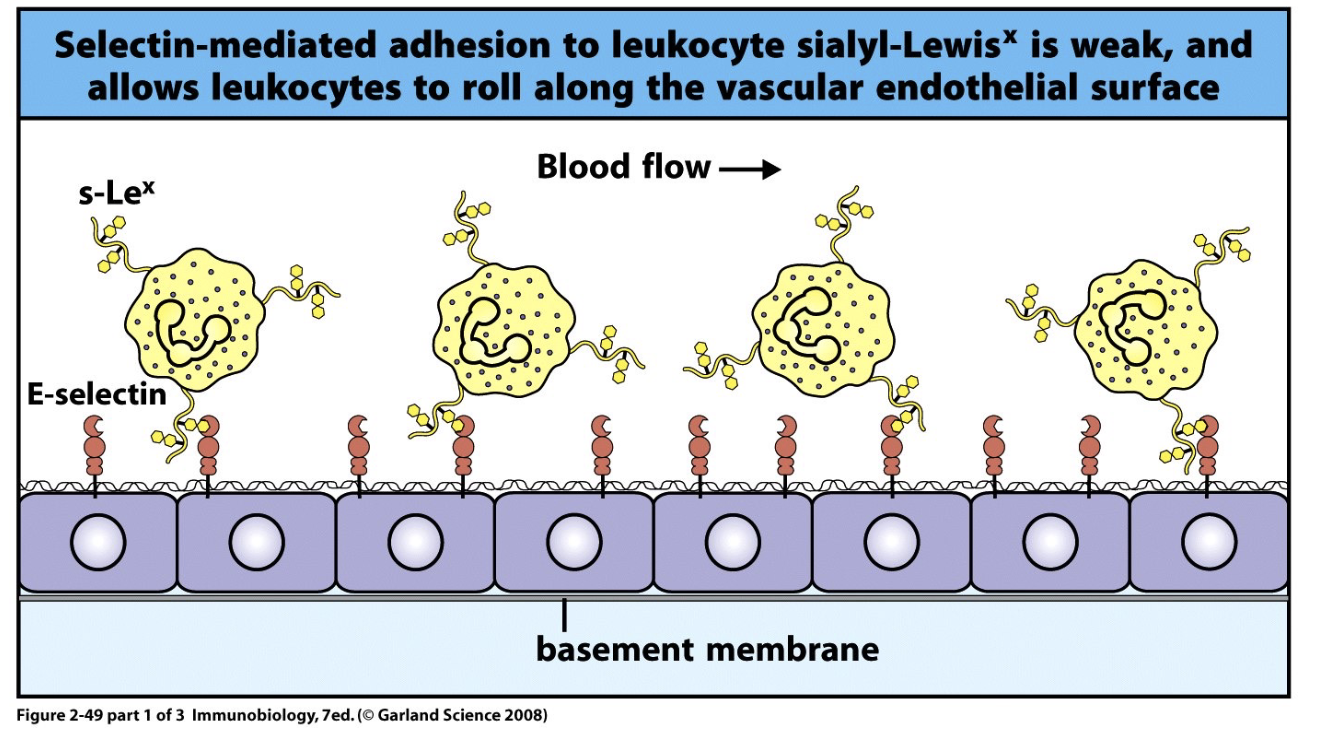

<ul><li><p>All leukocytes have sugar-like receptor (s-Le<sup>X</sup> ) that binds to selectin</p></li><li><p>Binding is not strong enough to attach, but slows leukocyte down</p><ul><li><p>Weak selectin and s-Le<sup>X</sup> binding → leukocytes roll along endothelium → prepares for firm adhesion</p></li></ul></li></ul><p></p>
13
New cards

What happens when ICAMs and integrins strongly bind during inflammation?

  • Strong ICAM–integrin binding = firm adhesion (“full brake”)

  • Concentration-dependent → highest at site of injury

  • Leukocytes (cars) come to complete stop on endothelium (highway)

  • Next step: transmigration (diapedesis)

    • Endothelial cells rearrange cytoskeleton → form pores

    • Allows leukocytes to exit blood vessel into tissue
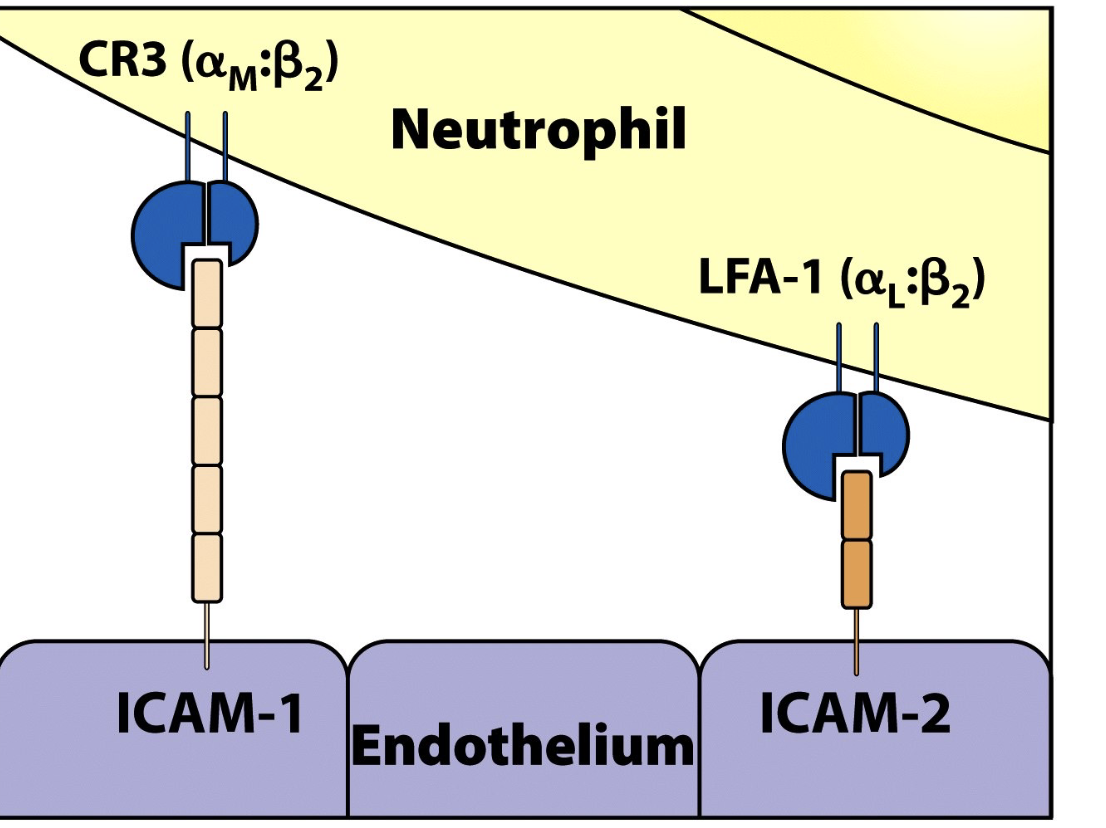

<ul><li><p>Strong ICAM–integrin binding = firm adhesion (<strong>“full brake”</strong>)</p></li><li><p>Concentration-dependent → highest at site of injury</p></li><li><p>Leukocytes (cars) come to <strong>complete stop</strong> on endothelium (highway)</p></li><li><p>Next step: <strong>transmigration (diapedesis)</strong></p><ul><li><p>Endothelial cells rearrange cytoskeleton → form pores</p></li><li><p>Allows leukocytes to exit blood vessel into tissue</p></li></ul></li></ul><p></p>
14
New cards

What are the 4 steps of leukocyte migration into infected tissue?

  • Rolling adhesion

  • Tight binding

  • Diapedesis (squeezing between endothelial cells)

  • Migration along chemokine gradient


<ul><li><p>Rolling adhesion</p></li><li><p>Tight binding</p></li><li><p>Diapedesis (squeezing between endothelial cells)</p></li><li><p>Migration along chemokine gradient</p></li></ul><p></p>
15
New cards

How do immune cells know where to go after leaving the bloodstream?

  • Step 1: Address recognition → ICAM–integrin binding stops leukocytes

  • Step 2: Chemotaxis → cells follow chemokine gradients

    • Highest chemokine concentration = site of injury/infection

    • Cells express chemokine receptors → move toward source

  • Movement: cytoskeleton rearranges → cells become pointy & crawl through extracellular matrix

  • Clinical relevance:

    • Basis for cancer immunotherapy → induce tumors to release chemokines to attract immune cells

  • Must be tightly coordinated → imbalance = harmful (e.g., excessive inflammation, fever)
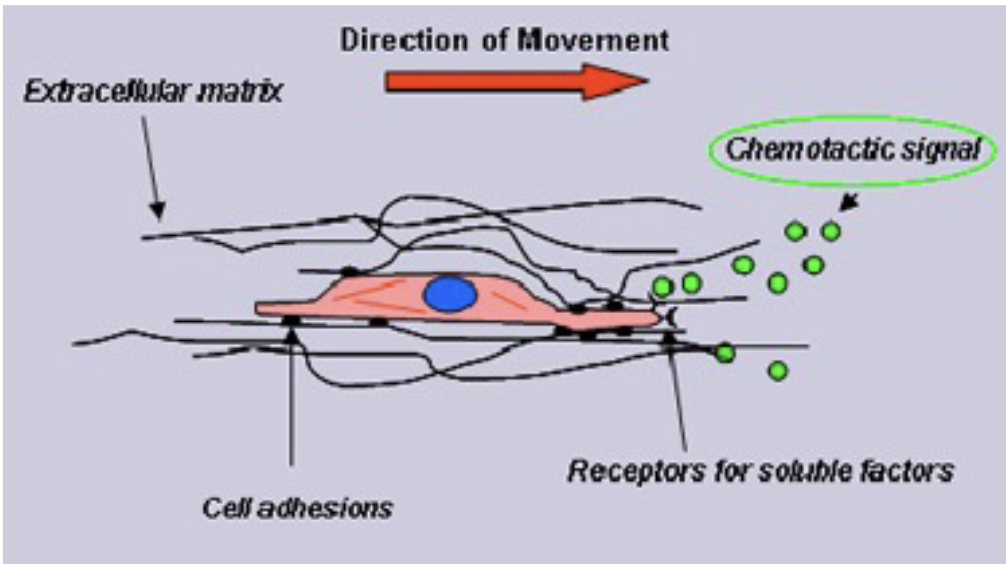

<ul><li><p>Step 1: <strong>Address recognition</strong> → ICAM–integrin binding stops leukocytes</p></li><li><p>Step 2: <strong>Chemotaxis</strong> → cells follow <strong>chemokine gradients</strong></p><ul><li><p>Highest chemokine concentration = site of injury/infection</p></li><li><p>Cells express chemokine receptors → move toward source</p></li></ul></li><li><p>Movement: cytoskeleton rearranges → cells become <strong>pointy &amp; crawl</strong> through extracellular matrix</p></li><li><p>Clinical relevance:</p><ul><li><p>Basis for <strong>cancer immunotherapy</strong> → induce tumors to release chemokines to attract immune cells</p></li></ul></li><li><p>Must be <strong>tightly coordinated</strong> → imbalance = harmful (e.g., excessive inflammation, fever)</p></li></ul><p></p>
16
New cards

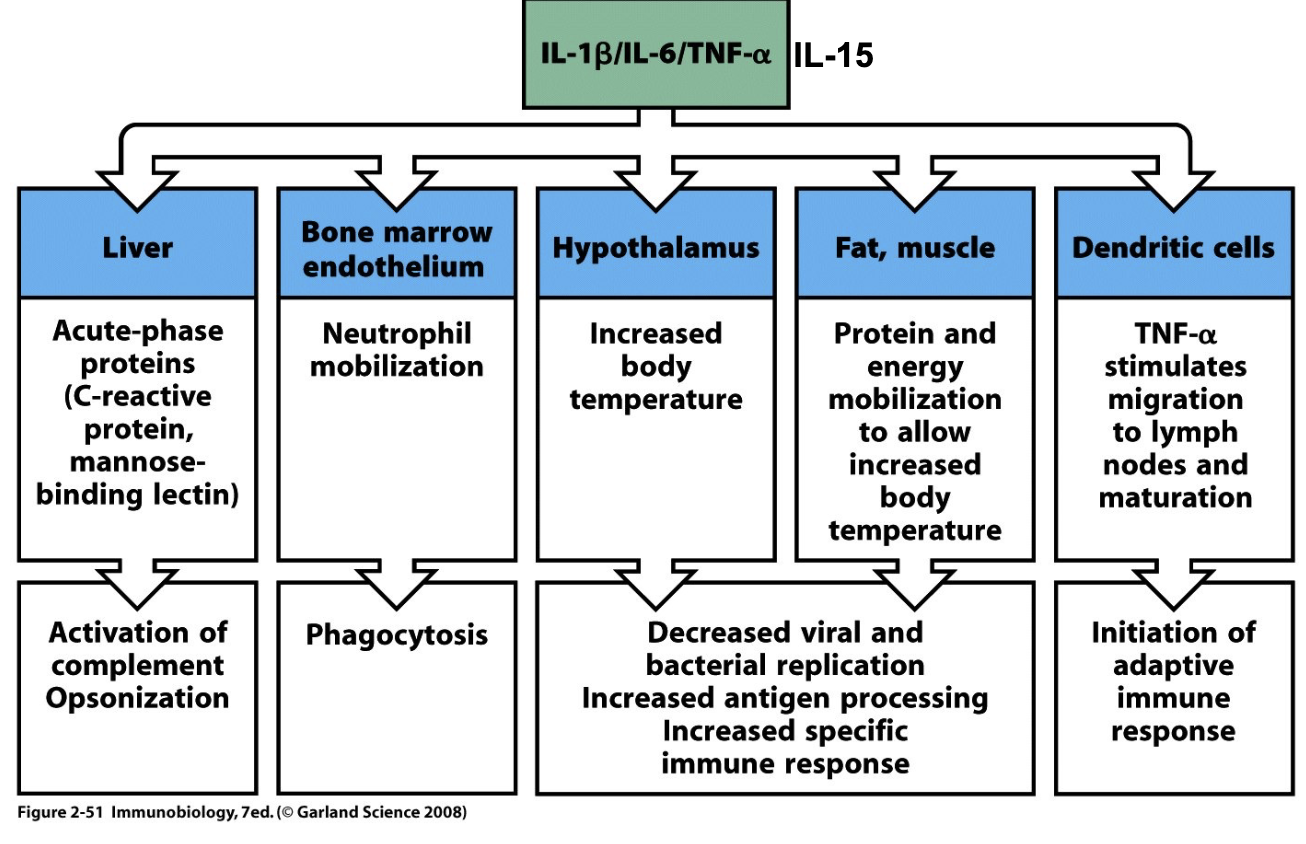
How do cytokines coordinate systemic immune responses?

  • Liver → IL-6 stimulates production of innate molecules (CRP, complement)

  • Bone marrow → cytokines signal stem cells to increase immune cell production (energetically costly)

  • Hypothalamus → raises body temperature (fever)

    • Short-term: shivering → rapid ATP + heat

    • Long-term: sustained higher temperature aids defense

  • Fat & muscle → contribute energy/heat

  • Dendritic cells → antigen-presenting cells, key for activating adaptive immunity

  • Overall: requires tight coordination across organs for effective protection

<ul><li><p><strong>Liver</strong> → IL-6 stimulates production of innate molecules (CRP, complement)</p></li><li><p><strong>Bone marrow</strong> → cytokines signal stem cells to increase immune cell production (energetically costly)</p></li><li><p><strong>Hypothalamus</strong> → raises body temperature (fever)</p><ul><li><p>Short-term: shivering → rapid ATP + heat</p></li><li><p>Long-term: sustained higher temperature aids defense</p></li></ul></li><li><p><strong>Fat &amp; muscle</strong> → contribute energy/heat</p></li><li><p><strong>Dendritic cells</strong> → antigen-presenting cells, key for activating adaptive immunity</p></li><li><p>Overall: requires <strong>tight coordination</strong> across organs for effective protection</p></li></ul><p></p>
17
New cards

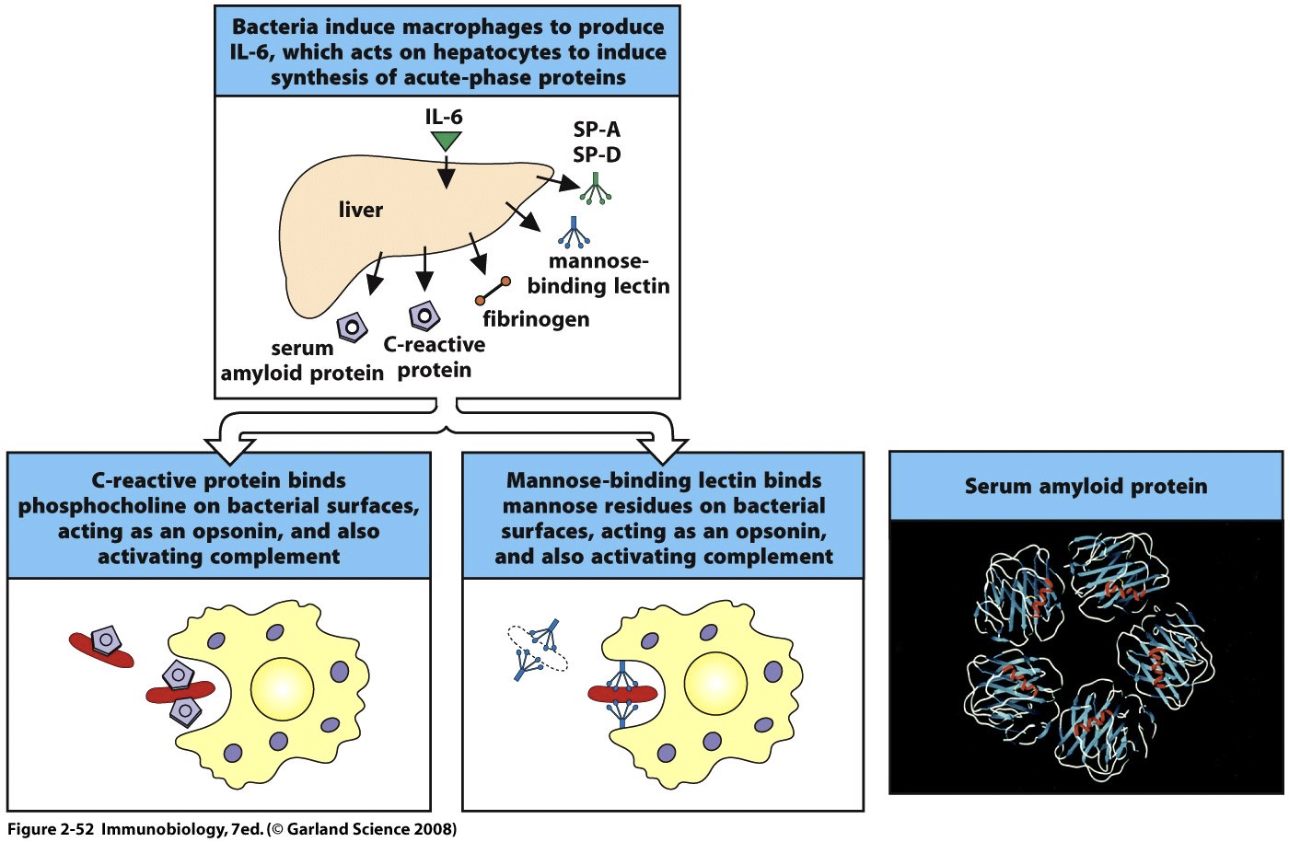
Why is the liver critical for innate immunity, and how does liver function affect immune response?

  • Liver produces key innate molecules: CRP, mannose-binding protein, serum amyloid, antimicrobial factors

  • Proper liver function = effective innate immunity

  • Fatty liver/poor liver function → weaker response

    • Explains variation in vaccine or inflammation responses

  • Age factor: younger people → stronger responses (better liver function); older people → weaker responses

<ul><li><p><strong>Liver produces key innate molecules</strong>: CRP, mannose-binding protein, serum amyloid, antimicrobial factors</p></li><li><p>Proper <strong>liver function = effective innate immunity</strong></p></li><li><p><strong>Fatty liver/poor liver function → weaker response</strong></p><ul><li><p>Explains variation in vaccine or inflammation responses</p></li></ul></li><li><p><strong>Age factor</strong>: younger people → stronger responses (better liver function); older people → weaker responses</p></li></ul><p></p>
18
New cards

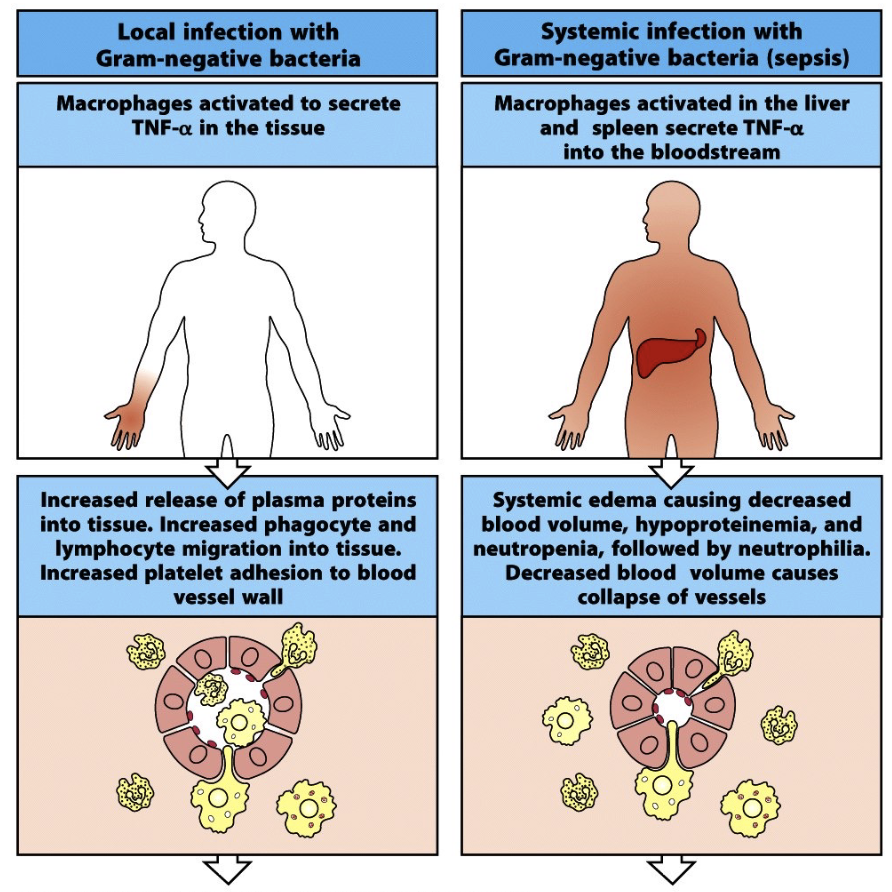
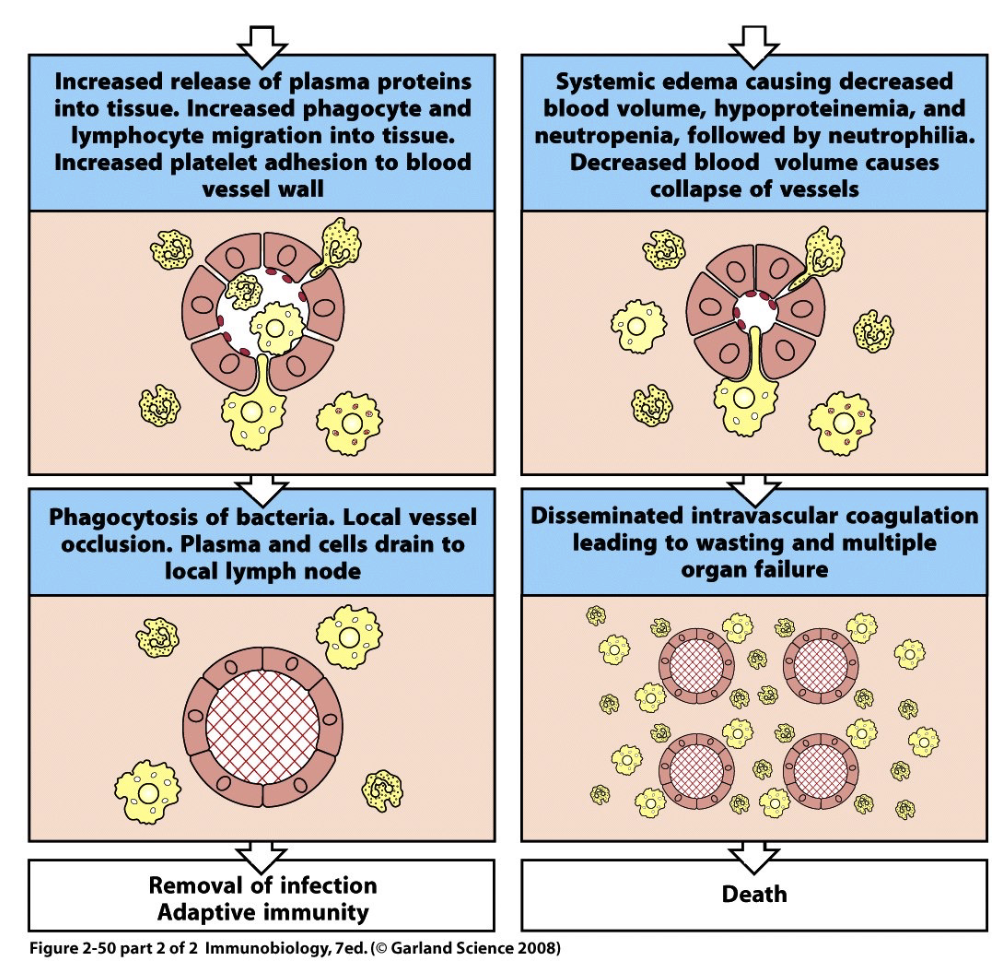
Why is regulation of local vs systemic inflammation critical?

  • Local inflammation → protective, controls pathogens, induces adaptive immunity

  • Systemic inflammation → dangerous, can cause widespread endothelial activation, plasma leakage, organ failure → high mortality (~95%)

  • Fine balance needed: uncontrolled systemic response = shock, kidney/liver/brain damage

  • Immune deregulation = main cause of damage; proper coordination prevents this

  • Innate & adaptive systems:

    • 99% protection comes from them

    • ~90% damage can also come from them if unregulated

<ul><li><p><strong>Local inflammation</strong> → protective, controls pathogens, induces adaptive immunity</p></li><li><p><strong>Systemic inflammation</strong> → dangerous, can cause widespread endothelial activation, plasma leakage, organ failure → high mortality (~95%)</p></li><li><p>Fine balance needed: uncontrolled systemic response = shock, kidney/liver/brain damage</p></li><li><p>Immune deregulation = main cause of damage; proper coordination prevents this</p></li><li><p>Innate &amp; adaptive systems:</p><ul><li><p>99% protection comes from them</p></li><li><p>~90% damage can also come from them if unregulated</p></li></ul></li></ul><img src="https://knowt-user-attachments.s3.amazonaws.com/3fbccef5-d731-4427-a8f8-7bc509aca767.png" data-width="100%" data-align="center"><p></p>
19
New cards

Why is systemic inflammation/shock more dangerous in males?

Not fully understood, likely linked to sex hormone differences and immune regulation

20
New cards

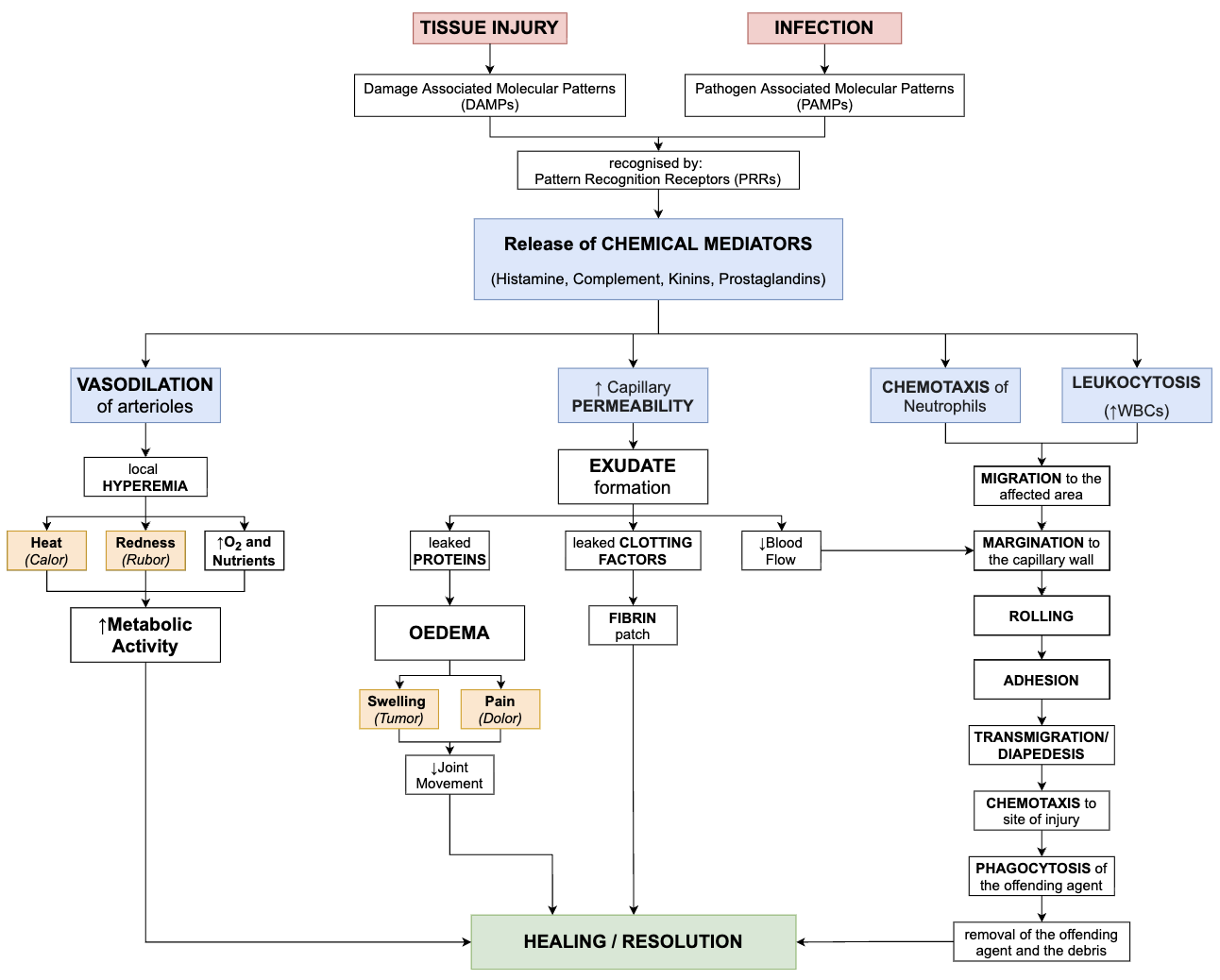
Summary: What sequence of events occurs in tissue injury & infection?

  1. Prevent infection → barriers, first-line defenses

  2. Innate killing → phagocytes, antimicrobial molecules

  3. Recognition → detect pathogen via PRRs, PAMPs

  4. Induction of local inflammation → recruit immune cells, start tissue response

  5. Adaptive immunity → antigen presentation → specific T/B cell response

  • Takeaway: inflammation is central; essential for vaccine response and all disease processes

<ol><li><p><strong>Prevent infection</strong> → barriers, first-line defenses</p></li><li><p><strong>Innate killing</strong> → phagocytes, antimicrobial molecules</p></li><li><p><strong>Recognition</strong> → detect pathogen via PRRs, PAMPs</p></li><li><p><strong>Induction of local inflammation</strong> → recruit immune cells, start tissue response</p></li><li><p><strong>Adaptive immunity</strong> → antigen presentation → specific T/B cell response</p></li></ol><ul><li><p><strong>Takeaway</strong>: inflammation is central; essential for vaccine response and all disease processes</p></li></ul><p></p>