Organic Chemistry 2 - Exam 2
 Call Kai
 Learn
Learn Practice Test
 Spaced Repetition
 Match
Match Flashcards
 Knowt Play
1/79

There's no tags or description
Looks like no tags are added yet.
Name | Mastery | Learn | Test | Matching | Spaced | Call with Kai | Chat |
|---|
No analytics yet
Send a link to your students to track their progress
80 Terms
carbonyl
C=O
alkyl group
carbon and hydrogen group
ketone
2 alkyl groups bonded to the carbonyl carbon atom

aldehyde
1 alkyl group and 1 hydrogen group bonded to the carbonyl carbon atom

electrophile
electron deficient, searches for and accepts electron pairs
nucleophile
electron rich, donates electron pair
ketone naming
replace normal -e at the end with -one
number the longest chain with carbonyl with numbering as low as possible for carbonyl
cyclic ketones have carbonyl assigned as #1
naming aldehydes
replace final -e with -al
aldehydes are at the ends on chains so it is #1 for substituents
if it is a substituent of a large unit like a ring, carbaldehyde
carbaldehyde
used when an aldehyde group is a substituent of a large unit like a ring
how to name if ketones or aldehydes are a substituent with a higher priority functional group at the root
prefix oxo- if long chain
not in chain is formyl-
carbon right next to carbonyl carbon
alpha

boiling point of ketones and aldehydes
larger than normal ethers or alkanes, lower than alcohols
cant H-bond but can accept H bonds
good solvents
grignard reagent
R-MgX
used to make alcohols
NaOCl
bleach
oxidizes secondary alcohols into ketones
ether
R-O-R’
HOAc
acetic acid, proton source to help with making ketones from secondary alcohols
synthesizing aldehydes to ketones

synthesizing primary alcohols to aldehydes
use NaOCl and TEMPO catayst

ozonolysis of alkenes
uses alkenes to make ketones and aldehydes
uses ozone at low temps, and a mild reduction agent (CH3)2S

phenyl ketones and aldehydes - friedal crafts acylation
uses AlCl3 and H2O

another reaction for phenyl ketones and aldehydes - gatterman koch
uses CO and HCl, then AlCl3 or CuCl

alkyne hydration to make ketones and aldehydes - acid and merciric salts
uses Hg2+, H2SO4, and water

alkyne hydration with hydroborationi oxidation to make aldehydes
uses di-borane, H2O2, and NaOH
anti mark

synthesis of ketones from carboxylic acids
uses LiOH, R-Li and H3O+

synthesis of ketones and aldehydes from nitriles
nitrile - C triple bond N
uses grignard reagent with H+ and H3O+

DIBAL-H
used to reduce nitriles
Reacting nitriles with DIBAL-H to make aldehyde
uses DIBAL-H and H3O+

acid chlorides to aldehydes
uses Li+-AIH(O-t-Bu)3 and H20

acid chlorides to ketones
uses R2CuLi

benzene
C6H6
alternating pi bonds rapidly intercoverting - resonance hybrid
has 3 conjugated pi bonds (double bond separated by a single bond)
sp2 hybridized and trigonal planar
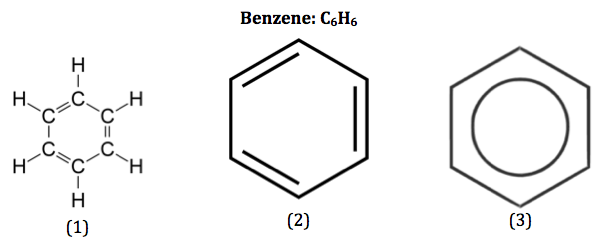
where is electron density in benzene ring
above and below the plane with P orbital overlap
conjugated pi bonds make the benzene
less reactive than normal C=C bonds
makes it a functional group because of this special property
what do the pi electrons do for benzene
makes it electron rich due to the electron density above and below the plane to act as a nucleophile that will react with an electrophile
benzenes do not do what reaction
addition, they only do substitution
heat of hydrogenation with benzene
much more stable than expected based on trends, 3 bonds on a ring if it were not benzene would be less stable
explains the lack of reactivity in addition reactions
how many pi molecular orbitals are there
6 p-orbital combine to make 6 pi molecular orbitals
lowest energy MO
no nodes with all constructive overlap
how many bonding and non bonding MO’s in benzene
3 bonding and 3 antibonding
how many nodes in bonding MO of benzene - HOMO
1 node - region with no probability of finding an electron
splits horizontally or vertically

anti-bonding MO’s in benzene
2 nodes
more antibonding = more pi *
LUMO

highest MO in benzene
all antibonding
3 nodes
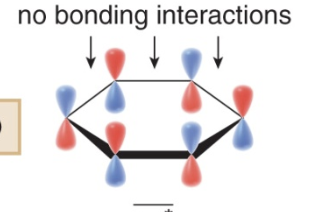
MO’s for cyclobutadiene
can be all bonding, 1 node, or 2 nodes with all antibonding to make pi*
degenerate
orbitals having the same energy
intermediate energy levels with 2 orbitals at each level
4 criteria for aromaticity
must be cyclic
the molecule (or the aromatic part) must be planar
all p orbitals on carbon must be parallel so the the pi electron density can be delocalized
ring must be completely conjugated
has a p orbital on every ring atom that overlaps with another p orbital
must satisfy huckels rule
huckels rule
must contain 4n+2 pi electrons
n is an integer - 0,1,2,3,4
gives 2,6,10,14,18
(count double bonds and lone pairs on carbon)
antiaromatic
systems that fulfill criteria 1-3 but not huckels rule, has 4n electrons
ex. cyclobutadiene
non aromatic
neither aromatic or antiaromatic, lacking continuous ring of overlapping p orbitals required for aromaticity or antiaromaticity
what is more stable antiaromatics or non-aromatics
nonaromatics
annulenes
hydrocarbons in a single ring containing a single ring with alternating c=c and c-c bonds
for naming - indicate the number of atoms in the ring in brackets and add the word annulene
annules like [10] annulene satisfies huckels rule but it is not planar due to steric strain that pushes H’s close
some are aromatic and some are not either due to huckels rule not being fulfilled or it cannot be planar
![<p>hydrocarbons in a single ring containing a single ring with alternating c=c and c-c bonds</p><p>for naming - indicate the number of atoms in the ring in brackets and add the word annulene</p><p>annules like [10] annulene satisfies huckels rule but it is not planar due to steric strain that pushes H’s close</p><p>some are aromatic and some are not either due to huckels rule not being fulfilled or it cannot be planar</p>](https://assets.knowt.com/user-attachments/a74a8ce8-77c9-4651-b85a-8cc0b95b8681.png)
aromatic ions
can have charges and be aromatic
lone pair must lie in the p orbital
radicals cannot be aromatic or antiaromatic, only nonaromatic - odd number of electrons
aromatic cations
can be aromatic

polyaromatic hydrocarbons PAH’s
2 or more rings with alternating double and single bonds fused together
to join 6 membered rings together
anthracene
penanthrene - angular
number of fused rings increases, the number of resonance forms increases
anthracene
3 linearly fused benzene rings

phenanthrene
angularly fused benzene rings

heterocyclic aromatics
rings containing O,N,S or other atoms
ex. pyridine - 1 nitrogen atom
have lone pairs so we need to know if they are localized on heteroatom or part of the delocalized pi systems
ex. pyridine has the lone pairs in the plane and there is still p orbital overlap
ex. pyrrole is a 5 membered ring that has a lone pair to make 6 pi electrons
basicity in nitrogen containing heterocycles
antiaromatics are much less basic
N-H are not basic

allotropes of carbon
different structural forms of the same chemical element in the same physical state - diamond and graphite
naming monosubstituted benzenes
use prefix of the substituent followed by benzene

phenol

toluene

aniline
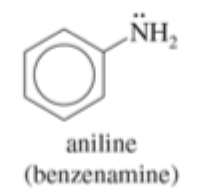
anisole

styrene
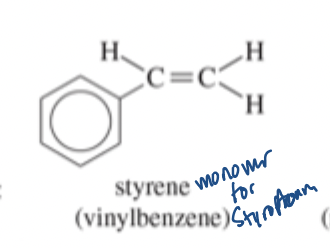
acetophenone

benzaldehyde

benzoic acid

naming disubstituted benzenes
name based on prefixes or numbers
if the 2 groups are different, alphabetize the names of substituents preceding the word benzene
if
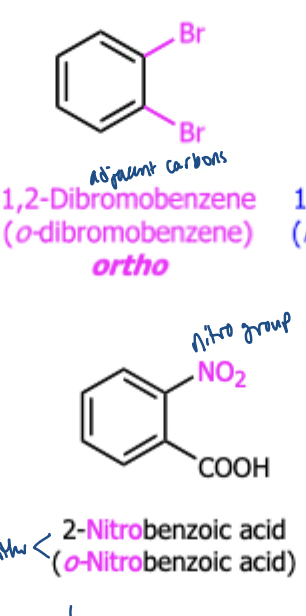
ortho, o-
adjacent carbon
meta, m-
2 carbons away

para, p-
opposite sides, 3 carbons away

xylenes
dimethylbenzenes can be o, m, or p

naming benzenes if the two groups are different
when it doesn’t have a trivial name - alphabetize the names of the substituents followed by benzene
when it has a trivial name - name it as a derivative of that parent, base is assumed to be in the 1st position

naming benzene rings with more than 2 substituents
indicate positions by numbers, numbered to give lowest possible numbers to the substituents, when they are different, list in alphabetical order

when benzene group is a substituent
called phenyl group (Ph), usually when hydrocarbon is unsaturated or when it is on a larger unit

benzyl
alternative name for the phenylmethyl group

benzene IR absorption
sp2 C-H above 3000, makes it different that the normal sp3 C-H
C=C 1600-1500 fingerprint region
benzene H NMR
7ppm for aromatic ring H
7-9 Hz for ortho
0-2.5 Hz for meta
1.5-2.5 ppm for benzylic carbon hydrogen
benzene C NMR
sp2 C is 120-150 ppm, very broad
H NMR diagnostic patterns for monosubstituted benzenes
ortho - 2 - doublet
mata -2 - triplet or doublet of doublet
para 1
H NMR patterns for disubstituted benzenes with different substitients
ortho - one big coupling of doublet with split peaks
meta - no big coupling with 1 signal, another one has 2
para - symmetrical with 2 H doublets
anything symmetrical will have 1 signal because they are all equivalent