Advanced Human Computer Interaction Exam
 Call Kai
 Learn
Learn Practice Test
 Spaced Repetition
 Match
Match Flashcards
 Knowt Play
1/43

There's no tags or description
Looks like no tags are added yet.
Name | Mastery | Learn | Test | Matching | Spaced | Call with Kai | Chat |
|---|
No analytics yet
Send a link to your students to track their progress
44 Terms
The movement of the eye from one location to another is tracked sometimes in HCI projects. This movement is referred to as
Saccades
T/F: In HCI human factors, eyes can be used as sensors and responders.
True
The term we use for the threshold between perceived and unperceived difference in stimuli is
Just noticeable difference
T/F: In HCI, handedness can be measured on a scale
True
Name two events or products that happened in 1983 that set the stage for the “Birth of the HCI field”.
Card, Moran, and Newell published The Psychology of Human-Computer Interaction
Apple Macintosh
The mouse user study in 1963 was an important user study for HCI. 13 participants took part to evaluate 5 devices and compare access time and motion time with the mouse prototype. What is the independent variable(s) and dependent variable(s) in this study?
Independent variable: input method (the device used).
EX: mouse, light pen, joystick (position-control), joystick (rate-control), and knee-controlled lever.
Dependent variables: task completion time, error rate
Classify the two major type of haptics in HCI.
Tactile haptics: sensation through receptors in the skin, such as texture, vibration, pressure, and temperature
Kinesthetic haptics: sensation through receptors in muscles, joints, and bones, such as force, resistance, and position
Name two problems with adding smell feedback in HCI.
Delivery and control: odours linger in the air and are hard to switch off or clear quickly, so one smell blends into the next and timing is imprecise.
Variability and hardware: people differ in how they perceive and tolerate smells (some find them unpleasant or trigger allergies)
When discussing memory in HCI the number (7+- 2) is significant, please explain.
amount of working (short-term) memory is small in terms of units or chunks
__________________ represents the amount of movement in a display object, such as a cursor, for a given amount of movement in a control.
CD gain
As an input controller, the most common mouse device is a two ________________________________ input device. (the word here describe the range of movement the mouse is capable of performing)
degree of freedom
A ____________________________ is a functioning arrangement or condition. An example is the SHIFT key when pressing it, the keyboard keys will produce key variations
mode
List two metaphors used in the Desktop computing interface. How are they metaphors?
1. Files and folders
A file is not paper, and a folder is not a cardboard sleeve. They are data structures on a storage device. The interface presents them as documents you can open, put inside folders, nest, move, copy and file away.
2. Trash can (Recycle Bin)
You drag an item to the trash to "throw it away." Nothing is physically discarded, because the system just marks the data for deletion. As with a real wastebasket, you can still retrieve the item until you empty it.

Given the mouse movement to control the cursor movement on the screen, fill out the following table:
Axis | Control (mouse) | Display (cursor) |
|---|---|---|
x | ||
y | ||
z |
Axis | Control (mouse) | Display (cursor) |
|---|---|---|
x | Move the mouse left/right (±x) | Cursor moves left/right (±x) |
y | Lifting/lowering the mouse is not sensed, so it has no effect | Cursor moves up/down (±y), driven by the mouse's z movement |
z | Move the mouse forward/back (toward or away from you) | Not used, because the display is 2D and has no z axis |
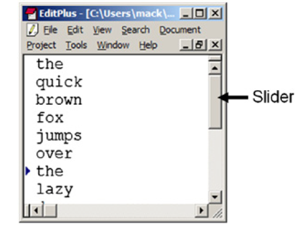
The scroll bar is both a display and a control. Explain this statement.
It gives the user information and also takes the user's input. As a display, the slider's size and position show how long the document is and which part is currently in view. As a control, the user can drag the slider or click the arrows or the track to change which part of the document is shown.

Is this a natural or learned control display relationship? Explain.
This is a natural control-display relationship. Moving the slider up makes the display level rise, and the arrows in the image show both moving in the same direction.
The delay between an input action and the corresponding response on a display is called ________________________
latency
Explain why HCI is an interdisciplinary field. Give two different disciplines that contribute to HCI and explain what each can contribute.
HCI is interdisciplinary because designing useful and usable technology requires knowledge from multiple areas.
Two examples are:
Computer science/software engineering: provides knowledge about how technology and interactive systems are built.
Psychology: helps understand human perception, cognition, behavior, attention, and performance.
A mouse has a CD gain of 3.
a. If the user moves the mouse 4 cm, how far does the cursor move on the display?
b. If the user wants the cursor to move 30 cm, how much must the mouse move?
c. What is one potential problem with using a very high CD gain?
a. 3(4) = 12 cm
b. 30 / 3 = 10 cm
c. A higher CD gain can allow faster gross positioning, but it can make fine positioning more difficult and potentially increase errors.
Consider the following two mappings:
Mapping A: Moving the controller to the right moves the display object to the right.
Mapping B: Moving the controller forward moves the display object upward.
a. Which mapping demonstrates spatial congruence?
b. Which mapping demonstrates a spatial transformation?
c. Why might Mapping B require more learning than Mapping A?
a. Mapping A demonstrates spatial congruence because the direction of controller movement corresponds directly to the direction of display movement.
b. Mapping B demonstrates a spatial transformation because forward controller movement is transformed into upward display movement.
c. Mapping B does not have a direct physical/spatial correspondence. The user must learn that moving forward produces upward movement on the display.
A desktop mouse provides 2 DOF through its x-y movement. Suppose a 3D application needs to manipulate an object using:
x position
y position
rotation around the z-axis
a. How many DOF does the display/object require?
b. Does the mouse provide enough DOF to control all of them simultaneously?
c. If not, what can the interface use to provide access to the additional DOF?
d. Give one disadvantage of using modes.
a. The object requires: 3 DOF. Two positional DOF plus one rotational DOF.
b. No, the mouse provides only 2 DOF, while the object requires 3 DOF.
c. The interface can use a mode to allow the same physical controls to control the additional DOF.
d. A disadvantage is that the user must know which mode is currently active. Poor mode visibility can cause errors because the same action can have different meanings in different modes. When control DOF < display DOF, modes can be necessary to access the full display DOF.
A researcher wants to understand why users have difficulty using a new ATM interface. Instead of putting users in a laboratory, the researcher observes people using the ATM in a realistic environment and conducts interviews afterward.
a. Which research method is most appropriate: observational, correlational, or experimental?
b. Is this method generally higher or lower in relevance?
c. Is it generally higher or lower in precision?
d. Why would an experiment be less appropriate if the main goal is to understand behavior in a natural setting?
a. Observational method
b. Higher relevance - The users are studied in a natural/realistic setting.
c. Lower precision - The researcher has less control over outside factors than in a laboratory.
d. A controlled experiment would provide greater control and precision, but the artificial laboratory environment could make the behavior less representative of how users actually behave with the ATM.
A researcher tests two mobile keyboards in a laboratory. Participants are highly controlled and distractions are minimized. However, participants type meaningless phrases while sitting in a quiet laboratory.
a. Would this setup generally help internal validity?
b. Would it potentially hurt external validity?
c. Explain the difference between internal and external validity.
a. Yes. The controlled environment helps ensure that observed differences are caused by the experimental conditions rather than uncontrolled variables.
b. Yes. The results may not generalize well to normal mobile-phone use because real users may type personalized text, encounter distractions, and use the keyboard in different environments.
c. Internal validity concerns whether the observed effects are actually caused by the experimental conditions. External validity concerns whether the results can be generalized to other people and situations.
The four measurement scales are nominal, ordinal, interval, and __________.
ratio
Nominal data are also known as __________ data.
categorical
A measurement scale that has equal distances between values but no absolute zero is the __________ scale.
interval
The research method that focuses on finding relationships between variables but cannot establish cause-and-effect is the __________ method.
correlational
What is the difference between an isotonic and isometric joystick?
Isotonic: senses displacement of the joystick.
Isometric: senses force applied to the joystick.
What type of measurement scale is a user's ranking of three GPS systems as 1st, 2nd, and 3rd?
Ordinal scale, because the values indicate an order or rank.
Which measurement scale has an absolute zero?
A. Nominal
B. Ordinal
C. Interval
D. Ratio
D. ratio
Which statement is most consistent with the course?
A. Research is primarily about building products.
B. Research questions should always be large and revolutionary.
C. Engineering and design focus on products, while research is typically narrower and incremental.
D. Research and engineering are exactly the same activity.
C. Engineering and design focus on products, while research is typically narrower and incremental.
What is the process of a research paper?
Research should be published
Published research undergoes peer review
Citations connect research to other research
Citation count can indicate impact
Approximately what percentage of information do people obtain through vision?
A. 25%
B. 50%
C. 80%
D. 95%
C. 80%
What is the difference between a fixation and a saccade?
A fixation is when the eyes remain stationary and take in visual detail. A saccade is the rapid movement of the eyes to another location so a new fixation can occur.
The physical properties of light include:
A. Color and brightness
B. Frequency and intensity
C. Sharpness and contrast
D. Texture and pressure
B. Frequency and intensity
Which of the following is an example of a haptic/tactile illusion?
A. Stroop effect
B. Phantom limb
C. Visual search
D. Saccade
B. Phantom limb
Which of the following is an example of an auditory illusion?
A. Rubin vase
B. Müller-Lyer arrows
C. Sheppard-Risset glissando
D. Ponzo lines
C. Sheppard-Risset glissando
Define human performance.
Human performance occurs when a person's sensors, brain, and responders work together to achieve a goal.
Human performance improves considerably and continuously with practice for many tasks. This is referred to as __________ behavior.
skilled
A person is driving while simultaneously texting on their phone. This is primarily an example of:
A. Selected attention
B. Divided attention
C. Simple reaction time
D. Skilled behavior
B. Divided attention
Why does the Stroop Effect demonstrate a limitation of attention?
A. People cannot see colors
B. The meaning of the word interferes with identifying its color
C. People cannot read words
D. Visual stimuli always produce slower responses than audio
B. The meaning of the word interferes with identifying its color
Define simple reaction time. Which stimulus has the fastest approximate reaction time?
a. Simple reaction time is the delay between the occurrence of a single fixed stimulus and the initiation of a response assigned to it.
b. Auditory
Define a simple human error.
A human error can be viewed as a discrete event where the outcome deviates from the desired outcome.
Serious accidents are sometimes attributed to human error, but the actual problem may be:
A. A lack of computer memory
B. A design-induced error
C. A faster reaction time
D. A JND experiment
B. A design-induced error