social influence
 Call Kai
 Learn
 Practice Test
 Spaced Repetition
 Match
 Flashcards
 Knowt Play
1/31

There's no tags or description
Looks like no tags are added yet.
32 Terms
social influence definition
the process whereby attitudes and behaviour are influenced by the real or implied presence of other people
compliance + reciprocity
compliance = attempts to persuade an individual to accept a request to respond in a desired way
reciprocity - key notion in social exchange
deeply ingrained and found in almost all cultures and societies
compliance: multiple requests
foot in the door technique
door in the face technique
low balling
compliance: foot in the door technique
smaller requests that virtually everyone agrees to, followed by the target large request
several factors affect the likelihood that people will comply in response to the foot in the door technique
e.g. individual differences (desire to act consistently) and same requester and target request
why does it work?
commitment to a course of action
change in self view: ‘i must be the type of person who supports good causes’
door in the face technique
larger request first that most people will reject, followed by a smaller and more reasonable request
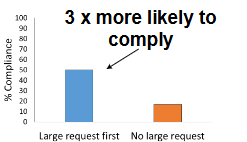
why does it work?
reciprocal concessions (Cialdini, 1975)
recognise the requester has made a concession, therefore there is pressure to reciprocate and compromise
social responsibility and guilt
large request indicates needs, feel obligated to help, accept smaller request as it’s the least you can do
accepting the second request alleviates negative emotions arising from declining first request
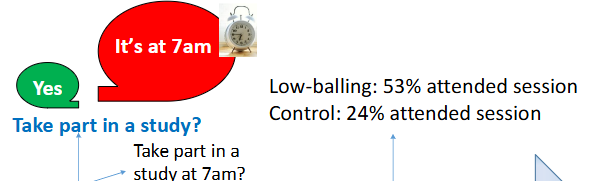
low balling
relies on the fact that people do not like to change their mind after committing to a course of action
obedience
the performance of an action in direct response to an order from a figure in authority
Milgram

what was said?

pre-study expectations
panel of 110 participants (including 39 psychiatrists)
predicted most people would not go beyond 150 volts
expected 4% would go up to 300v
expected only 1-2% to deliver full 450v
results
65% gave full 450 volt shock
replicated in different countries and samples
demonstrates power of authority influence - many people will blindly follow orders from authority figures

why do people obey? - agentic state
the instrument of another
increased psychological distance
little or no sense of personal responsibility
ethical considerations
harm
deception
insufficient debriefing
participants not told immediately that the learner did not receive any shocks
could any debrief overcome the emotional harm
transformed view of human behaviour
replications of Milgram’s study would not be possible today
critical eval of methods
researcher improvised from scripted prods and invented more coercive prods
were the prods a reflection of obedience to order?
some participants sceptical of cover story and only 50% believed the learner was receiving the shocks
engaged fellowship as an alternative explanation?
Milgram misrepresented debrief procedures
Asch conformity experiment (1950s)
majority influences
only ¼ of participants provided the correct answers on all 12 trials
¾ conformed to the group on at least one trial, total error rate: 36.8%
demonstrates the power of majority on group influence
does size of majority matter?

why did people conform? - Turner (1991)
informational influence - looking to others for help
normative social influence - need to be accepted
referent informational influence - people derive identity from majority response (conform to group schema)
critical eval
conformity or resistance?
demand characteristics
confusing situation
are the majority actually the minority?
minority influence in experimental settings - Moscovici
calling blue slides green
blue slides were called green by two confeds in a group of 6
consistent green - 8% say green
inconsistent green - 1.25% say green
consistency is critical for minority influence
minority influence
latent influence causes a conversion effect
majority members consider the viewpoint over time
over time, align attitudes and behaviour with the minority viewpoint
social facilitation
the enhancement of performance in the presence of other people
Triplett (1897; 1898)
cyclists were faster with other cyclists compared to alone
participants turning a fishing reel crank faster and for longer in the presence of others compared to stand along
why does social facilitation happen? - Zajonc (1965)
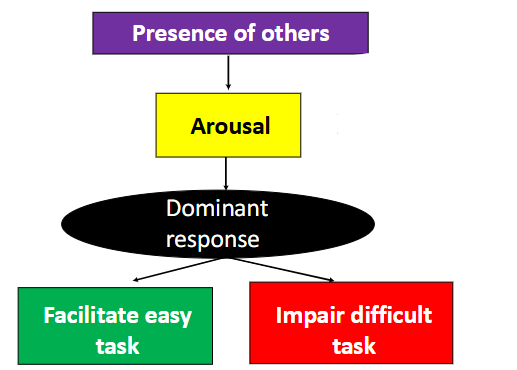
presence of others leading to arousal which increases the likelihood of performing the dominant (habitual) response
simple, well-practiced tasks - dominant response is usually correct
difficult task - dominant response is usually incorrect
key aspect of this explanation is that there is an innate physiological response to the audience
evidence for Zajonc explanation - Markus (1978)
participants - 45 male students
dressing and undressing task
- easy = remove shoes and put back on
- difficult = remove shoes, socks, coat and put on clothes provided
audience = alone, confederate watched
dependent variable = performance - time taken
results
easy = audience improved performance
difficult = audience impaired performance

how does working in a group affect performance?
Ringlemann’s (1913) tug of way study
group force was about 50% less than the sum of predicted infividual effrct
social loafing
when individuals work as a group, they often generate less effort than if they worked alone
why do people loaf?
evaluation apprehension
output equity
matching to a standard
deindividuation
being in a grou pleads to a weakened sense of personal identity; self awareness diminishes, people feel anonymous and less personally responsible for their actions - can lead to antisocial behaviour
Diener et al. (1976)
children took few sweets when they had to identify themselves during trick or treating