Muscular system (Ch11 CONC)
 Call Kai
 Learn
 Practice Test
 Spaced Repetition
 Match
 Flashcards
 Knowt Play
1/44

There's no tags or description
Looks like no tags are added yet.
45 Terms
Skeletal muscles
Tendons attach to and pull on bones, and movement occurs
Muscles can only pull; never push
What one muscle group “does,” another “undoes”
3 function groups
Agonist
Antagonist
Synergist
-flixators
Agonist
Main producer of specific movement
Antagonist
Opposes or reverses particular movement
Prime mover and antagonist are located on opposite sides of joint across which they act
Synergist
helps prime movers
Adds extra force to same movement
Reduces undesirable or unnecessary movement
Fixators
Fixators
type of synergist that immobilizes bone or muscle’s
Gives prime mover stable base on which to act
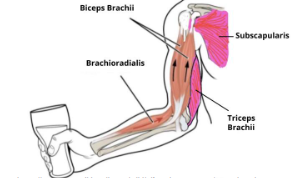
Lifting a cup off table
Prime mover: biceps brachii
Antagonist: triceps brachii
Synergists: brachoradialis, brachialis
Fixators: subscapularis
Muscle contraction
draws one articulating bone toward the other
Origin – the attachment to the stationary bone
Insertion – the attachment to the moveable bone

ligaments
bone to bone
tendons
muscle to bone
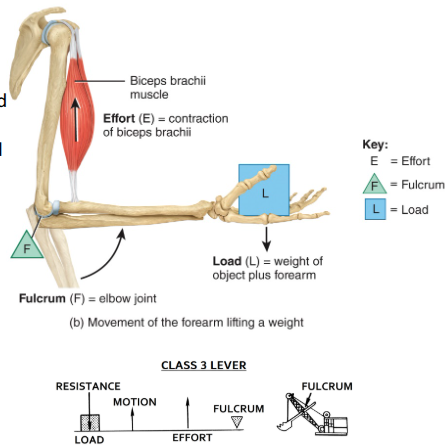
components of lever system
lever
effort
load
lever
bone that moves on a fixed point → fulcrum (joint)
fulcrum
elbow joint


effort
force (supplied by muscle contraction) applied to lever to move resistance (load)
load
resistance (bone + tissues + any added weight) moved by the effort

class 1 lever
head and neck

class 2 lever
toes pushing weight up to walk

class 3 lever
bicep curl

all skeletal muscles consist of …
fascicles (bundles of fibers)
Fascicular arrangement is correlated with:
The amount of power of a muscle can produce
ROM
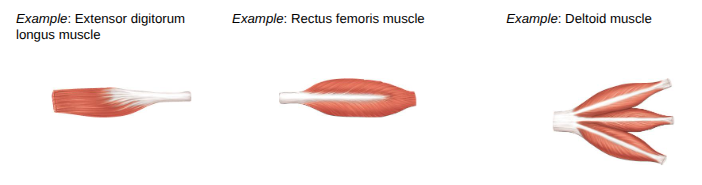
different arrangements of fascicles
circular
convergent
parallel
pennate
circular
in concentric circular arrangements form sphincter muscles that enclose an opening
Ex: Orbicularis oculi muscle

convergent
Muscle fascicles spread over broad area converge at thick central tendon; gives muscle a triangular appearance
Ex: Pectoralis major muscle

parallel
Muscle fascicles parallel to longitudinal axis of muscle; terminate at either end in flat tendons
Ex: Sternohyoid muscle

pennate
uni- 1 side of tendon
bi- both sides of tendon
multi- many directions to several tendons
Muscle names are derived based on a number of characteristics
location
temporalis
shape
deltoid
size
gluteus maximus
direction of fibers
rectus(straight)
# of origins
biceps
location of attatchments
sternocleidomastoid
muscle action
flexor
Facial expression
Move skin rather than joints when they contract
All innervated by cranial nerve VII (facial nerve)
2 groups:
scalp muscles and facial muscles

Eye and eyelid movement
extrinsic eye muscles
3 pairs
superior and inferior recti
lateral and medial recti
superior and inferior obliques

upper eyelids muscles
The tendon of the levator palpebrae superioris passes the eyeball and inserts into the upper eyelid
This point of insertion allows it to raise the eyelid

muscles of mastication
Move the mandible (jaw)
4 pairs innervated by cranial nerve V
Temporalis and masseter = jaw closure
Pterygoids = grinding movements
Buccinator = assists chewing

What are the 3 extrinsic muscles that move the tongue?
genioglossus
hyoglossus
styloglossus
Muscles of the Tongue
attached to the mandible, styloid process of the temporal bone, and the hyoid bone
highly mobile

Muscles of the Neck
Suprahyoid = elevate hyoid bone, floor of mouth, and tongue during swallowing
Infrahyoid = depress hyoid bone and help move the larynx

Muscles of the Abdomen
4 paired muscles formingn lateral and anterior wall
Rectus abdominis
External obliques
Internal obliques
Transversus abdominis

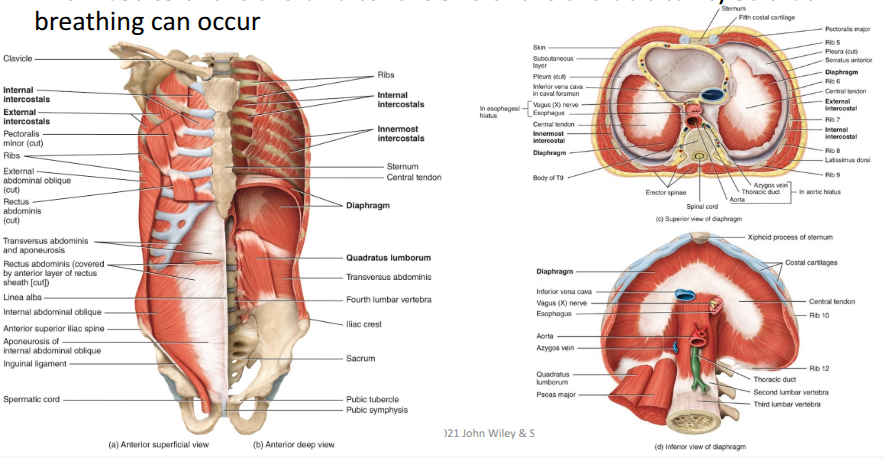
Muscles of the Thorax That Assist in Breathing
The muscles of the thorax alter the size of the thoracic cavity so that breathing can occur
Muscles of the Pelvic Floor
stretching from the pubis to the coccyx and from one lateral wall of the pelvis to the other

Muscles of the Perineum
region of the trunk inferior to the pelvic diaphragm
Diamond-shaped
Extends from the pubic symphysis to the coccyx and ischial tuberosities

Muscles of the Thorax That Move the Pectoral Girdle

Muscles of the Thorax and Shoulder that Move the Humerus
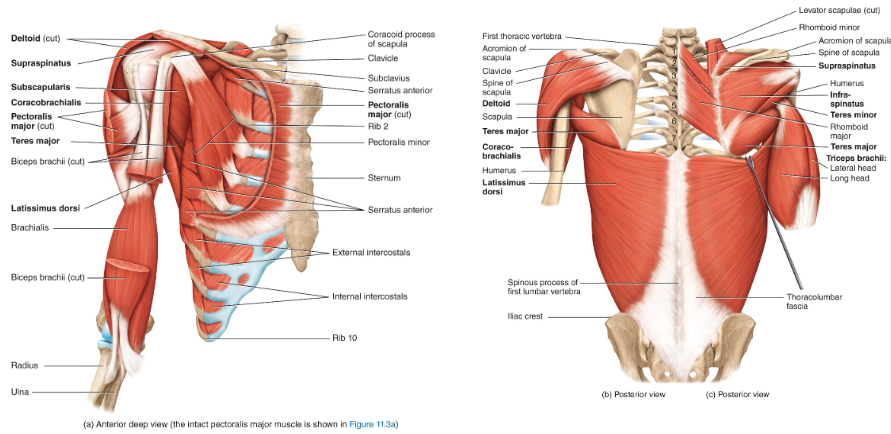
Muscles of the Arm That Move the Radius and Ulna
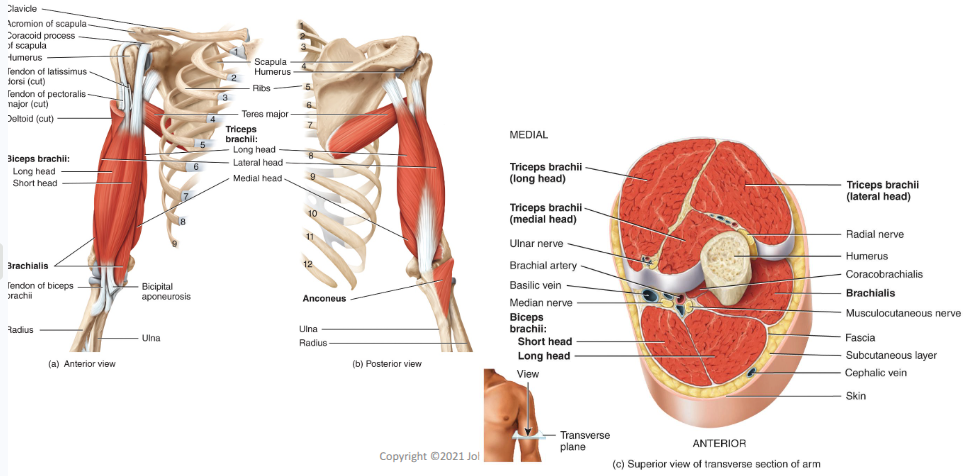
Muscles of the Forearm That Move the Wrist, Hand, Thumb, and Digits

Muscles of the Neck and Back That Move the Vertebral Column

Running related injuries
knee
faulty training techniques
PRICE
compartment syndrome
Pressure compresses blood vessels, reducing blood flow and causing:
Nerve damage
Muscle scarring and contractures (permanent tightening)
plantar fasciitis
painful heel condition from chronic irritation of calcaneus
Treatment includes ice, heat, stretching, weight loss, prosthetics, steroid injections, and/or surgery