Financial Statement Analysis - Formulas and Definitions - CFA L1
 Call Kai
 Learn
 Practice Test
 Spaced Repetition
 Match
 Flashcards
 Knowt Play
1/166

There's no tags or description
Looks like no tags are added yet.
167 Terms
Financial Reporting
the way companies show their financial performance to investors, creditors, and other interested parties by preparing and presenting financial statements
Standard-Setting Bodies
professional organizations of accountants and auditors that establish financial reporting standards
Form S-1
the registration statement filed before the sale of new securities to the public
Form 10-K
the required annual filing that includes information about the business, risks, and its management, audited financial statements and disclosures, and disclosures about legal matters involving the firm
Form 10-Q
U.S. firms are required to file this form quarterly, with updated interim financial statements (unlike Form 10-K, these statements do not have to be audited) and disclosures about certain events such as significant legal proceedings or changes in accounting policy. Non-U.S. companies are typically required to file the equivalent Form 6-K semiannually
Form DEF-14A
a company prepares a proxy statement for its shareholders before the annual meeting or other shareholder vote, it also files the statement with the SEC as Form DEF-14A
Form 8-K
form to disclose material events including significant asset acquisitions and disposals, changes in management or corporate governance, or matters related to its accountants, its financial statements, or the markets in which its securities trade
Form 144
issue securities to certain qualified buyers without registering the securities with the SEC, but it must notify the SEC that it intends to do so
Form 3,4 and 5
beneficial ownership of securities by a company's officers and directors. Analysts can use these filings to learn about purchases and sales of company securities by corporate insiders
Financial Statement Notes (footnotes)
disclosures that provide further details about the information summarized in the financial statements
Business Segment (operating segment)
a portion of a larger company that accounts for more than 10% of the company's revenues, assets, or income
Unqualified Opinion (unmodified opinion/clean opinion)
the auditor believes the statements are free from material omissions and errors
Qualified Opinion
If the statements make any exceptions to the accounting principles and explain these exceptions in the audit report
Adverse Opinion
the statements are not presented fairly or are materially nonconforming with accounting standards
Disclaimer of Opinion
the auditor is unable to express an opinion (e.g., in the case of a scope limitation)
Internal Controls
the processes by which the company ensures that it presents accurate financial statements
Contract
an agreement between two or more parties that specifies their obligations and rights
Performance Obligation
a promise to deliver a distinct good or service. A distinct good or service is one that meets the following criteria:
The customer can benefit from the good or service on its own or combined with other resources that are readily available.
The promise to transfer the good or service can be identified separately from any other promises.
Transaction Price
the amount a firm expects to receive from a customer in exchange for transferring a good or service to the customer
Matching Principle
expenses to generate revenue are recognized in the same period as the revenue. Inventory provides a good example. Assume that inventory is purchased during the fourth quarter of one year and sold during the first quarter of the following year. Using the matching principle, both the revenue and the expense (cost of goods sold) are recognized in the first quarter of the second year, when the inventory is sold
Capitalization
an application of the matching principle whereby costs are initially capitalized as assets on the balance sheet and then expensed, using depreciation or amortization, to the income statement over the asset's life as its benefits are consumed. Property, plant, and equipment (PP&E) and intangible assets with finite lives are examples of thi
Period Costs
expensed in the period incurred. For example, if a firm has occupied a leased premise, one year's worth of rent should be expensed to the income statement regardless of whether the rent has been paid
Research Costs
costs aimed at the discovery of new scientific or technical knowledge and understanding, are expensed as incurred
Development Costs
Development costs are incurred to translate research findings into a plan or design of a new product or process. To recognize an intangible asset in development, a firm must show that it can complete the asset and intends to use or sell the completed asset, among other criteria. These costs can be capitalized
Discontinued Operation
an operation that management has decided to dispose of, but either has not yet done so, or has disposed of in the current year after the operation had generated income or losses
Basic Earnings per Share (Basic EPS)

Stock Dividend
the distribution of additional shares to each shareholder in an amount proportional to their current number of shares. If a 10% stock dividend is paid, the holder of 100 shares of stock would receive 10 additional shares
Stock Split
the division of each "old" share into a specific number of "new" (post-split) shares. The holder of 100 shares will have 200 shares after a 2-for-1 split, or 150 shares after a 3-for-2 split
Dilutive Securities
stock options, warrants, convertible debt, or convertible preferred stock that would decrease EPS if exercised or converted to common stock
Antidilutive Securities
stock options, warrants, convertible debt, or convertible preferred stock that would increase EPS if exercised or converted to common stock
Diluted EPS

Treasury Stock Method
Method for calculative number of shares used in the denominator if the options or warrants are dilutive:
The treasury stock method assumes that the funds received by the company from the exercise of the options would be used to hypothetically purchase shares of the company's common stock in the market at the average market price.
The net increase in the number of shares outstanding (the adjustment to the denominator) is the number of shares created by exercising the options less the number of shares hypothetically repurchased with the proceeds of exercise.
Common Size Income Statement
expresses each category of the income statement as a percentage of revenue
Gross Profit Margin
gross profit / revenue
Net Profit Margin
net income / revenue
Identifiable Intangible Assets
acquired separately or are the result of rights or privileges conveyed to their owner. Examples of identifiable intangibles are patents, trademarks, and copyrights
Unidentifiable Intangible Assets
cannot be acquired separately and may have an unlimited life. The best example of an unidentifiable intangible asset is goodwill
Economic Goodwill
not to be confused with accounting goodwill. It is derived from the expected future performance of the firm, while accounting goodwill is the result of past acquisitions
Financial Instruments
contracts that give rise to both a financial asset of one entity and a financial liability or equity instrument of another entity
Held-to-Maturity Securities
debt securities acquired with the intent to hold them until they mature
Mark-to-Market Accounting
Financial assets measured at fair value including trading securities, available-for-sale securities, and derivatives
Trading Securities / Held for Trading Securities
debt securities acquired with the intent to sell them in the near term. Derivative instruments are treated the same as trading securities
Available for Sale Securities
debt securities that are not expected to be held to maturity or traded in the near term
Deferred Tax Liabilities
income taxes payable in future periods as a result of timing differences between financial accounting and tax accounting
Common Size Balance Sheet
expresses each item of the balance sheet as a percentage of total assets
Long-Term Debt to Equity Ratio
long-term debt / total equity
Total Debt to Equity Ratio
total debt / total equity
Debt Ratio
total debt / total assets
Financial Leverage Ratio
total assets / total equity
Cash Flow Statement
provides information for a reporting period beyond that available from the income statement, which is based on accrual, rather than cash, accounting
Cash Flows from Operations (CFO)

Cash Flow from Investing Activities (CFI)
the cash inflows and outflows that result from acquiring or disposing of long-term assets and certain investments
Cash Flow from Financing Activities (CFF)
the cash inflows and outflows that result from transactions affecting a firm's capital structure, such as borrowing, repaying debt, and issuing or redeeming equity securities
Free Cash Flow
measure of cash available for discretionary use, after a firm has covered its capital expenditures
Free Cash Flow to the Firm (FCFF)
cash available to all investors, both equity owners and debtholders

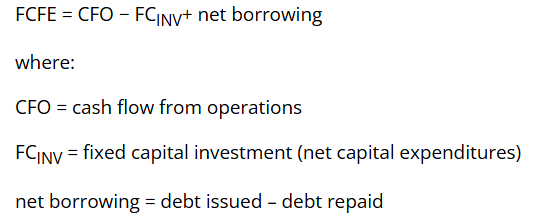
Free Cash Flow to Equity
the cash flow available for distribution to common shareholders
Cash Flow to Revenue Ratio
the amount of operating cash flow generated for each dollar of revenue

Cash Return on Assets Ratio
measures the return of operating cash flow attributed to all providers of capital

Cash Return on Equity Ratio
measures the return of operating cash flow attributed to shareholders

Cash to Income Ratio
measures the ability to generate cash from firm operations

Cash Flow per Share
a variation of basic earnings per share measured by using CFO instead of net income

Debt Coverage Ratio
measures financial risk and leverage

Interest Coverage Ratio
measures the firm's ability to meet its interest obligations

Reinvestment Ratio
measures the firm's ability to acquire long-term assets with operating cash flow

Debt Payment Ratio
measures the firm's ability to satisfy long-term debt with operating cash flow

Dividend Payment Ratio
measures the firm's ability to make dividend payments from operating cash flow

Investing and Financing Ratio
measures the firm's ability to purchase assets, satisfy debts, and pay dividends

Net Realizable Value (NRV)
equal to the expected sales price less the estimated selling costs and completion costs. If NRV is less than the balance sheet value of inventory, the inventory is "written down" to NRV, and the loss is recognized in the income statement either as a separate line item or by increasing cost of goods sold. If the value of the inventory recovers later, the inventory can be "written up," and the gain is recognized in the income statement as a separate line item or by reducing COGS by the amount of the recovery. Because inventory is valued at the lower of cost or NRV, inventory cannot be written up by more than it was previously written down
Lower of Cost or Market
LIFO inventory measurement method. Market is usually equal to replacement cost, but it cannot be greater than NRV or less than NRV minus a normal profit margin. If replacement cost exceeds NRV, then market is NRV. If replacement cost is less than NRV minus a normal profit margin, then market is NRV minus a normal profit margin.
LIFO Liquidation
occurs when a LIFO firm's inventory quantities decline. Older, lower costs are included in COGS compared to a situation in which inventory quantities are not declining. LIFO liquidation results in higher profit margins and higher income taxes compared to what they would be if inventory quantities were not declining
Inventory Disclosures
usually found in the financial statement footnotes, are useful for evaluating the firm's inventory management. The disclosures are also useful for adjusting a firm's financial statements to make them comparable with other firms in the industry
Inventory Turnover
cost of sales / average inventory
Days of Inventory on Hand
365 / inventory turnover
Intangible Assets
long-term assets that lack physical substance, such as patents, brand names, copyrights, and franchises. Some intangible assets have finite lives, while others have indefinite lives
Acquisition Method
used to account for business combinations. Under the acquisition method, the purchase price is allocated to the identifiable assets and liabilities of the acquired firm on the basis of fair value
Impairment
unanticipated decline in an asset's value, causing it to fall below the carrying value
Derecognition
an asset is disposed of or retired
Recoverable Amount
the greater of its fair value less any selling costs and its value in use
Value in Use
the present value of its future cash flow stream from continued use and disposal
Spinoff
the transfer of assets that constitute an entire division or subsidiary into a new legal entity, upon which the shares of the spinnee are subsequently distributed to its shareholders, and the shareholders do not surrender any stock of the spinnor
Fixed Asset Turnover
revenue / average fixed assets
Average Age of a Fixed Asset (Formula)

Total Useful Life (Formula)

Remaining Useful Life (Formula)

Finance Lease
any lease in which both the benefits and the risks of ownership are substantially transferred to the lessee
Operating Lease
either the benefits or the risks of ownership are not substantially transferred to the lessee
Sales-Type Lease
If manufacturing or dealing in the leased equipment is the main business operation of the firm, the sales proceeds will be in the revenue line and the carrying value of the asset will be a cost of sale. In other words, the treatment is like selling inventory
Direct Financing Leases
If the lessor is a financing company, rather than a manufacturer of the leased equipment, a gain or loss is not recognized at initiation. Instead, the gain or loss is deferred, and it is recognized over the life of the lease as interest income (for a gain) or an expense (for a loss)
Deferred Compensation
employees compensation in the current period but do not receive cash flows until later
Pension
a form of deferred compensation earned over time through employee service
Defined Contribution Plan
a retirement plan in which the firm contributes a sum each period to the employee's retirement account. The firm's contribution can be based on any number of factors, including years of service, the employee's age, compensation, profitability, or even a percentage of the employee's contribution. In any event, the firm makes no promise to the employee regarding the future value of the plan assets. The investment decisions are left to the employee, who assumes all of the investment risk
Defined Benefit Plan
the firm promises to make periodic payments to employees after retirement. The benefit is usually based on the employee's years of service and the employee's compensation at, or near, retirement. For example, an employee might earn a retirement benefit of 2% of her final salary for each year of service. Consequently, an employee with 20 years of service and a final salary of $100,000 would receive $40,000 ($100,000 final salary × 2% × 20 years of service) each year upon retirement until death. Because the employee's future benefit is defined, the employer assumes the investment risk
Service Cost
the present value of the additional benefits employees are entitled to after retirement because they have worked an additional year. This element also includes "past service costs," which represent changes to the benefits earned in previous periods resulting from alterations to the plan and other factors
Stock Grants
shares awarded outright, with restrictions, or contingent on performance
Performance Shares
stock grants that depend on meeting a set performance target
Employee Stock Options
options to invest in the company's stock at a given price (the exercise price) at a future date
Stock Based Appreciation Rights (SARs)
generate cash for the holders that is linked to stock performance
Taxable Income
income subject to tax based on the tax return
Taxes Payable
the tax liability caused by taxable income. This is also known as the current tax expense
Income Tax Paid
the actual cash flow for income taxes, including payments or refunds from other years