Plant Systematics Exam 2
 Call Kai
 Learn
 Practice Test
 Spaced Repetition
 Match
 Flashcards
 Knowt Play
1/45

There's no tags or description
Looks like no tags are added yet.
46 Terms
Water lilies, magnolias, and relatives
Not a monophyletic group, Similar in morphology
Number of floral parts is variable
Flower whorls are often poorly differentiated.
Floral parts may be arranged in spirals rather than distinct whorls.
Flowers often have strong odors - STANK!
Monocots
Monophyletic
ONE cotyledon
Parallel leaf venation
Flower parts in multiples of 3
never woody
Ex: grasses (Poaceae), sedges (Cyperaceae), lilies, orchids, palms
Dicots (Rosids & Asterids)
TWO cotyledons
netted leaf venation
flower parts in multiples of 4 or 5
Rosids VS Asterids
Rosids: petals not fused; more stamens than petals and not fused to petals; carpel number usually 3–5
Asterids: petals usually fused (connate); stamens equal to or fewer than petals and adnate to petals; usually 2 carpels (often 2 locules)
Key Differences between major groups (Monocots, Dicots, Rosids, Asterids)

Flower Formulas - key points
P = parienth that is indistinguishable
Calyx #, Corolla (A or Z) #, Androecium #, Gynoecium #
circle around = fusion, dashed circle = sometimes
line beneath G = superior ovary, line above = inferior
lines connecting parts = adnate fusion
Graminoid Monocots
“grass-like”
Juncaceae, Cyperaceae, Poaceae
small wind pollinated flowers often

Juncaceae - veg
Rush family
Herbaceous; often rhizomatous and clump-forming.
Leaves usually basal
**Rushes are round
Stems often hollow or partitioned.
Juncaceae - reproduction
Inflorescence: congested cyme.
usually 3-merous, radial, and bisexual.
Fruit: capsule (splits at 3 seams)

Cyperaceae - veg
Sedge family
Herbaceous; sometimes rhizomatous, often clumped
Stems solid and often triangular.
Leaves in three ranks
Leaf sheaths closed.
**Sedges have edges

Cyperaceae - reproduction
Flowers highly reduced; one scale-like bract below each flower. Perianth absent or hair-like.
Stamens & carpels 3-merous
Often monoecious
Fruit: achene
Poaceae - veg
Grass Family
Herbaceous; stem internodes often hollow (node is below leaf)
Leaves in two ranks; leaf sheaths open; leaves have ligules (flaps of tissue or hairs).
**Grasses have lashes (ligules)
Poaceae - reproduction (Spikelets)
Inflorescence: spikelets, arranged in spikes or panicles.
Fruit: caryopsis (grain).
Spikelet: 1+ flowers and bracts.
Glumes: bracts at the base of the spikelet.
Lemma (lower) and palea (upper): bracts below each flower.
Floret: one flower together with its lemma and palea.
Lodicules are highly reduced perianth structures.
Flowers usually perfect, typically with 3 stamens and 2 carpels.

Juncaceae vs. Cyperaceae vs. Poaceae

Ranunculaceae - veg
Buttercup Family
• Herbaceous; some vines/lianas
• Leaves variable: alternate or opposite, simple or divided.

Ranunculaceae - reproduction
Inflorescence a cyme or flowers solitary. Flowers usually large and radial.
Perianth often of petal-like tepals; sometimes sepals and petals distinct.
Many stamens and usually many simple pistils.
Fruits: aggregate of achenes or follicles.
Vitaceae - veg
Grape Family
• Woody vines = lianas
• Leaves alternate, usually palmately lobed or compound; sometimes pinnately divided.
• Tendrils positioned opposite the leaves (modified inflor)

Vitaceae - reproduction
Inflor: cyme, positioned opposite the leaves.
Flowers small and radial; plants often monoecious.
Sepals inconspicuous
Petals often fall off as the flower opens, sometimes fused at their tips.
2 fused carpels (compound pistil), ovary superior.
Fruit: berry; two seeds per locule, usually four per berry. Seeds have a raphe (raised line)
Rosaceae - veg
Rose family
Herbs, shrubs, trees
Leaves: alternate, simple or pinnate
Stipules present, often adnate to petiole
Armature
Ex: raspberries, roses, cherries, apples…

Roseaceae - Reproduction
Flowers: racemes, often large, radial, 5- merous
Hypanthium
Many stamens
Carpels = 5+
Fruits → diverse: aggregate, achenes, follicles, drupes, accessory fruits (enlarged hypanthium/receptacle)
**Apomixis: asexual reproduction, seeds without fertilization
Fabaceae - veg
Pea Family
usually vines (in VT), shrubs, trees
Leaves: alternate, pinnately compound, stipules present
Often terminal leaflet → tendrils
**Nitrogen fixation → bacteria in root nodules convert N to ammonia, helps plant grow in N-poor env

Fabaceae - reproduction
Inflor: Single or raceme
“Faboid” type flowers
5-merous, zygomorphic (bilaterally sym)
1 banner (top), 2 wings, 2 keel petals (fused)
10 stamens
Hypanthium
Fruit: legume or loment
Fabaceae Floral formula

Brassicaceae - veg
Mustard family
Herbaceous
Leaves: alternate, often basal, simple, sometimes lobed
No stipules
Mustard oils → strong smell & taste
Brassicaceae - reproduction
Inflor: racemes usually
Flowers: small/med sizes, yellow/white, radial, 4-merous
6 stamens (2 shorter outer, 4 longer inner)
2 carpels, superior
Fruit: Silique/silicile (specialized capsule)
Replum - thin membrane separating the 2 locules, formed from placenta, persists after dehiscence
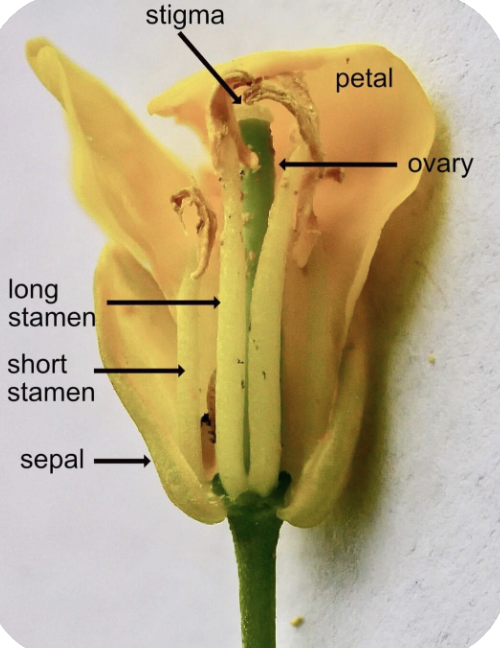
Brassicaceae floral formula

Onagraceae - veg
Evening Primrose family
Herbs & shrubs
Leaves: alternate or opposite, simple
Stipules - absent or very small
Hairy often
Onagraceae - reproduction
Infor: racemes, 4-merous, radial
Sepals reflexed (bent backward)
Petals yellow/pink
Hypanthium = large, elongate
Ovary inferior (4 fused carpels)
Fruit: capsule

Caryophyllales synapomorphy
Betalains (producing beet-red color)
Caryophyllaceae - veg
Carnation Family
Herbaceous
Leaves: opposite, simple, entire
Swollen nodes
Caryophyllaceae - reproduction
Inflor: cyme
Sepals usually fused (balloon-like in Silene)
No petals, rather petal-like structure is modified stamens (notched tips, 2 lobed because of anthers)
Fruits: capsules, opens by apical teeth, free-central placentation

Polygonaceae - veg
Knotweed Family
Herbaceous
Leaves: alternate, simple
Nodes swollen (polygon = multi joints)
Ocrea: sheathing stipule (papery, wrapped around stem)
Oxalic acid → sour taste
Polygonaceae - reproduction
Inflor: raceme or spike, flowers small
Tepals - petals & sepals near identical
1 whorl of 5 OR 2 whorls of 3
Fruit: achene, often winged
Basal placentation
**BUT derive from compound pistil but produces single seeded achene

Laminales characteristics
leaves: usually opposite
flowers: bilaterally symmetrical, 2 “lips” of petals (2 on top, 3 below)
stamens: 4 usually
Lamiaceae - veg
Mint family
Herbaceous
Leaves: opposite, simple, entire/toothed
Square stems
glandular hairs
very fragrant → minty!
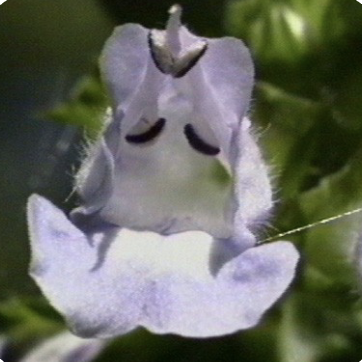
Lamiaceae - reproduction
Inflor: spike-like or axillary
Sepals: fused
Petals: 5, fused, forming 2 lips
Stamens: 4 didynamous (2 diff lengths - upper is shorter, below is longer)
Carpels: only 2 but deeply 4-lobed pistil, superior, style gynobasic (at base of gynoecium),
Fruit: schizocarp, producing 4 nutlets

Lamiaceae floral formula

Plantaginaceae - veg
Snapdragon family
Herbaceous
Leaves: opposite (or alternate), simple
Round stems
Plantaginaceae - reproduction
Inflor is variable, small to large flowers
4-5 Sepals, fused
5 Petals, 2 “lips” formed
4 Stamens (didynamous - 2 lengths), often additional staminode (sterile stamen)
Carpels: 2 fused, superior
Terminal styles
Fruits: many-seeded capsule (spooky af)

Asteraceae - veg
Herbs in VT, shrubs, trees
Leaves: alternate, opposite, whorled, simple often hairy
Strong smelling (terpenoids)
Asteraceae - reproduction
Flower = heads, capitulum (many small flowers)
head surrounded by involucre made of bracts (phyllaries)
Sepals - modified into pappus (w/ bristles, hairys, awns)
Petals - 5, fused
Stamens - 5, filaments adnate to corolla, anthers connately fused
Carpels - 2
Fruit: achene (cypsela), basal placentation, pappus at tip often, inferior ovary

Asteraceae Flower Development
Stamens form tube
Style & stigma push through tube
Pollen presented to pollinators
Stigma matures later

3 Asteraceae Flower Types
Disc: radially symmetrical, usually perfect
Ray: bilaterally symmetrical, sterile or pistillate
Ligulate: bilaterally symmetrical, usually perfect
3 Asteraceae Head Types
Discoid head: only disc flowers (ex: artichokes, thistles)
Radiate head: disc & ray flowers (ex: sunflower)
Ligulate head: only ligulate flowers (ex: lettuces, see image)

Apocynaceae - veg
Milkweed family
Herbs in VT
Leaves: opposite, whorled, simple
Latex - very toxic
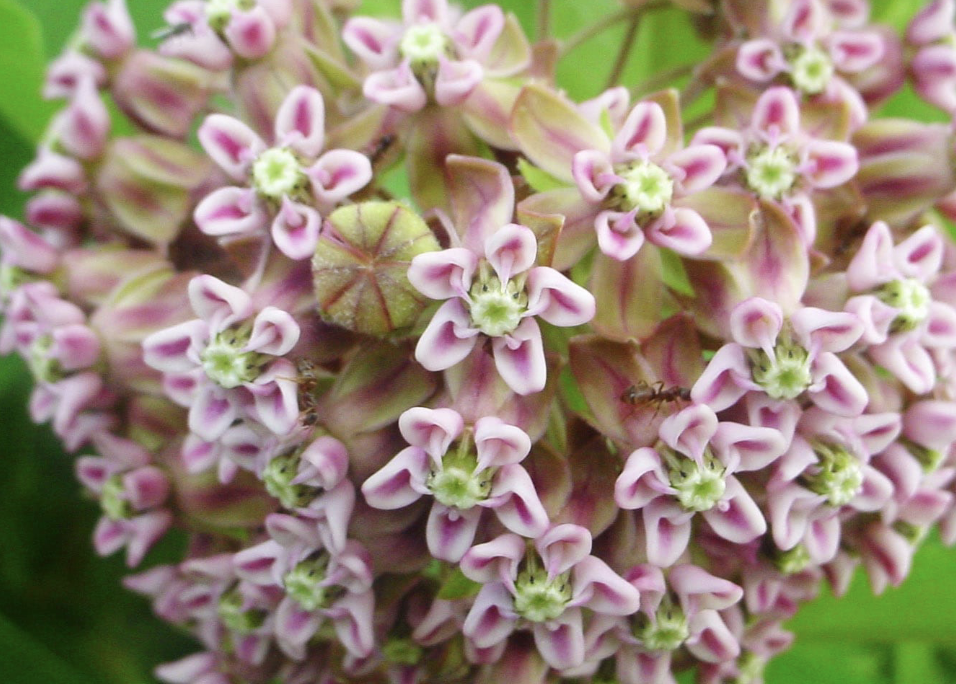
Apocynaceae - reproduction (inflorescence)
Inflor = cyme usually
**highly modified stamens/carpels make up most of flower
2 simple pistils (carpels), fused only at stigma, plate-like
gynostegium: fused anther & stigma
hoods (where nectar pools), stigmatic slit where pollinia are, bugs get stuck
Fruits: paired (simple, 1 per ovary) → follicles, berry, drupe
seeds with floofy hairs
free-central placentation
